
You are standing in the pasta aisle. On your right, a brightly colored box with a famous logo costs 2 dollars and 50 cents. On your left, a plain, white-labeled box with the store’s name costs only 90 cents. You hesitate. You wonder if the cheaper pasta will turn into mush or if it’s made with lower-quality wheat. You wonder if your family will notice.
Most people reach for the name brand because it feels “safer.” We have been conditioned by decades of television commercials and glossy magazine ads to associate a logo with quality. But what if I told you that in many cases, the only real difference between those two boxes is the 1 dollar and 60 cents you are handing over to a marketing department?
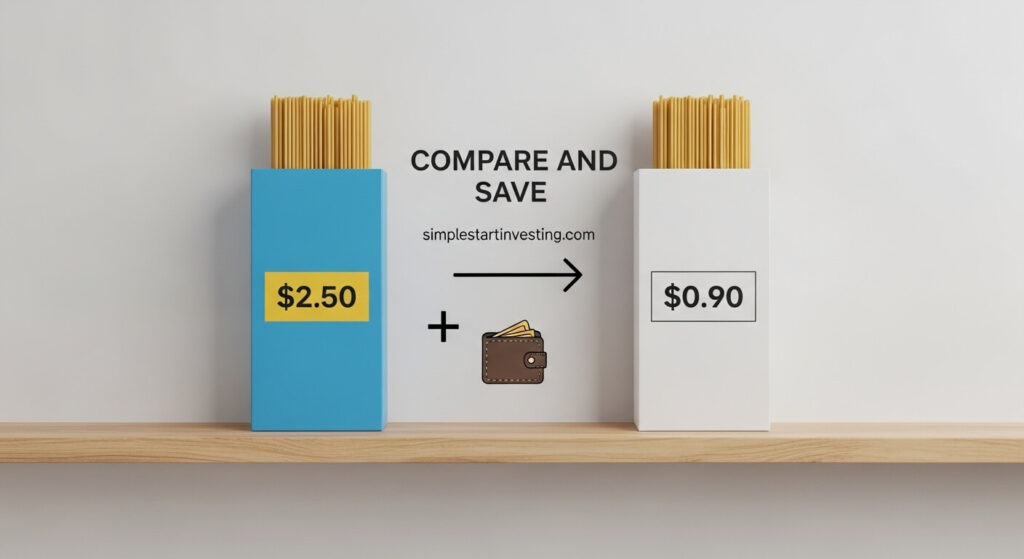
This is what we call the “Marketing Tax.” It is a fee you pay for the privilege of helping a massive corporation pay for their Super Bowl commercials. When you start looking at store brand savings through the lens of a smart investor, you realize that your grocery bill is one of the easiest places to find “found money” to fund your future.
What Are Store Brands Really?
To understand why the price difference is so large, we have to pull back the curtain on how products are made. Many beginners believe that every store brand—like Kirkland Signature at Costco, Great Value at Walmart, or 365 at Whole Foods—owns their own massive factories. In reality, that is rarely the case.
Most stores use something called “private labeling” or “co-packing.” This means a major manufacturer that produces a famous name-brand product also produces the store’s version. They might use the exact same recipe, or a slightly modified one, and simply put it in a different box.
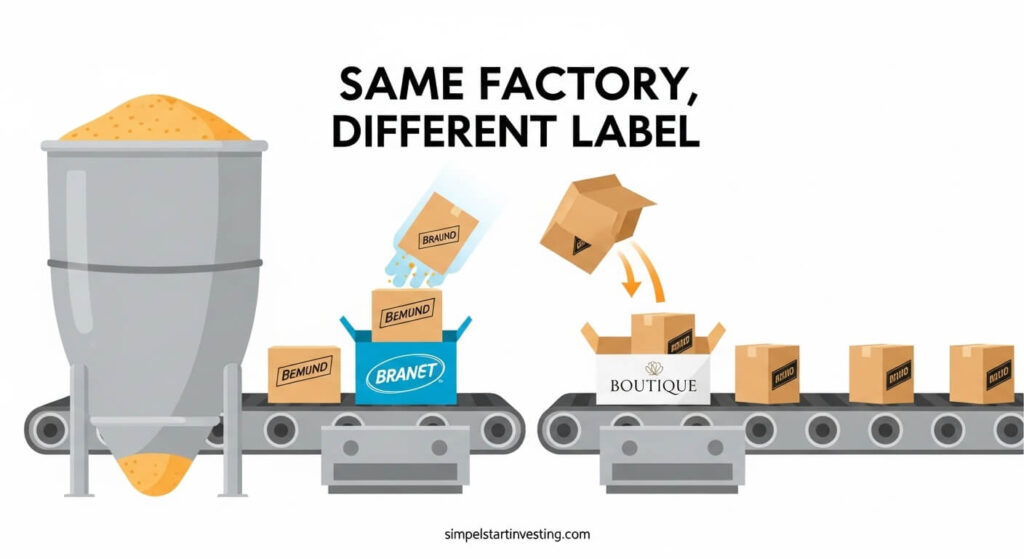
When you buy a name-brand box of crackers, the price includes the cost of the ingredients, the factory labor, the shipping, and a massive chunk for advertising. When you buy the store brand, the advertising cost is almost zero. The store doesn’t need to run a TV ad to convince you to buy their crackers; they already have you in their store. By cutting out the middleman of marketing, they can pass that 30 to 50 percent savings directly to you.
Why Our Brains Fight Against Saving Money
If the products are often the same, why do we feel so much guilt or hesitation when reaching for the “generic” version? It comes down to psychology. Brand names provide a sense of “perceived value.” We use brands as a shortcut for trust.
If you grew up eating a specific brand of peanut butter, that flavor becomes your baseline for what peanut butter “should” taste like. Any variation feels “wrong” or “cheap.” Marketers know this, which is why they spend billions to make sure their logo is etched into your memory from childhood.
However, once you realize that “store brand” does not mean “second class,” your perspective shifts. You aren’t being “cheap” by choosing the 90-cent pasta; you are being a disciplined manager of your own capital. You are choosing to keep your money rather than donating it to a corporation’s advertising budget.
The “Identical” List: Where You Can’t Go Wrong
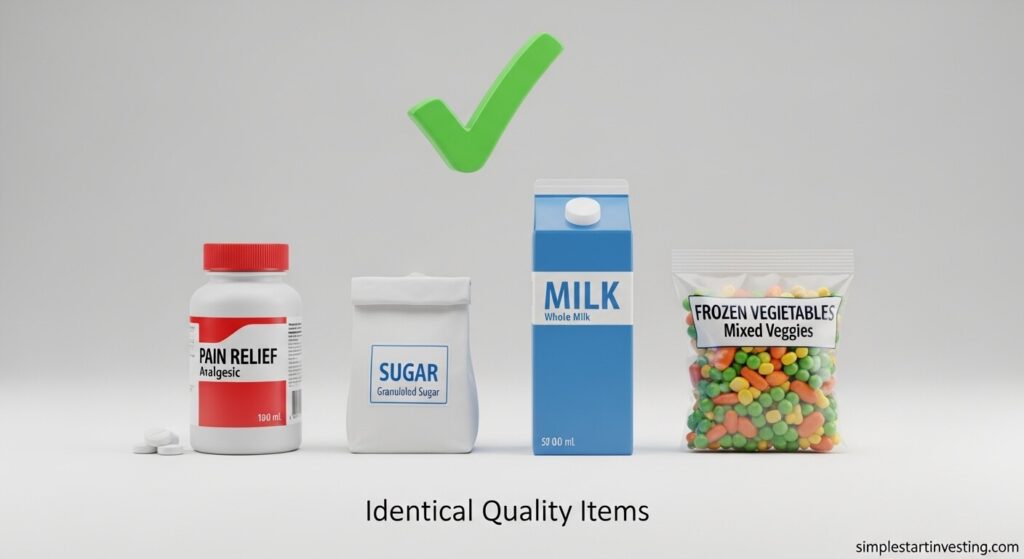
For a beginner looking to start the store brand savings challenge, there are certain aisles where the risk is effectively zero. These are products where the ingredients are so simple or so strictly regulated that the name brand and the store brand are virtually indistinguishable.
Over-the-Counter Medications
This is perhaps the most important category. In the United States, the Food and Drug Administration (FDA) requires that generic drugs have the same “active ingredients” as brand-name drugs. They must be just as strong and just as safe.
If you look at a bottle of name-brand Ibuprofen that costs 12 dollars and compare it to the store-brand bottle that costs 5 dollars, look at the back label. You will see the exact same amount of the active ingredient. The only difference might be the color of the pill or the shape of the bottle. By choosing the store brand here, you are saving 7 dollars on a single purchase for an identical medical result.
Pantry Staples: Salt, Sugar, and Flour
There are only so many ways to process granulated sugar or all-purpose flour. These are “commodities.” A bag of white sugar from a famous brand is chemically identical to the store-brand bag. Because these items are heavy and expensive to ship, the price difference can be significant.
Frozen Fruits and Vegetables
Frozen peas are frozen peas. Most major retailers source their frozen produce from the same massive farming cooperatives that name brands use. If the ingredient list just says “Green Peas,” you are paying a premium for the plastic bag if you choose the name brand.
Milk and Eggs
Dairy is highly regulated and usually sourced locally. The milk in the store-brand carton often comes from the exact same regional dairy farm as the one in the fancy branded carton. They are processed in the same facilities and delivered on the same trucks.
The Logic of the 30% Savings
Let’s look at how this changes your financial life using simple logic. Imagine your weekly grocery bill is 200 dollars. If you are a loyal name-brand shopper, you are likely paying that full amount every single week.
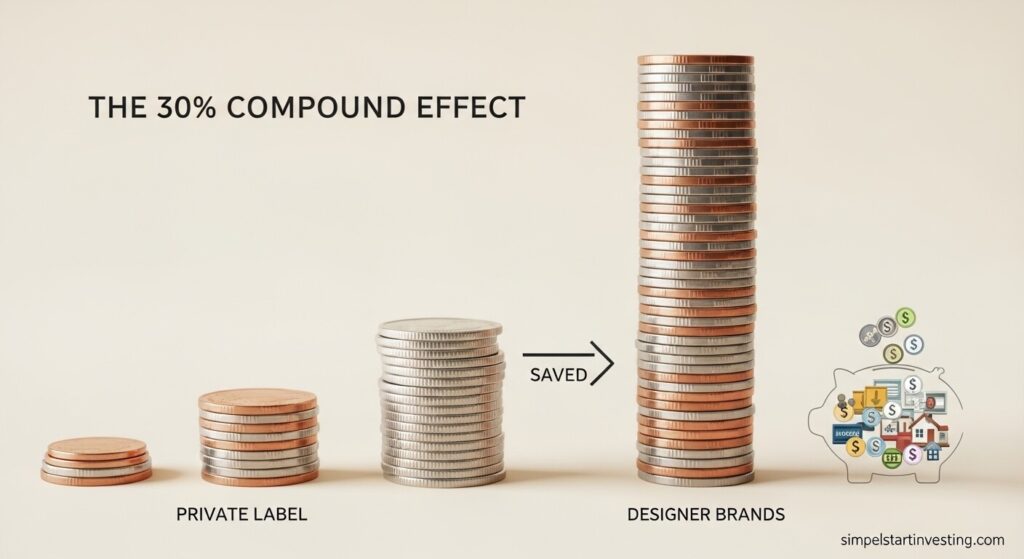
Now, let’s say you decide to switch just half of your cart to store brands. Because store brands are often 30 to 50 percent cheaper, you might save 30 dollars on that 200-dollar trip. That might not feel like much in the moment. It’s just 30 dollars, right?
But if you do that every week for a year, you have saved 1,560 dollars. If you take that 1,560 dollars and put it into a basic retirement account or use it to pay off a high-interest credit card, you are making a massive move toward financial freedom. You didn’t have to eat less. You didn’t have to change your diet. You just changed the label on the box.
When Should You Stick to the Brand Name?
To be a truly “simple start” investor, you have to be honest about quality. Not every store brand is a winner. There are times when the name brand actually is better, and it’s okay to spend the extra money if it provides genuine value to your life.
Complex Flavor Profiles
Products like “Secret Sauce,” specific spice blends, or certain types of soda often have proprietary recipes. A store-brand cola will rarely taste exactly like a Coca-Cola because the exact chemical formula is a trade secret. If that specific taste is vital to your happiness, the 1 dollar extra might be worth it to avoid “frugality fatigue.”
Textural Preferences
Sometimes, the manufacturing process for store brands differs in a way that affects texture. For example, some store-brand toilet papers or paper towels are not as absorbent or soft as the premium brands. In these cases, you might end up using twice as much of the “cheap” product, which means you aren’t actually saving any money in the long run.
The “Try One” Rule
The best way to navigate this is the “Try One” rule. Next time you need to restock a name-brand item, buy one store-brand version instead. Test it out. If you and your family can’t tell the difference, or if the difference is so small that it doesn’t matter, you have just found a permanent “raise” for your budget. If you hate it, you only lost a few cents, and you can go back to your brand name next time.
Breaking the “Cheap” Stigma
Many people feel a sense of embarrassment when they pull store-brand items out of their bags in front of friends or neighbors. This is a psychological hurdle that keeps people poor.
Wealthy people—the ones who actually keep their money—are often the biggest fans of store brands. They understand that a dollar saved on trash bags is a dollar that can be invested in a dividend-paying stock or a real estate fund. They don’t care about the logo on the box of aluminum foil because the foil ends up in the trash anyway.
True financial intelligence is knowing when “quality” is a real physical attribute and when it is just an expensive feeling created by an ad agency. By mastering store brand savings, you are proving to yourself that you are in control of your money, rather than letting your money (and the companies that want it) be in control of you.
How to Conduct Your Own “Grocery Audit”
If you want to take the “Generic Challenge” this week, start by looking at your receipt from your last trip. Circle every item that was a name brand. Then, next to it, estimate the store-brand price.
- Step 1: Identify the “No-Brainers.” These are the salts, sugars, medications, and cleaning supplies. Switch these immediately.
- Step 2: Identify the “Daily Drivers.” This is the milk, bread, and cereal you eat every day. Try the store brand once.
- Step 3: Calculate the difference. If you saved 20 dollars this week, physically move that 20 dollars from your checking account to your savings account.
Seeing that “found money” grow in a separate account is the best motivation to keep going. It turns a boring grocery chore into a game of “how much of my own money can I keep today?”

The Long-Term Impact
We often talk about “investing” as something that only happens on Wall Street. But the reality is that your household is a small business. Every business has “revenue” (your paycheck) and “expenses” (your bills). To make a profit—which we call “savings”—you either have to increase your revenue or decrease your expenses.
Increasing your revenue usually requires a promotion, a new job, or a side hustle. That takes a lot of time and effort. Decreasing your expenses by switching to store brands takes zero extra time. You are already at the store. You are already buying the pasta.
This is the ultimate “low-hanging fruit” of personal finance. When you stop paying the “Marketing Tax,” you are essentially giving yourself a tax-free raise. Over a decade, these small choices can result in tens of thousands of dollars when you factor in how that money could have grown if invested.
A Simple Start to a Richer Life
You don’t need a complex spreadsheet or a degree in finance to start building wealth. You just need the courage to realize that a fancy logo doesn’t make your soup taste better or your laundry cleaner.
The “Generic Challenge” is more than just a way to save a few bucks at the checkout line. It is a mindset shift. It is the moment you decide that your financial future is more important than the brand of crackers in your pantry. Start small, test the waters, and watch how those saved quarters and dollars eventually turn into the foundation of your financial independence.
Disclaimer: This content is for educational purposes only and does not constitute financial advice. Market prices and product qualities may vary by location and retailer; always check current pricing and ingredient labels at your local store.