Buying your first home in the United States is a thrill, but it can quickly turn into a headache if you do not have your paperwork in order. If you have been browsing listings on sites like Zillow or Realtor.com, you have likely heard two terms tossed around: mortgage pre-qualification and mortgage pre-approval.
They sound almost identical, right? In the world of real estate, however, the difference between these two could be the reason you either get the keys to your dream home or watch someone else walk away with them. Especially in today’s market, where inventory is shifting and interest rates are hovering around 6 percent, being prepared is your greatest advantage.
In this guide, we are going to break down exactly what these terms mean, why one is essentially a “nice to have” while the other is a “must-have,” and how you can navigate the process like a pro.
What is Mortgage Pre-qualification?
Think of a mortgage pre-qualification as the “first date” of the home-buying process. it is an initial, informal look at your finances to see what you might be able to afford.

The Simple Explanation Pre-qualification is a basic assessment performed by a lender. You tell them how much you earn, how much you owe, and what your credit score looks like. The lender takes your word for it, does a quick “soft” credit check (which does not hurt your score), and gives you a ballpark figure of the loan amount you might qualify for.
A Real-World Example Imagine you are a first-time buyer named Sarah. Sarah works at a large retailer like Walmart and earns 60,000 dollars a year. She has about 5,000 dollars in credit card debt. She calls a local bank and tells them these numbers. Within minutes, the bank says, “Based on what you told us, you could likely qualify for a home worth 300,000 dollars.” Sarah now has a general idea of her budget, but nothing is set in stone.
The Common Beginner Mistake Many beginners think a pre-qualification letter is enough to start making offers on houses. They walk into a competitive open house in a city like Austin or Charlotte, hand the seller a pre-qualification letter, and assume they are ready to buy.
The Logical Correction In reality, a pre-qualification letter carries very little weight with sellers. Because the bank has not actually verified your income with tax returns or W-2s, the letter is essentially just a “best guess.” If you try to buy a home with only a pre-qualification, the seller will likely choose another buyer who has a more solid guarantee from their bank.
What is Mortgage Pre-approval?
If pre-qualification is a first date, mortgage pre-approval is the signed marriage license. It is a formal, verified commitment from a lender.

The Simple Explanation To get a pre-approval, you must go through a rigorous process. You submit actual documents—like your most recent pay stubs, two years of tax returns, and bank statements. The lender performs a “hard” credit check and sends your file to an underwriter. This professional reviews your data to determine the exact amount the bank is willing to lend you.
A Real-World Example Let’s look at John, who is looking to buy a home in a busy market. John works for Amazon and provides the lender with his official income verification and tax documents. The lender sees that John has a high credit score and low debt. After a few days of review, they issue John a formal pre-approval letter for 450,000 dollars at a specific interest rate. John now has a document that says, “We have checked John’s history, and we are ready to give him this money.”
The Common Beginner Mistake Beginners often avoid pre-approval because they are afraid the “hard” credit check will lower their credit score. They worry that a five-point drop will ruin their chances of getting a good rate.
The Logical Correction While a hard credit check might cause a tiny, temporary dip in your score, the benefit far outweighs the cost. Without that pre-approval, you cannot effectively compete. Most sellers today will not even look at an offer that doesn’t include a pre-approval letter. It proves you have the “financial muscle” to close the deal.
Why Pre-approval is Essential in Today’s Market
The US housing market this year is in a state of “The Great Reset.” While interest rates have stabilized somewhat, the competition for well-priced homes is still fierce. Sellers want certainty. They do not want to take their house off the market for 30 days only to find out your loan was denied because you forgot to mention a student loan payment.

The Power of the Letter
When you submit an offer with a mortgage pre-approval, you are telling the seller three important things:
- You are serious: You have already done the hard work of organizing your finances.
- You are qualified: A bank has already vetted your income and assets.
- The deal is likely to close: Since the lender has already seen your documents, there are fewer “surprises” that could kill the deal during the closing process.
Understanding Your True Budget
A pre-approval also protects you from “house fever.” It is easy to fall in love with a home that costs 500,000 dollars, but if your bank only approves you for 400,000 dollars, you are setting yourself up for heartbreak. The pre-approval gives you a hard ceiling so you can shop with confidence.
How the Lender Calculates Your Numbers
You might wonder how a lender decides you are “worthy” of a 400,000 dollar loan. They use a few key metrics, and understanding these can help you prepare before you even talk to a bank.
Debt-to-Income Ratio (DTI)
Lenders look at how much of your monthly income goes toward paying off debt. To find your DTI, the bank takes your total monthly debt payments—like car loans, student loans, and credit card minimums—and adds the estimated cost of your new mortgage. They then divide that by your gross (before-tax) monthly income.
For example, if you earn 6,000 dollars a month and your total monthly debts (including the new house) would be 2,100 dollars, your DTI is 35 percent. Most lenders prefer to see a DTI of 43 percent or lower. If yours is higher, they might ask you to pay off a credit card or look for a cheaper house.

The Role of Your Credit Score
Your FICO score is a huge factor in the interest rate you will receive. For instance, a buyer with a score of 760 might get a 6 percent interest rate, while someone with a 620 score might be offered 7.5 percent. On a 300,000 dollar loan, that small difference in the interest rate could cost you tens of thousands of dollars over the life of the loan.
Steps to Get Your Mortgage Pre-approval
Getting pre-approved takes a bit of work, but it is the most important step in your home-buying journey. Here is a simple roadmap to follow:
- Gather Your Documents: You will need your last two years of W-2 forms, your last 30 days of pay stubs, and two months of bank statements. If you own a business, you’ll need your full tax returns.
- Check Your Credit: Before the lender does, check your own report for errors. If you see a debt that isn’t yours, get it cleared up now.
- Shop Around: You do not have to go with the first bank you call. You can talk to a local credit union, a big bank like JPMorgan Chase, or an online lender.
- Submit the Application: Fill out the formal loan application (often called a 1003 in the industry). This is where the lender will pull your credit and verify your documents.
- Receive Your Letter: Once approved, you will get a letter stating the loan amount and the type of loan (like an FHA or Conventional loan). Keep this letter handy—you’ll need it every time you make an offer!
A Quick Note on Digital Assets
Starting this year, the IRS has updated rules regarding digital assets. If you have sold cryptocurrency or other digital assets to fund your down payment, be prepared to provide extra documentation. Lenders are required to track the “source of funds” to ensure everything is legitimate.
Common Misunderstandings to Avoid
Mistake: Thinking Pre-approval is a Guarantee
Even with a pre-approval letter, the bank can still say “no” at the very end. A pre-approval is usually “conditional.” This means the loan is guaranteed as long as your financial situation does not change before you close.
The Logic Correction: Do not make any big purchases after getting pre-approved! If you go out and buy a new Tesla or a house full of furniture on credit, your DTI will change. The bank will re-check your credit right before you sign the final papers. If they see a new 600 dollar monthly car payment, they might cancel your home loan entirely. Stay financially “quiet” until you have the keys in your hand.

Mistake: Waiting for the “Perfect” Rate
Many beginners try to time the market, waiting for interest rates to drop from 6 percent to 5 percent.
The Logic Correction: Rates are unpredictable. If you wait for a lower rate, home prices might rise in the meantime, or more buyers might enter the market, making it even harder to win a bid. It is usually better to buy when you are financially ready and can afford the monthly payment. You can always look into refinancing later if rates drop significantly.
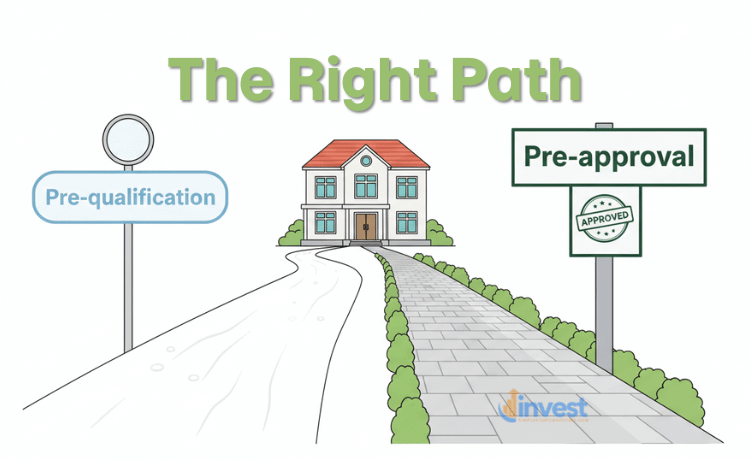
Summary of the Key Differences
To keep it simple, here is a quick review of how these two terms stack up against each other:
Mortgage Pre-qualification
- Verification: None. Based on what you tell the lender.
- Credit Check: Usually a “soft” pull that does not affect your score.
- Weight with Sellers: Very low. Most sellers will ignore this in a competitive market.
- Best Time to Use: When you are just starting to “dream” about a house and want a rough budget.
Mortgage Pre-approval
- Verification: High. Requires pay stubs, W-2s, and bank statements.
- Credit Check: A “hard” pull that gives an accurate look at your creditworthiness.
- Weight with Sellers: Very high. It is a powerful tool that makes your offer competitive.
- Best Time to Use: When you are ready to start touring homes and making offers.
Your Next Step
Now that you know the difference, it’s time to take action. If you are serious about buying a home this year, don’t just stop at a pre-qualification. Reach out to a few lenders and start the pre-approval process. It might take a few days of scanning documents, but having that letter in your pocket will give you the confidence to walk into any home and know exactly what you can afford.
Regulations and market conditions can change quickly. Always verify current mortgage guidelines with your lender or a qualified financial advisor before making a major purchase.
Disclaimer: This content is for educational purposes only and does not constitute financial advice. Mortgage rates and lending requirements vary by state and individual financial situation.