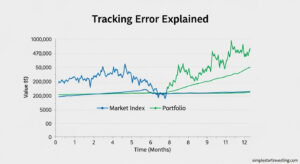
Many people believe that to be successful in the stock market, you need a room full of glowing monitors, complex charts, and a degree in high-level mathematics. They think that the more complicated a strategy is, the more money it must make. However, the reality of the American financial market often proves the exact opposite.
In the world of money, “simple” is not a synonym for “easy” or “lazy.” In fact, simple investing strategies often lead to much better long-term results than the most sophisticated trading systems used by professionals. Whether you are looking at giants like Apple or Tesla, or broad groups of companies, the data consistently shows that keeping it simple is often the winning move for your bank account.
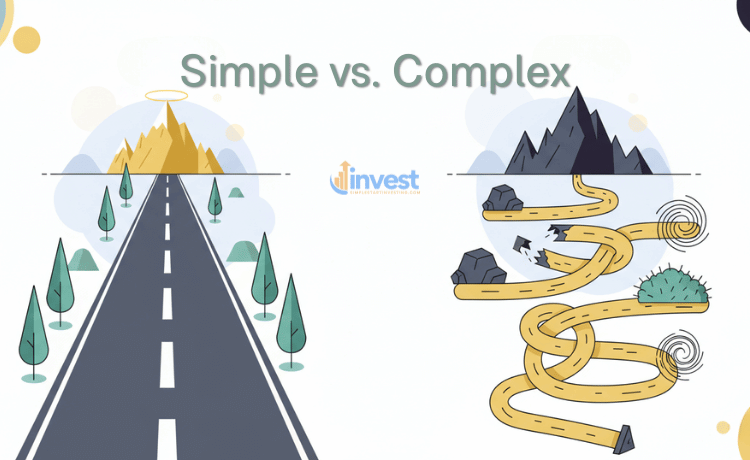
What Are Simple Investing Strategies?
A simple investing strategy is a plan that focuses on long-term growth by buying a broad range of assets and holding them for many years. Instead of trying to guess which specific stock will go up tomorrow or next week, you choose to own a small piece of hundreds of successful companies at once. This is often done through something called an index fund.
The 4-Step Breakdown of Simple Investing:
- Simple Explanation: Imagine you want to buy fruit. Instead of trying to guess which individual apple in the bin is the perfect one, you buy the entire orchard. By owning the whole orchard, you don’t care if one tree has a bad year because the other hundreds of trees will still produce plenty of fruit for you.
- Real-World Example: If you invest in an S&P 500 index fund, you are essentially buying a tiny slice of the 500 largest companies in America, including names you know like Amazon, Costco, and Walmart. When these 500 companies grow and make profits over 10 or 20 years, your investment grows along with them.
- Common Beginner Mistake: Many beginners think they need to “pick the next big winner.” They spend hours watching news clips about a single stock like Tesla (TSLA), hoping to buy it at exactly the right second and sell it for a quick profit.
- Logical Adjustment: Financial history shows that even professional fund managers fail to beat the overall market most of the time. By choosing a simple, broad strategy, you stop trying to “beat” the market and instead choose to “be” the market, which has historically returned about 10 percent per year on average over the long term.

The Hidden Trap of Complexity Bias
Why do we naturally gravitate toward complex things? Humans are wired to believe that more effort and more complexity should lead to better results. In school, a more complex essay might get a better grade. At work, a complex project might get a bigger promotion. But in the stock market, complexity usually just adds more ways for things to go wrong.
When you create a complex strategy, you often increase your “friction.” Friction in finance means anything that slows down your growth, such as high fees, frequent taxes, and emotional stress.

The 4-Step Breakdown of Complexity Bias:
- Simple Explanation: Complexity bias is the voice in your head that says, “It can’t be this easy.” It makes you want to add more steps, more indicators, and more “expert” opinions to your plan because you feel like you aren’t doing enough work.
- Real-World Example: A beginner might start with a simple plan to save 500 dollars a month in a broad fund. But after seeing a “guru” online, they decide they need to use “technical analysis” to trade options on volatile stocks like Nvidia. They end up spending four hours a day looking at screens, only to lose money because they made one small mistake in their complex calculations.
- Common Beginner Mistake: Beginners often confuse “activity” with “achievement.” They think that the more trades they make, the faster they will get rich.
- Logical Adjustment: Every time you trade, you have to be right twice: once when you buy and once when you sell. If you use a simple strategy, you only have to be right once: by deciding to start and staying invested.
Fees: The Silent Portfolio Killer
One of the biggest reasons complex strategies fail is the cost. Complex strategies often involve hiring “active” managers or using platforms that charge high commissions. While a one percent fee might sound small, it can eat away a massive portion of your wealth over several decades.

The 4-Step Breakdown of Investment Fees:
- Simple Explanation: Fees are like a small hole in a bucket of water. You might not notice the dripping at first, but over a long journey, you will arrive with much less water than you started with. Simple strategies usually use “passive” funds that have almost no “holes” in them.
- Real-World Example: Imagine two people, Alex and Jordan. They both start with 10,000 dollars. Alex chooses a complex fund with a 1 percent annual fee. Jordan chooses a simple index fund with a nearly zero fee (let’s say 0.03 percent). If they both earn a 7 percent return every year for 30 years, Jordan will end up with tens of thousands of dollars more than Alex, simply because Jordan didn’t pay those extra fees.
- Common Beginner Mistake: New investors often ignore the “expense ratio” (the fee) of a fund because they think a higher fee means they are paying for “better” management.
- Logical Adjustment: In the world of investing, you generally get what you don’t pay for. The less you pay in fees to a bank or a broker, the more money stays in your account to grow through compound interest.
The Tax Advantage of Keeping It Simple
In the United States, how much you keep is often more important than how much you make. The IRS (Internal Revenue Service) has different rules for how they tax your investment profits. If you trade stocks frequently (a complex strategy), you pay “Short-Term Capital Gains” taxes, which are usually much higher. If you hold for more than a year (a simple strategy), you pay “Long-Term Capital Gains” taxes, which are much lower.
The 4-Step Breakdown of Tax Efficiency:
- Simple Explanation: Think of taxes like a toll bridge. If you choose a complex strategy that involves moving your money in and out of stocks every week, you have to pay the toll every time you cross. If you choose a simple strategy and stay put, you only pay the toll once, many years from now.
- Real-World Example: According to current IRS guidelines for this year and next, if you are a single filer making a moderate income, you might pay 0 percent or 15 percent on your long-term profits. However, if you sell a stock like Apple (AAPL) after holding it for only six months, you might have to pay your standard income tax rate, which could be 22 percent, 24 percent, or even higher.
- Common Beginner Mistake: Beginners focus only on the “profit” number on their screen and forget that the IRS will take a big chunk of that profit if they trade too often.
- Logical Adjustment: By following a simple “buy and hold” strategy, you allow your money to grow undisturbed. You defer your taxes until the very end, allowing the money that would have gone to taxes to stay in your account and earn even more money for you. (Note: Tax regulations can change; please check current guidelines or consult a professional.)
Behavioral Finance: Your Emotions Are the Enemy
The hardest part of investing isn’t the math; it’s the psychology. Complex strategies are very hard to stick to when the market gets scary. When stock prices for companies like JPMorgan or Microsoft start to fall, people with complex plans often panic because they don’t truly understand every “moving part” of their strategy.
Simple strategies are easier to understand, which makes them much easier to stick to during a market downturn.
The 4-Step Breakdown of Emotional Investing:
- Simple Explanation: Imagine you are on a boat in a storm. If you have a simple, sturdy anchor, you can just sit tight and wait for the sun to come out. If you have a complex system of ropes and pulleys that you don’t fully understand, you are more likely to make a mistake and fall overboard while trying to fix it.
- Real-World Example: In a typical year, the stock market might drop by 10 percent or more at some point. An investor with a simple plan knows that “the market always goes through cycles” and does nothing. An investor with a complex strategy might see a “signal” on their chart, get scared, and sell everything at the bottom, missing out when the market eventually bounces back.
- Common Beginner Mistake: Beginners think they will be the one person who can keep a “cool head” while everyone else is panicking. In reality, our brains are biologically wired to feel pain when we lose money, leading to bad decisions.
- Logical Adjustment: A simple strategy removes the need for “decision-making” during stressful times. By automating your investments (putting the same amount of money in every month), you take your emotions out of the equation entirely.
How to Build Your Simple Strategy
Starting a simple strategy doesn’t require a lot of money or time. You can begin with as little as 10 or 100 dollars. The key is consistency and time.
- Choose a Broad Fund: Look for an ETF (Exchange Traded Fund) that tracks a major index like the S&P 500 or the Total Stock Market. These funds own pieces of hundreds or thousands of companies.
- Automate Your Savings: Set up a “recurring contribution” from your bank account. This is called Dollar Cost Averaging. You buy more shares when prices are low and fewer when prices are high, without even thinking about it.
- Hold for the Long Term: Treat this money as if it doesn’t exist for at least five to ten years. This allows “compound interest” to do the heavy lifting.
- Reinvest Your Dividends: Many companies pay out a small amount of cash to shareholders (dividends). If you set your account to “reinvest” these, you automatically buy more shares, which leads to even faster growth.
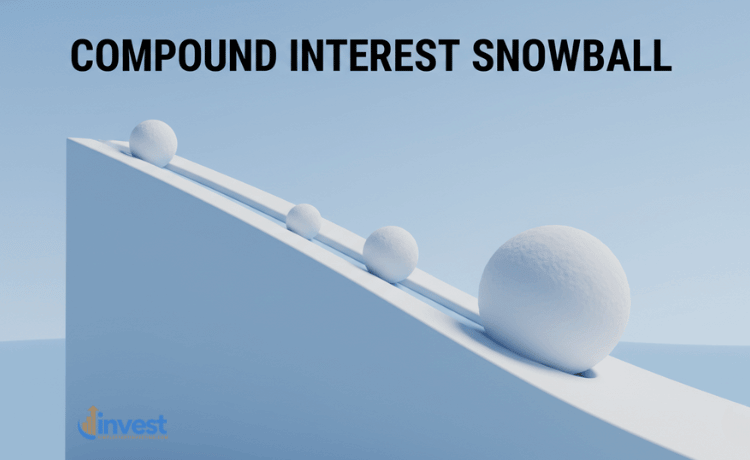
The 4-Step Breakdown of Compound Interest:
- Simple Explanation: Compound interest is like a snowball rolling down a hill. At first, it’s small and moves slowly. But as it rolls, it picks up more snow. The bigger it gets, the more snow it picks up every second. By the time it reaches the bottom, it’s a giant boulder.
- Real-World Example: If you start with 1,000 dollars and it earns 10 percent, you have 1,100 dollars at the end of the year. The next year, you earn 10 percent not just on your 1,000 dollars, but also on the 100 dollars you earned previously. Over 30 years, this “interest on interest” can turn a small amount of money into a fortune.
- Common Beginner Mistake: Beginners get discouraged because they don’t see massive growth in the first six months. They quit before the “snowball” has a chance to get big.
- Logical Adjustment: Investing is a marathon, not a sprint. The most successful investors aren’t the ones who found the “best” stock, but the ones who stayed in the game the longest.
Conclusion: Trust the Process
Complexity is often used to sell products, but simplicity is used to build wealth. By choosing a simple investing strategy, you are choosing to lower your costs, reduce your taxes, and protect your mental health. You don’t need to be a genius to succeed in the American markets; you just need to be disciplined.
Stick to your plan, ignore the daily noise on the news, and let the largest companies in the world do the hard work for you. Over time, you will likely find that doing “less” actually results in having “more.”
Disclaimer: This content is for educational purposes only and does not constitute financial advice. Investment involves risk, and past performance is not a guarantee of future results.