Think of your investment portfolio like a professional sports team. If you only have strikers who focus on scoring, you might lead for a while, but your defense will be so weak that the other team eventually catches up and wins. On the other hand, if you only have a goalie and defenders, you’ll never lose big, but you’ll also never score enough points to win the championship.

In the world of money, investing assets work the same way. To build real wealth in the U.S. market, you need a balance of “Offense” to grow your money and “Defense” to protect what you’ve already built. Whether the market is booming or hitting a rough patch, understanding these two roles is the secret to staying in the game for the long haul.
What Are Offensive Assets?
Offensive assets are the “players” on your team designed to score points—meaning they are there to grow your wealth as fast as possible. These are usually companies or investments that are expanding, innovating, or capturing new markets.
The Plain English Explanation Offensive assets, often called “growth stocks,” are investments in companies that are expected to grow at a faster rate than the average market. You buy them because you believe the price of the stock will be much higher in the future. They don’t usually pay you cash right now; instead, they reinvest their profits to become even bigger.

Real-World Example A classic example is Nvidia (NVDA) or Tesla (TSLA). These companies are often at the forefront of technology like Artificial Intelligence or Electric Vehicles. If you bought shares in a high-growth tech company, you aren’t doing it for a small monthly check. You are doing it because you hope the 100 dollars you invested today becomes 500 dollars in a few years.
The Common Beginner Mistake Many new investors see a stock like Meta (META) or Apple (AAPL) skyrocketing and decide to put 100% of their money into it. They think, “If it’s going up now, it will go up forever.” They treat the stock market like a high-speed elevator that only goes up.
The Financial Mindset Shift In reality, offensive assets are volatile. They can go up 20% in a month, but they can also drop 30% just as fast if the economy cools down. High growth comes with high “heartbeat” moments. You use offense to build wealth over decades, but you must be prepared for a bumpy ride.
What Are Defensive Assets?
If offensive assets are the strikers, defensive assets are your goalie and your backline. Their main job isn’t to make you a millionaire overnight; it’s to make sure you don’t go broke when the market gets scary.
The Plain English Explanation Defensive assets are investments in industries that people need no matter what is happening in the world. Think about things you can’t live without: electricity, water, medicine, and basic groceries. Because these businesses have steady customers, their stock prices don’t usually crash as hard as tech companies during a recession.

Real-World Example Consider a company like Walmart (WMT) or Coca-Cola (KO). Even if the economy is bad, people still buy groceries and basic beverages. Another great example is NextEra Energy (NEE), a utility company. People will almost always pay their electric bill before they buy a new iPhone. These companies also often pay “dividends,” which are small cash payments sent to you just for owning the stock.
The Common Beginner Mistake Beginners often call these stocks “boring.” They see Johnson & Johnson (JNJ) moving up only a tiny bit while a crypto-related stock doubles in price, and they think defensive assets are a waste of time. They feel like they are “missing out” on the action.
The Financial Mindset Shift Defensive assets are your “sleep-well-at-night” insurance. When the market drops by 20%, a defensive stock might only drop by 5% or even stay flat. This protects your total balance so you don’t panic and sell everything at the bottom. Winning the game of investing is often about avoiding “big losses” rather than just chasing “big wins.”
The Danger of Having No Defense: The Math of Recovery
Why is defense so important? Because of how math works when you lose money. Most people don’t realize that losing money hurts twice as much as gaining money helps.
Imagine you have 10,000 dollars in your account. You put it all into an aggressive, offensive stock. Suddenly, the market crashes, and your investment drops by 50%. You now have 5,000 dollars left.

To get back to your original 10,000 dollars, you don’t just need a 50% gain. You actually need a 100% gain on that 5,000 dollars just to get back to where you started! This is why investing assets that provide defense are crucial. They keep your “floor” high so you don’t have to climb out of a deep hole later.
How to Balance Your Team Based on Your Life
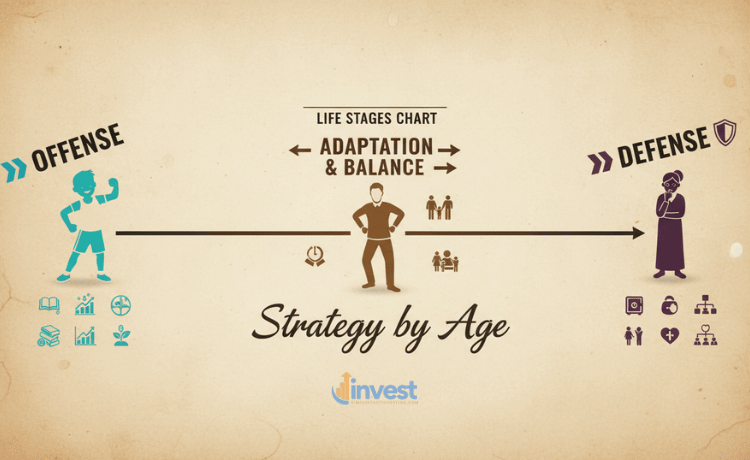
There is no “perfect” percentage for everyone, but there are general rules based on where you are in life.
- In Your 20s and 30s: You have a lot of time. You can afford to play a “heavy offense.” If your portfolio drops this year, you have thirty years for it to recover. Many people in this stage focus more on growth-oriented investing assets like tech ETFs or individual companies like Amazon (AMZN).
- In Your 40s and 50s: You are in your peak earning years. You might start adding more “mid-fielders”—balanced companies like Berkshire Hathaway (BRK.B) that have a mix of growth and stability.
- Near Retirement: Now, the goalie is the most important player. You can’t afford a 50% drop because you might need that money for living expenses next year. You shift toward high-quality bonds, cash accounts, and stable dividend stocks like Costco (COST).
Market Seasons: When Each Style Shines
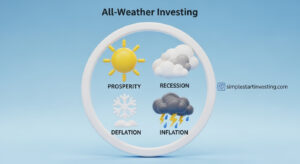
The economy moves in seasons, and different investing assets take turns leading the way.
1. The “Bull Market” (Summer)
This is when everything feels great. Interest rates are often low, and people are spending money. Offensive assets like Alphabet (GOOG) or small-cap growth companies usually sprint ahead. During these times, it’s easy to feel like you don’t need any defense at all.
2. The “Bear Market” (Winter)
This is when fear takes over. Maybe inflation is high, or there’s a global crisis. In this “season,” investors run toward safety. They buy gold, government bonds, or defensive stocks like Lockheed Martin (LMT). While the “strikers” are losing value, these “defenders” hold the line.

How to Start Building Your Balanced Portfolio
You don’t need to be a Wall Street pro to do this. You can start by asking yourself: “If my account dropped by 20% tomorrow, would I be able to stay calm?”
If the answer is no, you probably need more defense. You can find this by looking for “Value ETFs” or “Dividend Aristocrat” funds. These are groups of companies that have a long history of being stable and paying out cash to investors.
If the answer is yes, and you have many years before you need the money, you can look for “Growth ETFs” or “Information Technology” sectors. These will provide the “scoring power” you need to outpace inflation and build a significant nest egg.
Note: Tax regulations and contribution limits for accounts like IRAs can change. In the U.S., the IRS often adjusts these limits annually. For the current year, the standard deduction for a single filer is 16,100 dollars, and the IRA contribution limit is 7,500 dollars. Please check current IRS guidelines or consult a tax professional for the most up-to-date rules.
Final Thoughts for the Beginner
Successful investing isn’t about picking the one “miracle stock” that goes to the moon. It’s about building a team of investing assets that can play through any weather.
- Use Offense to build your future.
- Use Defense to protect your present.
- Stay Consistent so you don’t get kicked out of the game.
By understanding the roles of these different assets, you stop “gambling” and start “strategizing.” You become the coach of your own financial future.
Disclaimer: This content is for educational purposes only and does not constitute financial advice. Investing involves risk, including the potential loss of principal. Past performance is not indicative of future results.