Have you ever looked at your investment account, saw a small dip in price, and felt a sudden knot in your stomach? Even if your portfolio is mostly “in the green,” that one red line seems to scream louder than all your wins combined. If so, you aren’t “bad” at investing—you are simply human. This intense emotional reaction is driven by a deep-seated fear of losing money known in the financial world as Loss Aversion.
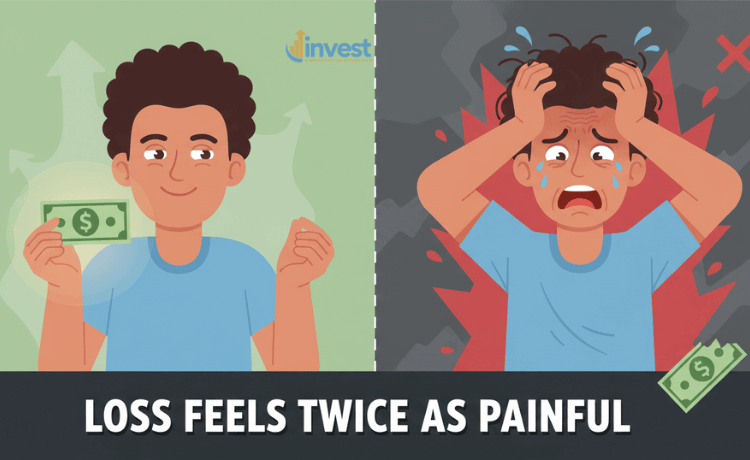
For a beginner, the fear of losing money can be the single greatest hurdle to building long-term wealth. Science shows that we feel the sting of a loss twice as sharply as we feel the joy of an equal gain. This biological “glitch” often leads us to make irrational choices, like selling great stocks during a temporary market dip or holding onto “zombie” companies hoping they will eventually break even. Understanding this bias is the first step to mastering your financial future.
What Exactly is Loss Aversion?
At its core, Loss Aversion is the psychological phenomenon where the pain of losing 100 dollars is significantly more intense than the happiness of finding 100 dollars. In the world of investing, this means your brain is naturally “tilted” toward avoiding risk rather than seeking rewards.
A Simple Explanation
Imagine you are walking down the street and find a 20 dollar bill. You feel a nice little surge of happiness. Now imagine that five minutes later, you realize that 20 dollar bill fell out of your pocket. Even though you are back exactly where you started, you will likely feel much worse than you felt good. The “negative” emotion of the loss completely overwhelms the “positive” emotion of the gain.
A Real-World Example
Let’s look at a popular stock like Tesla (TSLA). Suppose you bought shares and the price went up by 1,000 dollars in one month. You feel pretty good—maybe you treat yourself to a nice dinner. But the next month, the stock drops by 1,000 dollars. Suddenly, you feel a sense of panic. You might lose sleep, check your app ten times a day, or even consider selling everything. Even though your account balance is exactly where it started, the emotional “weight” of that 1,000 dollar drop feels like a catastrophe.
The Common Beginner Mistake
Most new investors believe they have a “high risk tolerance” when the market is going up. They think, “I can handle a 10 percent drop.” But when the fear of losing money actually hits during a market correction, they realize their emotional limit is much lower than they thought. They mistake their ambition for their actual emotional capacity.
The Correct Mindset
Instead of trying to “turn off” your emotions, you should acknowledge that losses are a natural part of the journey. If you start with 1,000 dollars and it grows to 1,100 dollars, then drops back to 1,000 dollars, you haven’t “failed.” You are simply experiencing the “breathing” of the market. Long-term wealth is built by those who can sit through the “exhales” (the losses) to enjoy the “inhales” (the gains).
Why Our Brains Are Wired This Way
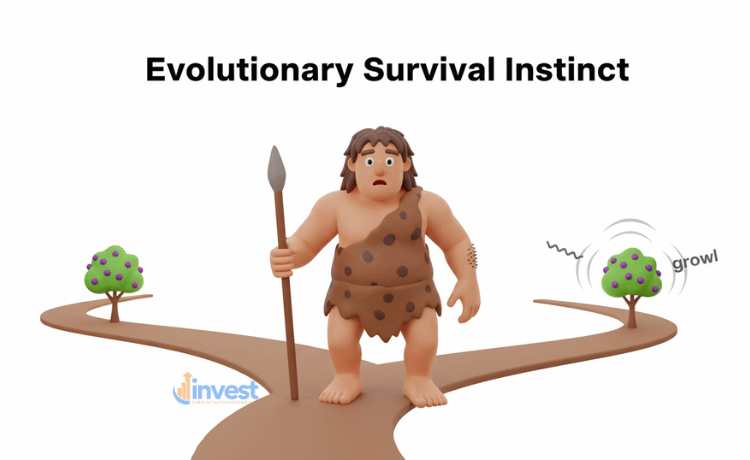
To understand why we have such an intense fear of losing money, we have to look back thousands of years. Our ancestors didn’t have stock portfolios; they had food, water, and shelter. In a survival situation, losing your food for the day was a life-threatening event. Finding extra food was nice, but it wasn’t as critical as keeping what you already had.
The Evolutionary Trigger
In the wild, avoiding a predator (a loss) was more important than finding a slightly better berry patch (a gain). Those who were hyper-sensitive to “losses” survived to pass on their genes. Today, your brain uses that same survival hardware to look at your Apple (AAPL) or Amazon (AMZN) stocks. When you see a “minus” sign in your account, your brain triggers a “fight or flight” response, even though you aren’t in physical danger.
The Beginner’s Misconception
Many beginners think they are “too emotional” or “not smart enough” to invest because they feel scared. They think professional investors are cold, emotionless robots who never feel fear.
The Reality Shift
Professionals feel the same fear! The difference is that they recognize it as a biological leftover from their caveman ancestors. They don’t let a primitive survival instinct dictate their 401(k) strategy. When you feel that surge of panic, tell yourself: “That’s just my inner caveman trying to protect me from a saber-toothed tiger that doesn’t exist.”
The “Disposition Effect”: Holding Losers Too Long
One of the most dangerous ways the fear of losing money manifests is something called the “Disposition Effect.” This is the tendency for investors to sell their winning stocks too early while stubbornly holding onto their losing stocks for too long.

The Logic Trap
When a stock goes up, we feel a “gain.” Because we fear losing that gain, we sell it immediately to “lock in the profit.” But when a stock goes down, we hate the feeling of a “loss” so much that we refuse to sell it. We tell ourselves, “I’ll just wait until it gets back to what I paid for it.”
A Real-World Example
Imagine you bought two stocks: Costco (COST) and a speculative new tech startup.
- Costco goes up 20 percent. You feel great, but you’re afraid the price will drop tomorrow. You sell it to “take your win.”
- The Startup drops 40 percent. It’s clearly a failing business. However, you refuse to sell because selling would mean “admitting” the loss. You hold it for three years as it slowly goes to zero.
By selling the winner and keeping the loser, you are essentially cutting the flowers and watering the weeds in your garden.
The Beginner’s Mistake
The biggest mistake here is the belief that “It’s not a loss until I sell.” This is a dangerous myth. If you bought a stock for 100 dollars and it is now worth 60 dollars, you have lost 40 dollars of purchasing power today. Refusing to click the “sell” button doesn’t make the money reappear.
The Correct Mindset
Evaluate your investments based on their future potential, not what you paid for them. Ask yourself: “If I had 60 dollars in cash today, would I buy this failing stock, or would I put it into a better company like Microsoft (MSFT)?” If the answer is Microsoft, then sell the loser and move on.
Panic Selling: The Cost of Emotional Speed
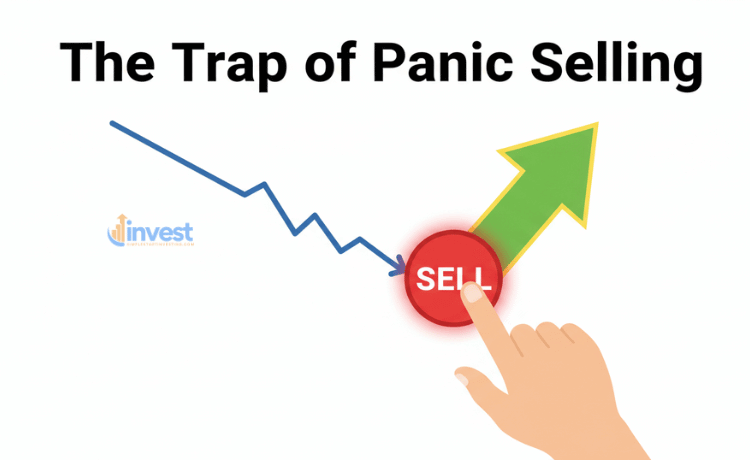
When the entire stock market takes a dip—which happens regularly—the fear of losing money can lead to a mass “stampede” out of the market. This is known as panic selling.
The “Safety in Numbers” Illusion
When we see everyone else selling, our brains tell us there must be a real danger. We sell our shares at the lowest possible price just to make the “pain” of watching the numbers go down stop.
A Numbers Example
Let’s say you have 10,000 dollars in a broad market fund. The market enters a “correction” and your balance drops to 8,000 dollars. You feel a 2,000 dollar “pain.” To stop the pain from becoming 3,000 dollars, you sell everything and move the 8,000 dollars to a savings account. Months later, the market recovers and goes back to its original level. But because you sold, you are still sitting on 8,000 dollars. You effectively turned a “temporary dip” into a “permanent loss.”
The Common Beginner Mistake
Beginners often think they can “outsmart” the fear by selling now and “buying back in when things look safer.” The problem is, by the time things “look safe,” the prices have usually already gone back up. You end up selling low and buying high.
The Correct Mindset
Understand that in the US stock market, volatility is the “fee” you pay for long-term returns. Think of a market dip like a “sale” at Walmart (WMT). If you liked the company at 100 dollars, you should love it at 80 dollars. Instead of running away, successful investors often see a dip as an opportunity to buy more at a discount.
The Tax Silver Lining: Using Losses to Your Advantage
While the fear of losing money is painful, the US tax code actually offers a small “consolation prize” for investment losses. This is a strategy known as Tax-Loss Harvesting.
How It Works
If you sell an investment for less than you paid for it in a taxable brokerage account, you can often use that “realized loss” to reduce your taxes.
A Simple Breakdown
- If you made 5,000 dollars in profit from selling Stock A, but you lost 2,000 dollars from selling Stock B, the IRS generally only taxes you on the “net gain” of 3,000 dollars.
- Even better, if your total losses are more than your gains, you can use up to 3,000 dollars of those extra losses to reduce your regular taxable income (like the money from your job).
The Common Misconception
Many beginners are so afraid of seeing “Loss” on their tax forms that they avoid selling even when it makes sense. They think a loss is a sign of being a “bad investor.”
The Correct Mindset
A strategic loss can be a powerful tool. By “harvesting” a loss on a failing stock, you can lower your tax bill and use that saved tax money to buy a better, high-quality investment. It’s about making the best of a bad situation. (Note: Tax regulations can change; please check current IRS guidelines or consult a professional.)
How to Overcome the Fear: Practical Steps
You can’t delete your emotions, but you can build a system that prevents them from ruining your wealth. Here are four ways to fight the fear of losing money.

1. The Power of Automation
The best way to avoid emotional mistakes is to take your hands off the steering wheel. Set up an automatic “recurring investment” from your bank account to your brokerage. Whether the market is up or down, you buy a set amount every month. This is called Dollar-Cost Averaging. When prices are low, your 100 dollars simply buys more shares.
2. Check Your “Score” Less Often
If you check your portfolio every day, you are guaranteed to see many “losing” days. This triggers your loss aversion constantly. If you check once a year, the historical probability of seeing a “gain” is much higher. Stop looking at the “weather” (daily price changes) and focus on the “climate” (long-term growth).
3. Use the “Overnight Test”
If you are panicking about a stock, ask yourself: “If I woke up tomorrow and this stock was replaced by its cash value in my account, would I use that cash to buy the stock again?” If the answer is “No,” then you are only holding it because of loss aversion. It’s time to let go.
4. Reframe Your Goals
Stop measuring success by the daily “Total Gain/Loss” column. Instead, measure success by how many shares you own or how much in dividends you are collecting. If you own 100 shares of JPMorgan (JPM), you still own 100 shares whether the price is 150 dollars or 140 dollars. Focus on the ownership, not the temporary price tag.
Final Thoughts: The Cost of Doing Nothing
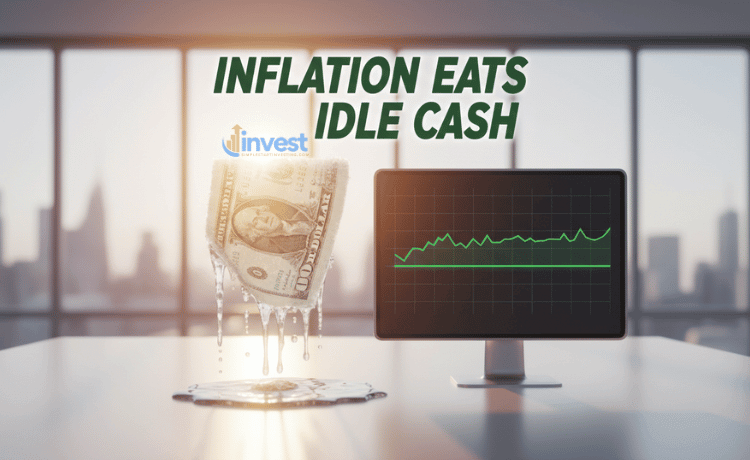
The ultimate irony of the fear of losing money is that it often leads to the biggest loss of all: Inflation.
If you keep all your money in a “safe” shoe box or a zero-interest checking account because you are afraid of the stock market, your money is guaranteed to lose value over time. As the price of bread, rent, and gas goes up, your “safe” 1,000 dollars buys less and less.
The goal isn’t to avoid all risk—it’s to take the right risks. By understanding Loss Aversion, you can stop reacting to every tiny dip and start focusing on the big picture. Your future self will thank you for having the courage to stay the course.
Disclaimer: This content is for educational purposes only and does not constitute financial advice.