Have you ever looked at your savings account or a stock like Apple and wondered, “When is this actually going to turn into a life-changing amount of money?” It is a question every beginner asks. We all want to know how long it takes to reach that next big milestone. The problem is that most of us aren’t math whizzes, and staring at a compound interest spreadsheet is a great way to get a headache.
Fortunately, there is a legendary mental shortcut used by Wall Street pros and savvy investors alike. It is called the Rule of 72. This “magic” number allows you to estimate exactly how many years it will take for your money to double without ever touching a calculator. Whether you are looking at the stock market, a high-yield savings account, or even the rising cost of living, this rule is your best friend for quick financial planning.
In this guide, we are going to break down the Rule of 72 so simply that you can use it while standing in line at Costco. We will look at real-world examples from this year’s market and show you how to avoid the mental traps that keep most beginners from building real wealth.
What Exactly Is the Rule of 72?
At its heart, the Rule of 72 is a simplified way to understand the power of compound interest. Compounding is what happens when your money earns interest, and then that interest earns interest on itself. It is like a snowball rolling down a hill, getting bigger and faster the further it goes.

To use the rule, you only need to know one thing: your expected annual rate of return. This is the percentage you expect your investment to grow each year. You take the number seventy-two and divide it by that interest rate. The number you get is the approximate number of years it will take for your initial investment to double in size.
A Simple Example in Today’s Market
Let’s say you decide to invest 10,000 dollars into an S&P 500 index fund. Historically, the market has returned around ten percent annually over long periods. If we take seventy-two and divide it by ten, we get seven point two. This means, in about seven years, your 10,000 dollars could grow to 20,000 dollars.
Many beginners make the mistake of thinking that a two percent difference in interest doesn’t matter much. But let’s look at what happens if you find a slightly better investment earning twelve percent—which some analysts are actually projecting for parts of the market this year. Seventy-two divided by twelve is six. Just by increasing your return by two percent, you’ve shaved over a year off the time it takes to double your wealth.
The Common Beginner Mistake: The Linear Trap
The most common mistake beginners make is thinking “linearly.” They think that if they earn ten percent a year, they will have a hundred percent growth in exactly ten years. They simply add ten plus ten plus ten until they hit one hundred.

The Mindset Shift: Exponential Thinking
In the world of finance, growth is exponential, not linear. Because your gains earn their own gains, you don’t need ten years to double your money at a ten percent return; you only need about seven. The Rule of 72 helps you shift your mindset from “saving” to “compounding.” It reminds you that time is just as important as the amount of money you invest.
How to Apply the Rule of 72 to Different Investments
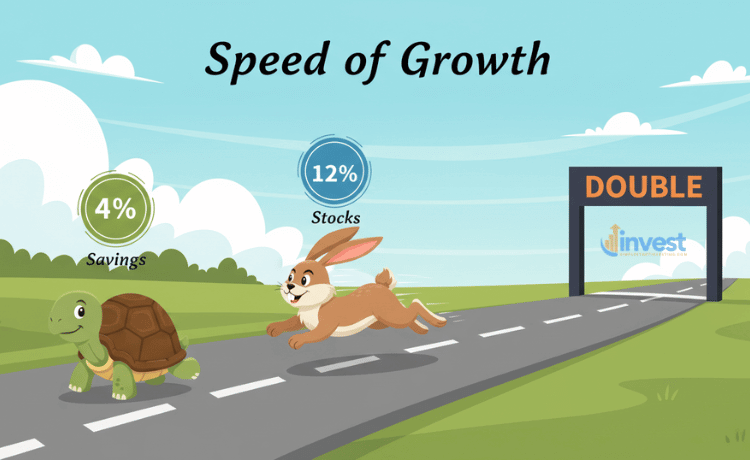
Not all investments are created equal. Some are like a steady turtle, while others are like a fast-moving (but sometimes erratic) rabbit. You can use the Rule of 72 to compare them instantly.
1. High-Yield Savings Accounts
In the current economic climate, interest rates on savings accounts have been higher than they were a few years ago. Let’s say you have a high-yield account at a bank like Ally or Goldman Sachs that offers a four percent return.
If you take seventy-two and divide it by four, you get eighteen. It will take eighteen years for your money to double in that account. While it’s safe, the Rule of 72 shows you that “safe” often means “slow.”
2. Blue-Chip Stocks like Walmart or Costco
Now, let’s look at a “boring” but reliable stock like Walmart (WMT) or Costco (COST). These companies often grow steadily and pay dividends. If a stock like this grows at an average of eight percent per year, seventy-two divided by eight is nine. Your money doubles in nine years—twice as fast as the savings account.
3. Growth Stocks like Tesla or Amazon
What about high-octane growth stocks like Tesla (TSLA) or Amazon (AMZN)? These can be much more volatile, but let’s assume an aggressive eighteen percent annual return during a bull market. Seventy-two divided by eighteen is four. Your money could double in just four years.
Wait! A Word of Caution: While the math looks amazing, remember that a higher rate of return always comes with higher risk. If the stock drops by fifty percent next year, the rule doesn’t help you much. The Rule of 72 assumes a consistent return, which the stock market rarely provides year-to-year.
The Beginner Misconception: “I’ll wait until I have more money.”
Many people wait until they have a “large” sum to start investing because they think doubling 1,000 dollars to 2,000 dollars isn’t worth it. They wait until they have 50,000 dollars.
The Logic Adjustment: The Cost of Waiting
The Rule of 72 shows us that the most valuable thing you have is a “doubling cycle.” If you start at age twenty-five with 10,000 dollars and it doubles every seven years, by age sixty, it will have doubled five times. If you wait until age thirty-two to start, you lose that entire final doubling cycle, which could be the difference between retiring with 320,000 dollars or 160,000 dollars.
The “Reverse” Rule of 72: Inflation and Debt
The Rule of 72 isn’t just for making money; it also shows you how fast you can lose it. This is where the rule becomes a reality check for your personal finances.

Using the Rule for Inflation
Inflation is the rate at which prices rise and the value of your dollar drops. If the inflation rate is three percent this year, you can use the rule to see how long it will take for your money to lose half its value. Seventy-two divided by three is twenty-four. In twenty-four years, your 100 dollars will only buy what 50 dollars buys today.
This is why “hiding money under the mattress” is a losing strategy. The Rule of 72 proves that if your money isn’t growing at least as fast as inflation, you are technically getting poorer every year.
Using the Rule for Credit Card Debt
This is the scariest application of the rule. Credit card companies in the U.S. often charge interest rates as high as twenty-four percent. Seventy-two divided by twenty-four is three. If you don’t pay off your balance, your debt will double in size every three years. While your investments might take seven or ten years to double, your debt can double in less than half that time.
The Misconception: “I can just pay the minimum.”
Beginners often think that paying the minimum on a credit card keeps the debt under control.
The Financial Reality
Because the interest rate is so high, the Rule of 72 shows that the debt is trying to double at a blistering speed. If you only pay the minimum, you aren’t even fighting the growth; you are just watching the snowball get bigger. Understanding this rule makes you realize why paying off high-interest debt is the best “investment” you can ever make.
Why 72? Why Not 70 or 75?
You might wonder why we use the number seventy-two. Mathematically, it is because seventy-two is a “convenient” number. It can be easily divided by two, three, four, six, eight, nine, and twelve. This makes the mental math easy when you are on the go.
Technically, for very low interest rates, the number seventy or sixty-nine might be slightly more accurate, but for the typical returns people see in the stock market (between five and fifteen percent), seventy-two is the “sweet spot” for a quick and reliable estimate.
The Beginner’s Trap: Over-Calculating
A lot of new investors get stuck in “analysis paralysis.” They spend weeks trying to calculate the exact decimal point of their future returns.
The Pro Mindset
Wealthy investors know that an “approximate” plan today is better than a “perfect” plan next year. The Rule of 72 is designed to give you a “ballpark” figure so you can make a decision and move forward. Whether it takes seven point two years or seven point five years to double doesn’t matter as much as the fact that you started investing today.

Using the Rule of 72 for Your Retirement Goals
If you are planning for retirement using a 401k or a Roth IRA, the Rule of 72 is an essential tool. It helps you work backward from your goal.
Let’s say you are thirty years old and you want to have one million dollars by the time you are sixty. If you have 125,000 dollars today, you need your money to double three times (from 125k to 250k, then to 500k, then to one million).
Since you have thirty years to reach that goal, each “double” needs to happen every ten years. Using our rule, seventy-two divided by ten is seven point two. You now know that you need to find an investment that returns at least seven point two percent annually to hit your goal without adding another penny.
The Misconception: “I need to hit a home run.”
Beginners often feel they need to find the next “moonshot” stock that returns fifty percent in a year.
The Strategic Shift
The Rule of 72 shows that even a modest, consistent return of seven or eight percent—which is very achievable with a diversified portfolio of companies like JPMorgan Chase (JPM), Apple (AAPL), and Walmart (WMT)—will double your money repeatedly over a career. Consistency is the real “magic” behind the rule.
Summary of the Rule of 72 for Beginners
To wrap up, here is your quick cheat sheet for the Rule of 72:
- The Calculation: Take seventy-two and divide it by your annual interest rate.
- The Result: The number of years it takes for your money to double.
- For Inflation: Divide seventy-two by the inflation rate to see how fast your buying power is cut in half.
- For Debt: Divide seventy-two by your credit card interest rate to see how fast your debt could double.
- The Big Takeaway: The higher the interest rate, the shorter the doubling time. But always balance that with the risk you are willing to take.
As we move through this year, with the Federal Reserve potentially adjusting interest rates, your “doubling time” on savings accounts and bonds might change. Keep the Rule of 72 in the back of your mind. Whenever you hear a new interest rate, do the quick math. It will tell you more about your financial future than any complex spreadsheet ever could.
Regulations and market conditions can change. Please check current interest rates or consult with a financial professional for your specific situation.
Disclaimer: This content is for educational purposes only and does not constitute financial advice. Investing involves risk, and past performance is not indicative of future results.