If you turn on any financial news channel today, you will see a sea of flashing red and green numbers, fast-talking experts using jargon like “quantitative easing” or “moving averages,” and complex charts that look like a heart monitor. It is overwhelming. For a beginner, this noise creates a dangerous illusion: that to be a successful investor, you must be a math genius or have a room full of monitors.
The truth is actually the opposite. Most of the world’s most successful investors, including legendary names like Warren Buffett, advocate for the KISS Principle: Keep It Simple, Stupid. When it comes to building long-term wealth, simple investment strategies almost always outperform the complicated ones. Wall Street makes money on complexity by charging you fees to “manage” the confusion. You make money on simplicity by keeping your costs low and your focus clear.
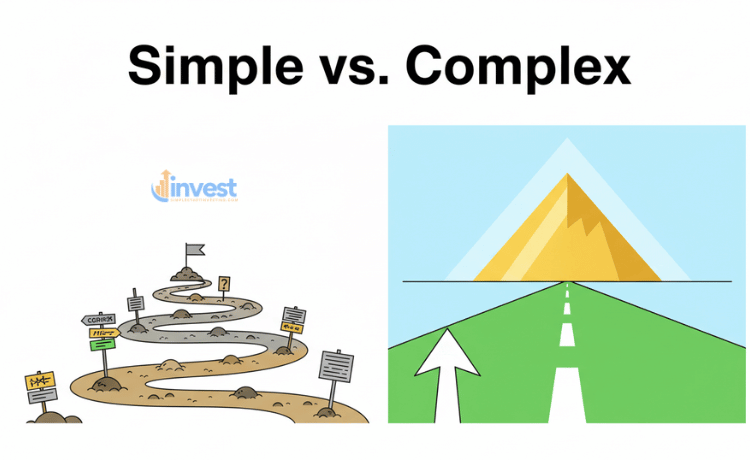
In this guide, we will break down why doing less often results in more. We will explore how you can build a robust financial future without needing a PhD in finance, and why a one-page plan is your strongest weapon against market volatility.
What Exactly Is the KISS Principle in Investing?
At its core, the KISS principle suggests that an investment strategy should be so easy to understand that you could explain it to a middle-school student in five minutes. It means choosing paths that require the fewest moves, the lowest fees, and the least amount of daily monitoring.
Simple investment strategies prioritize broad market exposure over picking individual “winner” stocks. Instead of trying to find the next Amazon (AMZN) or Apple (AAPL) before everyone else does, a simple investor decides to own a tiny piece of every major company at once. This approach acknowledges that while the market is unpredictable in the short term, it has a historic tendency to grow over the long term.
Why Beginners Get This Wrong
Many new investors believe that “simple” means “amateur.” They think that if they aren’t trading every day or using complex software to track price movements, they aren’t “really” investing. They feel a psychological need to “do something,” especially when the market gets bumpy. This leads to over-trading, which triggers higher taxes and brokerage fees.
The Correct Mindset
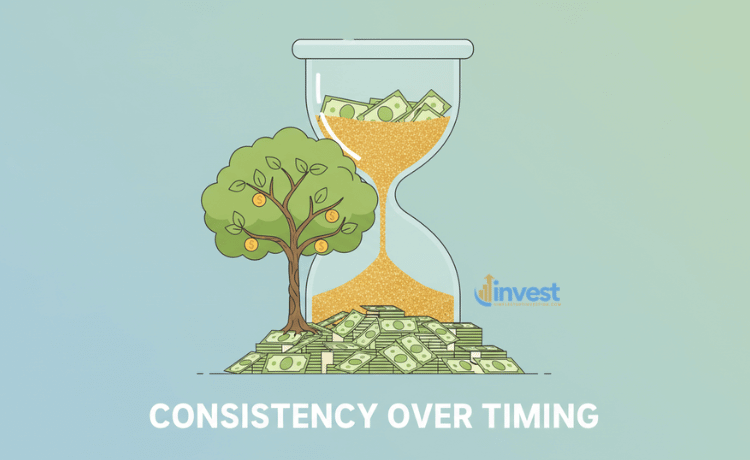
In the world of finance, activity is not the same as achievement. Think of your investments like a tree. If you plant a seed and then dig it up every two days to check the roots, the tree will die. If you plant it in good soil, water it, and leave it alone for twenty years, you get a forest. Simplicity is the water and the soil; patience is the time.
Strategy 1: Index Funds vs. Individual Stock Picking
The most common way people overcomplicate their journey is by trying to pick individual stocks. They hear a tip at a BBQ about a new tech company or read a “hot take” on social media and put their hard-earned money into one or two companies.
The Simple Explanation
An Index Fund is like buying the whole grocery store instead of trying to guess which specific apple will taste the best. For example, an S&P 500 index fund buys shares in the 500 largest companies in the United States. When you buy one share of that fund, you instantly own a tiny piece of Microsoft, Walmart, Disney, and 497 others.
Real-World Example
Imagine you spent weeks researching a specific electric vehicle company, thinking it was the next big thing. You put all your money into it. Suddenly, that company has a manufacturing delay, and the stock price drops 40 percent. Your entire portfolio is now in trouble.
Now, compare that to a simple strategy. You buy a total market index fund. Even if that EV company has a bad year, your portfolio stays steady because Costco, Home Depot, and thousands of other companies in your fund are still performing well. You don’t need to be right about one company; you only need to be right that the American economy will grow over time.
The Common Mistake
Beginners often think they can “beat the market.” They see a stock like Nvidia (NVDA) skyrocket and feel they missed out. They then go looking for the “next” Nvidia.
The Financial Logic Shift
Professional fund managers—people with supercomputers and Ivy League degrees—fail to beat the simple S&P 500 index over 90 percent of the time over a 10 to 15-year period. If the pros can’t do it consistently, the simplest and most logical path for you is to stop trying to beat the market and start owning the market.
Strategy 2: Dollar-Cost Averaging vs. Market Timing
Another way investors make life hard is by trying to “time the market.” They wait for a “dip” to buy or try to sell right before they think a “crash” is coming.

The Simple Explanation
Dollar-Cost Averaging (DCA) is the ultimate “simple” move. It means you invest the same amount of money at regular intervals—like every payday—no matter what the price of the stock is. Sometimes you buy when the price is high, and sometimes you buy when it is low. Over time, your cost averages out.
Real-World Example
Let’s say you decide to invest 500 dollars every month into a broad market fund.
- In month one, the market is “expensive,” and your 500 dollars buys 5 units.
- In month two, the market “crashes” or drops. People are panicking. But your automatic 500 dollars goes through anyway. Because the price is lower, that same 500 dollars now buys 10 units.
- In month three, the market recovers slightly.
By simply sticking to the plan, you automatically bought more when prices were “on sale” without having to look at a single chart.
The Common Mistake
New investors often sit on the sidelines with cash, waiting for the “perfect time” to enter. They wait and wait while the market goes up. When it finally drops, they get scared and wait for it to “drop more.” They end up missing the most profitable days of the market.
The Financial Logic Shift
Time in the market is much more important than timing the market. By automating your contributions, you remove your emotions from the equation. High-stress decisions lead to poor financial choices. Simple, automated systems lead to consistency.
Strategy 3: The Hidden Danger of High Fees
Complexity is often used as a cloak for high fees. If a financial product is hard to explain, it usually means someone is getting paid a lot of money to sell it to you.

The Simple Explanation
In investing, you get what you don’t pay for. Every dollar you pay in “management fees” or “expense ratios” is a dollar that isn’t growing for you. A “simple” fund might charge you 0.03 percent a year. A “complex” actively managed fund might charge you 1.0 or 2.0 percent.
A Simple Arithmetic Comparison
If you have 100,000 dollars invested and it grows by 7 percent this year, you earn 7,000 dollars.
- In a simple fund with a 0.03 percent fee, you pay only 30 dollars. You keep 6,970 dollars.
- In a complex fund with a 1.5 percent fee, you pay 1,500 dollars. You only keep 5,500 dollars.
Over 30 years, that “small” difference in fees can cost you hundreds of thousands of dollars in lost growth.
The Common Mistake
Beginners assume that if they pay more for a “premium” financial advisor or a “complex” hedge fund, they will get better results. In the world of luxury cars, a higher price usually means a better engine. In the world of investing, a higher price usually just means a smaller return for you.
The Financial Logic Shift
Think of fees as a leak in your financial bucket. The goal isn’t to find a “fancier” bucket; it’s to find the one with the fewest holes. Low-cost index funds are the sturdiest buckets available.
Strategy 4: Tax Efficiency and the “Lazy” Portfolio
Simplicity also extends to how you handle taxes. The more you move your money around, the more the IRS wants a piece of the action.

The Simple Explanation
The U.S. tax code favors people who buy and hold. If you buy a stock and sell it three months later for a profit, you pay “Short-Term Capital Gains,” which is taxed at the same high rate as your regular paycheck. If you hold that same investment for more than a year, you pay “Long-Term Capital Gains,” which is significantly lower for most people.
Real-World Example
Suppose you use a “complex” strategy where you sell stocks every time they go up 10 percent to “lock in profits.” You are constantly generating tax bills. At the end of the year, you might owe the IRS thousands of dollars, even if your total account value didn’t grow that much.
Now, imagine a “simple” investor who buys shares of a Vanguard or Fidelity index fund in their 401k or IRA. They don’t sell for 20 years. Their money grows and grows, and they don’t owe the IRS a penny in capital gains taxes until they start taking the money out in retirement.
The Common Mistake
Beginners often think they are “winning” when they see a small profit and sell immediately. They forget that the IRS is a partner in every trade they make.
The Financial Logic Shift
A “lazy” portfolio—one that stays put—is often the most tax-efficient portfolio. By doing nothing, you are actually protecting your wealth from being eroded by taxes. Current IRS rules for this year offer generous benefits for long-term holders; always check the current brackets or consult a tax professional, but the principle of “long-term is cheaper” remains a cornerstone of US investing.
How to Build Your One-Page KISS Investment Plan
If your investment plan is longer than one page, it is likely too complex. Here is what a simple, robust plan looks like for a beginner in the US market:
- The Foundation: Maximize your employer’s 401k match if they offer one. It is essentially a 100 percent return on your money before you even invest it.
- The Vehicle: Use a Roth IRA or a traditional Brokerage account for extra savings.
- The Assets: Pick 1 to 3 broad-market Index Funds or ETFs (Exchange Traded Funds). A common “simple” setup is a “Total US Stock Market” fund and a “Total International Stock Market” fund.
- The Action: Set up an automatic transfer from your bank account to your investment account every month.
- The Rule: Never sell because of a headline. Only sell when you have reached your goal (like retirement).
Why This Works
This plan requires about 30 minutes of setup and 0 minutes of daily maintenance. It covers the entire global economy, keeps your taxes low, and ensures you are buying in all market conditions. It beats the “complex” models because it is sustainable. You can stick to this plan for 40 years without getting burned out or making an emotional mistake.
The Psychological Barrier: Why We Love Complexity
If simplicity is so great, why does everyone make it so hard? Humans are biologically wired to believe that more effort equals more reward. In most areas of life—like sports or your career—this is true. If you practice more, you get better.
In investing, however, your “effort” often takes the form of meddling. Meddling leads to mistakes. The financial industry knows this and uses complex language to make you feel like you need them. They want you to feel that the market is a puzzle only they can solve.
Adjusting Your Perspective
Understand that the market is not a puzzle to be solved; it is a machine to be harnessed. You don’t need to understand how every gear in the engine works to drive the car. You just need to know that if you put gas in (invest regularly) and keep your foot on the pedal (stay invested), the car will move forward over the long haul.
Common Misconception
People think that because the world is complex, their portfolio must be complex to match it. They want to own “emerging tech,” “crypto-hedged assets,” and “gold-backed commodities.”
The Truth
The largest companies in the S&P 500—like Walmart (WMT), Amazon (AMZN), and JPMorgan Chase (JPM)—are already global powerhouses. They have thousands of experts working to navigate global complexity for you. When you own a simple index fund, you are hiring all those experts for a few pennies a year. That is the ultimate simple strategy.
Summary for the Simple Start Investor
Investing is one of the few areas in life where being “average” (matching the market index) actually makes you an elite performer over time. By embracing the KISS principle, you:
- Lower your stress: You don’t have to watch the news or check stock prices every day.
- Lower your costs: You stop paying high fees for “active” management that rarely works.
- Lower your taxes: You stop triggering unnecessary tax events by constantly buying and selling.
- Increase your odds: You bet on the entire economy rather than a few lucky guesses.
Start small, keep it simple, and let time do the heavy lifting. Your future self will thank you for not making it more difficult than it needed to be.