
Have you ever noticed how a popular song stays on the charts for weeks, or how a winning sports team seems to keep finding ways to win? In the world of physics, there is a concept that an object in motion tends to stay in motion. Believe it or not, the stock market often behaves the exact same way.
When a stock or a sector starts moving in a clear direction, it often continues that path for a period of time. This is the core of what we call a momentum strategy. For a beginner, it might feel counterintuitive. Most of us are told to “buy low and sell high,” but momentum investing suggests something different: buy high and sell higher.
If you are just starting your investing journey, the idea of jumping into a stock that has already gone up might feel scary. You might worry that you are “late to the party.” In this guide, we are going to break down how a momentum strategy works, why it is a legitimate way to build wealth, and how to avoid the common traps that catch newcomers off guard.

What Exactly is a Momentum Strategy?
At its simplest level, a momentum strategy is an investment approach where you buy assets that have shown an upward price trend and sell those that are trending downward. Think of it like catching a wave. You aren’t trying to predict where the wave will form; you are looking for a wave that is already moving and riding it until it begins to lose steam.
In the US stock market, momentum isn’t just a random occurrence. It is a documented “factor”—a specific characteristic that has historically led to higher returns over long periods. Investors using this method look at the past six to twelve months of performance. If a stock like Apple (AAPL) or Amazon (AMZN) has been consistently outperforming the rest of the market, a momentum investor assumes that the trend is likely to continue in the short term.
This strategy is built on the belief that the market does not always react to news instantly. Instead, it takes time for everyone to digest information, leading to a gradual climb in price rather than a single vertical jump. By the time you notice the trend, there is often still “gas in the tank” for further gains.

The Psychology: Why Does Momentum Exist?
You might wonder why a stock doesn’t just reach its “fair price” and stop moving. The answer lies in human psychology. We are social creatures, and investors are no different. There are three main psychological drivers behind the momentum strategy:
The Fear of Missing Out (FOMO)
When a specific sector, like Artificial Intelligence or Green Energy, starts to climb, it grabs headlines. As more people see their neighbors or friends making money, they want in too. This influx of new buyers pushes the price even higher, creating a self-fulfilling prophecy.

Underreaction and Overreaction
When a company like Costco (COST) or Walmart (WMT) releases a fantastic earnings report, the stock might jump. However, many big institutional investors—like pension funds—cannot buy millions of shares all at once without spiking the price. They buy slowly over weeks or months. This creates a steady “drift” upward that momentum traders can capitalize on.
Herding Behavior
Professional fund managers are often evaluated against a benchmark, like the S&P 500. If they see a group of stocks performing exceptionally well, they feel pressured to buy them so they don’t underperform their peers. This “herding” provides the sustained buying pressure that keeps the momentum alive.
Momentum vs. Value: Two Different Worlds
To understand a momentum strategy, it helps to compare it to its famous cousin: Value Investing.
A value investor acts like a bargain hunter at a garage sale. They look for something that is broken or undervalued, hoping that one day the world will realize its true worth. They want to buy a stock that is currently “on sale.”

A momentum investor, on the other hand, is like a fashion scout. They don’t care if the “outfit” is expensive or on sale; they only care if it is currently in style and becoming more popular. They aren’t looking for “cheap”; they are looking for “strong.”
Both methods can work, but they require very different mindsets. Value investing requires extreme patience, often waiting years for a turnaround. Momentum investing requires a watchful eye and the willingness to move when the trend changes.
Common Misconceptions That Hurt Beginners
Many beginners hear the phrase “buy what is going up” and think it means they should gamble on penny stocks or “meme stocks” they see on social media. This is a dangerous misunderstanding. Here are the most common ways people get it wrong:
Confusing Volatility with Momentum
A stock that jumps 50% in one day because of a rumor isn’t necessarily a momentum play; it is a volatile play. True momentum is a sustained, persistent trend over several months. Beginners often “chase” vertical spikes only to see the price crash the next day.
Holding On Too Long
The biggest trap in a momentum strategy is falling in love with the “winner.” In this strategy, you are not married to the stock. You are just dating it while it is doing well. If the trend reverses and the stock starts consistently underperforming, a momentum investor must be disciplined enough to sell.
Ignoring the “Why”
While momentum is mostly about price action, ignoring the underlying health of the company can be risky. If a stock is going up simply because of hype—without any actual revenue or growth—the “momentum” is fragile and prone to a “momentum crash.”
How a Momentum Strategy Works in Real Life
Let’s use a simple numerical example to see how this logic plays out. Imagine there are two fictional companies: “Steady Tech” and “Sinking Retail.”
Suppose you have 1,000 dollars to invest. You notice that over the last six months, Steady Tech has grown from 100 dollars per share to 120 dollars. Meanwhile, Sinking Retail has dropped from 100 dollars to 80 dollars.
A traditional “bargain hunter” might look at Sinking Retail and think, “It’s so cheap now! I’ll buy it and wait for it to go back to 100 dollars.”
A momentum investor looks at Steady Tech and says, “This company has clear strength. More people want to own it today than six months ago.” They buy Steady Tech at 120 dollars, betting that the factors making it successful will push it to 140 dollars or 150 dollars.
If Steady Tech goes to 140 dollars, the investor has made a profit by following the strength. If Sinking Retail continues to drop to 60 dollars, the bargain hunter has lost money by “catching a falling knife.”
The Tools of the Trade: How to Measure Momentum
You don’t need a PhD in mathematics to spot momentum. Most beginners can use simple, free tools found on any financial website like Yahoo Finance or Google Finance.
The 52-Week High
One of the simplest ways to find momentum is looking for stocks hitting new 52-week highs. Research has shown that stocks reaching new highs often continue to trend upward because they have “broken out” of their old price ranges and have no “resistance” from previous sellers who are just looking to break even.
Moving Averages
A moving average is simply the average price of a stock over a certain number of days. For example, a 200-day moving average smooths out the daily “noise” and shows you the long-term direction. If the current price is comfortably above the 200-day average and the average itself is sloping upward, the momentum is confirmed.
Relative Strength
This isn’t about how much a stock went up in total, but how much it went up compared to the rest of the market. If the S&P 500 is up 5% but a specific sector is up 15%, that sector has high “relative strength.” Those are the “winners” a momentum strategy seeks to ride.
The “Momentum Crash”: Understanding the Risks
No strategy is perfect, and the momentum strategy has a specific weakness: the sudden reversal.
When everyone is on one side of a trade, any bad news can cause a stampede for the exit. Because momentum stocks are often “expensive” by traditional standards, they can fall much faster than value stocks when the trend breaks. This is why risk management is the most important part of this strategy.
To protect yourself, you must have a plan for when to leave. This might be a “stop-loss” (a pre-determined price where you will sell) or a rule that says you will sell if the stock falls below its 50-day moving average. Without an exit plan, momentum investing becomes a game of “musical chairs,” and you don’t want to be the one without a seat when the music stops.
Taxes and Costs: The US Investor’s Reality
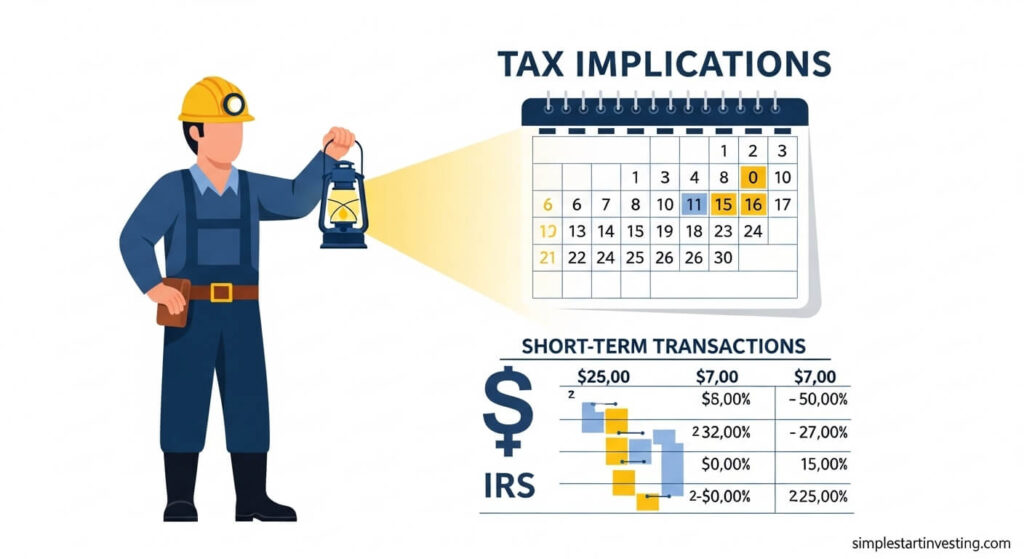
In the United States, your investment strategy has a direct impact on your relationship with the IRS. Because a momentum strategy involves more frequent buying and selling than a “Buy and Hold” strategy, you need to be aware of two things:
Short-Term Capital Gains
If you sell a stock for a profit after holding it for less than a year, that profit is taxed as “short-term capital gains.” This is usually the same as your regular income tax rate, which can be quite high. If you hold for more than a year, you get the lower “long-term” rate. Since momentum trends can sometimes last less than a year, your tax bill might be higher than expected.
The Wash Sale Rule
If you sell a stock at a loss to get out of a failing momentum trend and then buy that same stock (or something very similar) back within 30 days, the IRS will not let you claim that loss on your taxes. This is called the Wash Sale Rule. It’s a common trap for beginners who try to “day trade” momentum.
A Simpler Way: Momentum ETFs
If tracking individual stocks sounds like too much work, there is a much easier way for beginners to use a momentum strategy: Exchange-Traded Funds (ETFs).

An ETF is like a basket of stocks. There are specific “Momentum ETFs” (like the iShares MSCI USA Momentum Factor ETF, ticker: MTUM) that do the hard work for you. The fund uses an algorithm to automatically buy the strongest stocks in the market and sell the ones that are losing steam.
By using an ETF, you get:
- Diversification: You aren’t betting on just one company.
- Automatic Rebalancing: The fund managers handle the buying and selling.
- Lower Stress: You don’t have to watch the charts every single day.
For a complete beginner, starting with a Momentum ETF is often the safest way to “ride the winners” without the risk of picking the wrong individual horse.
How to Get Started Safely
If you want to try a momentum strategy, don’t dive into the deep end with all your savings. Follow these steps for a “Simple Start”:
- Educate Yourself First: Continue reading about different market cycles. Momentum works great in “Bull Markets” (when prices are rising) but can be very difficult in “Bear Markets” (when prices are falling).
- Start Small: Dedicate a small portion of your portfolio—perhaps 5% or 10%—to a momentum-based approach while keeping the rest in boring, broad-market index funds.
- Choose Your “Vehicle”: Decide if you want to pick individual stocks or use a Momentum ETF. For 90% of beginners, the ETF is the better choice.
- Set Your Rules: Decide before you buy what will make you sell. Will you sell if the price drops 10%? Will you sell if the news changes? Write it down so your emotions don’t take over later.
- Watch the Costs: Remember that every trade might have tax consequences and potentially small fees (though most US brokerages are now commission-free).
The Bottom Line
The momentum strategy is a powerful tool because it aligns with how the world actually works. Winners tend to keep winning until something fundamental changes. By focusing on strength rather than trying to find “hidden gems,” you simplify your decision-making process.
However, remember that “simple” does not mean “easy.” It takes discipline to buy something that has already gone up and even more discipline to sell it when the trend ends. Treat momentum as a way to participate in the market’s strongest moves, but always keep your “safety gear” on by diversifying and managing your risks.
Investing is a marathon, not a sprint. Whether you choose to follow the momentum or stick to a more traditional path, the most important thing is that you start, stay consistent, and keep learning.
Disclaimer: This content is for educational purposes only and does not constitute financial advice. Market conditions change frequently, and you should consult with a qualified financial professional or tax advisor before making any investment decisions.