

If you have ever bought a fraction of a Bitcoin, traded an Ethereum for a digital art piece, or even used Dogecoin to buy a sandwich, you have stepped into a world that the IRS is watching very closely. Many beginners dive into the world of digital assets thinking it is a “wild west” where the rules of traditional finance do not apply. They assume that because their name isn’t on a bank statement, the government won’t know about their profits.
Unfortunately, that line of thinking often leads to a very stressful letter in the mail. The reality of crypto tax rules is that the IRS treats your digital coins and NFTs much like they treat a piece of real estate or a stock. Every time you move that asset, there is a potential tax bill waiting for you. This year, the rules have become even more transparent, and the IRS has more tools than ever to see exactly what is happening in your digital wallet.

Understanding these rules is not just about staying out of trouble. It is about knowing how much of your profit is actually yours to keep. If you do not plan for taxes, you might find yourself in a situation where you owe the government money you have already spent. Let’s break down exactly how this works in plain English.
Why the IRS Cares About Your Digital Wallet
For a long time, cryptocurrency was seen as a niche hobby. Today, it is a multi-trillion dollar market. The IRS has realized that a significant amount of wealth is being generated in digital assets, and they want their fair share. To make this happen, they have categorized digital assets as “property.”
When we say crypto is property, it means the IRS does not see Bitcoin as “money” or “currency.” Instead, they see it like a house or a car. If you buy a vintage car for 5,000 dollars and sell it later for 7,000 dollars, you have a 2,000-dollar profit that needs to be taxed. Crypto tax rules work the exact same way.
The biggest mistake beginners make is thinking they only owe taxes when they “cash out” to a traditional bank account. That is a dangerous myth. In the eyes of the law, a taxable event happens the moment you trade one digital asset for something else, even if that “something else” is just another digital coin.
What Exactly Is a Taxable Event?
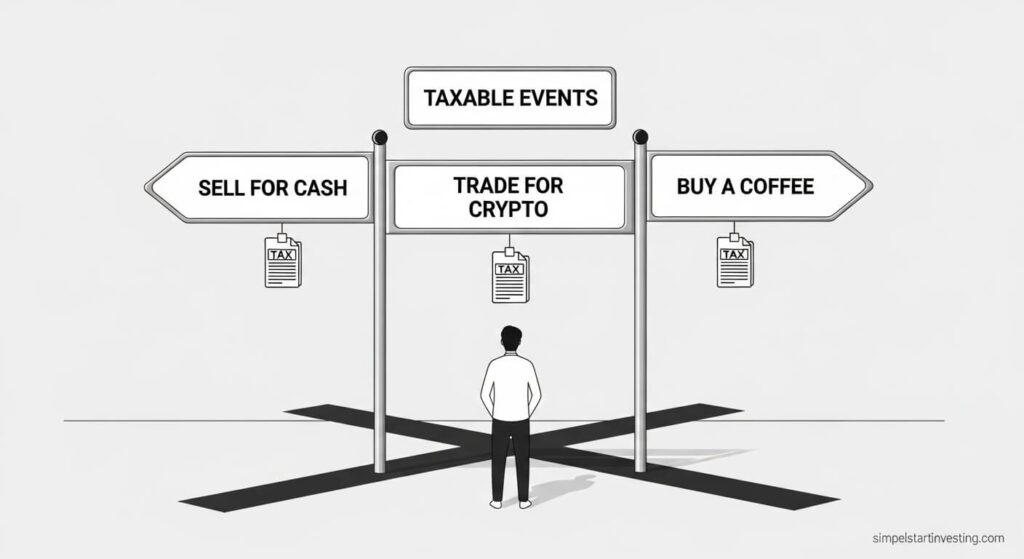
To navigate crypto tax rules successfully, you need to identify which actions trigger a tax bill. Not everything you do with crypto is taxed, but most things are.
Selling Crypto for Cash
This is the most straightforward scenario. If you bought some Bitcoin for 500 dollars and you sell it on an exchange for 800 dollars in cash, you have a 300-dollar gain. That gain is taxable.
Trading One Crypto for Another
This is where most beginners get tripped up. Imagine you have some Ethereum, and you decide to trade it directly for Solana. You never touched US dollars during this trade. However, the IRS views this as two separate actions: first, you “sold” your Ethereum for its current market value in dollars, and then you “bought” Solana with that cash. If your Ethereum was worth more when you traded it than when you originally bought it, you owe taxes on that growth.
Using Crypto to Buy Goods or Services
If you use your crypto to buy a new laptop or pay for a subscription, it counts as a sale. You are essentially selling your crypto to the merchant in exchange for a product. If the crypto you used to pay for that laptop had increased in value since you first acquired it, that increase is taxable profit.
Receiving Crypto as Payment or Income
If you are a freelancer and a client pays you in digital assets, or if you earn rewards through “staking” (which is like earning interest on your coins), that is considered ordinary income. You must report the dollar value of that crypto on the day you received it. This is taxed at the same rate as the salary from your regular job.
The New Era of Reporting: Form 1099-DA
Starting this year, the “hidden” nature of crypto is officially over. The IRS has introduced a new form called the 1099-DA. If you use a major American exchange like Coinbase or Kraken, they are now required to send this form to both you and the IRS.

This form lists your transactions, the dates you bought and sold, and your profits or losses. It is very similar to the forms you get from a traditional stock brokerage. What this means for you is simple: the IRS already knows the numbers. Trying to hide your activity is no longer an option.
For beginners, this is actually a bit of a relief. It means you will have a clear record of your activity provided by the exchange. However, it also means you must be diligent about checking these forms for accuracy, especially if you move your coins between different wallets or platforms.
Understanding Capital Gains: Short-Term vs. Long-Term
When we talk about crypto tax rules, we have to talk about how long you held the asset. The IRS rewards patience.
If you hold a digital asset for 365 days or less before selling or trading it, any profit is considered a “short-term capital gain.” This is taxed at the same rate as your regular income. Depending on how much you earn, this could be a significant percentage of your profit.
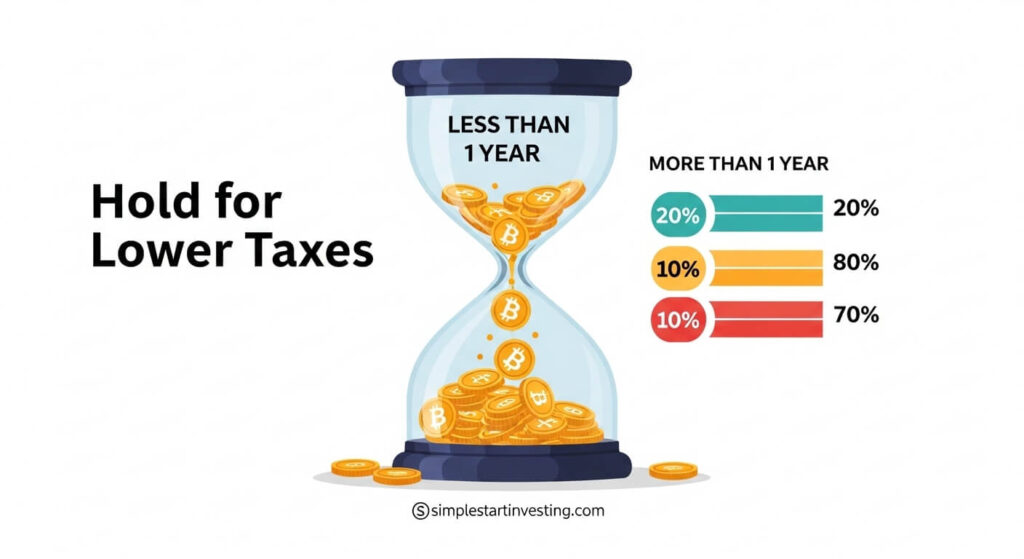
However, if you hold that asset for more than one year (366 days or more), it qualifies for “long-term capital gains” rates. These rates are significantly lower than ordinary income tax rates. For many people, the long-term rate is much lower, and for some, it might even be zero percent depending on their total annual income.
This is why “holding” (often called HODLing in the crypto community) is not just a cultural meme—it is a legitimate tax strategy. By waiting just one extra day past the one-year mark, you could save thousands of dollars in taxes.
The Complicated World of NFTs
Non-Fungible Tokens, or NFTs, follow many of the same crypto tax rules as Bitcoin, but with a few extra layers of complexity. Because NFTs are often digital art or collectibles, they may be subject to a higher “collectibles” tax rate if you are in a high-income bracket.

When you buy an NFT using crypto (like Ethereum), you are actually triggering two tax situations.
- First, you are “selling” your Ethereum to buy the NFT. If that Ethereum had gained value, you owe taxes on that gain.
- Later, if you sell the NFT for a profit, you owe taxes on the NFT’s growth as well.
It is a double-layered system that catches many new collectors off guard. Always remember that even if you are just “trading art,” the IRS sees it as a series of property exchanges, each with its own tax implications.
What Happens if You Lose Money?
The silver lining of crypto tax rules is that the IRS allows you to use your losses to your advantage. This is called “tax-loss harvesting.”
If you bought a coin for 1,000 dollars and its value dropped to 400 dollars, and you decide to sell it, you have a 600-dollar “capital loss.” You can use this loss to cancel out profits you made elsewhere. For example, if you made a 600-dollar profit on Bitcoin but lost 600 dollars on another coin, your net profit is zero, and you won’t owe taxes on those trades.

If your total losses for the year are more than your total gains, you can even use up to 3,000 dollars of those losses to reduce your regular taxable income from your job. Any losses beyond that 3,000-dollar limit can be “carried forward” to future years. This is a powerful tool to help soften the blow of a bad investment.
Common Misconceptions That Lead to Audits
Because the digital asset space moves so fast, myths spread quickly. Here are the most common things beginners get wrong about crypto tax rules.
Myth 1: “I don’t owe taxes if I don’t get a 1099 form.”
Even if an exchange is based outside the US and doesn’t send you a form, you are legally required to report your gains. The IRS has been very clear that “I didn’t know” or “I didn’t get a form” is not a valid excuse. They are increasingly using blockchain analysis tools to track transactions directly on the public ledger.
Myth 2: “Transferring crypto between my own wallets is a taxable event.”
This is actually false. If you move your Bitcoin from an exchange to a private “cold” wallet that you own, you haven’t sold or traded it. You are just moving your property from one pocket to another. This is not taxed. However, you should keep records of these transfers so you can prove to the IRS that you didn’t sell the coins.
Myth 3: “Gifting crypto is a tax loophole.”
While you can gift a certain amount of crypto to friends or family without triggering a tax bill for them immediately, there are limits. If you gift someone a large amount (currently over 18,000 dollars in a year), you may need to file a gift tax return. Additionally, when the person you gave the crypto to eventually sells it, they will owe taxes based on the price you originally paid for it, not the price on the day they received it.
How to Stay Prepared for Tax Season
The best way to handle crypto tax rules is to be proactive. If you wait until April to figure out your trades from the previous January, you are going to have a headache.
Keep Meticulous Records
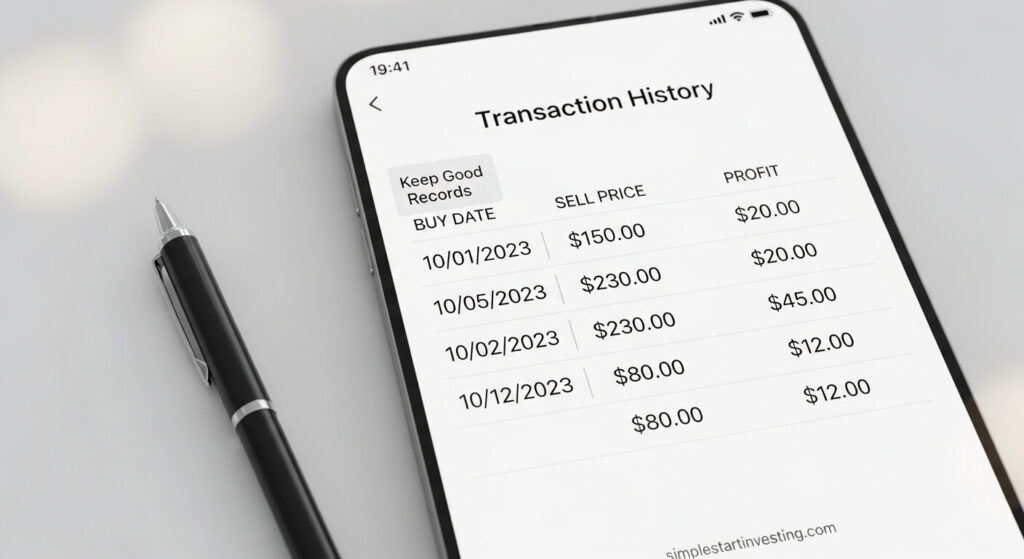
You need to know three things for every transaction:
- The date you acquired the asset and its price in US dollars at that exact moment.
- The date you sold or traded the asset and its price in US dollars at that moment.
- Any fees you paid to the exchange (these can often be used to reduce your taxable gain).
Use Specialized Software
Manual spreadsheets are fine for a few trades, but if you are active, it becomes impossible. There are many software tools designed specifically to connect to your wallets and exchanges, track your “cost basis” (what you paid), and generate the necessary forms for your tax return.
Set Aside Cash for Taxes
A common tragedy in crypto is the “crypto-rich, cash-poor” investor. Imagine making a 50,000-dollar profit in December. You owe taxes on that 50,000 dollars. Then, in January, the market crashes, and your total portfolio is only worth 10,000 dollars. You still owe the IRS based on that 50,000-dollar profit from December. Always set aside a portion of every profit in a traditional savings account to cover your tax bill.
Final Thoughts for the Beginner
Navigating crypto tax rules might feel like it takes the “fun” out of investing, but looking at it through a professional lens is what separates successful investors from those who lose it all to penalties. By understanding that crypto is property, recognizing taxable events, and keeping good records, you take the power back from the IRS.
Tax laws for digital assets are still evolving. The government is learning just as fast as the investors are. Staying informed and being honest on your tax returns is the only way to build long-term wealth in this space without looking over your shoulder.
Remember, the goal of investing is to grow your net worth. Paying taxes is simply a sign that you have succeeded in making a profit. Handle it with the same care you used to pick your investments, and you will be well on your way to a secure financial future.