
One of the most common questions people ask when they start thinking about the future is simply: “How much is enough?” We often see massive numbers like one million or two million dollars thrown around in news headlines. It can feel overwhelming, especially if you are just starting your journey.
The truth is, there is no single “magic number” that works for everyone. Your retirement savings goal is deeply personal. It depends on where you live, how you want to spend your days, and even your health. Thinking about retirement shouldn’t feel like a math test you are destined to fail. Instead, think of it as building a roadmap to your own personal freedom.
In this guide, we are going to break down how to find your “Freedom Number.” We will look at why the standard advice might be wrong for you and how to build a realistic plan that fits your life. By the end, you will have a much clearer picture of what you are aiming for and why that specific retirement savings goal matters for your future.
The Myth of the “Magic Million”
For decades, many people believed that one million dollars was the gold standard for a comfortable life after work. While one million dollars is certainly a lot of money, it is just a number without context. In some parts of the midwestern United States, a million dollars can provide a very high standard of living. In cities like San Francisco or New York, that same amount might only cover basic expenses for a decade or two.
The biggest mistake beginners make is picking a random, large number and hoping for the best. When you set a retirement savings goal based on a headline rather than your own life, you risk two things. You might over-save and deprive yourself of joy today, or you might under-save and face a difficult wake-up call later in life.
Instead of chasing a myth, we need to focus on your actual expenses. Retirement isn’t about how much you have in the bank; it’s about how much income that bank account can provide you every month without running dry.
Defining Your Retirement Lifestyle
Before we even look at the numbers, we have to talk about how you want to live. Your retirement savings goal starts with a vision. Ask yourself a few questions: Do you plan to stay in your current home, or will you downsize? Do you want to travel the world, or are you happy spending time in your garden?

Your expenses will likely shift when you stop working. For example, you will no longer have commuting costs, work clothes to buy, or daily lunches out with coworkers. However, you might spend more on hobbies, gas for road trips, or dining out with friends.
Most experts suggest that you will need roughly 70 percent to 80 percent of your pre-retirement income to maintain your lifestyle. But this is just a starting point. If you plan to be a world traveler, you might actually need 100 percent or more. If you plan to live a very simple life in a low-cost area with a paid-off mortgage, you might get by on 50 percent.
The “Rule of 25” Explained Simply
To find your retirement savings goal without using complex calculators, many people use a simple logic called the “Rule of 25.” This is a way to estimate how much total capital you need based on the annual income you want your portfolio to provide.
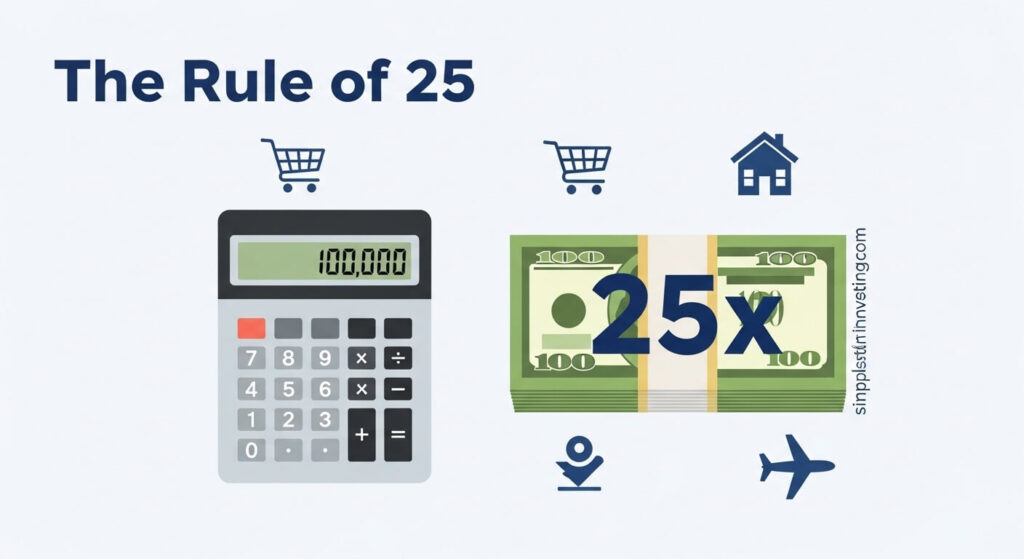
Here is how it works in plain English. First, estimate how much money you want to spend each year in retirement, after taxes. Let’s say you decide you need 50,000 dollars a year to live comfortably. You then multiply that annual amount by 25.
In this example, 50,000 dollars multiplied by 25 equals 1.25 million dollars. This 1.25 million dollars is your estimated “Freedom Number.” The logic behind this is tied to the idea that if you have this amount invested, you can safely withdraw a small portion each year—usually around 4 percent—and your money has a high probability of lasting for 30 years or more.
Understanding the Safe Withdrawal Rate
The “Rule of 25” is the inverse of what professionals call a “Safe Withdrawal Rate.” For a long time, the 4 percent rule was the gold standard. It suggested that if you withdraw 4 percent of your balance in the first year and adjust that amount for inflation every year after, your portfolio should survive.
However, it is important for beginners to understand that this is a guideline, not a guarantee. If the stock market has a very bad year just as you retire, taking out 4 percent might hurt your long-term balance. Conversely, if the markets do very well, you might find you could have spent more.
When setting your retirement savings goal, it is safer to be a bit flexible. Some people prefer a 3 percent or 3.5 percent withdrawal rate to be extra cautious. This would mean you need a larger total nest egg—multiplying your annual needs by 30 or 33 instead of 25—but it provides a bigger safety net for your peace of mind.
Factoring in Social Security and Other Income
The good news is that your retirement savings goal doesn’t have to be funded entirely by your own savings. Most workers in the United States will receive Social Security benefits. While you shouldn’t rely on Social Security to be your entire income, it acts as a very helpful floor.
To get a realistic “Freedom Number,” subtract your expected Social Security benefit from your total annual needs. Let’s say you need 50,000 dollars a year, and the Social Security Administration estimates you will receive 20,000 dollars a year. Now, your savings only need to provide the remaining 30,000 dollars.
Using our previous logic: 30,000 dollars multiplied by 25 equals 750,000 dollars. By including Social Security in your math, your target becomes much more achievable. You can check your estimated benefits by creating an account on the official Social Security website. It is a great way to see how much the government will contribute to your future.
Don’t Forget Uncle Sam: The Impact of Taxes
One of the biggest “gotchas” for new investors is forgetting about taxes. If you have all your money in a traditional 401k or a traditional IRA, that money hasn’t been taxed yet. When you withdraw it in retirement, the IRS will take a cut, just like they do from your paycheck now.
If you think you need 50,000 dollars to live on, and you pull that 50,000 dollars from a traditional 401k, you might only end up with 40,000 dollars after taxes. This means your actual retirement savings goal needs to be higher to account for what you will owe the government.
This is why many people like Roth IRAs or Roth 401ks. With a Roth account, you pay the taxes now, and the money grows tax-free. When you take it out in retirement, you keep every penny. Having a mix of “pre-tax” and “post-tax” accounts gives you more flexibility to manage your tax bill when you stop working.
Healthcare: The Hidden Expense
As we get older, healthcare usually becomes one of our largest expenses. Even with Medicare, there are premiums, deductibles, and things that insurance doesn’t cover, like vision or dental care. Many people underestimate this when setting their retirement savings goal.

Current estimates suggest that a healthy 65-year-old couple retiring today might need around 300,000 dollars just to cover healthcare costs throughout their retirement. This doesn’t mean you need that cash on day one, but your monthly budget needs to have a dedicated “health” category.
If you have access to a Health Savings Account (HSA) through your work, it can be a secret weapon for retirement. It is the only account that is “triple-tax-advantaged”: you put money in tax-free, it grows tax-free, and you take it out tax-free for medical expenses. It’s essentially a secondary retirement fund specifically for your health needs.
Inflation: The Silent Thief of Purchasing Power
Inflation is the reason a loaf of bread costs more today than it did thirty years ago. When planning for a 30-year retirement, inflation is a major factor. A 50,000-dollar lifestyle today will likely cost 100,000 dollars or more in a few decades.

When you are calculating your retirement savings goal, you have to think in “today’s dollars” but understand that the number will grow. This is why we invest in assets like stocks and real estate rather than just putting cash under a mattress. Historically, the stock market has grown faster than inflation, which helps protect your purchasing power.
If you are 20 or 30 years away from retirement, don’t let the inflated future numbers scare you. Your salary will likely rise over time as well, and your ability to save will increase. Focus on the percentage of your income you are saving today, as that is the engine that drives you toward your goal.
Location, Location, Location
Where you choose to live is perhaps the biggest lever you can pull to change your retirement savings goal. This is often called “geographic arbitrage.” If you spend your career in a high-cost area like Seattle or Boston but retire in a lower-cost state like South Carolina or Texas, your savings will go much further.
Housing is usually the largest expense for any household. If you enter retirement with a fully paid-off mortgage, your “Freedom Number” drops significantly. For many, the goal is to pay off the house by the time they stop working. This reduces the amount of monthly income you need to draw from your investments, making your nest egg last much longer.
What If You Are Starting Late?
If you are reading this and realize you are behind on your retirement savings goal, do not panic. The worst thing you can do is give up. There are several ways to “catch up” even if you are in your 40s or 50s.

First, the IRS allows “catch-up contributions.” Once you reach age 50, you can put extra money into your 401k and IRA beyond the normal limits. This allows you to supercharge your savings in the final decade of your career.
Second, consider working just a few years longer. Every extra year you work does three powerful things: it gives your current savings more time to grow, it allows you to add more to your accounts, and it reduces the number of years your savings need to support you. Even retiring at 67 instead of 62 can make a massive difference in your financial security.
Finally, “semi-retirement” is a growing trend. Many people find a low-stress part-time job or turn a hobby into a small business. If you can earn even 1,000 dollars a month in semi-retirement, that is 12,000 dollars a year you don’t have to take out of your savings.
Avoiding Common Pitfalls
Many beginners fall into the trap of being too conservative or too aggressive. Being too conservative—like keeping all your money in a savings account—means inflation will eat away at your wealth. You need some growth to reach a long-term retirement savings goal.
On the other hand, being too aggressive and taking big risks with “meme stocks” or unproven investments can lead to losing your hard-earned savings right when you need them most. A balanced approach with a mix of stocks and bonds is usually the path to steady progress.
Another pitfall is “lifestyle creep.” As you earn more, it is tempting to spend more. If you can keep your expenses steady while your income grows, you can divert all those extra dollars toward your future. This “gap” between what you earn and what you spend is the most important number in your financial life.
Your Next Steps Toward Freedom
Finding your “Freedom Number” isn’t a one-time event. It is a conversation you have with yourself every few years. As your life changes—maybe you get married, have kids, or decide you want to move to the coast—your retirement savings goal will change too.
Start by tracking your current spending. You can’t know where you are going if you don’t know where you are starting. Use the “Rule of 25” as a rough guide to see how close you are. Don’t worry if the number seems huge right now. The beauty of compound growth is that small amounts saved consistently over time do the heavy lifting for you.
Remember, retirement isn’t an end; it’s a new beginning. It is the time when you get to reclaim your 40 hours a week and spend them on the things that truly matter to you. By understanding your numbers today, you are giving your future self the greatest gift possible: the freedom to choose.