Imagine you spend weeks gathering receipts, documenting every deduction, and carefully following the rules to lower your tax bill. You finally reach the end of your tax return, feeling proud of your savings, only to find a strange line item that says you owe thousands of dollars more than you expected. You’ve just met the Alternative Minimum Tax, often called the AMT.
The Alternative Minimum Tax is essentially a “shadow” tax system that runs parallel to the standard income tax rules we all know. It was created with good intentions—to ensure that the very wealthy couldn’t use loopholes to pay zero taxes—but over the decades, it has started to catch many unsuspecting middle- and upper-middle-class families in its net. If you are a high-earner or someone with specific types of investment income, understanding how this system works isn’t just helpful; it’s a necessity for your financial health.
In this guide, we will break down the mystery of the AMT. We’ll look at why it exists, how it differs from your “regular” taxes, and what specific life events might trigger it for you this year. Most importantly, we’ll explain it in plain English, without the confusing jargon or complex math usually found in IRS handbooks.
The Backstory: Why Does a “Second” Tax System Even Exist?
To understand the Alternative Minimum Tax, we have to go back to 1969. At that time, the Treasury Department discovered that 155 high-income households—people earning more than 200,000 dollars, which was a fortune back then—paid absolutely zero dollars in federal income tax. They managed this by using perfectly legal deductions and credits.
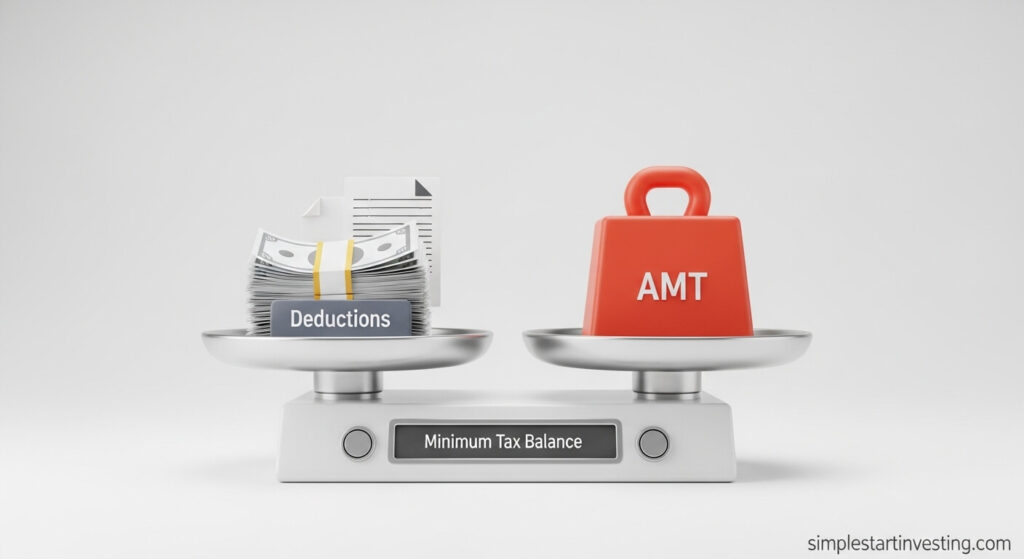
The public was outraged. In response, Congress created the AMT. The logic was simple: no matter how many deductions or “loopholes” you have, everyone who makes a certain amount of money should pay at least a “minimum” amount of tax.
For a long time, the AMT only affected the ultra-wealthy. However, because the original law wasn’t tied to inflation, it started “creeping” down the income ladder as wages rose over the decades. Recent changes in tax law have pushed the thresholds higher, meaning fewer people pay it today than ten years ago, but it remains a significant factor for many professionals and investors.
How the Alternative Minimum Tax Actually Works
Think of your tax filing process like a race with two different tracks.
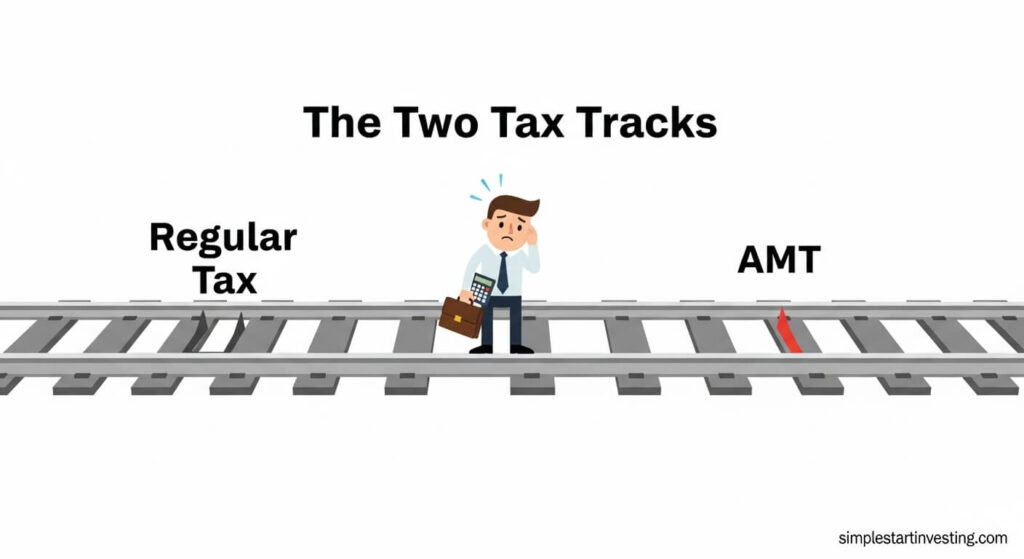
On the first track—the Regular Tax System—you take your total income and subtract things like the standard deduction or your itemized deductions (like mortgage interest). You apply the standard tax brackets, and you get a final number.
On the second track—the Alternative Minimum Tax System—the rules change. The government ignores many of those deductions. It adds back certain types of income that were “hidden” or “protected” on the first track. Then, it gives you one large, flat exemption amount and applies a different, simpler tax rate.
At the end of the day, you calculate your tax on both tracks. You don’t get to choose which one you like better. The IRS requires you to pay whichever amount is higher. If your AMT calculation results in a 25,000 dollar tax bill, but your regular tax was only 22,000 dollars, you owe that extra 3,000 dollars. That extra amount is technically the “Alternative Minimum Tax.”
What Triggers the AMT? Common Red Flags for Beginners
Most people don’t need to worry about the AMT if their income is in the modest range and they take the standard deduction. However, once you start reaching higher income levels or engaging in specific financial moves, the “AMT sirens” might start going off.
One of the biggest misconceptions is that the AMT only hits people “making millions.” In reality, certain life events can trigger it even if your salary hasn’t changed.
1. Exercising Incentive Stock Options (ISOs)
This is perhaps the most common way tech employees and startup workers get hit with a surprise bill. When you exercise ISOs, you aren’t taxed for “regular” tax purposes at the moment of exercise. However, the AMT system sees things differently. It views the “spread”—the difference between what you paid for the stock and what it was worth when you bought it—as income. This can create a massive tax bill on paper, even if you haven’t sold the shares or seen a dime of actual cash.
2. High State and Local Taxes (SALT)
Under the regular tax system, you might be able to deduct a portion of the taxes you paid to your state or city. Under the AMT, these deductions are generally not allowed. If you live in a high-tax state like California, New York, or New Jersey, you are statistically more likely to deal with the AMT because the deductions that help you on your “regular” taxes are ignored by the AMT.
3. Large Numbers of Dependents
While tax laws have changed significantly regarding how dependents are treated, historically, having a large family was a primary reason people fell into the AMT. This is because the AMT uses a different method for calculating personal exemptions. While this is less of a factor than it used to be, it’s still something the system looks at.
4. Private Activity Bonds
Many people invest in municipal bonds because the interest is usually tax-free at the federal level. However, interest from “private activity bonds”—bonds issued by a government entity to fund a private project like a stadium or an airport—is often considered taxable income under the AMT rules.
The Role of the AMT Exemption
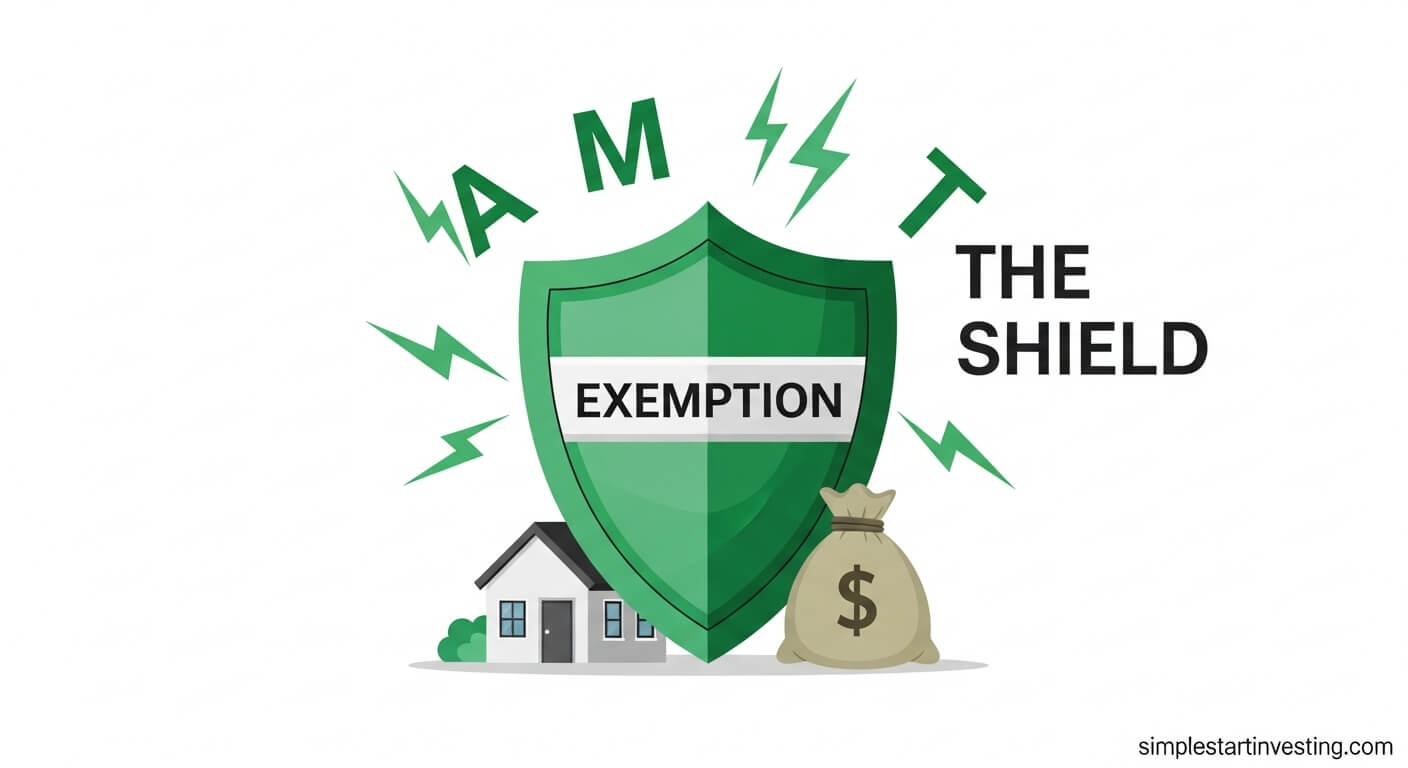
The only reason most of us don’t pay the Alternative Minimum Tax is the “Exemption.” Think of this as a shield provided by the IRS.
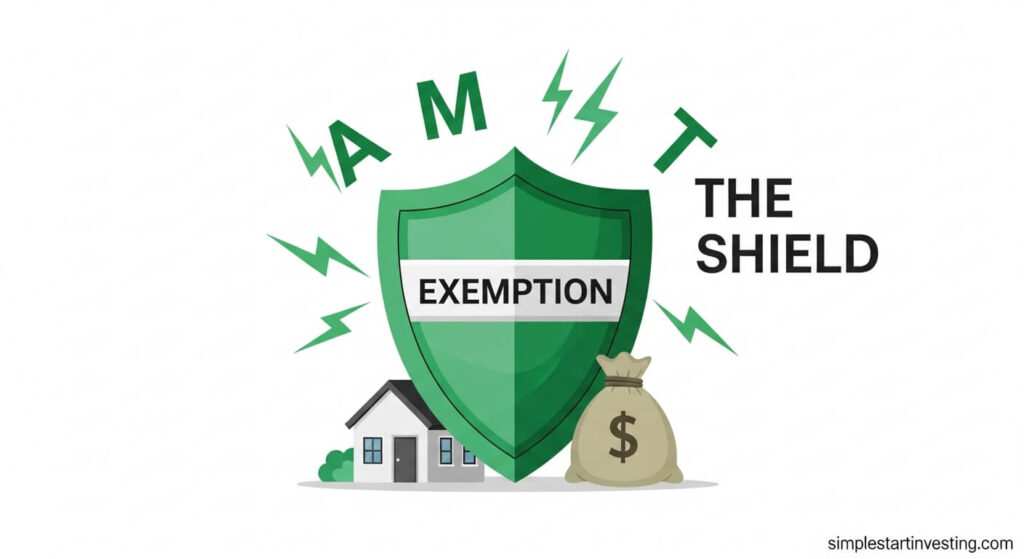
Every year, the IRS sets a specific amount of income that is completely “exempt” from the AMT. For example, if the exemption for a single person is around 80,000 dollars, the first 80,000 dollars of your “AMT income” isn’t taxed at all.
However, there is a catch. This shield starts to disappear as you earn more. This is called the “Phase-out.” Once your income crosses a certain high threshold (often over 600,000 dollars for individuals), the exemption starts to shrink. If you earn enough, the shield disappears entirely, exposing all of your income to the AMT rates.
Why Beginners Often Get Confused (and the Risks of Ignoring It)
The biggest mistake beginners make is assuming that because they don’t feel “rich,” they don’t have to worry about the AMT. Tax systems don’t care about your lifestyle or your cost of living; they only care about the boxes you check on your forms.
Myth: “My accountant will handle it, so I don’t need to know.”
While a professional will certainly do the math, they can’t change the past. If you exercise a large amount of stock options in December without realizing it triggers the AMT, your accountant can only give you the bad news in April. Understanding the triggers allows you to make decisions before the tax year ends.
Myth: “If I have no cash, I don’t owe taxes.”
As we saw with Incentive Stock Options, the AMT can tax “phantom income.” You might owe 50,000 dollars in tax because you exercised stock options, even if the stock price has dropped since then and you haven’t sold a single share. This has led to devastating financial situations for people who didn’t plan ahead.
Myth: “The AMT is a penalty.”
It isn’t a penalty; it’s just a different way of calculating what you owe. In some cases, if you pay the AMT one year (specifically due to things like stock options), you might actually get an “AMT Credit” that you can use to lower your taxes in future years. It’s a complex “pay now, save later” cycle that requires careful tracking.
Navigating the “Two-Track” System: A Practical Example
Let’s look at a simplified story of how this plays out in real life. Meet Sarah. Sarah is a software engineer who earns a good salary.
The Regular Track: Sarah calculates her taxes. After her deductions, she owes 30,000 dollars. She feels okay about this.
The AMT Track: Sarah exercised stock options this year that had a “paper gain” of 100,000 dollars. For her regular taxes, she doesn’t report that gain yet. But for the AMT, the IRS adds that 100,000 dollars back into her income. Now, her “Alternative Minimum Taxable Income” is much higher. After applying the AMT exemption and the AMT tax rate (which is usually a flat 26 percent or 28 percent), her “Tentative Minimum Tax” comes out to 42,000 dollars.
The Result: Because 42,000 dollars (AMT) is higher than 30,000 dollars (Regular Tax), Sarah must pay 42,000 dollars. That extra 12,000 dollars is her AMT.
Sarah might be shocked because she didn’t actually “receive” that 100,000 dollars in cash—it’s just the value of the shares she bought. This is why the Alternative Minimum Tax is often called the “surprise tax.”
Looking Forward: The 2026 Sunset
If you are reading this in the context of your long-term planning, there is a major event on the horizon. Many of the tax laws passed in 2017—which significantly increased the AMT exemption and made it harder for people to fall into this tax trap—are scheduled to “sunset” or expire at the end of 2025.

If Congress does not act, the AMT exemptions could drop significantly in 2026. This would mean that many more people who haven’t had to worry about the AMT for the last few years might suddenly find themselves back in the “danger zone.”
This is why staying informed about the Alternative Minimum Tax is more important now than it has been in nearly a decade. The rules are in a state of flux, and being a “beginner” is the best time to build a foundation of knowledge so you aren’t caught off guard.
How to Know if You Are at Risk
While only a tax software or a CPA can tell you the exact numbers, you can ask yourself a few simple questions to see if you should be on high alert:
- Did I exercise Incentive Stock Options (ISOs) this year? If yes, your risk is very high.
- Is my income significantly above the national average (e.g., over 200,000 dollars)? If yes, you are in the demographic where the AMT phase-outs begin to matter.
- Do I have a lot of “tax-preferred” items? This includes things like large capital gains, interest from specific types of municipal bonds, or high accelerated depreciation from a business.
- Do I live in a state with very high income and property taxes? If you are itemizing these on your federal return, the AMT might “disallow” them, pushing your AMT bill higher than your regular bill.
Final Thoughts for the Simple Start Investor
The Alternative Minimum Tax sounds like a nightmare, but it’s really just another set of rules in the giant board game of American finance. For most people starting out, the standard income tax is all they will ever see. But as you grow your wealth, invest in companies, and earn more, you naturally graduate into more complex tax situations.
The key is not to fear the AMT, but to respect it. By knowing that this “second track” exists, you can consult with tax professionals before making big moves like exercising stock options or selling large assets. Most financial disasters related to taxes aren’t caused by the tax itself, but by the surprise of not having the cash ready to pay it.
Stay curious, keep learning, and always remember that the tax code is designed to be navigated, not just endured.
Disclaimer: This content is for educational purposes only and does not constitute financial or tax advice. Tax laws are subject to change, and you should always consult with a qualified tax professional or the IRS for your specific situation.