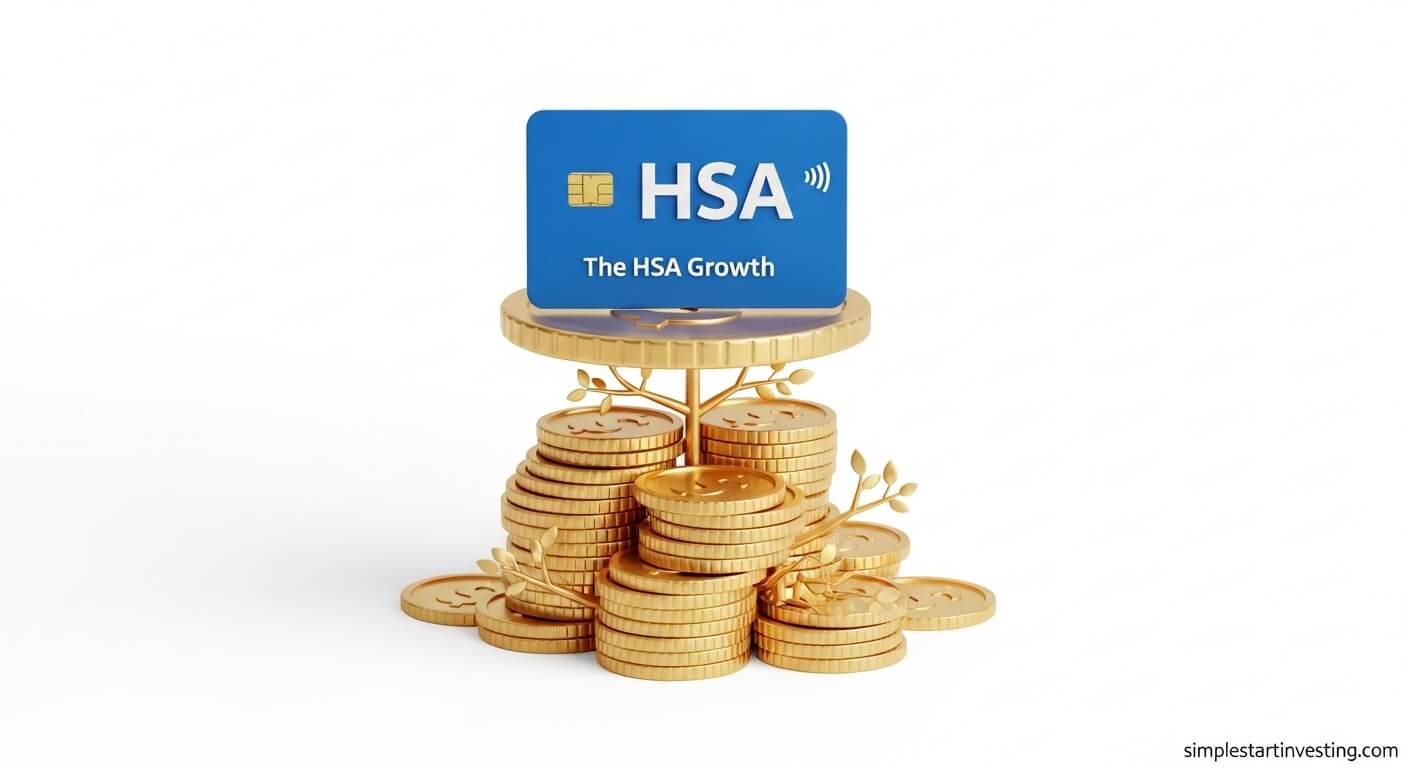
You probably received a shiny plastic card in the mail from your insurance company or employer recently. It looks like a standard debit card, and most people use it exactly that way. They head to the pharmacy, swipe the card for some cough medicine or a doctor’s co-pay, and never think about it again.
If that sounds like you, you are missing out on what many financial experts call the ultimate retirement vehicle. This isn’t a 401(k) or a Roth IRA. It is the Health Savings Account, commonly known as an HSA.
While the name suggests it is just for “health,” the way the tax code is written makes it a powerhouse for building long-term wealth. In fact, if you use it correctly, an HSA can actually outperform almost every other retirement account available to the American public.
In this guide, we are going to pull back the curtain on why the Health Savings Account is the best-kept secret in retirement planning and how you can start using it to build a massive nest egg today.
What Exactly is a Health Savings Account?
At its simplest level, a Health Savings Account is a type of savings account that lets you set aside money on a pre-tax basis to pay for qualified medical expenses. By using untaxed dollars from an HSA to pay for deductibles, co-payments, and other expenses, you can lower your overall healthcare costs.
However, there is a catch. You cannot just open an HSA whenever you want. To be eligible to contribute to an HSA, you must be enrolled in a High Deductible Health Plan (HDHP).
An HDHP is exactly what it sounds like: a health insurance plan with a higher deductible than a traditional plan. This means you pay more out of pocket for your medical care before the insurance kicks in, but your monthly premiums (the amount you pay to have the insurance) are usually much lower.
The government created the HSA to help people with these high-deductible plans save up for those out-of-pocket costs. But they accidentally created a “super-account” that savvy investors have been using to retire early for years.
The Triple Tax Advantage Explained
When we talk about investing, taxes are usually your biggest enemy. They eat into your profits when you earn money, they eat into your growth while you hold investments, and they eat into your withdrawals when you retire.

Most retirement accounts offer one or two tax breaks. For example, a 401(k) gives you a break on the way in, but you pay taxes on the way out. A Roth IRA makes you pay taxes on the way in, but gives you a break on the way out.
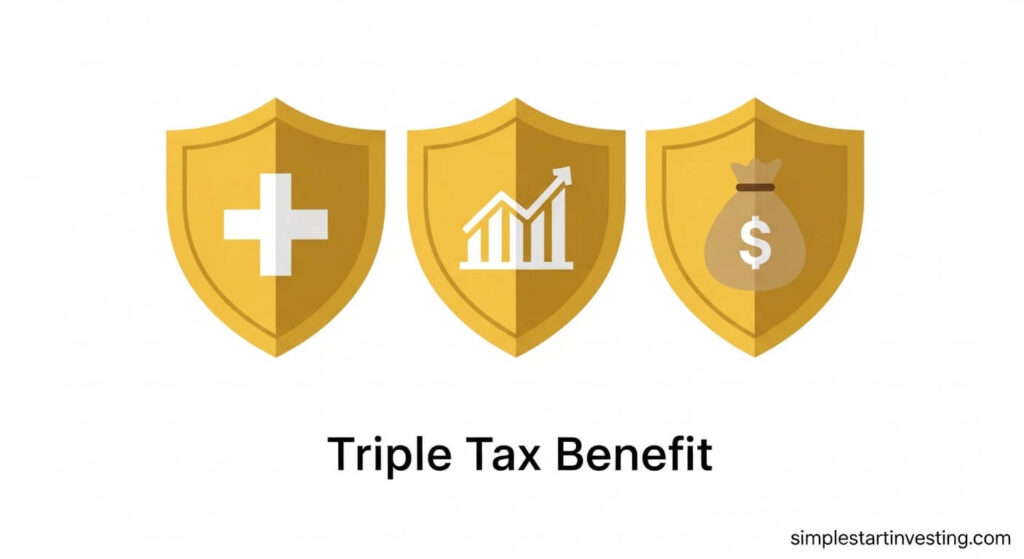
The Health Savings Account is the only account that offers a triple tax advantage. This is the holy grail of finance. Here is how it works:
- Tax-Free Contributions: The money you put into your HSA is “pre-tax.” This means if you earn 50,000 dollars a year and put 4,000 dollars into your HSA, the IRS only looks at you as if you made 46,000 dollars. You don’t pay income tax on that money.
- Tax-Free Growth: Once the money is in the account, you can invest it in the stock market. Any interest, dividends, or capital gains you earn inside the account are not taxed. If your 4,000 dollars grows to 40,000 dollars over twenty years, you owe zero dollars in taxes on that growth.
- Tax-Free Withdrawals: As long as you use the money for “qualified medical expenses,” you pay zero taxes when you take the money out.
No other account in the United States offers all three of these benefits at the same time. This is why the Health Savings Account is so powerful.
The Common Mistake: Using It Like a Gift Card
Most people treat their HSA like a “use it or lose it” Flexible Spending Account (FSA). It is important to note that an HSA is NOT an FSA. With an FSA, if you don’t spend the money by the end of the year, the boss keeps it.
With a Health Savings Account, the money is yours forever. It rolls over year after year. It stays with you even if you change jobs or retire.
The biggest mistake beginners make is using their HSA to pay for a 20-dollar prescription today. If you have 20 dollars in your checking account, you should use that instead.
Why? Because if you leave that 20 dollars in your HSA and invest it, it could grow into 200 dollars by the time you retire. By spending it now, you are “killing” the future growth of that money.
The “Shoebox” Strategy: Investing for the Future
This is where the “secret” comes in. The IRS does not require you to reimburse yourself for medical expenses in the same year you incur them.
Imagine you go to the dentist today and it costs 500 dollars. You have 500 dollars in your HSA. Instead of using the HSA debit card, you pay with your own credit card or cash. You take the receipt, scan it, and save it in a digital folder (the “digital shoebox”).
You leave that 500 dollars in your Health Savings Account and invest it in a broad market index fund. Fast forward twenty-five years. That 500 dollars has grown significantly—let’s say it is now worth 2,500 dollars.
You can now pull out that original 500 dollars tax-free because you have the receipt from twenty-five years ago! You just gave yourself a tax-free “loan” from your younger self, while the remaining 2,000 dollars stays in the account to keep growing.
What Happens When You Turn 65?
A major fear people have is: “What if I stay healthy and don’t have enough medical expenses to use all this money?”
First of all, that is a great problem to have. But secondly, the government has a special rule for when you turn 65.

Once you reach age 65, the Health Savings Account essentially turns into a Traditional IRA. You can withdraw the money for anything—a new boat, a vacation, or a grandchild’s wedding.
If you use it for a non-medical expense after age 65, you simply pay regular income tax on the withdrawal, just like you would with a 401(k). However, there is no penalty.
But here is the best part: if you use it for medical expenses, it stays tax-free. Since most people have higher medical costs as they age, you will likely have plenty of ways to use that money without ever paying a dime in taxes.
HSA vs. 401(k): Which One Should You Fund First?
If you are a beginner looking to invest your first few dollars, the “order of operations” is very important.
Most experts agree that your first priority should be getting your employer’s match in your 401(k). That is a 100 percent return on your money immediately.
But once you have secured that match, many argue that the Health Savings Account should be your next stop—even before you finish filling up your 401(k) or a Roth IRA.
The reason is simple: the 401(k) and Roth IRA only have a “double” tax advantage (either tax-free in or tax-free out). The HSA has the “triple” advantage. By prioritizing the HSA, you are effectively keeping more of your hard-earned money away from the tax man.
How to Start Investing Your HSA
Simply putting money into an HSA isn’t enough to make it a retirement fund. If you just let it sit in the cash account, it will earn almost no interest, and inflation will eat away at its value.
To turn your Health Savings Account into a wealth builder, you must invest the balance.
Most HSA providers require you to keep a small amount (usually around 1,000 or 2,000 dollars) in cash. Anything above that amount can be moved into an investment account.
Inside that investment account, you can usually choose from a variety of mutual funds or Exchange Traded Funds (ETFs). For a beginner, looking for a low-cost “Total Stock Market” fund or an “S&P 500” fund is often a popular way to get broad exposure to the economy without having to pick individual stocks.
Understanding the Limits and Rules
To keep your Health Savings Account strategy legal and effective, you need to follow a few simple rules set by the IRS.
First, there is a limit to how much you can contribute each year. These limits change slightly over time to keep up with inflation. For this year, an individual can contribute up to 4,300 dollars, and a family can contribute up to 8,550 dollars. If you are 55 or older, you can add an extra 1,000 dollars as a “catch-up” contribution.
Second, be careful about the 20 percent penalty. If you take money out for a non-medical reason before you turn 65, the IRS will hit you with a 20 percent penalty plus regular income tax. This is much harsher than the 10 percent penalty for early withdrawals from a 401(k).
This is why the HSA should be viewed as “long-term” money. It is not an emergency fund for a car repair; it is a fund for your future healthcare or your senior years.
Common Misconceptions About HSAs
Because the Health Savings Account is relatively new compared to the 401(k), there is a lot of misinformation out there. Let’s clear some of it up.
Misconception 1: “I have to use the money by the end of the year.” As we discussed, this is false. That is the rule for an FSA. An HSA is your property. It never expires.
Misconception 2: “The HDHP insurance is always worse.” Not necessarily. While the deductible is higher, the lower monthly premiums often save you enough money to cover that deductible. If you are generally healthy and don’t visit the doctor every month, an HDHP plus an HSA is often the cheapest way to be insured in the long run.
Misconception 3: “It’s too complicated to track receipts.” It is easier than ever. Most HSA providers have an app where you can take a picture of your receipt and store it digitally on their servers. You don’t need a physical shoebox in your closet anymore.
Why You Should Care About This Right Now
Healthcare is likely to be your single biggest expense in retirement. Studies often show that a retired couple might need over 300,000 dollars just to cover medical costs during their golden years.
By starting a Health Savings Account today, you are essentially pre-funding your future medical needs with tax-free money.
If you start with 0 dollars and contribute 4,000 dollars a year for 30 years, and that money grows at a typical market rate of 7 percent, you could end up with over 400,000 dollars.
Because you used an HSA, that entire 400,000 dollars could be completely tax-free if used for healthcare. If you had that same money in a 401(k), you might have to pay 80,000 or 100,000 dollars of it in taxes to the government.
Steps for Beginners to Get Started
- Check your health plan: During your next open enrollment period at work, see if an HDHP is offered. If you are self-employed, look for HSA-eligible plans on the marketplace.
- Open the account: If your employer doesn’t provide one, you can open an HSA at many major banks or investment firms like Fidelity or Vanguard.
- Automate your contributions: Set it so that a portion of every paycheck goes directly into the HSA before you even see the money.
- Invest the surplus: Once your balance hits the investment threshold, move that money into a diversified fund.
- Pay out of pocket (if you can): If your budget allows, pay for your current band-aids and doctor visits with your regular income and let the HSA grow untouched.
- Save your receipts: Keep a digital folder of every medical expense you pay for out of pocket.
The Health Savings Account is a rare gift from the tax code. It was designed to help you pay for a doctor’s visit, but it was built to help you fund a lifestyle. By shifting your perspective from “spending” to “investing,” you can turn a simple healthcare tool into a powerful engine for your financial independence.
Whether you are in your 20s just starting out or in your 50s looking to catch up, the HSA is a strategy that works for almost everyone. It’s time to stop looking at that plastic card as a way to buy aspirin and start looking at it as your secret ticket to a wealthier retirement.