

Losing a loved one is an incredibly difficult experience, and dealing with the financial aftermath can feel overwhelming. If you have recently learned that you are the beneficiary of a retirement account, you likely have many questions. You might be wondering what an Inherited IRA actually is and what you are supposed to do with it.
The rules surrounding an Inherited IRA have changed significantly in recent years. It is no longer as simple as just letting the money sit and grow for decades. Understanding these rules is crucial because making a mistake can lead to heavy taxes and expensive penalties from the IRS. This guide is designed to help you navigate the process with confidence, ensuring you honor your loved one’s legacy while protecting your own financial future.
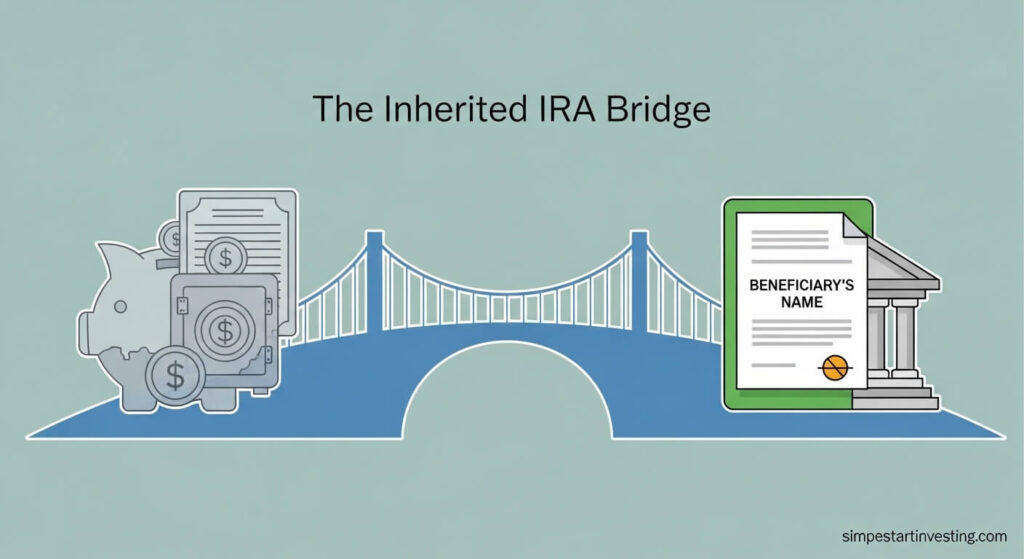
What Exactly Is an Inherited IRA?
At its simplest level, an Inherited IRA is an account that is opened when someone passes away and leaves their individual retirement account (IRA) to a beneficiary. This could be a spouse, a child, a relative, or even a friend. Unlike a standard IRA that you open for yourself, you cannot contribute new money to an inherited version. Its sole purpose is to hold and eventually distribute the assets left behind.
Think of it as a “bridge” account. The money moves from the deceased person’s name into a new account that is in your name, but it still carries the “inherited” label. This label is important because it tells the IRS that different rules apply to this money compared to your own retirement savings.
Many people assume that because the money was in a retirement account, it is “tax-free.” That is a common misunderstanding. Whether or not you owe taxes depends entirely on what type of account you inherited and your relationship to the person who passed away. Understanding these distinctions is the first step in making the right choice for your situation.
The Two Main Flavors: Traditional vs. Roth
Before you do anything, you need to identify what kind of account you are dealing with. In the world of US retirement, there are two primary types of IRAs, and they behave very differently when they are inherited.

Inherited Traditional IRAs
In a Traditional IRA, the original owner usually got a tax break when they put the money in. Because the IRS hasn’t taxed that money yet, they are waiting to collect their share when the money comes out. If you inherit a Traditional IRA, every dollar you withdraw is generally treated as taxable income.
For example, if you withdraw 50,000 dollars from an inherited Traditional IRA this year, the IRS views that just like a 50,000 dollar salary from a job. It gets added to your other income, which could potentially push you into a higher tax bracket.
Inherited Roth IRAs
A Roth IRA is the opposite. The original owner paid taxes on the money before putting it in. As long as the account has been open for at least five years, the distributions you take are usually tax-free. This makes an inherited Roth IRA a very valuable asset because you can take the money out without worrying about a giant tax bill at the end of the year.
The Big Change: Understanding the 10-Year Rule
If you talk to a friend who inherited an IRA ten years ago, their advice might be outdated. In the past, beneficiaries could “stretch” their distributions over their entire lifetime. This meant a 30-year-old could take tiny amounts out for 50 years, letting the rest grow tax-deferred.

However, new laws (specifically the SECURE Act) changed everything for most people. Now, the majority of non-spouse beneficiaries are subject to the 10-Year Rule.
Under this rule, you are required to empty the entire account by December 31st of the tenth year following the original owner’s death. You don’t necessarily have to take money out every single year, but the balance must be zero by the end of that tenth year.
Why the 10-Year Rule Matters
Imagine you inherit a Traditional IRA worth 100,000 dollars. Under the old rules, you might have taken out 2,000 dollars a year for decades. Under the new rules, you have a deadline. If you wait until year ten to take it all out, you will have a 100,000 dollar (plus growth) tax bill all at once.
Proper planning means looking at those ten years and deciding when it makes the most sense to take the money out to minimize the “tax bite.”
Are You a Spouse or a Non-Spouse?
The IRS treats spouses much differently than other heirs. Your relationship to the deceased determines your options and your timeline.
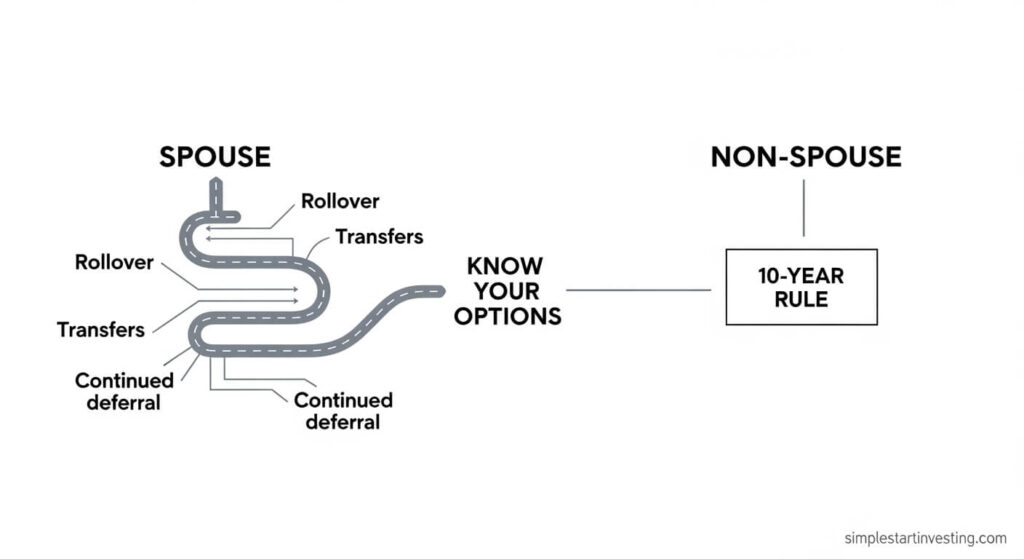
If You Are the Surviving Spouse
Spouses have the most flexibility. You generally have three main choices:
- The Spousal Rollover: You can treat the IRA as your own. You move the money into your own existing IRA. From that point on, it’s like the money was yours all along. You don’t have to take distributions until you reach the age for Required Minimum Distributions (RMDs).
- Open an Inherited IRA: You can move the money into an inherited account. This is often done if the surviving spouse is younger than 59 and a half and needs the money now. Why? Because you can take money out of an inherited IRA without the 10% early withdrawal penalty, even if you are young.
- Take a Lump Sum: You can take all the money at once. However, for a Traditional IRA, this usually results in a massive tax bill, so it is rarely the first choice.
If You Are a Non-Spouse Beneficiary
This category includes children, grandchildren, siblings, and friends. Most people in this group fall under the 10-year rule mentioned above. You cannot “roll over” the money into your own IRA. It must stay in an account titled as an Inherited IRA.
The Exceptions: “Eligible Designated Beneficiaries”
Not everyone is forced into the 10-year rule. The IRS created a special category called Eligible Designated Beneficiaries (EDBs). These people can still “stretch” distributions over their lifetime, similar to the old rules. This group includes:
- Surviving Spouses: As we discussed, they have special rights.
- Minor Children of the Deceased: Note that this only applies to the deceased’s own children, not grandchildren. Once the child reaches the age of majority (usually 21), the 10-year clock starts ticking.
- Disabled or Chronically Ill Individuals: There are specific legal definitions for these categories that must be met.
- Individuals Not More Than 10 Years Younger Than the Deceased: For example, if you inherit an IRA from a sibling who was only five years older than you, you might be able to use the stretch rule.
Required Minimum Distributions (RMDs): The Latest Twist
One of the most confusing parts of an Inherited IRA is whether you have to take money out during those ten years or if you can just wait until the very end.
For a long time, many experts thought you could wait until year ten. However, recent IRS clarifications have added a layer of complexity. If the original owner had already started taking their own Required Minimum Distributions (RMDs) before they passed away, you might be required to continue taking annual distributions during the 10-year period.
If the original owner had not yet reached the age where they were required to take money out, you generally have more freedom to decide when to take distributions within that 10-year window. This is a technical area where rules have been updated recently, so it is always wise to double-check the current status for the specific year you are in.
Common Mistakes Beginners Make
When you are grieving, it’s easy to make quick decisions. Here are a few traps to avoid with your Inherited IRA:
1. Taking the Cash Immediately It is tempting to just “check out” the account and put the cash in your bank. If it’s a Traditional IRA, this could be a huge mistake. If you inherit 200,000 dollars and take it all in one year, you might lose nearly half of it to federal and state taxes. It is almost always better to spread those withdrawals out.
2. Forgetting to Change the Title You cannot just keep the account in the deceased person’s name. You must set up a properly titled Inherited IRA (e.g., “John Doe, Deceased, for the benefit of Jane Doe, Beneficiary”). If you move the money into your own name incorrectly, the IRS may view it as a full distribution, making the whole amount taxable immediately.
3. Missing the RMD Deadline The IRS is very strict about deadlines. If you are required to take an annual distribution and you miss it, the penalty used to be 50% of the amount you were supposed to take. While that penalty has been reduced recently, it is still a very expensive mistake.
4. Not Naming Your Own Beneficiaries Once you have an Inherited IRA, you should name your own beneficiaries for that account. If you pass away before the 10 years are up, you want to ensure the remaining money goes where you want it to go without getting stuck in probate court.

Strategy: How to Manage the 10-Year Window
Since most heirs are now on a 10-year schedule, managing the tax impact is the name of the game. You don’t want to blindly take out 10% each year, nor do you want to wait until the very end.
Consider Your Current Income If you know you are going to retire in three years, your income will likely drop. It might make sense to take smaller withdrawals now while you are working and larger withdrawals after you retire and are in a lower tax bracket.
Conversely, if you are currently in a low-income year (maybe you went back to school or are between jobs), that is a great time to take a larger distribution from a Traditional Inherited IRA because the tax rate you pay will be lower.
The Roth Advantage If you inherited a Roth IRA, you have a 10-year window, but the money is tax-free. In this case, it usually makes sense to wait until the very last minute (Year 10) to take the money out. Why? Because you can let that money grow entirely tax-free for a full decade before touching it.
The Role of the Successor Beneficiary
What happens if you inherit an IRA, start your 10-year clock, but pass away in Year 5? The person you named as your beneficiary is called a Successor Beneficiary.
They don’t get a new 10-year clock. They must finish out your original 10-year window. This is a common point of confusion. The “clock” is tied to the death of the original owner, not the death of the first beneficiary. This makes it even more important to have a clear plan for how and when the money will be moved.
Step-by-Step Checklist for New Heirs
If you’ve just discovered you are an heir, take a deep breath and follow these steps:
- Get the Documents: You will need a certified copy of the death certificate and the original owner’s social security number.
- Identify the Type: Is it a Traditional IRA or a Roth IRA? This changes everything regarding taxes.
- Determine Your Category: Are you a spouse? An Eligible Designated Beneficiary? Or a “standard” beneficiary subject to the 10-year rule?
- Open the New Account: Work with a financial institution to open a properly titled Inherited IRA. Do not roll this into your own personal IRA unless you are a spouse.
- Check for RMDs: Find out if the original owner was already taking distributions. This tells you if you have to take money out this year or if you can wait.
- Plan the 10-Year Strategy: Look at your projected income for the next decade and decide on a withdrawal schedule that keeps your tax bill as low as possible.
Final Thoughts for the Beginner
Inheriting an IRA is a significant financial event, but it doesn’t have to be a source of stress. The key is to understand that the IRS has a very specific “timer” for this money. Whether it is a Traditional IRA that requires careful tax planning or a Roth IRA that offers tax-free growth, the most important thing you can do is move slowly and follow the rules.
By avoiding the “lump sum” trap and spreading out your distributions, you can make the most of the gift your loved one left behind. Remember that tax laws can change, and the IRS often issues new clarifications, so keeping an eye on the rules each year is a smart habit to develop.