If you have ever opened your first “real” paycheck and felt a sudden sting of disappointment, you are not alone. You might have calculated your hourly wage or salary and expected a specific number, only to find that the amount landing in your bank account is significantly smaller.
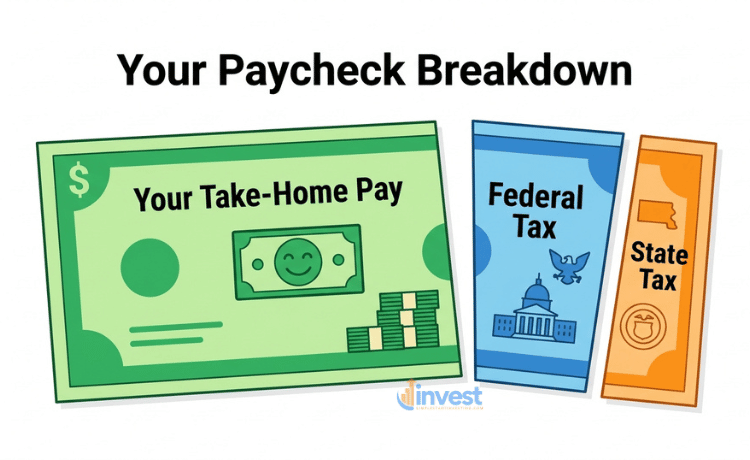
Where did that money go? For most workers in the United States, that missing chunk is taken by two different entities: the federal government and your state government. This is often referred to as the “double hit” of State and Federal income tax.
Understanding how these two systems work together—and sometimes differently—is the first step to mastering your personal finances. Let’s break down exactly why you pay taxes twice and how to navigate the rules so you aren’t caught off guard during tax season.
What Exactly Is Federal Income Tax?
Federal income tax is the money collected by the Internal Revenue Service (IRS) on behalf of the United States government. This is a national tax, meaning it applies to you regardless of whether you live in the sunny hills of California or the snowy plains of Maine.
Think of federal tax as your membership fee for being part of the United States. This money funds national priorities like the military, federal highways, national parks, and social programs like Social Security and Medicare.
How It Works in the Real World
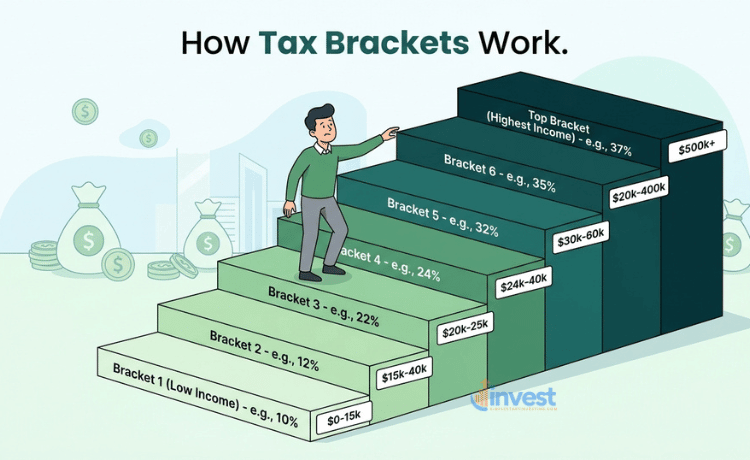
The federal system uses what is called a “progressive” tax structure. This means that as you earn more money, the percentage of tax you pay on those higher dollars increases.
For example, imagine a worker at Amazon named Sarah. If Sarah earns 50,000 dollars a year, she doesn’t pay one flat percentage on the whole 50,000 dollars. Instead, her first chunk of income is taxed at a low rate (like 10 percent), and the next chunk is taxed at a slightly higher rate (like 12 percent).

The Common Beginner Mistake
Many beginners believe that if they get a raise and move into a “higher tax bracket,” they will actually take home less money because their entire salary is now taxed at that higher rate.
The Financial Reality
This is a myth. Only the dollars that fall into the higher bracket are taxed at the higher rate. If you earn one dollar over the line into a 22 percent bracket, only that single dollar is taxed at 22 percent. Your previous earnings stay taxed at the lower 10 percent and 12 percent rates. Never turn down a raise out of fear of tax brackets!
What Is State Income Tax?
While federal tax goes to Washington D.C., state income tax stays much closer to home. This tax is collected by your specific state’s department of revenue. It is used to fund local needs like your neighborhood schools, state police, local roads, and state-level healthcare initiatives.
The biggest difference here is that every state has its own rules. Some states want a big piece of your pie, while others don’t take a single bite of your income.
A Tale of Two States
Consider two friends, one working at a Walmart in Florida and another working at a Walmart in New York.
The friend in New York will see state income tax deducted from every single paycheck. New York has a progressive system similar to the federal one. However, the friend in Florida will see zero dollars taken out for state income tax. This is because Florida is one of a handful of states that chooses not to tax personal income at all.
The Common Beginner Mistake
A common mistake is moving to a “no-income-tax” state like Texas or Nevada solely to save money, assuming their total cost of living will plummet.
The Financial Reality
States need money to function. If they don’t get it from your paycheck, they usually get it from somewhere else. Often, states with no income tax have much higher sales taxes (the tax you pay at the register) or much higher property taxes (the tax you pay for owning a home). Always look at the total “tax burden,” not just the income tax line on your stub.
Why Is There a “Double Hit”?
You might feel like it’s unfair to pay taxes twice on the same dollar. However, the U.S. operates on a system of “Federalism,” where the national government and state governments have separate powers and separate bills to pay.
The federal government handles big-picture items (like national defense), while the state handles day-to-day local infrastructure. Because they provide different services, they both require a portion of your earnings.
How Withholding Works
To make sure you don’t get a massive bill at the end of the year, your employer performs “withholding.” This is when they take a calculated guess at how much State and Federal income tax you will owe and subtract it from your check before you ever see it.
For instance, if you work at Costco, their payroll system looks at the form you filled out when you were hired (the W-4). If you told them you are single with no kids, they will withhold more money than if you told them you are married with three children.
The Common Beginner Mistake
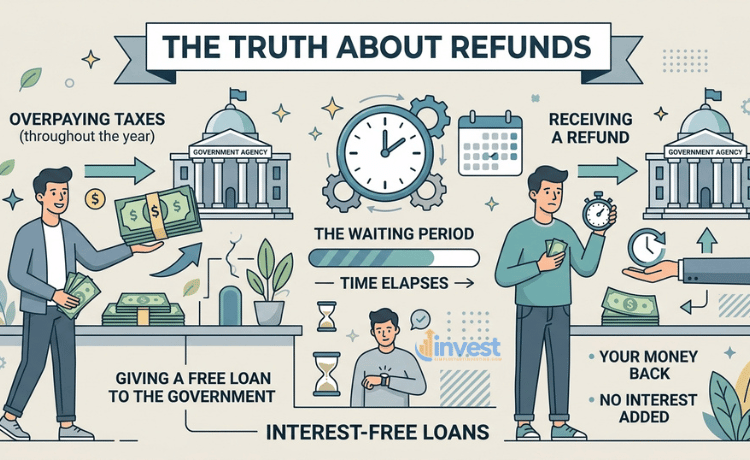
Many people think that a “big tax refund” in April is a gift from the government or a sign of great financial planning.
The Financial Reality
A refund simply means you overpaid your taxes throughout the year. You essentially gave the government an interest-free loan. While it feels nice to get a 3,000 dollar check in the spring, that is 3,000 dollars that could have been in your monthly budget to pay off high-interest debt or invest in stocks like Apple (AAPL) or Tesla (TSLA).
States with No Income Tax: The 2025-2026 Landscape
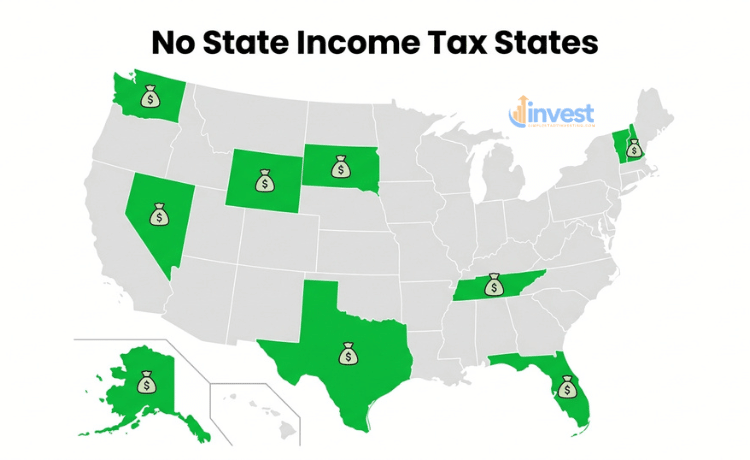
As of this year, there are nine states that do not have a general income tax on wages:
- Alaska
- Florida
- Nevada
- South Dakota
- Tennessee
- Texas
- Washington
- Wyoming
- New Hampshire (which is currently phasing out its tax on interest and dividends)
If you live in one of these states, your paycheck will only show federal deductions (and FICA, which we will discuss next). This can feel like a massive “pay raise” compared to living in high-tax states like California, Hawaii, or New Jersey, where the state might take an additional 5 percent to 13 percent of your income.
Practical Example: The Relocation
Imagine you work for a tech company like Google in Mountain View, California, earning 100,000 dollars. California will take a significant amount in state taxes. If you move to their office in Austin, Texas, while keeping the same 100,000 dollar salary, you could suddenly have several hundred extra dollars in your pocket every single month simply because the state tax line item disappears.
The “Other” Taxes: FICA and Beyond
When looking at the gap between your “Gross Pay” (the big number) and “Net Pay” (the money you keep), you will see more than just State and Federal income tax. You will also see “FICA.”
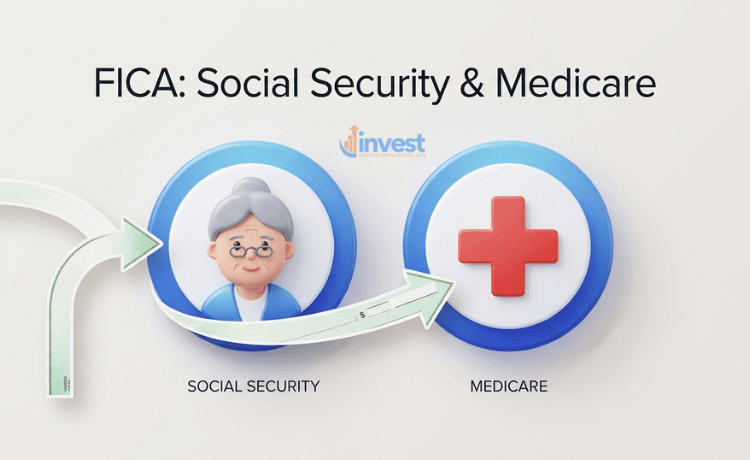
FICA stands for the Federal Insurance Contributions Act. This is a mandatory payroll tax that funds two specific things:
- Social Security: Money for retirees and the disabled.
- Medicare: Health insurance for people over age 65.
Unlike federal income tax, which has those “brackets” we talked about, FICA is generally a flat rate for most workers. You pay about 6.2 percent for Social Security and 1.45 percent for Medicare. Your employer also pays an equal amount on your behalf behind the scenes.
The Common Beginner Mistake
New employees often look at their check, see “FICA” or “OASDI” (another name for Social Security tax), and assume it is part of their state tax or an optional insurance premium.
The Financial Reality
These are federal requirements and are almost never optional. Even if you live in a state with no income tax, you will still see FICA coming out of your check. It is important to factor this 7.65 percent total hit into your budget from day one.
How to Plan for the Double Hit
Now that you understand the two layers of taxation, how do you handle them without going crazy?
1. Master Your W-4 and State Equivalent
When you start a job at a company like JPMorgan Chase or a local grocery store, you fill out a W-4 for federal taxes and usually a similar form for your state. If you want more money in your paycheck now, you have to be careful how you fill these out. If you withhold too little, you will owe the government money in April, which can lead to penalties.
2. Understand Deductions
Both the federal and state governments allow you to “deduct” certain expenses. A deduction lowers the amount of your income that is actually subject to tax.
For example, if you earn 60,000 dollars but you put 5,000 dollars into a 401k retirement plan at work, the government generally only taxes you as if you earned 55,000 dollars. This is a powerful way to reduce the “double hit.”
3. Check for State Credits
Some states offer unique tax credits that the federal government does not. For instance, some states give you a tax break for contributing to a college savings account (529 plan) for your children. This reduces your state tax bill specifically.
Summary: Federal vs. State at a Glance
To keep it simple, remember these core differences:
- Who gets the money? Federal tax goes to the national government (IRS). State tax goes to your local state capital.
- Is it mandatory? Federal tax is mandatory for everyone above a certain income. State tax is mandatory only if your state chooses to have one.
- How much is it? Federal tax is based on your income level (progressive). State tax can be progressive, a flat rate (everyone pays the same percentage), or zero.
- What does it pay for? Federal pays for “big” things like the Army and Social Security. State pays for “local” things like schools and paving your street.
Understanding these layers helps you realize that your paycheck isn’t just “disappearing.” You are paying for services at two different levels of government. By knowing how the brackets and withholdings work, you can make smarter choices about where you live, how much you save for retirement, and how to avoid a nasty surprise when April 15th rolls around.
Tax rules can be complex and change frequently based on new laws passed in Washington or your state capital. Always check the current year’s guidelines from the IRS or your state’s tax website, or talk to a qualified tax professional to ensure you are on the right track.
Disclaimer: This content is for educational purposes only and does not constitute financial or tax advice. Tax laws are subject to change; please consult with a professional or check current IRS and state regulations for your specific situation.