Transitioning from a traditional job to being your own boss is one of the most exciting moves you can make in your career. Whether you are launching a freelance writing business, driving for a ride-share app, or opening a boutique consulting firm, the freedom is unmatched. However, that freedom comes with a new set of responsibilities, and the most significant one is understanding the self-employment tax.
If you are used to receiving a W-2 at the end of the year, you might be surprised by how different taxes look when you work for yourself. For employees, taxes are quietly taken out of every paycheck before the money even hits your bank account. When you are self-employed, the IRS expects you to handle that process yourself. Learning how to navigate the self-employment tax is the difference between a thriving business and a stressful financial surprise during tax season.
In this guide, we will break down exactly what this tax is, how it works, and how you can prepare so that you stay in the clear with the IRS while keeping your business running smoothly.
What Exactly is Self-Employment Tax?
In simple terms, self-employment tax is a tax consisting of Social Security and Medicare taxes primarily for individuals who work for themselves. It is very similar to the Social Security and Medicare taxes withheld from the pay of most wage earners. The big difference is that when you work for a company, your employer pays half of these taxes, and you pay the other half. When you are the boss, you are responsible for both halves.
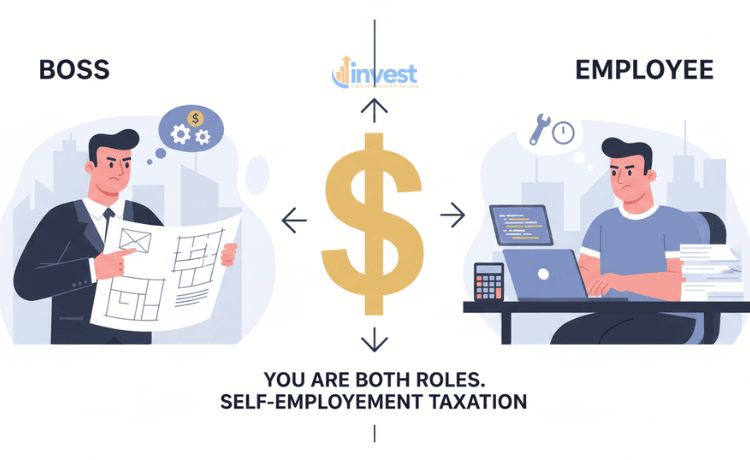
Think of it this way: the Social Security system provides benefits for retirement, disability, and survivors. The Medicare system provides hospital insurance. Every worker in the United States contributes to these programs. Usually, an employer like Walmart or Apple would handle the paperwork and pay a portion on your behalf. As a freelancer or independent contractor, you are essentially both the “employer” and the “employee,” so you cover the full amount.
A Real-World Scenario
Imagine Sarah, a talented graphic designer who recently left a big agency to start her own freelance business. In her first year, she lands a major project for a tech company like Google. She earns 50,000 dollars in net profit. Unlike her old job, where her taxes were deducted every two weeks, Sarah receives the full 50,000 dollars. She needs to remember that a portion of that money—specifically the self-employment tax—doesn’t actually belong to her; it belongs to the IRS for her future social benefits.
The Common Beginner Mistake
Many beginners think that because they are paying “income tax,” they don’t have to worry about anything else. They assume that if they fall into a low-income bracket, they might not owe much. They treat their gross business income as their personal “spending money” and wait until April to see what happens.
The Financial Logic Shift
You must shift your mindset to see yourself as two different entities: a business and an individual. The self-employment tax is a non-negotiable business expense. It is a flat-rate contribution to your future self. Even if you have enough deductions to owe zero “income tax,” you will likely still owe self-employment tax if your business made a profit.
Breaking Down the 15.3% Rate Without the Math Headaches
The current rate for self-employment tax is 15.3 percent of your net earnings. This sounds like a specific, intimidating number, but it is easier to understand when you see where it goes. The total is made up of two distinct parts: 12.4 percent goes toward Social Security, and 2.9 percent goes toward Medicare.
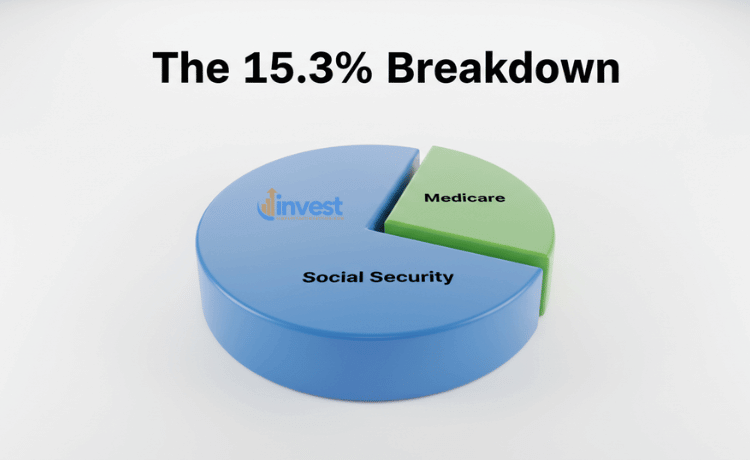
When you work a “normal” job, your paycheck only shows 7.65 percent being taken out for these items because your boss is paying the other 7.65 percent behind the scenes. When you are self-employed, you are simply paying the total 15.3 percent yourself. It isn’t a “penalty” for being a business owner; it is just the full cost of the social safety net that everyone participates in.
A Real-World Scenario
Let’s look at Mark, who runs a small delivery business using his own van. If Mark makes 100 dollars in profit after paying for his gas and insurance, he should immediately set aside about 15 dollars for his self-employment tax. While the actual calculation by the IRS involves a few small adjustments that slightly lower the taxable amount, thinking of it as a 15 percent “set-aside” ensures Mark is never caught off guard.
The Common Beginner Mistake
New business owners often look at the 15.3 percent and feel like they are being double-taxed. They might think, “Why am I paying more than my friends who work at Starbucks?” This leads to frustration and sometimes a dangerous temptation to underreport income to avoid the “extra” cost.
The Financial Logic Shift
Understand that you aren’t paying “extra.” You are simply seeing the full cost of employment that was previously hidden from you. In a corporate job, your “total compensation” actually includes that 7.65 percent the company pays for you. Now that you are the company, you are just managing that full amount directly. It’s a sign of a growing, legitimate business.
Does Everyone Have to Pay This Tax?
Not every dollar you receive is subject to self-employment tax. The IRS has a specific threshold. If your net earnings from self-employment were 400 dollars or more during the year, you must pay this tax. This applies even if you already have a full-time job and are just doing a side hustle on the weekends.

Net earnings are what remains after you subtract your business expenses from your total income. If you sold 1,000 dollars worth of handmade jewelry on Etsy but spent 700 dollars on beads, shipping, and marketing, your net profit is 300 dollars. In this specific case, you wouldn’t owe self-employment tax because you are below the 400-dollar mark.
A Real-World Scenario
Consider David, a high school teacher who spends his summer painting houses. He earns 5,000 dollars over the summer. Because he is already an employee at the school, he might think his side job is “tax-free” or covered by his teaching taxes. However, since his painting profit is well over 400 dollars, he must file a Schedule SE and pay the self-employment tax on that 5,000 dollars.
The Common Beginner Mistake
A frequent error is believing that “side hustles” or “hobby income” are exempt. People often think that if they don’t receive a Form 1099-NEC from a client, the IRS doesn’t need to know about the money. This is incorrect. You are responsible for reporting all profit, regardless of whether a form was mailed to you.
The Financial Logic Shift
Adopt a “proactive reporting” mindset. Every dollar of profit over 400 dollars is an investment in your Social Security credits. By paying the tax correctly, you are ensuring that your “work credits” are tracked by the Social Security Administration, which determines your benefits when you retire.
The Hidden Advantage: The Self-Employment Tax Deduction
While paying the full 15.3 percent feels heavy, the IRS offers a “silver lining” to make it more equitable. You are allowed to deduct the “employer-equivalent” portion of your self-employment tax when calculating your adjusted gross income.
In simpler terms, even though you pay the full 15.3 percent, the IRS treats the half that represents the “employer share” (7.65 percent) as a business expense. This deduction only affects your income tax, not the self-employment tax itself, but it can significantly lower the total amount of tax you owe at the end of the year.
A Real-World Scenario
Let’s go back to Sarah, our graphic designer. When she does her taxes, she calculates that she owes 7,000 dollars in self-employment tax. The IRS allows her to take half of that—3,500 dollars—and subtract it from her total income before she calculates how much “income tax” she owes. It’s like the government saying, “Since you acted as your own boss, we’ll let you write off the boss’s share of the taxes.”
The Common Beginner Mistake
Many beginners miss this deduction because they don’t realize it’s an “above-the-line” deduction. They think they have to “itemize” (like having a huge mortgage or massive medical bills) to get any tax breaks. Because they don’t have enough traditional deductions, they skip this one entirely and pay more than they should.
The Financial Logic Shift
Think of this deduction as a “rebate” for the extra responsibility you’ve taken on. You don’t need to do anything fancy to qualify for it; you just need to fill out the correct lines on your Form 1040. It is a built-in way the tax code recognizes that running a business has costs that regular employees don’t face.
Quarterly Estimated Payments: Avoiding the “April Surprise”
The US tax system is a “pay-as-you-go” system. For employees, this happens every payday. For the self-employed, the IRS expects you to make four payments throughout the year, known as quarterly estimated tax payments. These payments cover both your income tax and your self-employment tax.

If you wait until April 15th to pay the entire year’s worth of tax, you might be hit with an underpayment penalty. More importantly, you might not have the cash on hand to pay a massive bill. By breaking it into four manageable chunks, you keep your cash flow steady and stay on the good side of the IRS.
A Real-World Scenario
Imagine James, who runs a successful consulting business. In the first three months of the year, he makes a profit of 20,000 dollars. Instead of spending all of it on a new car, he calculates that he will likely owe about 30 percent in total taxes (including self-employment tax). He sends 6,000 dollars to the IRS in April. He repeats this in June, September, and January. When tax season arrives, he discovers he actually owed 23,000 dollars total. Since he already paid 24,000 dollars, he gets a 1,000-dollar refund instead of a 23,000-dollar bill.
The Common Beginner Mistake
The most painful mistake is the “April Shock.” A freelancer has a great year, spends the money as it comes in, and then realizes in April that they owe 15,000 dollars that they simply do not have. This often leads to high-interest debt or long-term payment plans with the IRS.
The Financial Logic Shift
Treat the IRS as your most important “vendor.” Just as you pay your internet bill or your rent every month to keep your business running, you should pay your taxes every quarter to keep your business legal and stress-free. If you set aside 25 to 30 percent of every check you receive into a separate “tax savings account,” you will never have to worry about where the money will come from.
How to Keep Records Like a Professional
To accurately calculate your self-employment tax, you need to know your exact profit. You cannot know your profit if you are mixing your personal grocery receipts with your business software subscriptions. Proper record-keeping is the foundation of managing your taxes effectively.
You don’t need expensive accounting software to start. A simple spreadsheet or a dedicated business bank account can work wonders. The goal is to have a clear list of every dollar that came in and every business-related dollar that went out. Remember, the self-employment tax is only calculated on your profit, so every legitimate business expense you track helps lower your tax bill.
A Real-World Scenario
Maria is a freelance photographer. She uses a separate bank account for all her photography income. When she buys a new lens or pays for a gallery space, she uses the business debit card. At the end of the year, she doesn’t have to hunt through hundreds of personal transactions. She simply downloads her business bank statement, and she has her total income and total expenses ready for her tax preparer.
The Common Beginner Mistake
The “shoebox method” is the biggest pitfall. This is when a business owner throws all their receipts into a box and hopes for the best in April. Not only does this lead to missed deductions (meaning you pay more self-employment tax than necessary), but it also makes an IRS audit a nightmare.
The Financial Logic Shift
View record-keeping as a way to “protect your profit.” Every time you record a business expense, you are essentially lowering the amount of money the IRS can tax. It is not just “busy work”; it is a high-hourly-rate activity that keeps more money in your pocket.

Summary of Key Actions for New Business Owners
Managing your taxes as a self-employed individual doesn’t have to be overwhelming. If you follow these core principles, you will be ahead of 90 percent of other beginners:
- Set Aside Early: Aim to save 25 to 30 percent of every payment you receive. This covers both your self-employment tax and your federal/state income taxes.
- Track Every Expense: Use a dedicated business account to make sure you aren’t paying taxes on money you spent to run the business.
- Pay Quarterly: Don’t wait for the end of the year. Use Form 1040-ES to send payments to the IRS four times a year.
- Consult a Professional: Tax laws are complex and can change. While you can do it yourself, a Certified Public Accountant (CPA) or Enrolled Agent can often save you more money than they cost by finding deductions you missed.
Being your own boss is a rewarding journey. By mastering the self-employment tax now, you are building a solid financial foundation that will allow your business to grow for years to come.
Rules and regulations regarding taxes can change; please check current IRS guidance or consult with a tax professional for your specific situation.
Disclaimer: This content is for educational purposes only and does not constitute financial or tax advice. Always consult with a qualified professional regarding your personal financial situation.