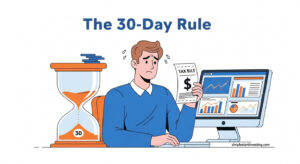
We have all been there. You open your brokerage app, ready to see a sea of green, but instead, you are met with a bright red number. Maybe that “sure thing” tech stock you bought last summer hasn’t performed as expected, or perhaps the entire market decided to take a nap. It is painful to see your hard-earned money dip in value.
But what if I told you that those red numbers could actually put money back in your pocket come tax season? In the world of investing, there is a strategy that acts like a “silver lining” for your losses. It is called tax-loss harvesting.
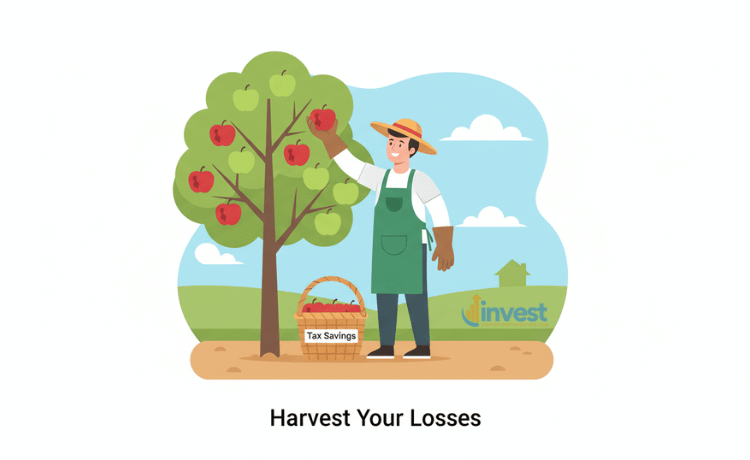
This might sound like a complicated term used by Wall Street suits, but for a beginner, it is one of the most powerful tools to understand. Tax-loss harvesting is essentially the art of turning an investment “lemon” into financial “lemonade.” Instead of just sitting on a losing stock and feeling bad about it, you can use that loss to lower your tax bill.
In this guide, we are going to break down how this works, why most beginners miss out on it, and how you can use it to your advantage this year.
What is Tax-Loss Harvesting?
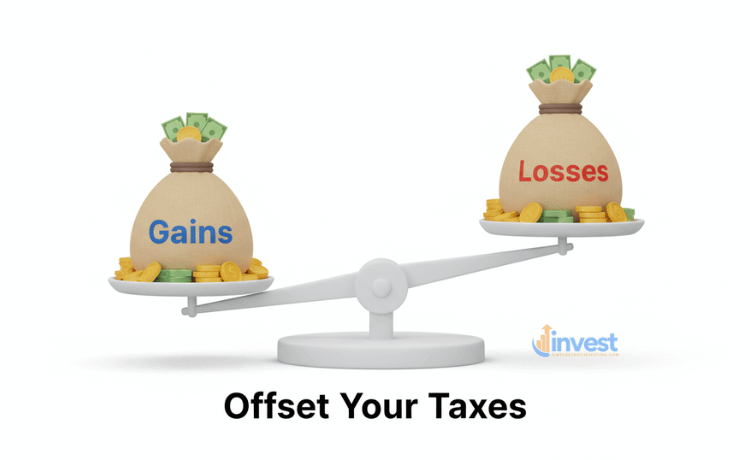
At its simplest level, tax-loss harvesting is the process of selling an investment that has dropped in value so you can use that loss to offset the taxes you owe on your “winning” investments.
Think of it like gardening. Throughout the year, you have some plants that grow tall and produce fruit (your gains). You also have some plants that wither and die (your losses). Harvesting your losses is like taking those dead plants and using them as compost to help your overall garden thrive by reducing the “tax weeds” that eat into your profits.
The 4-Step Breakdown
1. The Simple Explanation When you sell a stock for more than you paid, the government wants a piece of that profit. This is called a capital gains tax. However, if you sell a stock for less than you paid, you have a capital loss. The IRS allows you to subtract your losses from your gains. If you made 5,000 dollars on one stock but lost 5,000 dollars on another, you effectively made zero dollars in the eyes of the tax man.
2. Real-World Example Let’s look at a hypothetical scenario with two popular companies: Amazon (AMZN) and Tesla (TSLA). Imagine you bought shares of Amazon years ago and decided to sell them this year for a profit of 10,000 dollars. Normally, you would owe taxes on that full 10,000 dollars.
However, let’s say you also bought Tesla recently, and the price dropped, leaving you with a current value that is 4,000 dollars less than what you paid. If you sell those Tesla shares, you “realize” that 4,000 dollar loss. Now, instead of paying taxes on 10,000 dollars of Amazon profit, you only pay taxes on 6,000 dollars because your Tesla loss “canceled out” part of your Amazon gain.
3. Common Beginner Mistake Many beginners think they should hold onto a losing stock forever because “it’s not a loss until you sell.” While it is true that the price might go back up, they miss out on the immediate tax benefit. By refusing to sell a loser, they end up paying high taxes on their winners, essentially leaving money on the table that could have been used to reinvest.
4. The Right Mindset The correct logic is to view every investment in your portfolio based on its future potential, not its past price. If a stock is down and you no longer believe it is the best place for your money, selling it doesn’t just “lock in a loss”—it creates a “tax asset.” You are taking a bad situation and making it work for you.
How it Works Beyond Just “Canceling Gains”
What happens if you have more losses than gains? This is where tax-loss harvesting gets even more interesting for the average person.
The IRS is surprisingly generous here. If your total losses for the year are greater than your total gains, you can use up to 3,000 dollars of those extra losses to offset your “ordinary income.” This means the money you earn from your 9-to-5 job, your freelance work, or even your interest from a savings account.
The 4-Step Breakdown
1. The Simple Explanation Most taxes are paid on the money you earn from working. By using your stock market losses, you can actually lower the amount of “work income” the government taxes you on. It is like getting a discount on your income tax just because your portfolio had a rough patch.
2. Real-World Example Suppose you are a software engineer at Microsoft or a manager at Walmart. You earned a good salary this year, but your stock portfolio ended up with a net loss of 5,000 dollars because you had no winning stocks to sell.
You can use 3,000 dollars of that loss to reduce your taxable salary. If you earned 70,000 dollars, the IRS would only tax you as if you earned 67,000 dollars. What about the remaining 2,000 dollars of loss? You don’t lose it! You can “carry it forward” to next year or the year after that. It stays on your “tax shelf” until you have gains to offset.
3. Common Beginner Mistake New investors often think that if they lose more than 3,000 dollars, the rest of the money is just “gone.” They get discouraged and stop investing.
4. The Right Mindset Think of excess losses as a “gift card” for future taxes. If you have a bad year where you lose 10,000 dollars, you use 3,000 dollars this year, 3,000 dollars next year, 3,000 dollars the year after, and so on. You are essentially building a shield that protects your future profits from being taxed.
The Golden Rule: Beware the “Wash Sale” Trap
If tax-loss harvesting sounds too good to be true, it’s because there is one big rule you must follow: the Wash-Sale Rule.
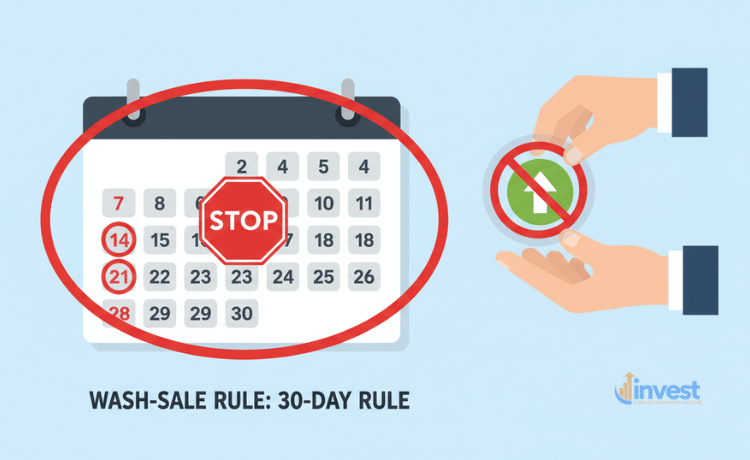
The government knows that people might try to sell a stock just to get the tax break and then immediately buy it back because they still like the company. To prevent this “gaming of the system,” the IRS created a 30-day “no-go” zone.
The 4-Step Breakdown
1. The Simple Explanation If you sell a stock for a loss, you cannot buy that same stock (or one that is nearly identical) within 30 days before or after the sale. If you do, the IRS will “disallow” your loss. It is as if the sale never happened for tax purposes. You still lost the money, but you don’t get the tax break.
2. Real-World Example Imagine you own Apple (AAPL). The price drops, and you want to claim a 1,000 dollar loss for your taxes. You sell the shares on a Monday. On Tuesday, you realize you really love Apple and buy the shares back. Because you didn’t wait at least 31 days, you cannot use that 1,000 dollar loss to lower your taxes. You have “washed” the sale.
3. Common Beginner Mistake Many beginners think they can sell Coca-Cola at a loss and immediately buy an incredibly similar company like Pepsi to avoid the rule. While these are different companies, the IRS rule also applies to “substantially identical” securities. For example, selling one S&P 500 fund and immediately buying a different S&P 500 fund from a different bank might trigger this rule because they perform exactly the same.
4. The Right Mindset If you want to stay in the market while waiting out the 30-day window, you need to find a “replacement” that is similar but not “identical.” For instance, if you sell a specific tech stock like Nvidia (NVDA), you might buy a general “Technology ETF” instead. They are both in the tech sector, but they are not “substantially identical.” This keeps your money working in the market while you safely capture your tax loss.
Strategic Timing: When Should You Harvest?
A common myth is that tax-loss harvesting is only something you do in December. While many people do wait until the end of the year to “clean up” their portfolio, savvy investors look for opportunities all year long.

Why Year-Round Harvesting Matters
The stock market moves in waves. A stock like Netflix (NFLX) might have a terrible month in March but recover by December. If you wait until December to look at your portfolio, you might see that Netflix is back to “even” or even in a profit.
If you had sold it during that dip in March and waited 30 days before buying it back, you would have captured that “loss” on paper to use against your taxes, even if the stock eventually went back up. By harvesting during the dips, you are capturing “tax assets” when they are available.
Keeping Your Portfolio Balanced
Another reason to harvest throughout the year is to keep your portfolio in balance. Let’s say your shares of Costco (COST) have grown so much that they now make up 50% of your total accounts. You want to sell some to diversify, but you are afraid of the big tax bill.
By looking for “losers” in other parts of your portfolio (maybe some bonds or an international fund that is down), you can sell both at the same time. The gains from Costco are offset by the losses from the other funds, allowing you to rebalance your portfolio for “free” without paying a massive tax penalty.
Taxable vs. Retirement Accounts: A Crucial Distinction
It is vital to remember that tax-loss harvesting only works in “taxable” brokerage accounts. These are accounts where you pay taxes on your activity every year (like a standard account at Charles Schwab, Fidelity, or Vanguard).
If your investments are inside a 401(k) or a Traditional/Roth IRA, tax-loss harvesting does not apply. Why? Because the IRS already gives you a tax break on those accounts (either when you put money in or when you take it out). Inside a retirement account, you can buy and sell stocks all day long, and the IRS doesn’t care about your gains or losses until you start withdrawing the money in retirement.
Note: Be careful! If you sell a stock for a loss in your taxable account but buy it back within 30 days inside your IRA, the IRS still considers that a wash sale. They are very good at connecting the dots between your different accounts.
Why Beginners Feel “Loss Aversion”
The biggest hurdle to tax-loss harvesting isn’t the math—it’s the psychology. Humans are hard-wired to hate losing. Psychologists call this “loss aversion.” The pain of losing 100 dollars is twice as strong as the joy of gaining 100 dollars.

When a beginner sees a stock is down, their instinct is to hide, wait, and hope. Selling feels like admitting defeat. However, in the world of professional finance, selling a loser is seen as a tactical move. It is about efficiency.
Think of your portfolio like a team of employees. If one employee is consistently underperforming and costing you money, you wouldn’t keep paying them just because you “hope” they get better. You would let them go and use the “severance” (the tax break) to hire someone better.
How to Get Started
If you want to try this strategy, here is a simple checklist for a beginner:
- Look for the Red: Identify which stocks in your taxable account are currently worth less than what you paid for them.
- Check for Gains: Do you have any stocks you want to sell for a profit? Or did you already sell some earlier this year?
- The 30-Day Check: Make sure you haven’t bought more shares of that losing stock in the last 30 days.
- Execute the Sale: Sell the losing shares to “capture” the loss.
- Wait or Pivot: Either keep that money in cash for 31 days or buy a “similar but different” investment to stay in the market.
- Report it: When tax season comes around next year, you (or your tax software) will use Form 1040, Schedule D to report these trades.
Conclusion: Making the Best of a Bad Market
The stock market will always have ups and downs. While we all want our investments to go “to the moon,” the reality is that some will fall. Tax-loss harvesting gives you a way to stay in control. It turns a market dip from a total negative into a strategic advantage.
By understanding the basic rules—offsetting gains, the 3,000 dollar income limit, and avoiding the wash-sale trap—you can significantly lower your lifetime tax bill. This means more money stays in your account to compound and grow over time.
Remember, the goal of investing isn’t just to pick winners; it is to keep as much of your profit as possible. And sometimes, picking a “loser” to sell is the best way to do exactly that.
Regulations and tax laws are subject to change. The rules mentioned here are based on current IRS guidelines for the current tax year. Always check for the most recent updates or consult with a qualified tax professional before making significant financial decisions.
Disclaimer: This content is for educational purposes only and does not constitute financial, legal, or tax advice. Investing involves risk, including the loss of principal.