It is never a fun feeling to log into your brokerage account and see red numbers. We have all been there. You bought a stock or an index fund with high hopes, but the market had other plans. Usually, seeing a loss feels like a total defeat. But what if I told you that the Internal Revenue Service (IRS) actually provides a way for you to find a silver lining in those losses?
In the world of investing, there is a strategy called tax-loss harvesting. It sounds like something only Wall Street pros or high-priced accountants do, but it is actually a straightforward concept that any beginner can use to keep more money in their pocket. Think of it as a way to let the government share some of your investment “pain” by reducing your tax bill.
By the end of this guide, you will understand exactly how this works, why it is one of the most powerful tools for building long-term wealth, and how to avoid the common traps that trip up new investors.
What Exactly Is Tax-Loss Harvesting?
At its simplest, tax-loss harvesting is the act of selling an investment that has dropped in value to “realize” a loss. In the eyes of the tax man, a loss is not real until you actually sell the asset. Once you sell it, that loss can be used to cancel out the taxes you owe on investments you sold for a profit.
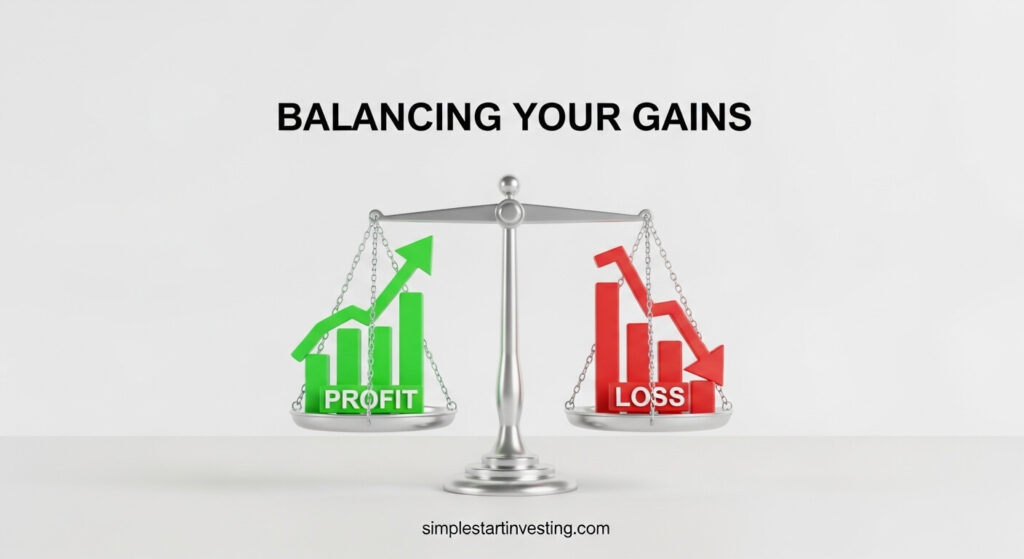
Think of your investment portfolio like a scale. On one side, you have your “wins”—the stocks you sold for more than you paid. On the other side, you have your “losses”—the ones you sold for less. Tax-loss harvesting is the process of intentionally putting weight on the “loss” side of the scale to balance out the “wins,” so your total taxable amount is lower.
The goal isn’t just to lose money for the sake of it. The goal is to be strategic. You sell the losing investment, claim the tax benefit, and then typically take that cash and reinvest it into something similar so your money stays in the market and keeps growing.
Why Beginners Often Get It Wrong
Many people start investing and think that taxes are just something you deal with in April. They assume that if they lose 5,000 dollars on a bad trade, that money is just gone forever. This is a huge misconception.
Another common mistake is thinking that you can only use losses to offset gains from other stocks. While that is the primary use, the IRS actually allows you to use a portion of your investment losses to offset your regular “ordinary” income—the money you earn from your job.
Lastly, beginners often panic-sell during a market dip without a plan. They sell because they are scared, not because they are being tax-efficient. Tax-loss harvesting is a controlled, calm, and planned maneuver. It turns a bad market situation into a strategic tax win.
The Power of Offsetting Capital Gains
To understand why this matters, we have to look at how the government taxes your investments. When you sell a stock for a profit, that profit is called a capital gain. The government wants a piece of that profit. Depending on how long you held the stock and how much you earn, you could owe a significant percentage of those gains in taxes.
Let’s look at a simple scenario. Imagine you sold some shares of a big tech company like Apple and made a profit of 10,000 dollars. If your tax rate on that gain is 15 percent, you would owe the IRS 1,500 dollars.
Now, imagine you also have an investment in a different company that hasn’t done so well. It is currently worth 4,000 dollars less than what you paid for it. If you choose to do nothing, you still owe that 1,500 dollars in taxes.
But, if you use tax-loss harvesting, you sell that losing investment. Now, your “taxable gain” is no longer 10,000 dollars. It is 10,000 dollars minus your 4,000 dollar loss, which equals 6,000 dollars. Instead of paying taxes on 10,000 dollars, you only pay taxes on 6,000 dollars. Your tax bill drops from 1,500 dollars down to 900 dollars. You just “saved” 600 dollars in taxes simply by being smart about your losses.
Using Losses to Lower Your Regular Income Tax
What if you don’t have any gains this year? What if the whole market is down and everything you sold was at a loss? You can still benefit.
The IRS allows individual investors to use up to 3,000 dollars of net investment losses to offset their “ordinary income” each year. This is the income you get from your salary or your business.
If you earn 60,000 dollars a year at your job and you have 3,000 dollars in investment losses that you “harvested,” the IRS will treat you as if you only earned 57,000 dollars. This can lead to a direct refund or a lower tax bill when you file your return.
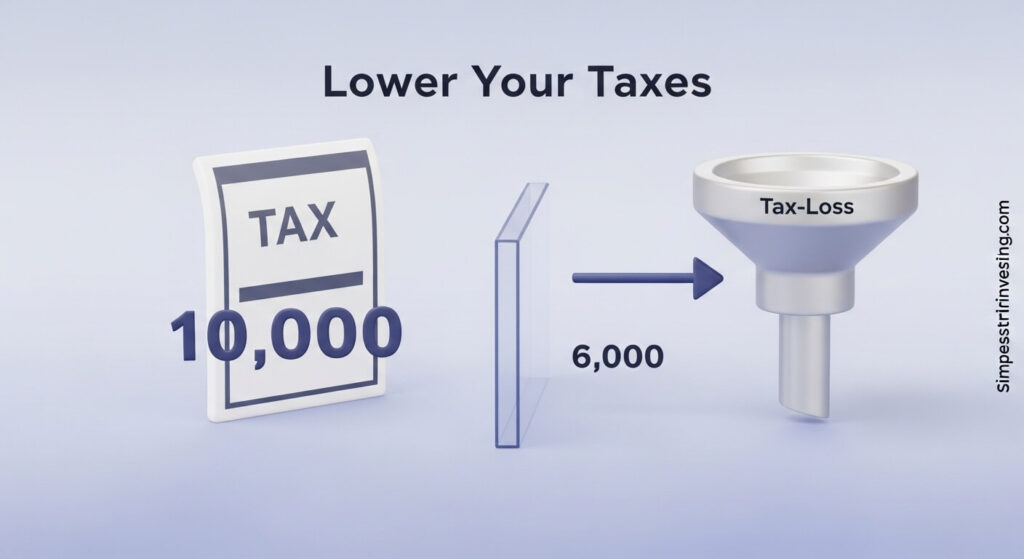
And here is the best part: if your losses are even bigger than 3,000 dollars, you don’t lose the extra. You can “carry forward” the remaining losses to future years. If you have a 10,000 dollar loss this year and no gains, you use 3,000 dollars this year, and you still have 7,000 dollars waiting to be used in the years to come. It’s like a tax-saving coupon that never expires.
The “Golden Rule” You Cannot Break: The Wash-Sale Rule
This strategy sounds so good that you might be thinking, “Why don’t I just sell all my losers today to get the tax break and then buy them right back tomorrow?”
The IRS is one step ahead of you. They created something called the Wash-Sale Rule to prevent people from “gaming” the system.
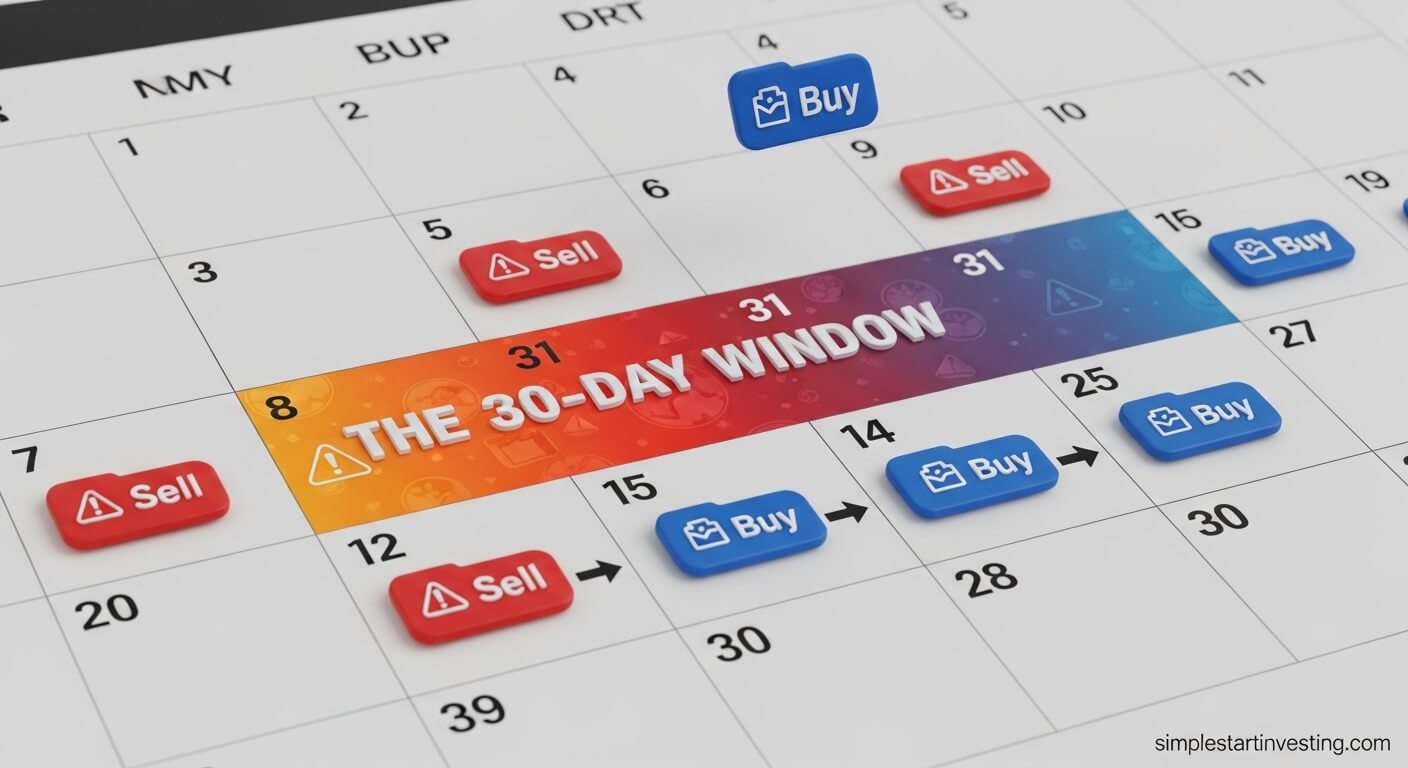
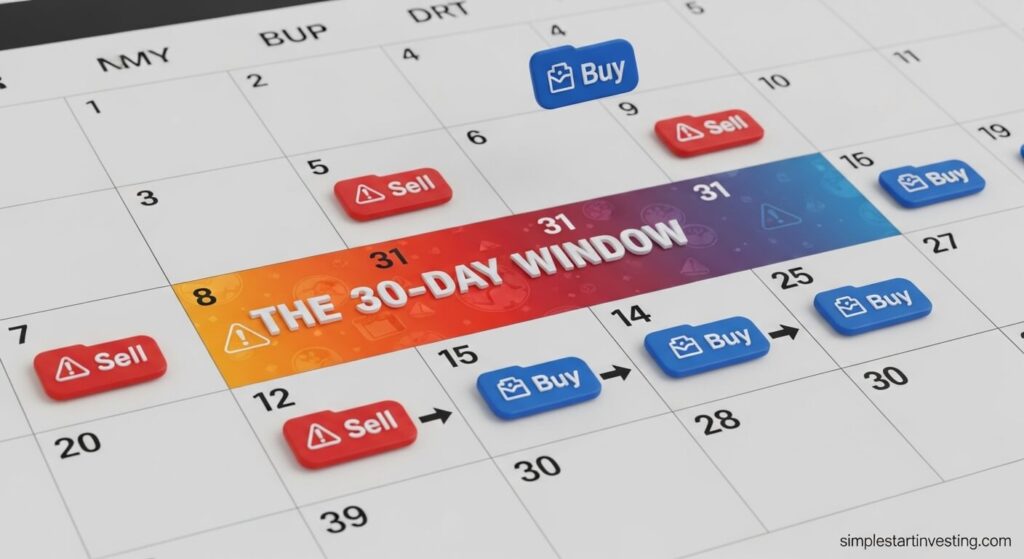
Under this rule, if you sell an investment at a loss and then buy that same investment (or something “substantially identical”) within 30 days before or 30 days after the sale, the IRS will disallow your tax loss. In other words, you won’t get the tax break.
For example, if you sell 100 shares of Tesla at a loss on Monday and buy those same 100 shares back on Tuesday, your loss is “washed away” for tax purposes. You have to wait at least 31 days to buy that specific stock back if you want to claim the loss on your taxes.
How to Stay Invested While Following the Rules
The trick to tax-loss harvesting is to sell the “loser” and immediately buy something else that is similar but not “substantially identical.”
If you sold an individual stock like Ford because it was down, you might buy shares in another car company like General Motors. They are in the same industry, but they are different companies, so the Wash-Sale Rule usually doesn’t apply.
If you sold an Index Fund that tracks the S&P 500 (like VOO), you might buy a different fund that tracks a slightly different index (like an “immense-cap” or “total market” fund). This allows you to keep your money in the market so you don’t miss out if the stocks start going back up, while still securing that valuable tax loss.
Where Can You Harvest Losses?
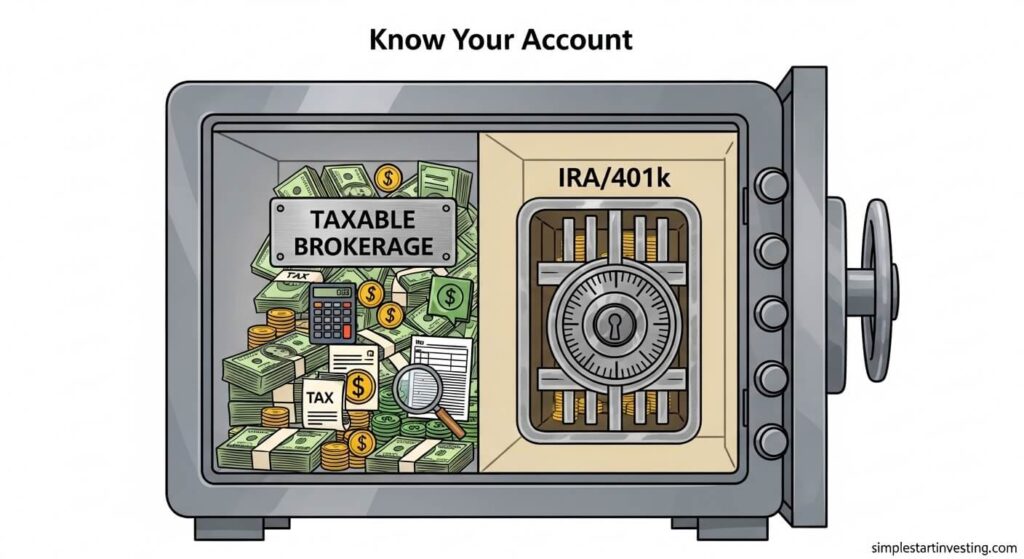
It is important to know that tax-loss harvesting only works in taxable brokerage accounts. These are the accounts you open with companies like Fidelity, Schwab, or Robinhood where you pay taxes on your gains every year.
You cannot use this strategy in retirement accounts like a 401(k), a Traditional IRA, or a Roth IRA. Why? Because those accounts are already “tax-advantaged.” In a 401(k) or IRA, you don’t pay taxes on individual trades or gains while the money is in the account. Since you aren’t being taxed on the gains, the IRS doesn’t let you claim the losses either.
If you have a loss in your Roth IRA, it’s just a loss. There is no tax benefit to be found there. This is why many experts suggest being extra mindful of your taxable accounts—that is where the “tax-loss harvesting” magic happens.
Step-by-Step Logic of a Harvest
Let’s walk through how a beginner might actually do this in real life. We will use a hypothetical investor named Mike.
- Identify the Loser: Mike looks at his taxable brokerage account in November. He sees that he bought 5,000 dollars worth of an Energy ETF a few months ago, and it is now worth only 3,500 dollars. He has an “unrealized loss” of 1,500 dollars.
- Check for Gains: Mike also sold some shares of a tech stock earlier this year and made a 2,000 dollar profit. He knows he will owe taxes on that 2,000 dollars.
- Execute the Sale: Mike sells the Energy ETF for 3,500 dollars. He has now “realized” a 1,500 dollar loss.
- Reinvest Wisely: Mike doesn’t want to be out of the energy sector. He immediately takes that 3,500 dollars and buys a different Energy ETF from a different company. This keeps his portfolio balance the same.
- The Result: When tax season comes, Mike reports his 2,000 dollar gain and his 1,500 dollar loss. He only pays taxes on the 500 dollar difference.
- The Wait: Mike makes sure not to buy back that original Energy ETF for at least 31 days to avoid the Wash-Sale Rule.
Common Pitfalls to Avoid
While the logic is simple, there are a few traps that beginners should watch out for.
1. Let the “Tax Tail” Wag the “Investment Dog”
This is a famous saying in finance. It means you shouldn’t make a bad investment decision just to get a tax break. If you really believe a company is about to skyrocket, selling it just for a small tax saving might be a mistake if you miss the rebound. Always put your investment strategy first and taxes second.
2. Transaction Costs
Every time you sell and buy, there might be fees (though many brokers are now zero-commission) or “bid-ask spreads” (the difference between the buying and selling price). If you are harvesting a very small loss, say 50 dollars, the effort and the potential costs might not be worth it.
3. Dividend Reinvestment
This is a “hidden” trap for the Wash-Sale Rule. Many people have “automatic dividend reinvestment” turned on. If your stock pays a dividend and automatically buys more shares within 30 days of you selling for a loss, that could trigger a partial Wash-Sale. It’s a good idea to check your settings before you harvest.
4. Forgetting the Cost Basis
When you sell a stock and buy a similar one, you need to keep track of your “cost basis” (what you paid). Most modern brokerages do this for you automatically, but it is always good to double-check your statements to ensure your losses are being reported correctly to the IRS.
When Is the Best Time to Harvest?
Most people think about tax-loss harvesting in December as they prepare for the end of the year. This is a fine time to do it, but “year-round” harvesting is often more effective.
The market doesn’t only go down in December. If there is a big market dip in June, that might be the best time to lock in those losses. By waiting until the end of the year, the market might have already recovered, and your “loss” might have disappeared. If you see a significant drop in one of your holdings at any point during the year, it is worth asking if now is the time to harvest.
Is It Worth the Effort?
For a beginner starting with a small amount of money, the savings might seem modest at first. Maybe you save 100 dollars or 200 dollars on your taxes. But over 20 or 30 years of investing, those savings add up.
If you reinvest your tax savings back into the market, that money compounds. Saving 500 dollars on taxes this year and letting it grow at 8 percent for 20 years turns into over 2,300 dollars. Multiply that by every year you harvest losses, and you are looking at a significantly larger retirement fund.
Tax-loss harvesting is essentially a way to keep your money working for you instead of sending it to the government. It is one of the few “free lunches” in the investing world, provided you follow the rules.
Summary Checklist for Beginners
If you are thinking about trying this, here is a simple checklist to keep you on track:
- Is the account taxable? (Make sure it is not an IRA or 401k).
- Do I have a “realized” gain to offset? (Or do I want to offset my ordinary income up to 3,000 dollars?)
- Is the loss significant enough to be worth the trade?
- Do I have a “replacement” investment ready that isn’t substantially identical?
- Am I aware of the 30-day window? (No buying the same thing 30 days before or after).
- Did I check my automatic dividend settings?
Investing involves risk, and seeing losses is part of the journey. But by understanding tax-loss harvesting, you can take those inevitable market downturns and turn them into a tool for financial success. You are no longer just a passive observer of your portfolio’s value; you are an active manager of your tax liability.
Disclaimer: This content is for educational purposes only and does not constitute financial or tax advice. Tax laws can change, and individual circumstances vary. Always consult with a qualified tax professional or financial advisor before making significant investment decisions.