Most new investors are taught a very specific ritual: check your portfolio once a year, usually on January 1st, and move things back to where they started. It sounds organized, like a New Year’s resolution for your money. However, the stock market doesn’t care about our human calendar. It doesn’t wait for January to become volatile, and it certainly doesn’t follow a schedule. This is where portfolio rebalancing bands come into play.
Imagine you are driving a car. If you only adjust the steering wheel every five miles regardless of the curves in the road, you are going to end up in a ditch. You adjust the wheel when the car drifts too far from the center of the lane. In the investing world, those lane markers are your rebalancing bands. They provide a mathematical boundary that tells you exactly when to take action and, perhaps more importantly, when to stay perfectly still.

For a beginner, understanding portfolio rebalancing bands is like gaining a superpower. It moves you away from emotional “gut feelings” and away from arbitrary calendar dates. Instead, it puts you in a position where you only trade when the math says your risk has changed. It is a disciplined, professional way to manage a portfolio that keeps your original goals in sight without over-trading.
What Exactly Are Rebalancing Bands?
At its simplest level, a rebalancing band is a set of “permission slips” you give yourself. When you build a portfolio, you decide on a target. For example, you might want 60 percent of your money in stocks and 40 percent in bonds. That is your “home base.” But because market prices change every second, your portfolio will almost never stay at exactly 60/40.
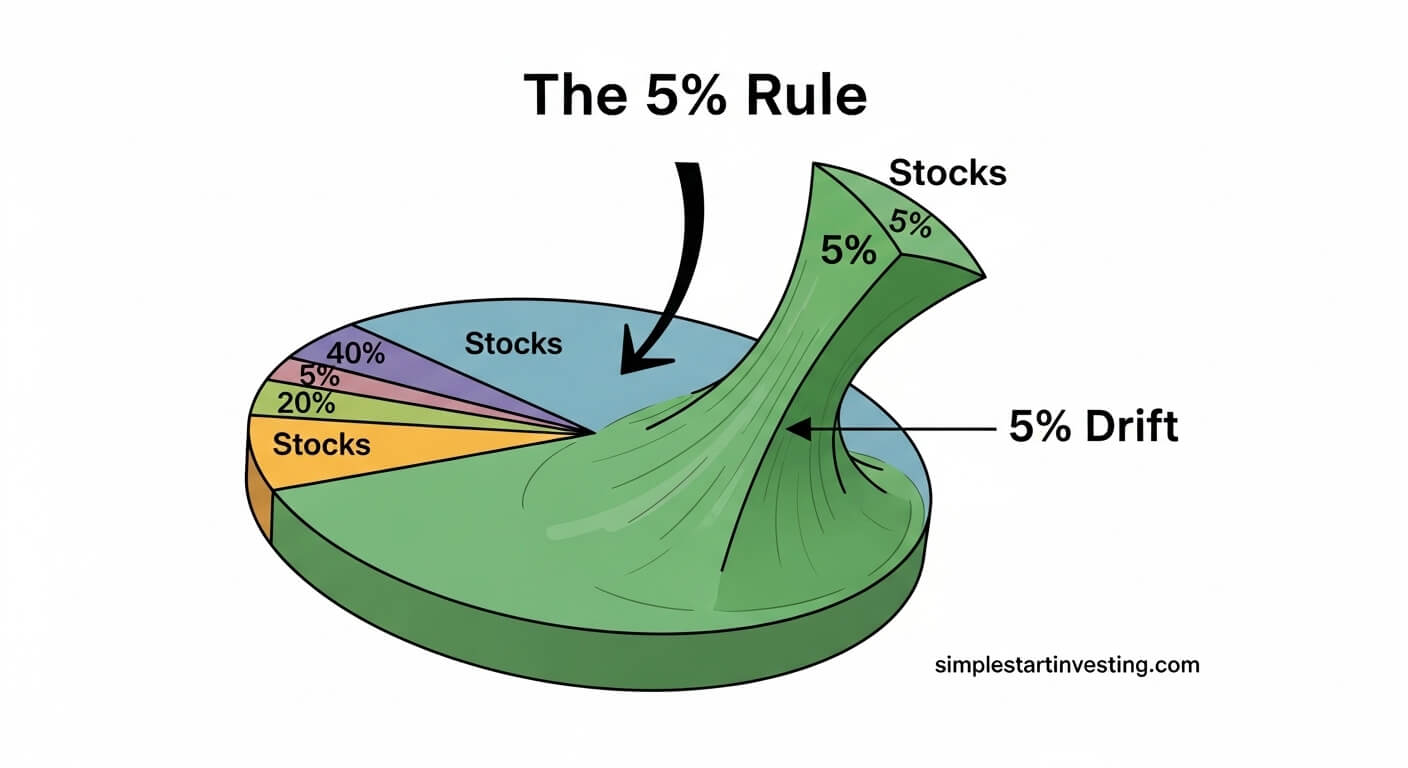
Portfolio rebalancing bands are the allowed “drift” you are willing to tolerate before you step in to fix things. If you set a 5 percent band, you are saying, “I am okay if my stocks grow to 65 percent, or if they drop to 55 percent. But if they hit 66 percent, I’m selling the extra to get back to my 60 percent target.”
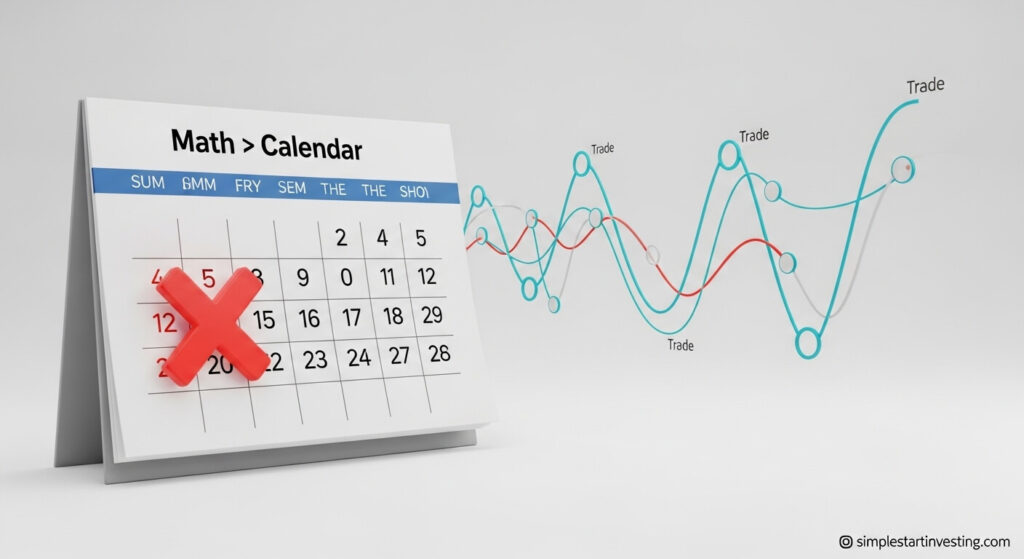
This approach is fundamentally different from “calendar rebalancing.” With a calendar, you might rebalance on June 30th even if your portfolio is only 1 percent off its target. That costs you money in transaction fees and potentially taxes for almost no benefit. With bands, you only move when the change is significant enough to actually alter your risk profile.
Why the Calendar Often Fails Beginners
We love the idea of “set it and forget it,” but the calendar method can be surprisingly inefficient. Think about a year where the market is very calm. If you rebalance every quarter just because the calendar says so, you might be selling winners and buying losers when the difference in their value is tiny. You are essentially paying “tolls” (taxes and fees) for a trip you didn’t really need to take.
On the flip side, imagine a year where the market crashes in March and recovers by December. If you only look at your account on January 1st, you missed the entire event. You didn’t buy the “sale” in March when stocks were cheap, and you didn’t lock in gains during the recovery. You slept through the opportunity because your calendar told you it wasn’t “time” yet.
Portfolio rebalancing bands solve this by being “event-driven.” They don’t care if it’s Monday morning or Christmas Eve. They only care about the math. If a major market swing happens, the bands alert you that your risk has changed. This allows you to be proactive during market volatility rather than reactive to a date on a wall.
The 5% Rule: A Simple Way to Visualize the Math
Let’s look at a practical example of how this works without getting bogged down in complex equations. Suppose you have a total of 10,000 dollars invested. You have decided that you want 5,000 dollars in a Total Stock Market ETF and 5,000 dollars in a Bond ETF. This is a 50/50 split.
Now, imagine the stock market has a fantastic month. Your 5,000 dollars in stocks grows to 6,000 dollars. Meanwhile, your bonds stayed the same at 5,000 dollars. Your total account is now 11,000 dollars. If you do the math, stocks now make up about 54.5 percent of your total money.
If you have a 5 percent rebalancing band, you look at your target (50 percent) and your current state (54.5 percent). Since the drift is only 4.5 percent, you do nothing. You let your winners run. However, if those stocks grew just a bit more and hit 56 percent of your total portfolio, you have crossed the 5 percent “band” (50 plus 5). That is your signal to sell enough stocks to bring that number back down to 50 percent.
Why Beginners Often Misunderstand This Concept
Many new investors hear the word “rebalancing” and think it’s about “timing the market.” They think they are trying to predict which way the wind will blow. In reality, portfolio rebalancing bands are the exact opposite of market timing. Market timing is based on a guess about the future; rebalancing is based on a fact about the present.
The biggest misunderstanding is that rebalancing is meant to increase your returns. While it can sometimes help, its primary job is risk management. If you start with a 60/40 portfolio and it drifts to 80/20 because stocks went up, you are no longer a “moderate” investor. You have accidentally become an “aggressive” investor. If the market then crashes, you will lose a lot more money than you ever intended to risk.
Another common mistake is setting bands that are too tight. If you set a 1 percent band, you will be trading every other week. This leads to “churn,” where your profits are eaten up by the costs of trading. For most beginners in the US market, a band of 5 percent is widely considered a “sweet spot” that balances risk control with cost efficiency.
The Psychological Advantage of Using Math Over Mood
Investing is 10 percent math and 90 percent temperament. When the market is booming, your brain screams at you to buy more. When the market is crashing, your brain screams at you to sell everything and hide under the bed. These are the moments where beginners make the biggest mistakes.
Portfolio rebalancing bands act as an emotional circuit breaker. When the market is high and everyone is greedy, your bands will eventually tell you to “sell.” You aren’t selling because you’re a genius who knew the peak was coming; you’re selling because the math says you have too much risk.

Conversely, when the market is crashing and everyone is terrified, your bands will likely show that your stock percentage has dropped below the threshold. The math tells you to “buy.” This forces you to follow the most famous (and hardest to follow) advice in investing: Buy low and sell high. It turns a scary emotional decision into a routine maintenance task.
Tax Considerations for the US Investor
When we talk about selling assets to rebalance, we have to talk about the IRS. In the United States, if you sell a stock for more than you paid for it in a standard brokerage account, you owe capital gains tax. This is why portfolio rebalancing bands are so much better than calendar rebalancing for taxable accounts.
By using bands, you reduce the number of times you trigger a tax bill. You only sell when it is absolutely necessary to protect your risk level. If you rebalance on the calendar every year, you might be paying taxes on gains that weren’t even large enough to matter for your portfolio’s health.
However, if you are investing through a 401(k) or an IRA, you generally don’t have to worry about these immediate taxes. In these “tax-advantaged” accounts, you can rebalance as much as your bands dictate without the IRS taking a cut of the transaction. This makes these accounts the perfect “laboratory” for beginners to practice using rebalancing bands.
How to Set Up Your Own Bands
You don’t need a fancy software program or a degree in finance to implement portfolio rebalancing bands. You can do it with a simple checklist.
First, define your “Targets.” This is your ideal mix of stocks, bonds, and perhaps international investments. Let’s say it’s 70 percent stocks and 30 percent bonds.
Second, define your “Tolerance.” For most beginners, a 5 percent absolute band is a great starting point. This means if any asset class moves 5 percent away from its target (e.g., stocks hitting 75 percent or 65 percent), you take action.
Third, set a “Check-in Schedule.” This is the only part that involves a calendar. You don’t trade on the schedule, but you look on the schedule. Maybe once a month or once a quarter, you log in to your account and check the percentages. If no bands are broken, you close the laptop and go back to your life. If a band is broken, you perform the trade.
Common Pitfalls to Avoid
Even with a clear strategy like portfolio rebalancing bands, beginners can stumble. One major pitfall is “The Small Account Trap.” If you only have 1,000 dollars invested, a 5 percent move is only 50 dollars. If your brokerage charges a fee to trade, or if the effort of calculating the move takes two hours of your time, it might not be worth it. For very small accounts, simply adding new money to the “underweight” asset is often a better way to rebalance.
Another pitfall is “Asset Class Overlap.” If you have three different ETFs that all hold large-cap US stocks (like Apple, Microsoft, and Amazon), and you try to set bands for each one individually, you are going to get frustrated. It is much easier for beginners to set bands for broad categories: Total Stocks vs. Total Bonds.
Lastly, beware of the “Wash Sale Rule” if you are rebalancing at a loss in a taxable account. The IRS prevents you from claiming a tax loss if you buy a “substantially identical” security within 30 days before or after the sale. While rebalancing usually involves selling winners, if you are selling a loser to rebalance into something else, you need to be aware of this rule.
Real-World Scenario: The Tech Surge
Let’s look at a recent real-world hypothetical. Suppose an investor had a portfolio that was 10 percent invested specifically in tech-heavy stocks (like those found in the Nasdaq 100). Over a year, tech stocks might surge by 50 percent while the rest of the market only moves a little.
Suddenly, that 10 percent “slice” of the pie has grown to 15 or 16 percent. To a beginner, this feels great—you’re making money! But your risk has shifted. You are now significantly more exposed to a tech crash than you were when you started.
By having portfolio rebalancing bands in place, you would see that 15 percent mark hit and realize, “Okay, the math says I’m over-leveraged in tech.” You sell that extra 5 or 6 percent and move it into your “boring” assets like bonds or cash. If tech then crashes the following month, you’ve already moved your “winnings” to a safe harbor.
Why “Doing Nothing” Is Often the Best Move
The hardest part of using portfolio rebalancing bands is the “waiting” period. There will be months, or even years, where you check your portfolio and realize you don’t need to do anything. For a new investor who is excited about “doing things,” this can feel like you are failing.
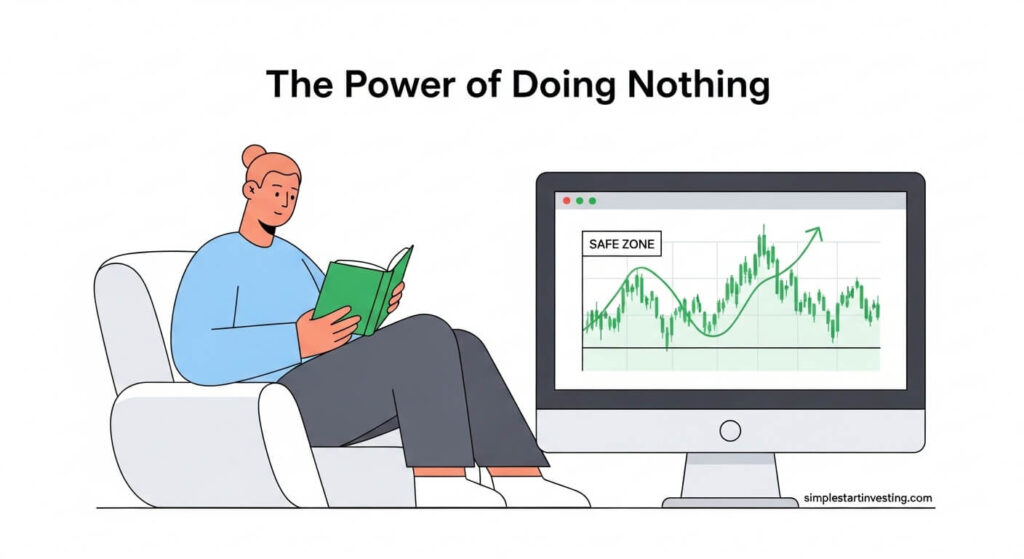
In reality, “doing nothing” is a deliberate choice. It is the choice to avoid unnecessary taxes, avoid unnecessary fees, and let your investments grow undisturbed. Rebalancing bands give you the confidence to do nothing because you know that if things do get out of hand, you have a pre-set alarm system ready to go off.
This strategy turns you into a “Passive-Aggressive” investor in the best way. You are passive because you aren’t constantly tinkering, but you are aggressive about maintaining your risk profile when the market forces your hand.
Summary of the “Bands” Strategy
Using portfolio rebalancing bands is about creating a system that respects both your long-term goals and the reality of market movement. It moves the conversation away from “What month is it?” and toward “What is my risk today?”
- Logic over Legend: Stop following “traditions” like January rebalancing and start following the data of your own account.
- Cost Efficiency: Minimize the number of trades you make, saving you money on taxes and potential transaction costs.
- Risk Control: Ensure that a “good year” in one sector doesn’t leave you dangerously exposed if that sector turns sour.
- Emotional Stability: Give yourself a clear set of rules to follow so you don’t have to make hard decisions when the market is panicking or euphoric.
As you grow as an investor, you will realize that the best strategies are the ones that save you from yourself. We are biologically wired to be bad at investing; we want to run when things are scary and jump in when things are exciting. Portfolio rebalancing bands are the guardrails that keep you on the road to long-term wealth, regardless of how many curves the market throws at you.
Setting up your first set of bands might take an hour of planning, but it will save you hundreds of hours of worrying in the future. It is the ultimate “work smarter, not harder” tool for the modern beginner investor.
Disclaimer: This content is for educational purposes only and does not constitute financial, tax, or investment advice. Market conditions change rapidly, and you should consult with a qualified professional or conduct your own due diligence before making any investment decisions.