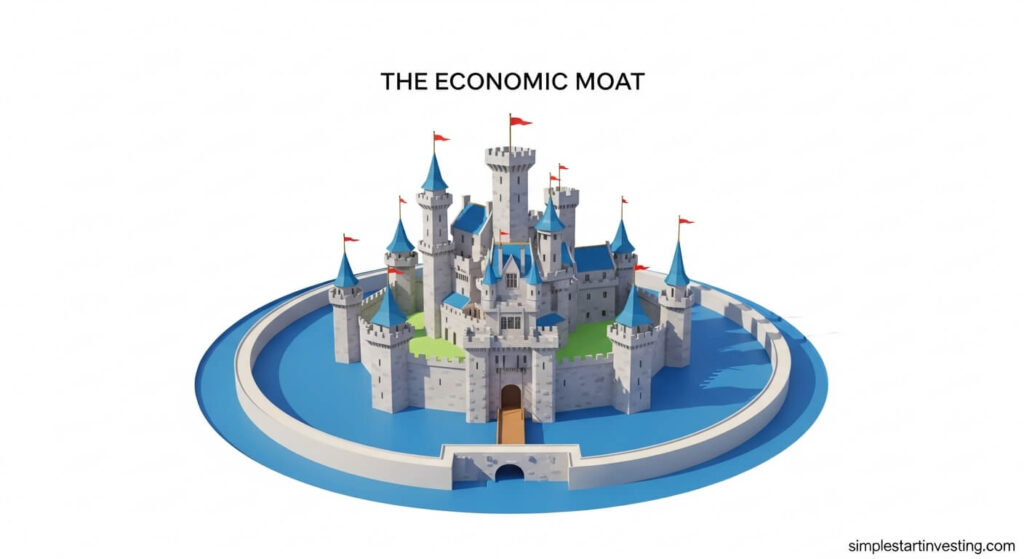
Imagine you are standing in front of a majestic medieval castle. To keep the treasure inside safe, the king didn’t just build thick walls. He dug a deep, wide trench around the castle and filled it with water. This is a moat. Its only job is to make it incredibly difficult for enemies to reach the gates.
In the world of the stock market, your “treasure” is the profit a company makes. The “enemies” are the thousands of other businesses trying to steal those profits by offering a cheaper or better version of the same product. When we talk about an economic moat, we are looking for companies that have a structural, unfair advantage that keeps competitors at bay for years, or even decades.
Finding companies with a strong economic moat is one of the most effective ways for a beginner to start thinking like a seasoned investor. Instead of guessing which stock price will go up tomorrow, you are looking for businesses that are built to last.
What is an Economic Moat?
An economic moat is a term popularized by Warren Buffett to describe a business’s ability to maintain its competitive advantages over its rivals in order to protect its long-term profits and market share. Just like a physical moat protects a castle, an economic moat protects a company’s “bottom line.”
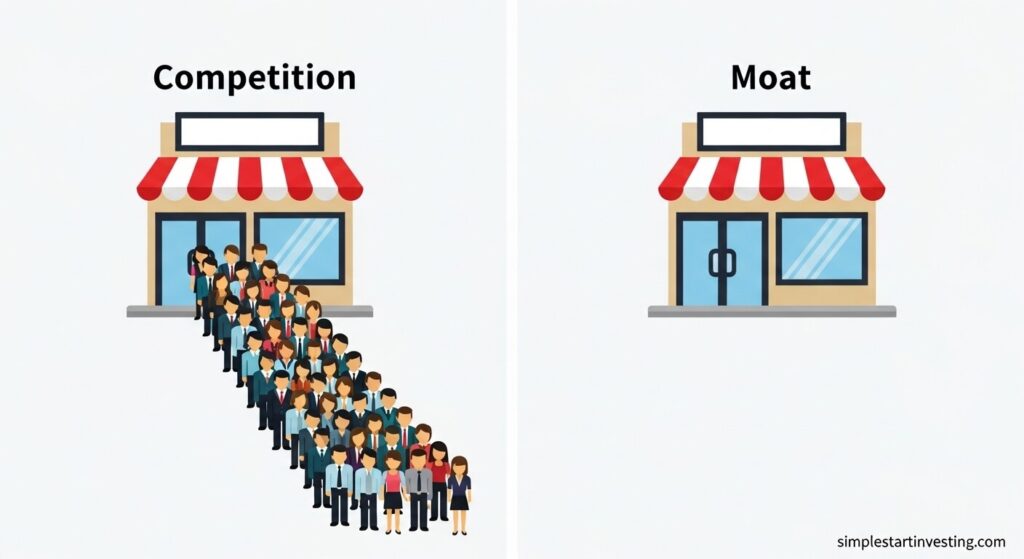
In a free-market economy, competition is the default setting. If a local bakery starts making a huge profit selling a specific type of sourdough bread, three other bakeries will likely open nearby and sell the same bread for 1 dollar less. Eventually, that original bakery has to lower its prices, and its high profits disappear.
A company with a moat, however, doesn’t have this problem. They have something that others cannot easily copy. Maybe it is a brand name that people trust implicitly, or perhaps they own a piece of technology that no one else can use. When you use the economic moat strategy, you are looking for these “protected” businesses.
Why Beginners Often Get It Wrong
Many people starting their investment journey mistake a “great product” for a “great business.” This is perhaps the most common trap. You might see a new restaurant that is always crowded and think, “I should invest in this!” However, a crowded restaurant doesn’t necessarily have a moat. If it’s just good food, another chef can move in next door and do the same thing.
The Popularity Trap
Being popular is not the same as having a moat. A company can be “trendy” for a summer, but if it doesn’t have a structural advantage, that trend will fade. Think of fashion brands that were everywhere five years ago but are now in the clearance bin. They had popularity, but they lacked a moat to defend their position when the next trend arrived.
The High-Growth Illusion
Just because a company is growing fast doesn’t mean it is protected. In fact, fast growth often attracts the most “attackers.” If a company is making a 50% profit margin on a new gadget, every tech giant in Silicon Valley will try to build a version of that gadget. Without a moat, that 50% profit margin will eventually be squeezed down to 5% as competition moves in.
Understanding the “Mean Reversion” Concept
To understand why moats matter, you have to understand a concept called “mean reversion.” In simple terms, this means that over time, most things return to the average.
In business, if a company is making way more money than the average company, competitors will jump in until that profit drops back down to the average. A moat is the only thing that stops this from happening. It allows a business to stay “above average” for a very long time.
The Five Main Types of Economic Moats
To use the economic moat strategy effectively, you need to know what these advantages look like in the real world. Most successful moats fall into one of these five categories.
1. Brand Power and Intangibles
This is the most famous type of moat. Intangible assets include things you can’t touch but that hold immense value, like patents, government licenses, and brand names.
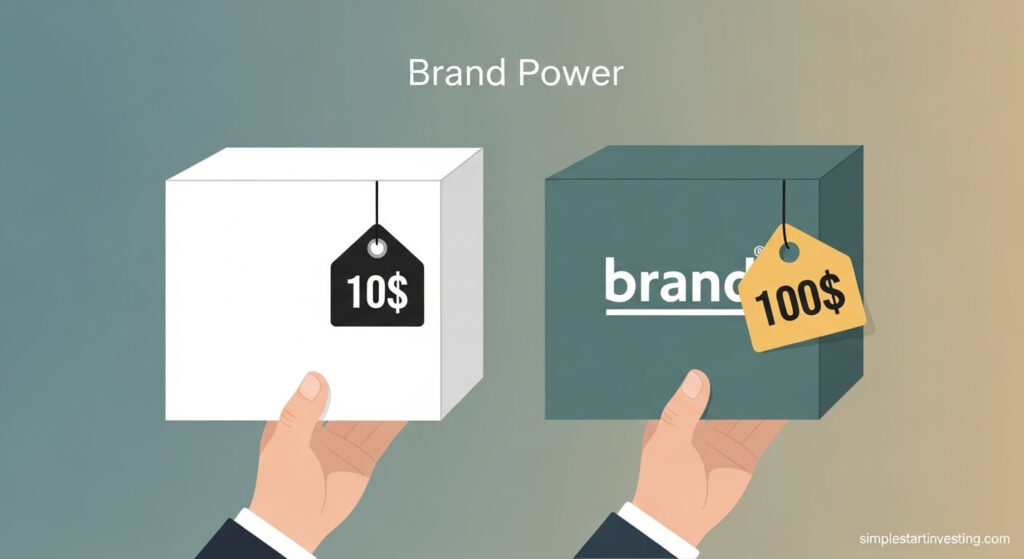
Think about a bottle of soda. You can find a generic store-brand cola for maybe 50 cents. Yet, millions of people will happily pay 2 dollars for a Coca-Cola. Why? It isn’t because the ingredients are significantly more expensive. It is the brand. People trust the taste and the feeling associated with it. That brand allows the company to charge a “premium” price, and that premium is the moat.
2. The Switching Cost Moat
Have you ever wanted to change your bank or your cell phone provider but realized it would take three days of paperwork, moving all your automatic bill payments, and setting up new accounts? That “headache” is a switching cost.
When it is too difficult, expensive, or time-consuming for a customer to switch to a competitor, the company has a moat. Many software companies use this perfectly. Once a large corporation trains 5,000 employees to use a specific accounting software, they are very unlikely to switch to a different one just to save a few dollars. The “cost” of retraining everyone is too high.
3. The Network Effect
This is one of the most powerful moats in the modern world. The network effect happens when a service becomes more valuable as more people use it.

Consider a site like eBay or a social media platform. If you want to sell a vintage watch, you go to the site where the most buyers are. If you are a buyer, you go where the most sellers are. A new competitor could build a “better” website, but if it has no users, it is useless. The value isn’t in the code; it’s in the massive network of people already there.
4. Cost Advantage
Some companies are simply better at making things cheaper than anyone else. This isn’t just about being “thrifty.” It is usually about scale.
Take a company like Walmart or Costco. Because they buy such massive quantities of goods—imagine buying 10 million rolls of paper towels at once—they get a price that a local grocery store can never match. If a competitor tries to lower their prices to compete, they will lose money, while the big player still makes a profit. Their size is their moat.

5. Efficient Scale
This is a bit more niche but very real. Imagine a small town that only needs one utility company or one major airport. It wouldn’t make sense for a second company to build a whole new set of power lines or a second runway because there aren’t enough customers to support both. The first company to get there “wins” the market, and the sheer cost for someone else to enter makes it a natural moat.
How to Spot a Moat: A Simple Logic Test
You don’t need a degree in finance to start identifying these advantages. You can use a simple logical “thought experiment” when looking at a company.
- Step 1: Imagine I gave you 10 billion dollars today.
- Step 2: Could you use that money to build a competitor that would actually take significant business away from the company you are looking at?
If the answer is “Yes, I could just build more stores and hire more people,” then the company probably doesn’t have a strong moat.
However, if you look at a company like Visa and realize that even with 10 billion dollars, you couldn’t convince millions of merchants and billions of people to stop using their cards and start using “YourName-Card” tomorrow morning, you have found a moat. The infrastructure and trust are too deep to be bought with just cash.
Looking at the Numbers (Without the Math)
While we aren’t using complex formulas, there are “telltale signs” in a company’s performance that suggest a moat exists.
Imagine two companies: Company A and Company B. Both companies sell 1,000 units of a product for 100 dollars each. This means they both bring in 100,000 dollars.
Company A spends 90,000 dollars to make and sell those products. They are left with 10,000 dollars in profit. Company B, because of a special machine they own (a moat), only spends 60,000 dollars to make the same products. They are left with 40,000 dollars in profit.
If a recession hits and everyone has to lower their prices by 15%, Company A is now losing money. They are in trouble. But Company B? They are still making a healthy profit. That “cushion” or “margin” is the physical proof of a moat. When you see a company that consistently makes a higher percentage of profit than its competitors year after year, it is usually because a moat is protecting them.
The “Wide” vs. “Narrow” Moat
In the investment world, not all moats are created equal. Professionals often categorize them into two groups:
- Wide Moats: These are the giants. These companies have advantages that are expected to last for more than 20 years. Think of a brand that your grandparents used, you use, and your children will likely use.
- Narrow Moats: These are companies that have an advantage, but it might only last for 10 years. Perhaps they have a patent on a specific drug that will expire in a decade. It is a great advantage now, but it has an “expiration date.”
As a beginner, aiming for “Wide Moats” provides a higher level of safety. It gives the company more room to make mistakes without going out of business.
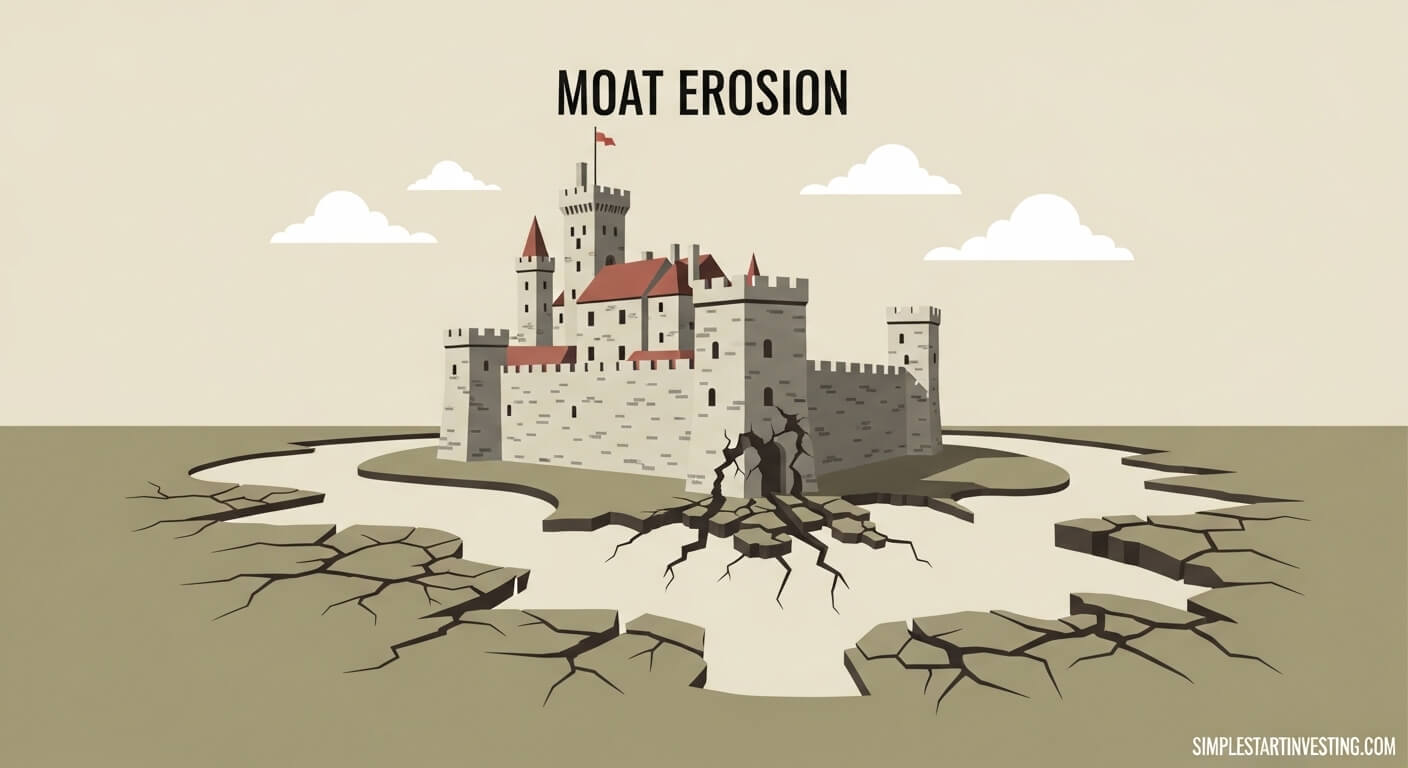
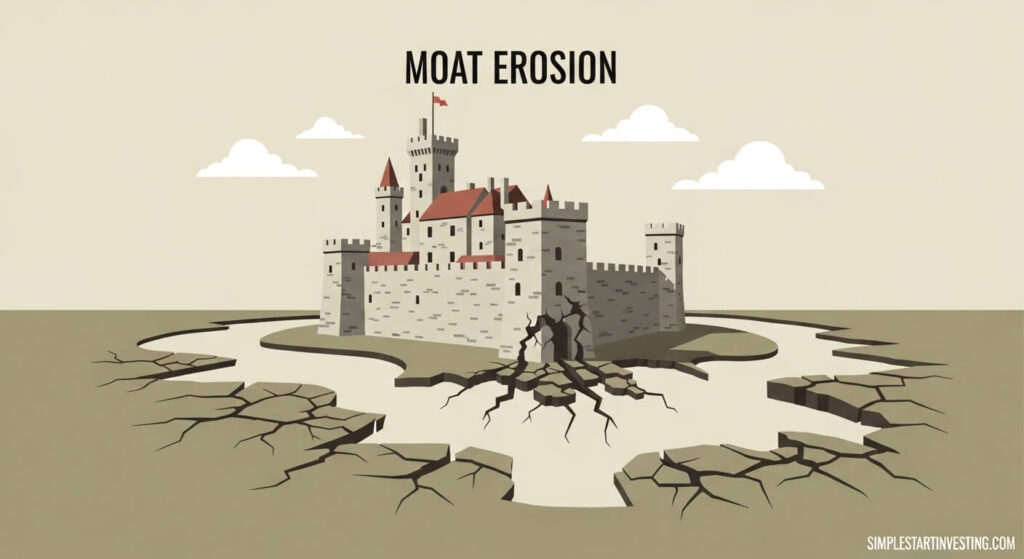
Why Moats Can Dry Up
Nothing in the world of investing is permanent. Even the deepest moats can be bridged if the world changes fast enough. This is where many investors get caught off guard.
Technology Shifts
Think about Blockbuster Video. They had a massive moat consisting of thousands of physical locations in the best street corners across America. It was very hard for a new video store to compete with that scale. But then, the internet arrived. Suddenly, having thousands of physical buildings was a liability, not an advantage. Netflix didn’t try to build a better physical store; they made the “castle” irrelevant by delivering movies through the “air.”
Management Hubris
Sometimes, the people running a company with a great moat get “lazy.” They stop innovating because they feel safe. They might start charging customers too much or stop caring about quality. This creates a “crack” in the moat. Eventually, a competitor will find a way to exploit that crack.
Regulatory Changes
In the US, many companies rely on specific laws or government protections for their moats. If the government changes the rules—for example, by passing new laws that make it easier for competitors to enter a market—that moat can vanish overnight. This is why it is important to stay aware of what is happening in the news regarding the companies you are interested in.
How to Start Your Moat Research
If you want to apply the economic moat strategy to your own learning process, start with what you know. Look around your house and your daily life.
- Check your subscriptions: What is the one service you would never cancel, even if they raised the price by 2 dollars a month? Why? (Switching costs or Brand).
- Check your phone: Which apps do you use because “everyone else is there”? (Network effect).
- Check your pantry: Are there certain items where you refuse to buy the “generic” version? (Brand power).
- Check your wallet: Which credit card logo do you see the most at the stores you visit? (Cost advantage/Network effect).
By observing your own behavior as a consumer, you are actually performing high-level “moat research.” You are identifying the companies that have successfully “captured” your loyalty and defended it against competitors.
The Safety Factor for Beginners
The reason we focus so much on the economic moat strategy for new investors is “Capital Preservation.” That is just a fancy way of saying “not losing your money.”
Companies with no moat are “fragile.” If the economy gets bad, they are the first to suffer. If a competitor has a sale, they lose customers.
Companies with wide moats are “resilient.” They can survive a bad CEO, a tough economy, or an aggressive competitor because their structural advantages provide a safety net. For someone just starting out, investing in resilience is often much more important than chasing the next “big thing” that might not be around in three years.
Summary: Thinking Like a Castle Owner
Investing isn’t about finding the fastest horse; it’s about finding the strongest fortress. When you look at a business, stop looking at just the “shiny” new products. Look at the ground around the building.
Is there a moat? Is it deep? Is it wide? Does it have crocodiles in it (metaphorically speaking)?
A company with a wide economic moat might not be the most exciting topic at a dinner party. It might be a boring company that makes trash cans, or sells insurance, or processes credit card swipes. But in the long run, “boring” companies with “unfair” advantages are often the ones that build the most sustainable wealth for their owners.
Always remember that even the best company can be a bad investment if you pay too high a price for it, and even the widest moat can dry up if the world changes. Your job is to keep watching the water levels.
Disclaimer: This content is for educational purposes only and does not constitute financial advice. Investing involves risk, and past performance is not indicative of future results. Always conduct your own research or consult with a licensed professional before making financial decisions.