If you have ever looked at the stock market news and felt a knot in your stomach, you are not alone. Investing can feel like trying to predict the weather in the middle of a hurricane. One day the market is up, the next day a global event sends everything crashing down. For most of us, especially those just starting out, the biggest fear isn’t just losing money—it is the exhausting “emotional roller coaster” of not knowing what to do when things get messy.
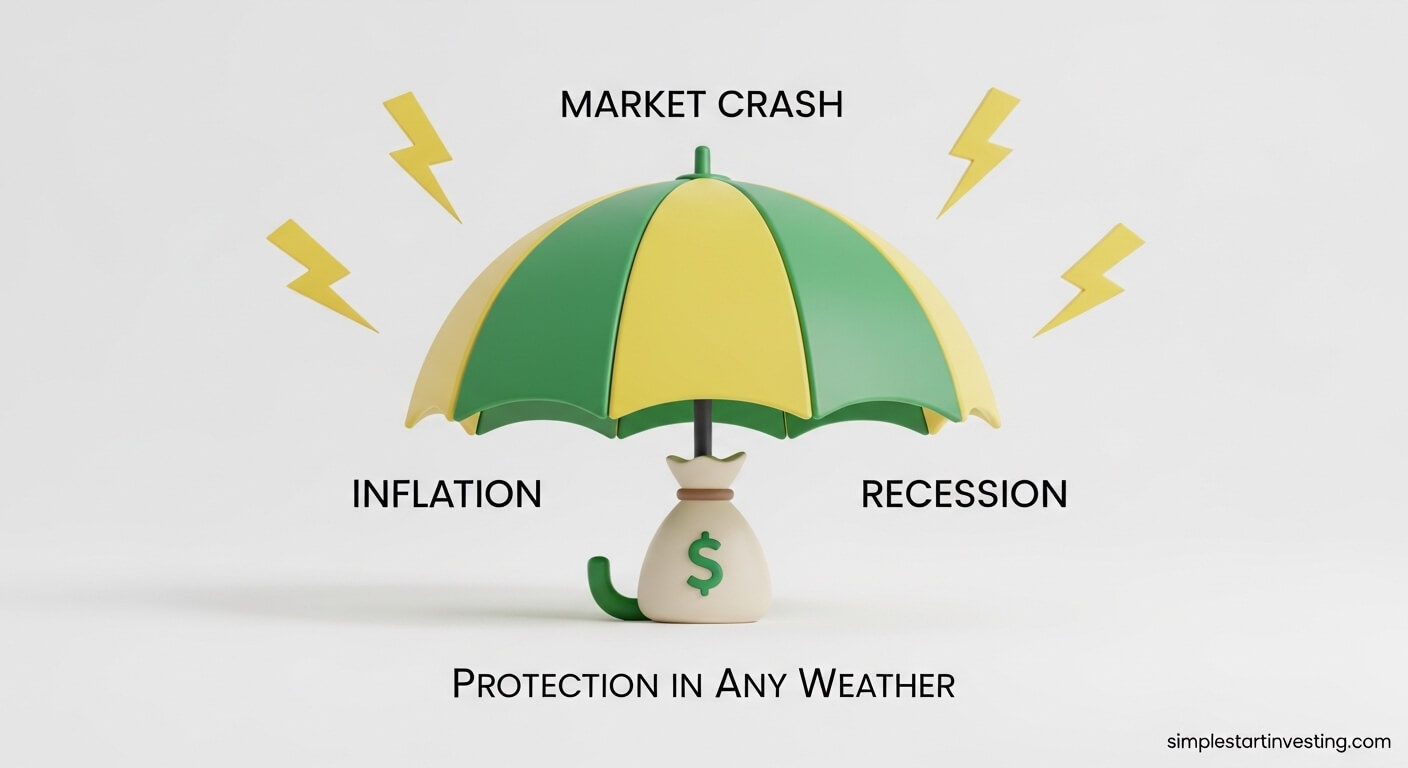
This is where the Permanent Portfolio comes in. Created by Harry Browne in the 1980s, this strategy was designed with one specific goal: to let you sleep at night regardless of what the economy is doing. It is built on the idea that we cannot predict the future, so we should build a “shield” that works in every possible scenario.
In this guide, we are going to break down exactly what the Permanent Portfolio is, why it works for beginners, and how it challenges the common mistakes most people make when they first start investing.
What Exactly Is the Permanent Portfolio?
Imagine you are packing for a trip, but you have no idea where you are going. It could be the Arctic, or it could be the Sahara Desert. To survive, you would need a coat, a swimsuit, an umbrella, and hiking boots. You pack all four because you want to be prepared for anything.
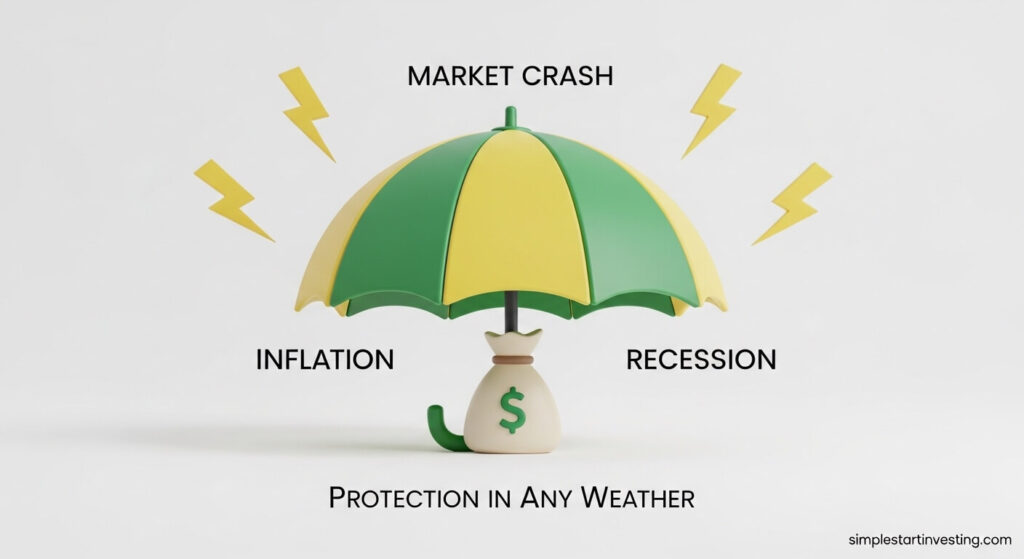
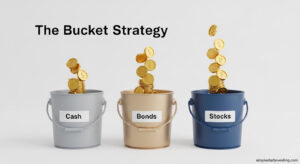
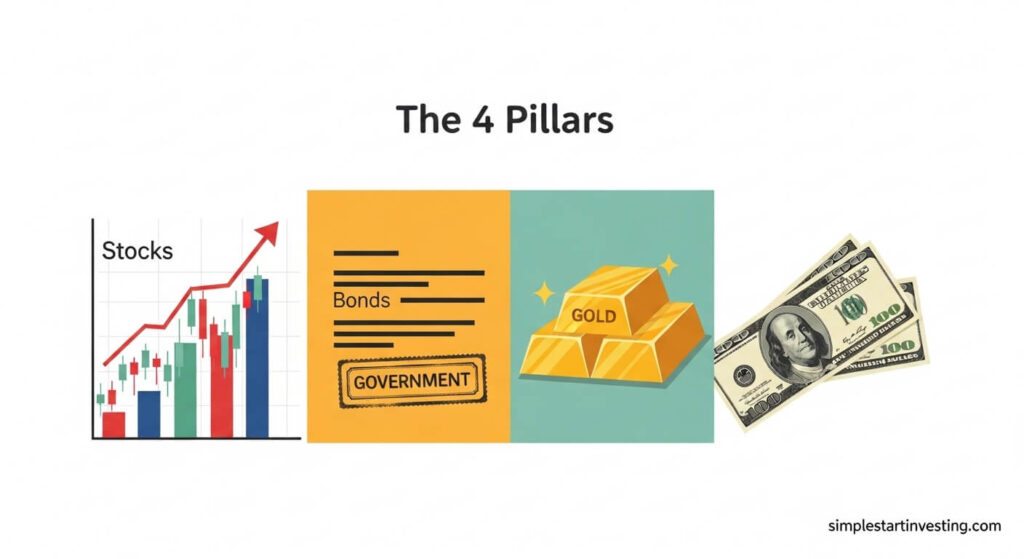
The Permanent Portfolio is the financial version of that suitcase. It splits your money equally into four different “buckets,” each making up 25 percent of your total investment. These buckets are:
- Stocks (for periods of prosperity)
- Bonds (for periods of falling interest rates or deflation)
- Gold (for periods of high inflation or currency trouble)
- Cash (for periods of recession or tight money)
By holding all four at once, you aren’t gambling on which one will win this year. Instead, you are accepting that while one or two might perform poorly, the others will likely do the heavy lifting to keep your total balance stable.
Why Beginners Often Get It Wrong
Most new investors fall into the trap of “performance chasing.” When they see tech stocks like Nvidia or Apple soaring, they want to put all their money there. When they hear about a housing boom, they want to jump into real estate.
The problem is that by the time a beginner hears a “hot tip,” the best gains have usually already happened. Even worse, if the economy shifts—say, inflation suddenly spikes—those tech stocks might crash. If you only own stocks, your entire financial future is tied to one single “weather pattern.”
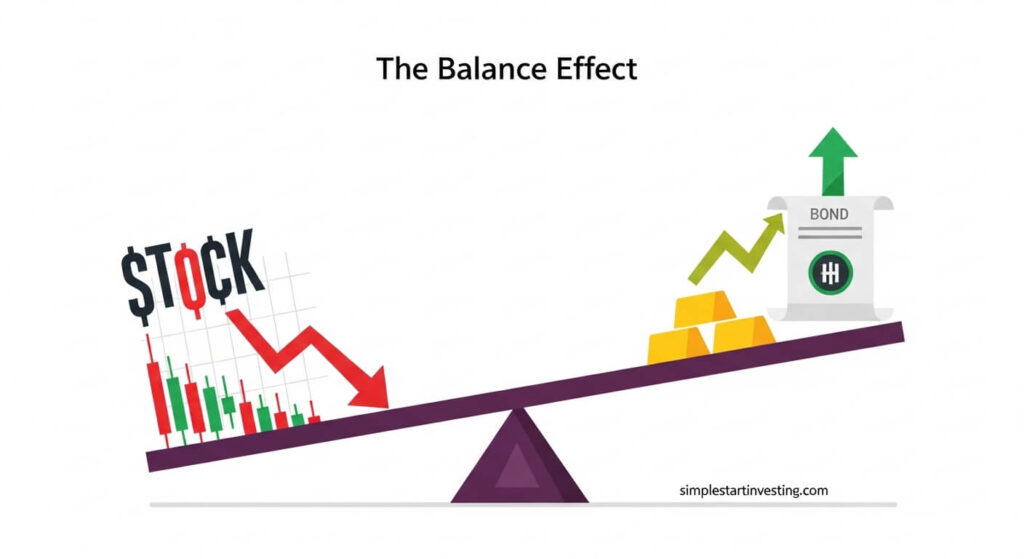
Another common mistake is thinking that “diversification” just means owning ten different stocks. In reality, if those ten stocks all belong to the same industry, they will likely all crash at the same time. The Permanent Portfolio offers true diversification because the four assets are “uncorrelated.” This means they usually don’t move in the same direction at the same time. When one goes down, another is designed to go up.
Pillar 1: Stocks for Prosperity
When the economy is growing, businesses are selling more products, people are getting raises, and everyone feels optimistic. This is the “Prosperity” phase. In this environment, Stocks are your best friend.
In the Permanent Portfolio, you typically hold a broad market index. Think of companies like Amazon, Walmart, or Costco. When these companies thrive, the value of your stock portion grows. Stocks are the “engine” of your portfolio. They provide the long-term growth that helps your money stay ahead of the cost of living.
However, stocks are volatile. They can drop 20 or 30 percent in a few weeks. That is why we don’t put everything into them. We only use them for that 25 percent “growth” slice of the pie.
Pillar 2: Bonds for Deflation
Deflation is a word we don’t hear often, but it is a serious economic state where prices fall and the economy slows down significantly. In this environment, cash becomes more valuable, and interest rates usually drop.
The Permanent Portfolio uses long-term Treasury Bonds for this section. When interest rates fall, the value of existing bonds with higher rates goes up. It is like owning a vintage car that is no longer being made—it becomes more precious.
Bonds act as the “parachute.” When the stock market crashes because of a slowing economy, bonds often move in the opposite direction, cushioning the fall. For a beginner, seeing your bonds go up while your stocks go down is the best way to prevent a panic-sell.
Pillar 3: Gold for Inflation
Inflation is the silent thief. It is what happens when your 100 dollars this year can only buy what 95 dollars bought last year. If you only hold stocks and bonds, a period of massive inflation—where the value of the US dollar drops—can hurt your purchasing power.

Gold is the “insurance policy” in this portfolio. Throughout history, gold has held its value when paper currencies struggled. It doesn’t pay a dividend, and it doesn’t “grow” like a company, but it acts as a store of value.
If there is a crisis or if the government prints too much money, gold prices usually spike. By keeping 25 percent in gold, you are protecting yourself against the “worst-case” scenarios that can ruin traditional stock-and-bond portfolios.
Pillar 4: Cash for Recession
When we say “Cash” in the context of the Permanent Portfolio, we don’t mean a pile of 20-dollar bills under your mattress. We mean very safe, short-term investments like Treasury Bills (T-Bills) or high-yield money market funds.
Cash is your “stability.” During a recession, when banks are tight with money and businesses are struggling, having liquid cash is vital. It provides two things:
- Safety: Your cash balance won’t drop by 50 percent overnight.
- Opportunity: If the other assets crash, your cash stays steady, allowing you to use it to buy more of the assets that are now “on sale” (we will talk about this in the “Rebalancing” section).
The Power of the 25% Split
You might be wondering: “Why exactly 25 percent? Why not more in stocks?”
The reason is psychological. If you have 10,000 dollars and you put 5,000 into stocks, a 50 percent market crash means you lose 2,500 dollars. That hurts. But if you only have 2,500 dollars in stocks (which is 25 percent), that same 50 percent crash only costs you 1,250 dollars.
More importantly, while those stocks were crashing, your bonds or gold were likely rising, perhaps making up for that 1,250 dollar loss entirely. The Permanent Portfolio isn’t about getting rich the fastest; it is about making sure you never get “wiped out.” For a beginner, staying in the game is more important than winning a sprint.
How to Handle the “Rebalancing” Process
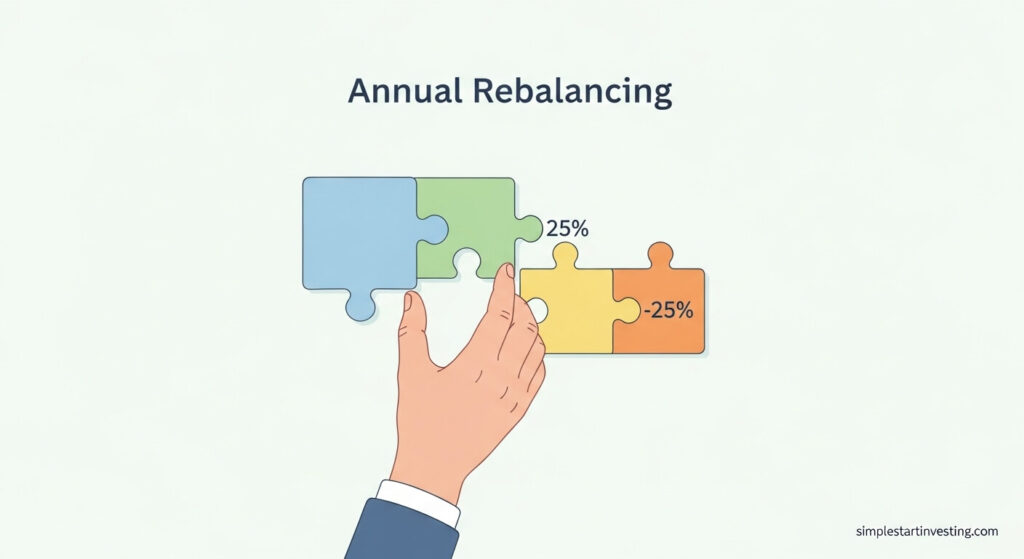
This is where the magic happens. Over a year, your 25 percent slices will naturally change. Because the market moves, you might find that after a great year for tech, your stocks now make up 30 percent of your portfolio, while your gold has dropped to 20 percent.

Rebalancing is the simple act of bringing them back to 25 percent each. You sell a little bit of what did well (Selling High) and use that money to buy what did poorly (Buying Low).
Let’s look at a simple example. If you started with 1,000 dollars total, you had 250 dollars in each bucket. After a year, your stocks grew to 350 dollars, and your gold fell to 150 dollars. To rebalance, you would sell 100 dollars of your stocks and buy 100 dollars of gold. Now you are back to 250 dollars in each.
By doing this once a year, you are forcing yourself to follow the most important rule of investing: Buy Low, Sell High. You don’t need a PhD in finance; you just need to follow the 25 percent rule.
Common Misconceptions About the Permanent Portfolio
“Gold is a useless rock.” You will hear many famous investors criticize gold. They are right that gold doesn’t produce anything. However, in the Permanent Portfolio, gold isn’t there to “produce.” It is there to protect. It is like the fire extinguisher in your kitchen. You hope you never have to use it, and most of the time it just sits there, but you are very glad to have it if a fire starts.
“Bonds are dead because interest rates are low.” People often think bonds are only for earning interest. In this strategy, bonds are also a “capital gains” play. If the economy enters a deep “deflationary” depression, bonds can soar in value. They are your hedge against a repeat of the 1930s.
“I should have more stocks to make more money.” This is the “greed” trap. If you increase your stocks to 50 percent or 70 percent, you are no longer in a Permanent Portfolio. You are now in a “Aggressive Growth” portfolio. That is fine if you can handle your balance dropping by 40 percent in a bad year. Most beginners think they can handle it until it actually happens. The 25 percent limit protects you from your own emotions.
Tax Considerations for US Investors
Since we are talking about the US market, we have to mention the IRS. When you “Rebalance” (sell something that went up), you might trigger “Capital Gains Tax.”
If you hold these investments in a standard brokerage account, you will owe taxes on the profit every time you sell. To avoid this, many beginners choose to run this strategy inside a “Tax-Advantaged” account like a 401(k) or an IRA.
Inside an IRA, you can sell your “winning” assets and buy the “losing” ones without triggering a tax bill that year. This allows your money to compound much faster over time. If you are doing this in a regular account, you might choose to rebalance by simply adding “new” money to the assets that are lagging, rather than selling the ones that are up. This is a “tax-efficient” way to keep your 25 percent slices in balance.
Is This Strategy Still Relevant Today?
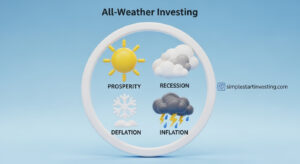
We live in a world of high-speed trading and complex crypto-currencies. It is easy to think a simple four-asset strategy from the 80s is outdated. However, the four economic states—Prosperity, Inflation, Deflation, and Recession—have not changed.
The US economy still cycles through these phases. Whether it was the dot-com bubble of 2000, the housing crash of 2008, or the recent spikes in inflation, the Permanent Portfolio has historically provided a much smoother ride than owning stocks alone.
For a beginner, the biggest enemy is not the market—it is “Panic.” Most people quit investing because they lose too much money too fast and get scared. The Permanent Portfolio is designed to prevent that panic by keeping your losses small and your recovery fast.
Steps to Get Started
If this approach sounds right for you, here is how a beginner typically thinks about setting it up:
- Open a Brokerage Account: You need a place to buy your assets (like Vanguard, Fidelity, or Charles Schwab).
- Select Your “Instruments”: You don’t buy physical gold bars or individual stock certificates. Instead, most people use ETFs (Exchange Traded Funds). You would look for one ETF for the total stock market, one for long-term Treasury bonds, one for gold, and keep the rest in a money market fund (cash).
- Divide Your Initial Amount: If you have 4,000 dollars, put 1,000 into each.
- Set a Calendar Reminder: Once a year, check your percentages. If one has moved too far from 25 percent, adjust it.
- Ignore the Noise: Stop checking the daily price of Bitcoin or the latest “hot stock” on the news. Your portfolio is built for the long haul.
Summary of the Journey
The Permanent Portfolio is not a “get rich quick” scheme. It is a “stay wealthy” strategy. It acknowledges that the future is uncertain and that “the experts” are often wrong.
By accepting that you don’t know what will happen next, you actually become a smarter investor. You stop guessing and start preparing. Whether the next decade brings a booming economy or a difficult recession, you can breathe easy knowing that 25 percent of your portfolio is specifically designed to handle exactly what is happening.
It is simple, it is balanced, and for many people, it is the key to a stress-free financial life.
Disclaimer: This content is for educational purposes only and does not constitute financial advice. Investment involves risk, and past performance is no guarantee of future results. Please consult with a qualified professional before making any financial decisions.