Losing money on a stock trade is never a fun experience. Whether you took a gamble on a tech startup or held onto a blue-chip company that hit a rough patch, seeing that red number in your portfolio hurts. However, in the world of American investing, there is a small silver lining to these losses: tax deductions. The IRS allows you to use your investment losses to offset your gains, which can lower your overall tax bill.
But there is a catch that catches thousands of new investors off guard every year. It is called the Wash-Sale Rule. If you aren’t careful, you could sell a stock at a loss, buy it back because you still believe in the company, and suddenly find out that your tax deduction has vanished into thin air.
Understanding the Wash-Sale Rule is essential for anyone starting their investing journey. It isn’t just a technicality; it’s a regulation that dictates how and when you can claim your losses. If you ignore it, you might end up paying more to the government than you actually owe. Let’s break down exactly how this rule works, why it exists, and how you can navigate it like a pro.
What Exactly is the Wash-Sale Rule?
In the simplest terms, the Wash-Sale Rule is a regulation from the IRS that prevents investors from claiming a tax deduction for a security sold at a loss if they buy that same security (or one that is nearly identical) too quickly.
The IRS created this rule to stop people from “gaming the system.” Without it, an investor could sell a stock on December 31st just to claim a tax loss, and then buy it back on January 1st to keep their position in the company. The IRS views this as a “wash”—meaning nothing really changed in your portfolio except for an artificial tax benefit.
To prevent this, the government established a specific timeframe. If you sell for a loss and buy back within that window, your loss is “disallowed” for the current tax year. You don’t lose the money forever, but you can’t use it to lower your taxes right now.
The 61-Day Danger Zone
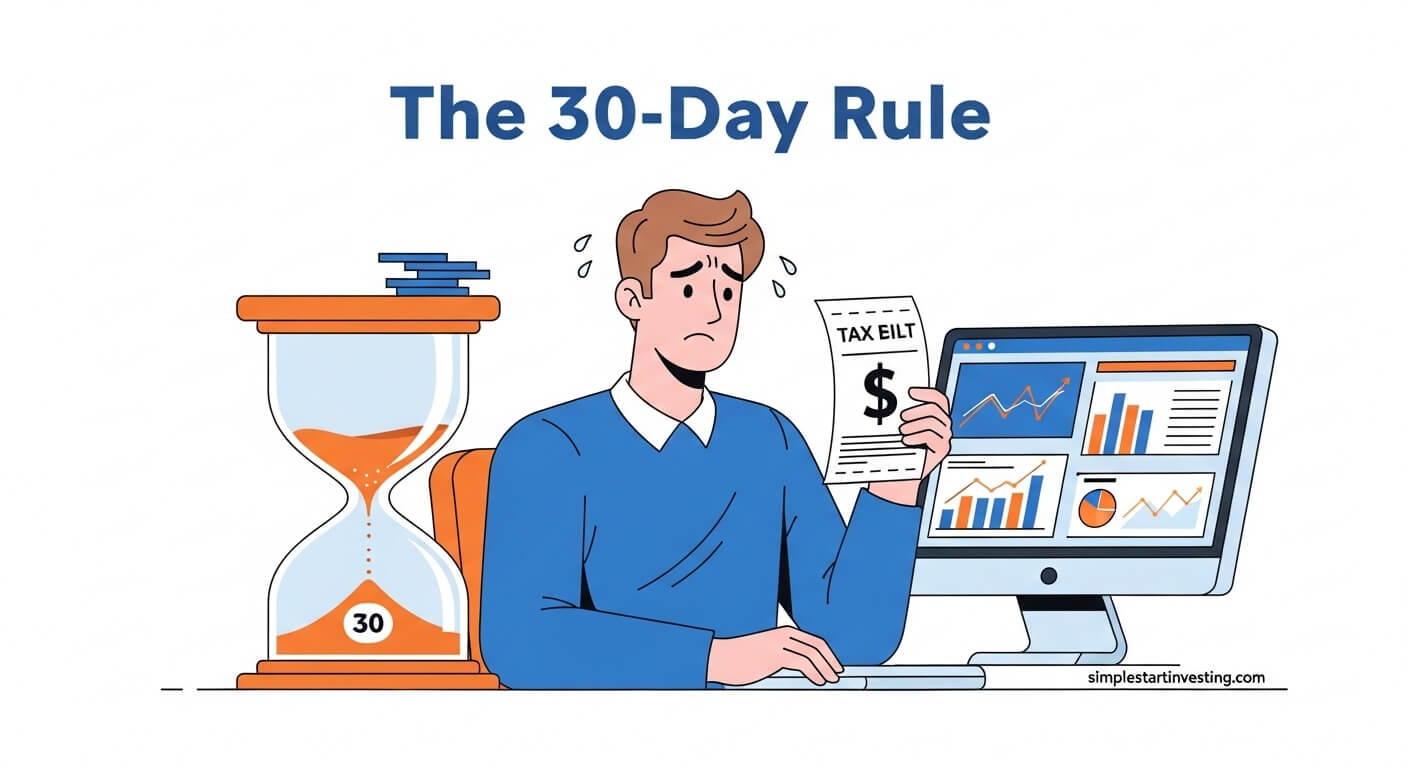
Most beginners think the Wash-Sale Rule only applies if they buy a stock back after they sell it. This is a common misconception. The rule actually covers a 61-day window. This includes:
- The 30 days before the sale.
- The actual day of the sale.
- The 30 days after the sale.
This means if you already owned 100 shares of a company and you decided to buy another 100 shares today, and then sold your original 100 shares for a loss tomorrow, you have triggered a wash sale. Because you bought shares within 30 days before the sale, the IRS considers that a replacement.
Counting the days is the most important part of staying compliant. If you sell a stock at a loss on the 15th of the month, you generally need to wait until at least the 16th of the following month before buying it back if you want to claim that loss on your taxes this year.
Why Investors Get Confused About “Substantially Identical”
One of the most complex parts of the Wash-Sale Rule is the term “substantially identical.” The IRS doesn’t just look at the exact same stock ticker; they look at whether the new investment is essentially the same thing.
If you sell Apple stock (AAPL) and buy Apple stock back, that is a clear wash sale. But what if you sell an S&P 500 Index Fund from one company and immediately buy an S&P 500 Index Fund from a different company?

While the IRS hasn’t given a 100% definitive list, most tax professionals agree that two funds tracking the exact same index are “substantially identical.” However, if you sell an S&P 500 fund and buy a “Total Stock Market” fund, they are likely different enough to avoid the rule, even though they hold many of the same companies.
For a beginner, the safest path is to avoid buying anything that mirrors your old investment too closely during that 60-day window. If you sell a tech stock at a loss, maybe look at a different sector or a broad-market fund instead of a direct competitor that moves the exact same way.
The Cost Basis: The Silver Lining You Need to Know
If you accidentally trigger a wash sale, you might feel like you’ve been penalized. While it’s true you can’t claim the loss on your taxes this year, the IRS doesn’t just steal that money. Instead, they require you to add the amount of the loss to the “cost basis” of your new shares.
Let’s walk through a simple example of how this works in practice. Imagine you bought a share of a company for 100 dollars. A few months later, the price drops, and you sell it for 80 dollars. You have a 20-dollar loss.
If you wait 31 days to buy it back, you can tell the IRS you lost 20 dollars, and that will lower your taxable income. However, if you buy it back the next day for 80 dollars, the Wash-Sale Rule kicks in. You cannot claim that 20-dollar loss this year.
Instead, the IRS says your “new” cost basis for that share is 100 dollars (the 80 dollars you just paid plus the 20-dollar loss you weren’t allowed to claim). When you eventually sell that new share in the future for 120 dollars, the IRS will see your cost as 100 dollars, meaning you only owe taxes on a 20-dollar gain instead of a 40-dollar gain.
In short, the rule postpones your tax benefit; it doesn’t delete it. But for many investors who were counting on that deduction to lower their tax bill this year, the delay can be a major headache.
The IRA Trap: A Common Beginner Mistake
Many new investors think they can outsmart the Wash-Sale Rule by using different types of accounts. They might sell a stock for a loss in their regular taxable brokerage account and then immediately buy it back in their Roth IRA.
The IRS is one step ahead of this strategy. They have explicitly stated that buying a stock in an IRA after selling it for a loss in a taxable account triggers a wash sale.
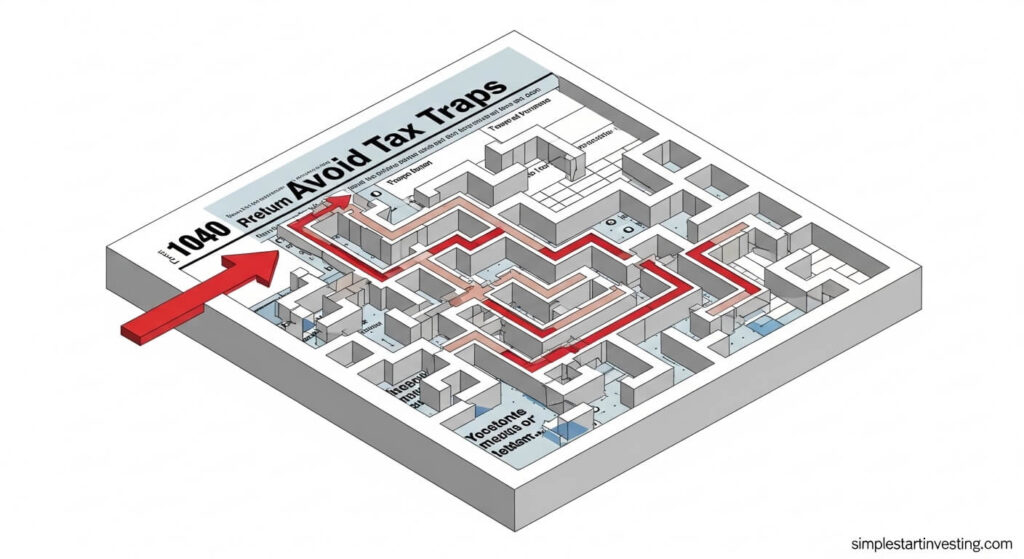
What makes this even worse is that when a wash sale happens involving an IRA, you might actually lose the tax benefit forever. Because IRAs have different tax rules, you can’t always “add the loss to the cost basis” like you can in a regular account. This is a “permanent” loss of a deduction.
If you are selling for a loss specifically to help your taxes, you must ensure that neither you nor your spouse buys that same stock in any account—including retirement accounts—for at least 30 days before or after.
Why Does “Tax Loss Harvesting” Matter?
To understand why the Wash-Sale Rule is so important, you have to understand the strategy of “Tax Loss Harvesting.” This is a common practice where investors intentionally sell losing investments to offset the gains they made on winning investments.
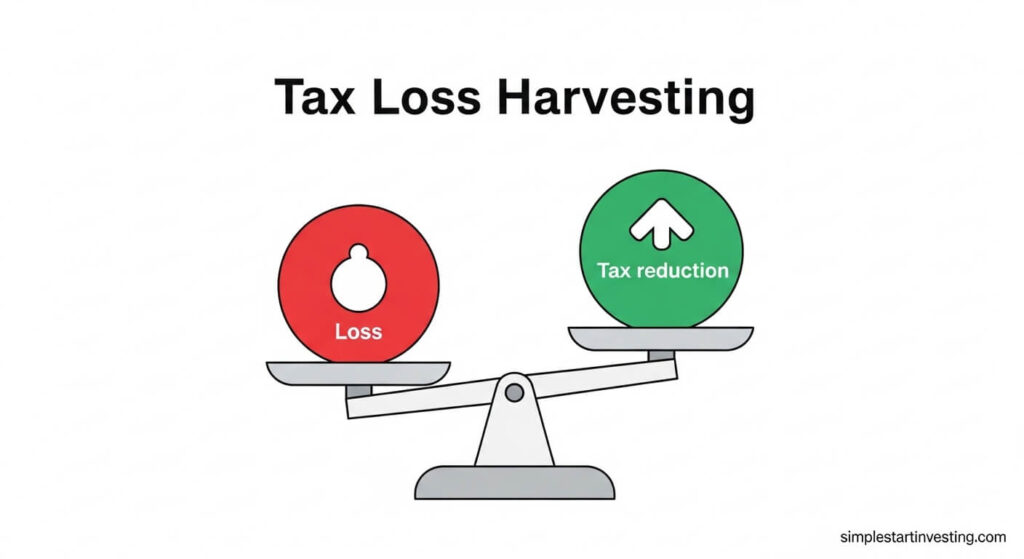
For example, if you made 5,000 dollars in profit from selling Tesla stock, but you are currently holding a 5,000-dollar loss in a different stock, you could sell the loser to “wipe out” the gains. In the eyes of the IRS, you made zero dollars in profit, and you won’t owe any capital gains tax.
This is a powerful tool for building wealth. It allows more of your money to stay invested and grow over time rather than being paid out in taxes. The Wash-Sale Rule is simply the “speed limit” for this strategy. You can harvest your losses, but you can’t immediately jump back into the exact same position.
How to Handle a Wash Sale if it Happens to You
Don’t panic if you see a “W” or a “Wash Sale” note on your brokerage statement. It happens to the best of us, especially when we use automated features like dividend reinvestment.
If you have a “DRIP” (Dividend Reinvestment Plan) turned on, your brokerage automatically uses your dividends to buy more shares. If you sell a stock for a loss and a dividend happens to be paid and reinvested within 30 days, that tiny reinvestment can trigger a wash sale for a portion of your shares.
The best way to handle this is to simply keep track of it for tax season. Most modern brokerage platforms (like Fidelity, Schwab, or Vanguard) do a great job of tracking wash sales for you. When they send you your 1099-B tax form at the end of the year, it will show your total losses and specifically list how much was disallowed due to wash sales.
Strategies to Avoid the Wash-Sale Rule
If you want to sell a stock to get the tax break but you still want exposure to that industry, there are a few smart ways to do it without breaking the IRS rules.
First, you can wait out the clock. This is the most straightforward method. Sell the stock, put the cash in a high-yield savings account or a money market fund, and set a calendar reminder for 31 days. Once the 31 days have passed, you are free to buy back in and claim your loss.
Second, you can “Double Up.” If you really love a stock and don’t want to be out of the market for 30 days, you could buy an equal amount of new shares, wait 31 days, and then sell your original shares for a loss. Since the purchase happened more than 30 days before the sale, it doesn’t trigger the rule. However, this requires having extra cash on hand and doubling your risk for a month if the stock price continues to drop.
Third, you can use a “Substitute.” If you sell a specific airline stock at a loss, you could immediately buy an Airline ETF (Exchange Traded Fund). While the ETF might hold the stock you just sold, it is not “substantially identical” because it represents a whole basket of companies. This allows you to stay invested in the recovery of the airline industry while still capturing the tax loss from the individual company.
Common Myths About the Wash-Sale Rule
There is a lot of misinformation online, especially on social media, about how to “bypass” these rules. Let’s clear up a few of the most common myths.
Myth 1: “It only counts if I sell and buy the exact same number of shares.” False. If you sell 100 shares for a loss and buy back 10 shares, those 10 shares will trigger a wash sale for a portion of your loss. The rule applies proportionally.
Myth 2: “The IRS won’t know if I use a different brokerage.” False. While your brokerage might not see a trade you made on a different platform, you are still legally required to report wash sales across all your accounts. If you get audited, the IRS will look at your total activity. Using two different apps does not make it legal.
Myth 3: “This rule applies to crypto.” This is a gray area. For a long time, the Wash-Sale Rule only applied to “securities” (stocks and bonds). Currently, the IRS classifies cryptocurrency as “property.” However, there have been many discussions in Congress about changing this to bring crypto in line with stocks. You should always check the most current IRS guidelines regarding digital assets, as the landscape is shifting quickly.
Planning for the End of the Year
The Wash-Sale Rule is most dangerous in December. Many investors wait until the final week of the year to do their tax planning. If you sell a stock for a loss on December 28th, you cannot buy it back until late January.
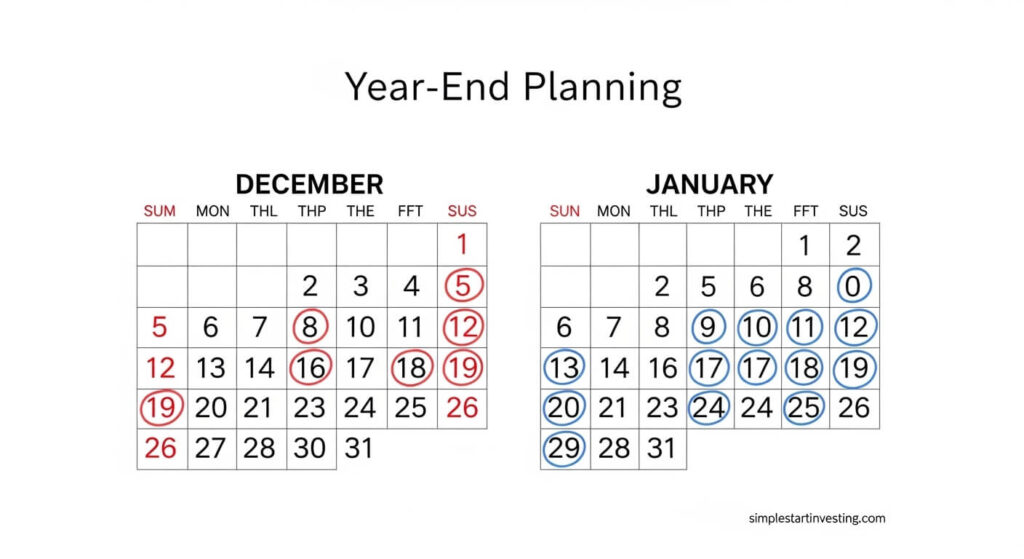
If you buy it back on January 10th, that loss you took in December becomes “disallowed” for the previous year. It gets moved into the new year’s cost basis. This can lead to a nasty surprise when you realize you owe more in taxes for the year that just ended than you expected.
To be safe, try to finish your tax-loss selling by the end of November or very early December. This gives you plenty of time to clear the 30-day window before the new year begins, ensuring your deductions are locked in.
Is the Wash-Sale Rule Always a Bad Thing?
Surprisingly, no. For long-term investors, a wash sale is often just a minor accounting adjustment. Since the loss is added to your cost basis, you will eventually get that tax benefit whenever you sell the new shares for good.
The only time a wash sale is truly “bad” is when you urgently need that deduction to offset a large gain this year, or when you trigger it in an IRA and lose the deduction forever. Otherwise, it is simply a timing issue.
The key is to remain intentional. Don’t let your emotions drive your trades. If a stock you own drops significantly, take a deep breath. Decide if you want to hold it for the long term or if you want to use that loss to help your taxes. If you choose the tax route, just remember to respect the 30-day clock.
The Importance of Professional Help
While this guide provides a deep dive into the basics, everyone’s tax situation is unique. As your portfolio grows, the complexity of managing multiple accounts, wash sales, and different types of assets increases.
If you find yourself frequently triggering wash sales or if you are dealing with very large sums of money, it is worth speaking with a tax professional or a Certified Public Accountant (CPA). They can help you look at your overall “tax picture” and ensure you are maximizing your deductions without running into trouble with the IRS.
Investing is a marathon, not a sprint. Learning the “rules of the road” like the Wash-Sale Rule helps you avoid unnecessary potholes and keeps more of your hard-earned money in your pocket. Stay patient, stay informed, and always keep an eye on the calendar when you’re managing your losses.
Disclaimer: This content is for educational purposes only and does not constitute financial or tax advice. Tax laws are subject to change and vary based on individual circumstances. Always consult with a qualified tax professional regarding your specific situation.