Investing often feels like trying to predict the weather. One day the sun is shining on your portfolio, and the next, a sudden storm wipes out months of progress. For many beginners, this roller coaster is so terrifying that they either never start or they quit at the worst possible time. But what if you could build a portfolio designed to handle any “economic weather” while still growing your wealth?
This is where the Golden Butterfly Portfolio comes in. It is a modern investment strategy that has gained a cult following for its ability to deliver stock-like returns with much less of the stomach-churning volatility. In this guide, we will break down exactly what this portfolio is, why it works, and why it might be the perfect starting point for your financial journey.
What is the Golden Butterfly Portfolio?
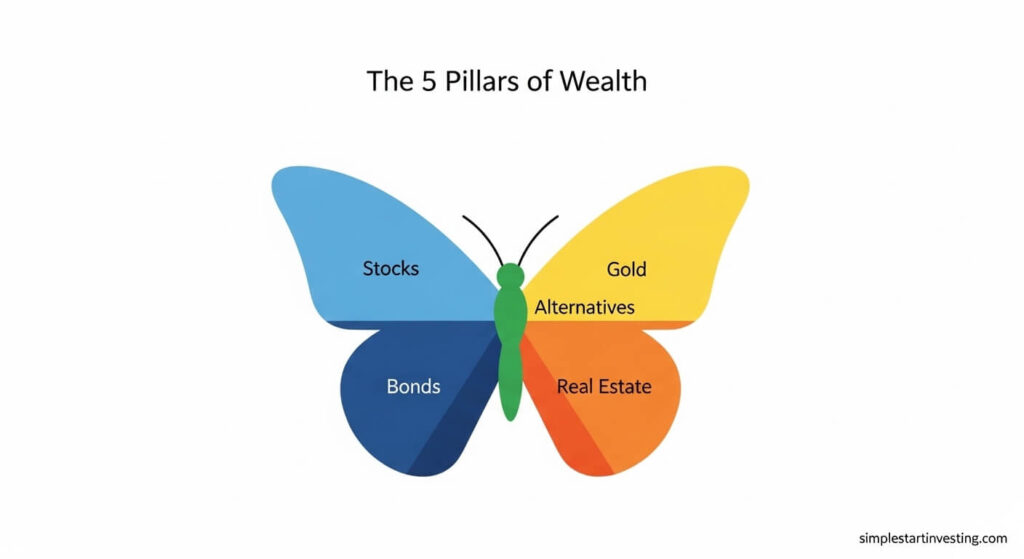
At its heart, the Golden Butterfly Portfolio is a diversified investment strategy that splits your money equally into five different buckets. Each bucket represents 20% of your total investment. This specific mix was designed to capture growth when the economy is booming but protect your savings when things take a turn for the worse.
The strategy is a variation of the famous “Permanent Portfolio” created by Harry Browne in the 1980s. While the original version focused almost entirely on safety, the Golden Butterfly adds a “growth engine” to the mix. It aims to give you the best of both worlds: the safety of a bunker and the growth of a high-performance engine.
The five pillars of this portfolio are Total Stock Market, Small-Cap Value Stocks, Long-Term Treasury Bonds, Short-Term Treasury Bonds, and Gold. By keeping exactly 20% in each, you create a balanced system where, usually, when one part is struggling, another part is thriving.
Understanding the Five Pillars
To understand why the Golden Butterfly Portfolio is so effective, we need to look at what each of these five components does for you. Think of them like a sports team where every player has a unique and vital role.
1. Total Stock Market (20%)
This is your primary growth engine. When you buy a “Total Stock Market” fund, you are buying a tiny piece of almost every public company in the United States. From tech giants like Apple and Microsoft to retail leaders like Walmart, you own it all. When the US economy grows, this part of your portfolio does the heavy lifting.
2. Small-Cap Value Stocks (20%)
This is the “secret sauce” of the Golden Butterfly. Small-cap stocks are smaller companies, and “value” means they are currently priced lower than what they might actually be worth. Historically, these stocks have outperformed the broader market over long periods. By adding this, you are boosting your potential returns without relying solely on the big names everyone already knows.
3. Long-Term Treasury Bonds (20%)
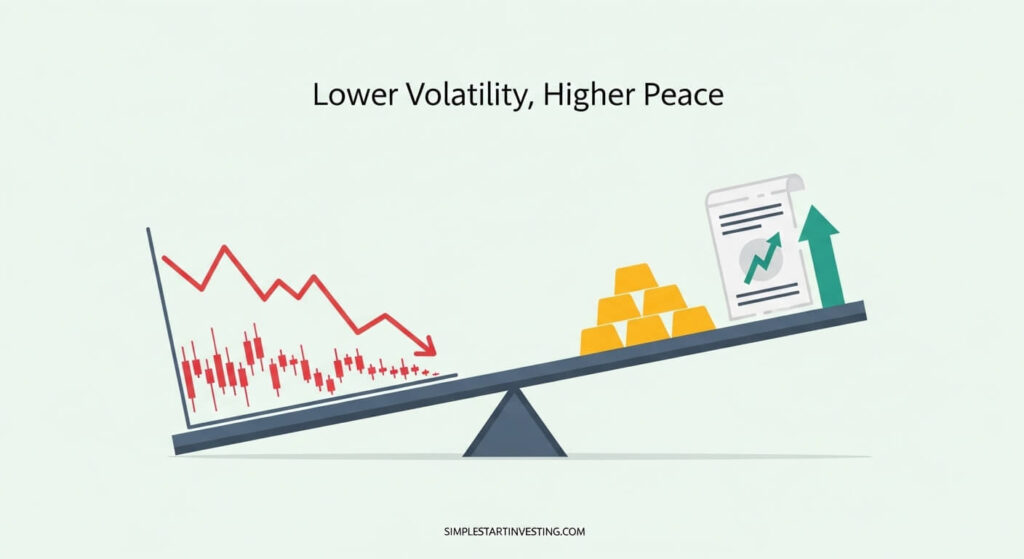
Think of these as your insurance policy against a crashing stock market. Long-term bonds are loans you give to the US government for a long period (usually 20 to 30 years). When stocks crash because investors are scared, they often run to the safety of long-term bonds. This creates a “seesaw” effect: when your stocks go down, your long-term bonds often go up, cushioning the fall.
4. Short-Term Treasury Bonds (20%)
This is your “cash-like” safety net. These are very short-term loans to the government. They don’t fluctuate much in price, and they provide a stable place for your money to sit and earn a little bit of interest. During times of extreme market chaos, having 20% of your money in something that barely moves provides incredible peace of mind.
5. Gold (20%)
Gold is often misunderstood. In this portfolio, gold isn’t there to make you rich. It is there to protect your “purchasing power.” When inflation rises and the value of the dollar drops, the price of gold typically goes up. It acts as a hedge against currency problems and extreme economic instability.
Why Beginners Often Misunderstand Diversification
Many people think they are diversified because they own five different tech stocks. But if the tech sector crashes, all five of those stocks will likely drop together. That isn’t true diversification; that’s just putting five eggs in the same basket.
The Golden Butterfly Portfolio uses “low correlation” assets. This is a fancy way of saying that the five components don’t move in the same direction at the same time. When the stock market is having a bad year, gold or bonds are often having a great year.
New investors often make the mistake of chasing whatever performed best last year. If stocks were up 30%, they want to put all their money in stocks. But the Golden Butterfly teaches us that we don’t know what next year will bring. By owning all five pillars, you are prepared for whatever happens next, rather than gambling on a single outcome.
The Four Economic Seasons
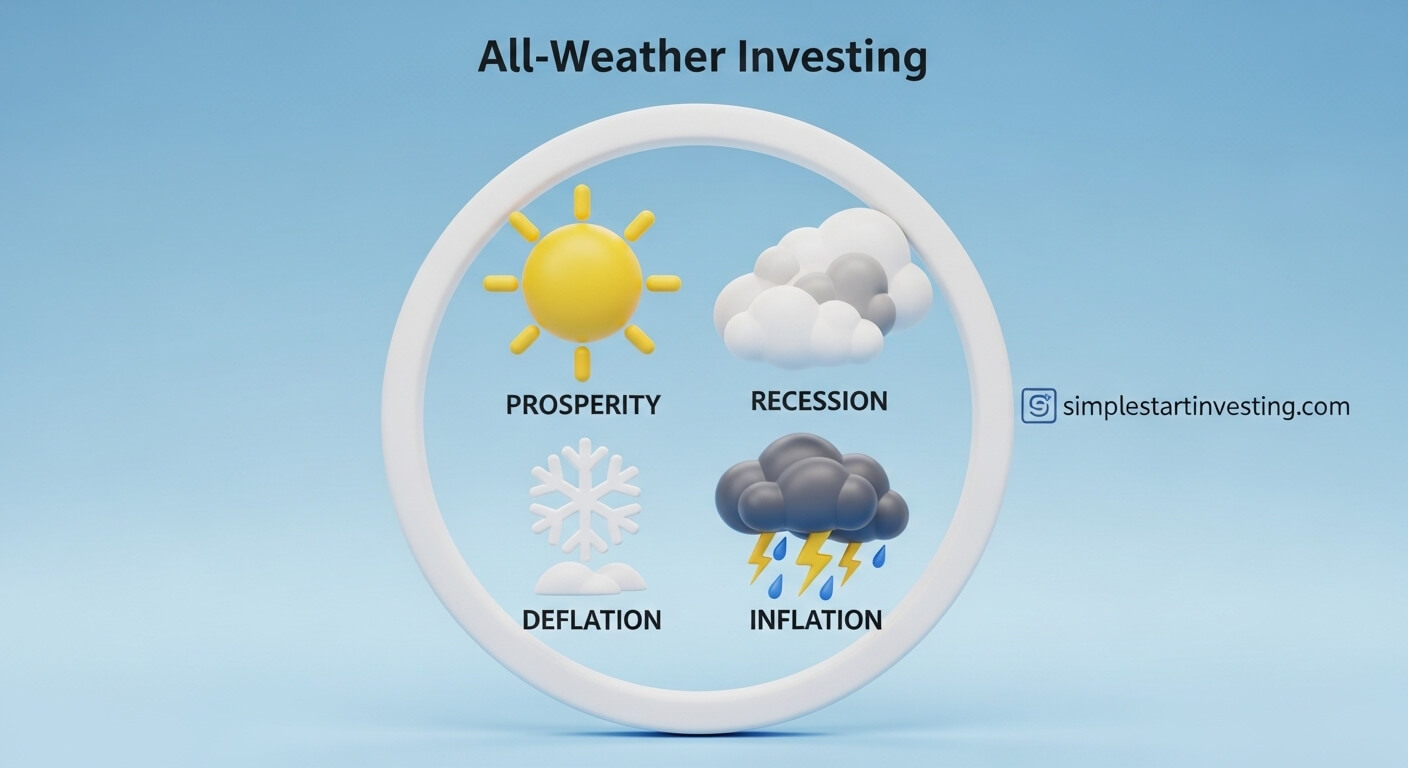
To truly appreciate this strategy, you have to understand that the economy moves in cycles, or “seasons.” There are generally four environments we might find ourselves in:
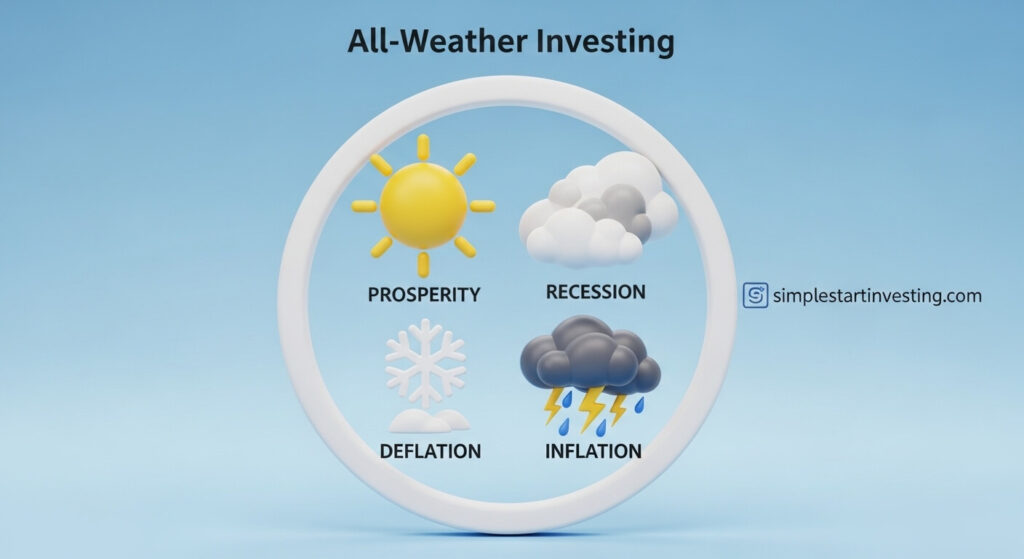
- Prosperity: The economy is growing, and inflation is low. In this season, your Total Stock Market and Small-Cap Value segments will soar.
- Inflation: Prices are rising fast, and the dollar is losing value. This is where Gold shines, protecting your wealth while stocks and bonds might struggle.
- Deflation: Prices are falling, and the economy is shrinking. During these times, Long-Term Treasury Bonds usually perform exceptionally well as interest rates drop.
- Recession/Crisis: Everything feels uncertain. Your Short-Term Treasuries (cash-like safety) and Gold provide the stability needed to keep you from panicking.
The beauty of the Golden Butterfly Portfolio is that it has a “winner” for every season. You never have to guess which season is coming; you are already dressed for all of them.
The Power of Rebalancing (Without the Math)
One of the most important parts of managing this portfolio is a process called “rebalancing.” Since you want to keep 20% in each of the five categories, you will eventually notice that some have grown faster than others.
Imagine you started with 1,000 dollars. You put 200 dollars into each of the five buckets. After a year, the stock market did great, and your stock bucket grew to 250 dollars. Meanwhile, gold didn’t do much and stayed at 200 dollars, and long-term bonds actually dropped to 150 dollars.

To rebalance, you would take some of the profit from your “winning” stock bucket and use it to buy more of the “losing” bond bucket until all five are equal again.
This forces you to do the one thing every investor knows they should do but finds emotionally difficult: Buy Low and Sell High. You are selling the assets that have become expensive and buying the ones that are currently “on sale.” Over time, this simple habit can significantly increase your total wealth while keeping your risk levels exactly where you want them.
Common Myths About the Golden Butterfly
As you research the Golden Butterfly Portfolio, you might encounter some common criticisms. It’s important to look at these through the lens of a beginner.
Myth 1: “Gold is a useless, unproductive asset.”
Critics say gold doesn’t pay dividends or grow like a company does. While that’s true, gold’s role in this portfolio isn’t growth—it’s protection. In years when the stock market loses 30% of its value, gold often gains value. That gain allows you to sell some gold and buy stocks while they are cheap. Gold is the “ballast” on your ship that keeps you from tipping over in a storm.
Myth 2: “You are holding too many bonds in a low-interest-rate environment.”
Some people argue that bonds aren’t worth holding if interest rates are low. However, bonds serve a structural purpose. They move in the opposite direction of stocks during a crash. Even if they don’t pay a high “rent” (interest), their value as a hedge is priceless when the rest of your portfolio is in the red.
Myth 3: “A 100% stock portfolio will make more money.”
In theory, over 40 years, a total stock market fund might have a higher final number than the Golden Butterfly. But there is a catch: Can you actually handle the journey? A 100% stock portfolio can drop by 50% in a single year. Most beginners panic and sell when that happens, locking in their losses. The Golden Butterfly rarely drops significantly, making it much easier for a normal person to stay invested for the long haul.
How the Numbers Work in Real Life
Let’s look at a simple logic-based example of how this provides stability.
Suppose you have 10,000 dollars. In a typical “bad year” for the economy, the stock market might drop by 20%. If you were 100% in stocks, your 10,000 dollars would turn into 8,000 dollars. That is a 2,000-dollar loss that hurts to look at.
In that same bad year, with the Golden Butterfly Portfolio, only 40% of your money (4,000 dollars) is in those falling stocks. That part of your portfolio would drop by 800 dollars. However, in such a bad year, investors usually run to safety. Your 2,000 dollars in Long-Term Bonds might grow by 10% (adding 200 dollars), and your 2,000 dollars in Gold might grow by 15% (adding 300 dollars). Your Short-Term Bonds (2,000 dollars) would likely stay the same or grow slightly.
When you add it all up, your 800-dollar loss in stocks is partially canceled out by 500 dollars in gains from bonds and gold. Your total “loss” is only 300 dollars. Compare a 300-dollar dip to a 2,000-dollar crash. Which one allows you to sleep better at night?
Is the Golden Butterfly Right for You?
Choosing an investment strategy is a personal decision. The Golden Butterfly is likely a good fit if:
- You hate seeing your account balance drop. If a 10% drop makes you want to sell everything, you need a portfolio that prioritizes stability.
- You want a “Set it and Forget it” approach. You only need to check this portfolio once or twice a year to rebalance.
- You are close to retirement. If you need your money in the next 5 to 10 years, you cannot afford to wait for a 100% stock portfolio to recover from a crash.
On the other hand, if you are 22 years old, have a high-paying job, and truly do not care if your balance drops by half because you have 40 years to wait, you might prefer a more aggressive, stock-heavy approach.
How to Start (The Practical Steps)
Building this portfolio in the US is remarkably simple because of low-cost Exchange Traded Funds (ETFs). Most major brokerages allow you to buy these with no commissions.
You would look for:
- A Total Stock Market ETF (like VTI).
- A Small-Cap Value ETF (like VBR or AVUV).
- A Long-Term Treasury ETF (like TLT).
- A Short-Term Treasury ETF (like SHY or VGSH).
- A Gold ETF (like IAU or GLD).
You simply divide your initial investment by five and put an equal amount into each. Once a year—perhaps on your birthday or at the start of the year—you check the balances. If one has become much larger than the others, you sell a bit of the “winner” and buy more of the “losers” to get back to that 20% balance for each.
Understanding the Tax Side
When you rebalance, you are selling assets. In a regular brokerage account, selling something for a profit usually triggers “Capital Gains Tax.”
To keep things simple and tax-efficient, many investors prefer to hold the Golden Butterfly Portfolio inside a tax-advantaged account like a Roth IRA or a 401(k). In these accounts, you can buy and sell (rebalance) as much as you want without triggering a tax bill. If you are using a regular taxable account, you can often rebalance just by adding new money to the “losers” instead of selling the “winners.”
The Psychology of Winning Slowly
The biggest challenge with the Golden Butterfly Portfolio isn’t the math or the stocks—it’s your own boredom. In years when the stock market is booming and your friends are bragging about their 30% gains, you might only be up 12% or 15%. It can be tempting to abandon your plan and chase the “hot” stocks.

But remember: the Golden Butterfly isn’t trying to win the sprint; it’s trying to win the marathon. The people bragging about 30% gains are often the same ones who lose 50% the following year. By staying consistent and keeping your “Butterfly” balanced, you are building a resilient financial future that doesn’t depend on luck or market timing.
Investing is not about being the smartest person in the room; it’s about being the most disciplined. The Golden Butterfly gives you a clear, simple map to follow. All you have to do is stay on the path.
Disclaimer: This content is for educational purposes only and does not constitute financial advice. Investment involves risk, and past performance is no guarantee of future results. Please consult with a qualified financial professional or tax advisor before making any investment decisions.