Have you ever found yourself staring at your phone at two in the morning, watching the red lines of a stock chart dip lower and lower? If you have, you already know that investing is not just about numbers on a screen. It is about how those numbers make you feel when you close your eyes at night.
For many beginners, the concept of risk tolerance feels like a term found only in dusty textbooks or complex financial software. However, in the real world of personal finance, it is the most important factor in whether you will actually reach your long-term goals. If your portfolio is too aggressive, you might panic and sell everything at the worst possible time. If it is too conservative, you might not grow your wealth enough to retire comfortably.
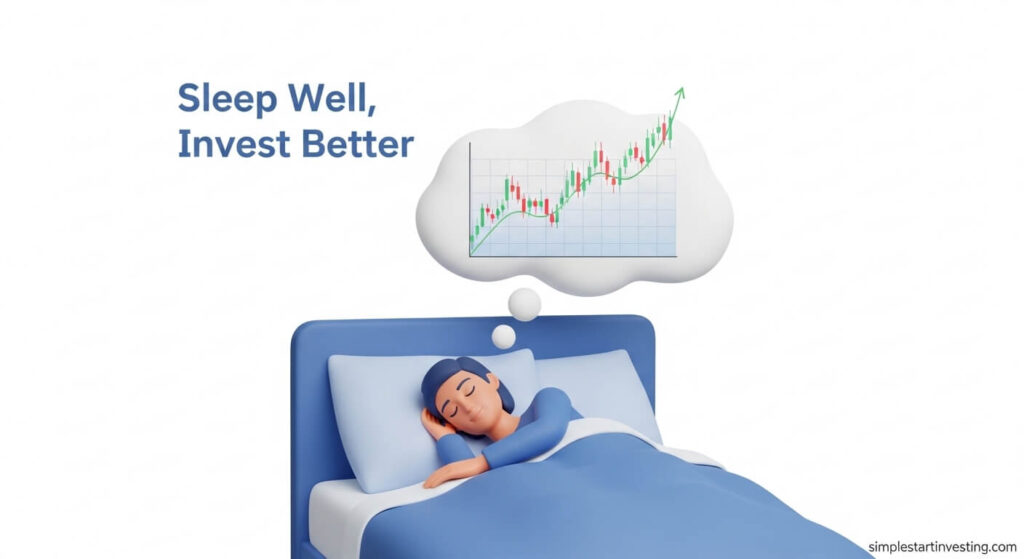
The “Sleep Test” is the most honest, effective, and simple tool to find your perfect balance. It ignores the complex algorithms and focuses on the one thing that truly matters: your peace of mind. If you are constantly worried about your money, your current risk tolerance is likely being pushed beyond its limit.
What Is Risk Tolerance and Why Does It Matter?
At its core, risk tolerance is your emotional and psychological ability to handle a drop in the value of your investments. It is a measure of how much “pain” you can stand before you decide to quit.
Imagine you decide to invest 1,000 dollars in a new tech company. A week later, that investment is worth only 800 dollars. You have “lost” 200 dollars on paper. Does that make you want to buy more because the price is lower, or does it make you want to pull your money out before it hits zero? Your answer to that question defines your risk tolerance.
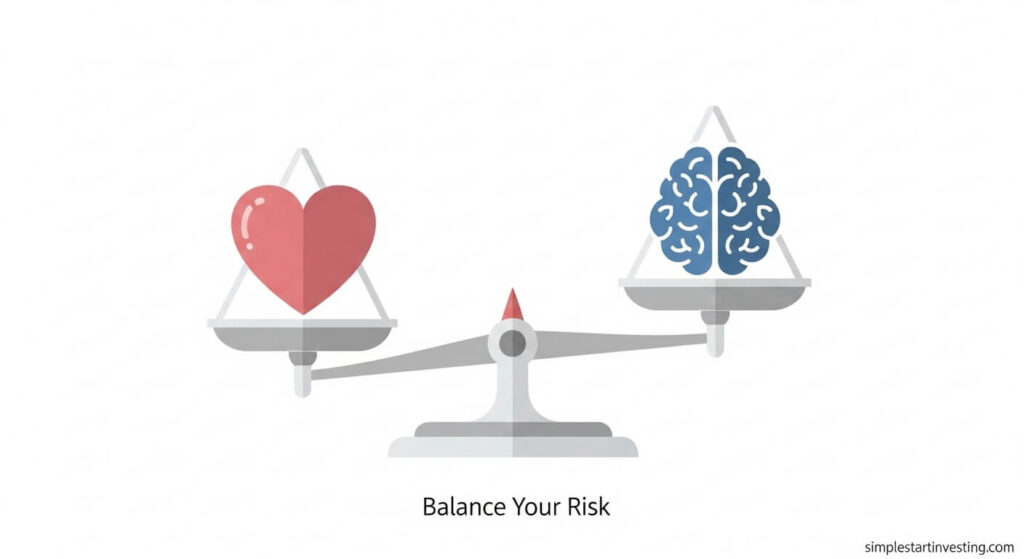
Many new investors make the mistake of thinking they have a high tolerance for risk because they want high returns. It is easy to be brave when the market is going up every single day. The true test of your character as an investor happens when the market takes a sudden, sharp turn downward.
Why Beginners Often Miscalculate Their Risk
The most common reason beginners fail in the stock market is not a lack of intelligence; it is a lack of self-awareness. When the market is in a “Bull Market”—meaning prices are rising and everyone is making money—it is very common to feel invincible.
You might see a friend make a lot of money on a volatile cryptocurrency or a high-growth stock like Nvidia or Tesla. Naturally, you feel like you are missing out. You might label yourself an “aggressive investor” because you want those same gains. However, this is usually “false bravery” fueled by FOMO (Fear Of Missing Out).
True risk tolerance is not about how much you want to win. It is about how much you are prepared to lose. Beginners often overlook the psychological toll of a “Bear Market,” where prices can drop by 20% or more and stay there for months or even years. If you haven’t lived through a period where your 401(k) or brokerage account looks like a sinking ship, you don’t truly know your tolerance yet.
Introducing the Sleep Test
The Sleep Test is the ultimate “low-tech” way to gauge your comfort level. It is a simple observation of your behavior and physical stress levels during market volatility.
If you can check your portfolio once a month, see that it is down by 10%, and then go back to eating your dinner and sleeping soundly, you have found a strategy that fits your risk tolerance. Your asset allocation—the way you divide your money between stocks, bonds, and cash—is working for you.
However, if you find yourself checking your balance five times a day, feeling a knot in your stomach when the news mentions a “market correction,” or lying awake wondering if you should sell everything, you have failed the Sleep Test. This is a loud and clear signal from your brain that you are taking on too much risk. Your current strategy is unsustainable because eventually, that stress will lead to a bad emotional decision.
Risk Tolerance vs. Risk Capacity: The Important Distinction
While they sound similar, these two concepts are very different, and understanding the difference is key to your success this year and beyond.
Risk Tolerance is emotional. It is how you feel. Risk Capacity is mathematical. It is what you can actually afford.
You might have a very high risk tolerance (you love gambling and don’t care about losing), but if you are 64 years old and planning to retire next year, your risk capacity is very low. You cannot afford a 40% drop in your portfolio because you don’t have the time to wait for it to recover.
Conversely, a 22-year-old starting their first job has a very high risk capacity because they have 40 years before they need that money. However, if that 22-year-old is naturally anxious and loses sleep over a 5% dip, their risk tolerance is low.
A successful investment plan must balance both. You should never exceed your risk capacity (the math), and you should never exceed your risk tolerance (the sleep).
The Dangers of Ignoring Your Sleep Test Results
What happens if you ignore the fact that you are losing sleep? Usually, it leads to the “Panic Sell.”
Let’s look at a simple example. Suppose you have 10,000 dollars invested entirely in aggressive stocks. The market hits a rough patch, and your account drops to 7,000 dollars. Because you ignored your low risk tolerance, the stress becomes unbearable. You decide to sell everything to “save” the remaining 7,000 dollars.
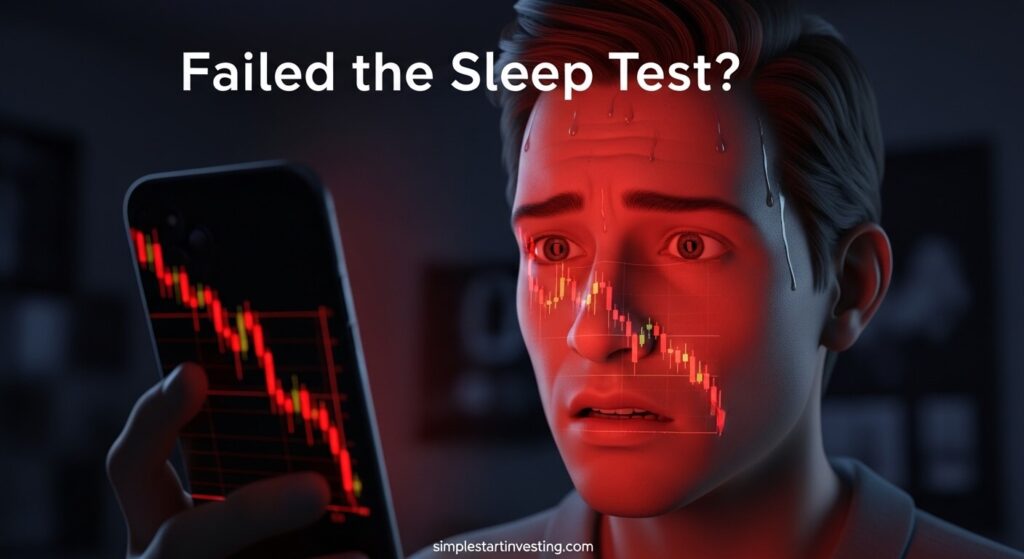
The problem is that by selling, you have turned a “paper loss” into a “real loss.” Markets historically recover over time. If you had an allocation that allowed you to sleep, you would have stayed invested and likely seen that 7,000 dollars grow back to 10,000 dollars and beyond. By panicking, you missed the recovery and permanently damaged your wealth.
This is why the Sleep Test is a defensive tool. It protects you from your own emotions.
How to Adjust Your Strategy Based on the Sleep Test
If you realize you are failing the Sleep Test, don’t worry. It doesn’t mean you shouldn’t invest; it just means you need to adjust your “dial.” Think of your portfolio like a radio. If the static is too loud (the risk), you need to turn the volume down.
1. Increase Your Bond and Cash Allocation
Stocks are generally more volatile than bonds. If a portfolio of 100% stocks is keeping you awake, try a mix. Perhaps 70% stocks and 30% bonds. Bonds act as a “cushion” during market storms. While they might not grow as fast as stocks like Amazon or Apple over decades, they generally don’t drop as far or as fast during a crash.
2. Diversify Your Holdings
If you have all your money in one or two individual companies, your risk is extremely high. If one of those companies has a bad earnings report, your whole world shakes. By using low-cost index funds or ETFs that track the entire market (like the S&P 500), you spread your risk across hundreds of companies. It is much easier to sleep when you know that even if one company fails, the other 499 are still working for you.
3. Build a Larger Emergency Fund
Sometimes, the reason we lose sleep isn’t about the stocks themselves, but about our own security. If you only have 500 dollars in your bank account but 5,000 dollars in the stock market, every market dip feels like a threat to your survival.
If you increase your cash savings—your emergency fund—to cover six months of expenses, you will likely find that your risk tolerance for your investments goes up. You can sleep better knowing that even if the market crashes tomorrow, your rent and groceries are covered.
Real-World Scenarios: Finding Your Comfort Zone
Let’s walk through two different people to see how the Sleep Test applies in real life.
Investor A: Sarah Sarah is 30 years old. She has a stable job and no debt. She understands that the market goes up and down. When she sees her account drop by 2,000 dollars in a week, she thinks, “Oh well, it will be back in a few years,” and goes back to sleep. Sarah has a high risk tolerance. She can afford to be aggressive and keep most of her money in stocks.
Investor B: Michael Michael is also 30 and has the same job. However, Michael grew up in a household that struggled with money. Seeing his account drop even by 100 dollars makes his heart race. He finds himself checking his investment app during lunch breaks and feeling angry all afternoon. Michael has a low risk tolerance.
Even though “the math” says Michael should be aggressive because he is young, the “Sleep Test” says he shouldn’t. If Michael forces himself into a high-risk portfolio, he will eventually panic and quit. Michael is much better off with a balanced portfolio that grows more slowly but allows him to stay the course for 30 years.
The Role of Market Cycles in Your Sleep Test
It is important to remember that your risk tolerance might change as the market environment changes.
In a “sideways” market—where prices don’t move much—you might feel bored. Boring is good for sleep. But when the market becomes “volatile”—meaning it swings up and down violently—that is when your Sleep Test is truly active.
Don’t be afraid to re-evaluate. If you find that the current market headlines are making you anxious, it is okay to move some money into safer “cash-like” investments like a High-Yield Savings Account or a Money Market Fund. The goal of investing is to grow your wealth, but never at the expense of your mental health.
Why Time Is Your Best Friend
One of the best ways to improve your Sleep Test results is to change your perspective on time. Most of the stress in investing comes from looking at the short term.
If you look at the stock market on a daily basis, it looks like a chaotic mess. It’s like looking at a single wave in the ocean; it goes up, it crashes down, it’s unpredictable. But if you look at the market over ten or twenty years, it looks more like a rising tide.
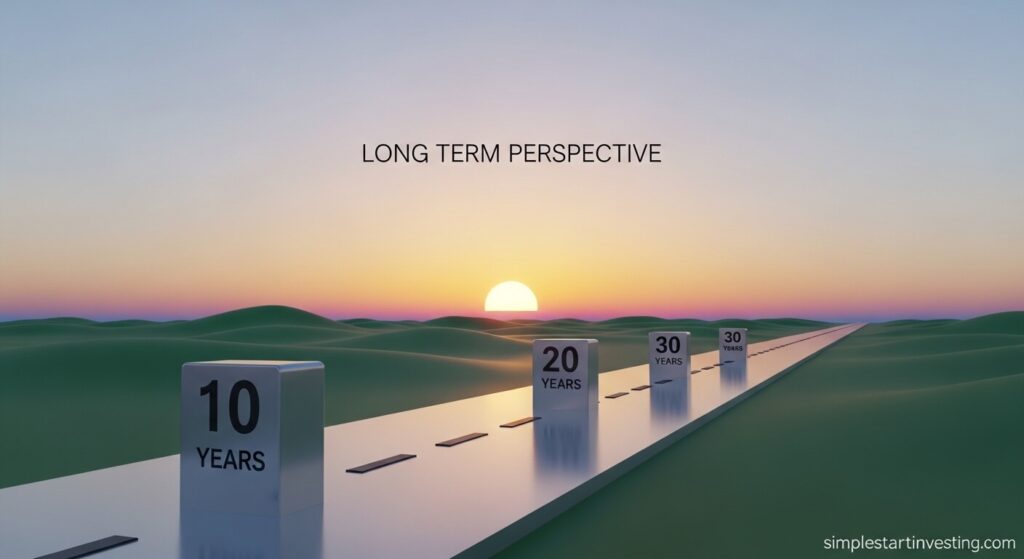
When you stop caring about what happens this week and start focusing on what happens in ten years, your risk tolerance naturally increases. You stop losing sleep over the “noise” of the daily news.
Conclusion: Listen to Your Gut
Investing is a marathon, not a sprint. To finish the marathon, you have to stay in the race. The only way to stay in the race is to make sure your journey is comfortable enough that you don’t want to hop off the track.
The Sleep Test isn’t about being “right” or “wrong” compared to other investors. It’s about being right for you. There is no shame in having a lower risk tolerance. In fact, knowing yourself is the greatest “alpha” (investment advantage) you can have.
Next time the market gets bumpy, pay attention to your body. Are you sleeping? Are you calm? If not, take it as a friendly suggestion from your subconscious to adjust your strategy. Your future self—and your health—will thank you.
Disclaimer: This content is for educational purposes only and does not constitute financial advice. Market investments involve risk, and past performance is not indicative of future results. Always consult with a qualified financial professional before making significant investment decisions.