
One of the biggest fears for anyone starting their investment journey is the thought of running out of money in their later years. You work hard for decades, pouring money into your 401k or IRA, watching companies like Apple (AAPL) or Amazon (AMZN) grow your wealth. But then comes the big question: How much of that money can you actually spend each year without watching your balance hit zero?
This is where the 4% rule comes into play. It is often called the “gold standard” of retirement planning because it provides a simple, clear target for anyone trying to figure out when they can finally stop working. In this guide, we will break down exactly how this rule works, why it is so popular in the United States, and the common traps that beginners often fall into.
What Exactly Is the 4% Rule?
At its heart, the 4% rule is a guideline used to determine how much money you can take out of your retirement portfolio during your first year of retirement. The idea is that if you withdraw this amount and then adjust your future withdrawals based on the cost of living, your money has a very high chance of lasting at least thirty years.
How it works in plain English
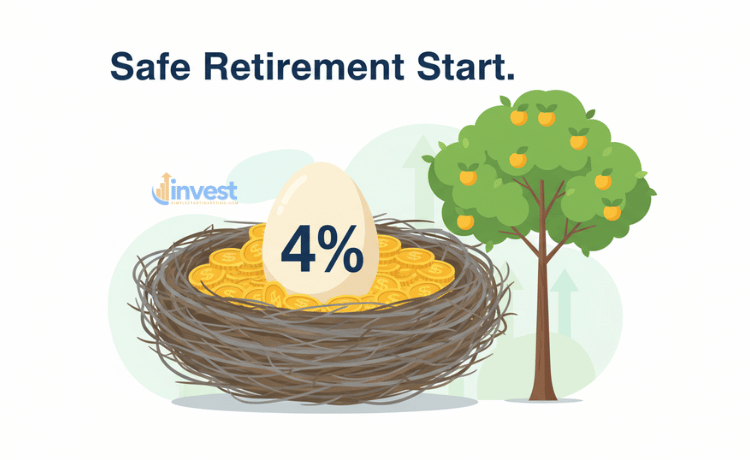
Imagine you have spent your career building a “nest egg” made up of stocks and bonds. When you retire, you don’t just sell everything and put it under a mattress. You keep it invested so it continues to grow. The 4% rule suggests that in your very first year of retirement, you should take out 4 percent of your total balance.
For the years that follow, you don’t just take another 4 percent of whatever is left. Instead, you take the same amount you took the first year and increase it slightly to keep up with how much prices have gone up at the grocery store or the gas station. This adjustment is what we call “accounting for inflation.”
A real-world example
Let’s look at a hypothetical example. Suppose you have managed to save 1 million dollars by the time you retire. According to this strategy, in your first year of retirement, you would withdraw 40,000 dollars to live on.
Now, let’s say that over that first year, the cost of living in the U.S. goes up by 3 percent. To keep your lifestyle the same, you wouldn’t take 40,000 dollars again the next year. You would add 3 percent to that amount, which is an extra 1,200 dollars. So, in your second year, you would withdraw 41,200 dollars. You continue this process every year, regardless of whether the stock market is up or down.
The common beginner mistake
Many people hear “4% rule” and assume it means they should look at their account balance every single year and take 4 percent of whatever the current number is. They think, “If my account goes up, I spend more. If it goes down, I spend less.”
The logic shift
While that sounds logical, it isn’t the 4% rule. The actual rule is designed to give you a steady, predictable paycheck
Why Is This Rule So Important for Your “Freedom Number”?
If the 4% rule tells you how much you can spend, it also tells you the opposite: how much you need to save. This is what many in the financial world call your “Financial Independence” number or your “Freedom Number.”
The “Rule of 25” explained
To find out how much you need to retire using this logic, you can use a simple mental shortcut. If you want to be able to withdraw a certain amount of money every year, you need to have 25 times 그 amount saved up.

A real-world example
Let’s say you sit down and look at your budget. You realize that to live comfortably in a city like Austin or Charlotte, you need about 60,000 dollars a year after your Social Security benefits are factored in. To find your target, you would multiply 60,000 dollars by 25. This tells you that your “Freedom Number” is 1.5 million dollars. If you reach that milestone in your retirement accounts, the 4% rule suggests you are likely ready to retire.
The common beginner mistake
A common error is forgetting to account for taxes. Beginners often look at their 401k balance and think every dollar belongs to them. However, if that money is in a traditional 401k or IRA, the IRS is going to take a cut when you withdraw it.
The logic shift
When calculating your “Freedom Number,” you must think in after-tax dollars. If you need 60,000 dollars to live on, you might actually need to withdraw 75,000 dollars from your account to cover your taxes and still have 60,000 dollars left over. Always remember that your withdrawal rate must cover your lifestyle plus the government’s share.
The “Danger Zone”: Sequence of Returns Risk
The 4% rule was famously tested against some of the worst economic times in American history, including the Great Depression and the high-inflation era of the 1970s. What the research found was that the timing of when you retire matters more than the average return of the market. This is known as “Sequence of Returns Risk.”

Explaining the risk simply
Think of your retirement portfolio like a fruit tree. If the tree is healthy and growing, you can pick a few apples every year without a problem. But if a massive storm hits and breaks half the branches, and you still go out and pick the same amount of apples, you might damage the tree so much that it can never recover.
In the stock market, if you retire right at the start of a “bear market” (when prices drop significantly), you are forced to sell your shares of companies like Tesla (TSLA) or Walmart (WMT) while they are “on sale” at low prices. This depletes your account faster than if the market had stayed flat or gone up.
A real-world example
Imagine two neighbors, John and Sarah. Both have 1 million dollars. John retires in a year when the market goes up 20 percent. Even after he takes his 40,000 dollars, his account is much bigger than when he started.
Sarah retires the next year, but the market drops 20 percent. She still takes her 40,000 dollars because she needs to pay her bills. Because the market is down, she has to sell more shares to get that 40,000 dollars. Her account shrinks significantly, leaving less money behind to grow when the market eventually recovers.
The common beginner mistake
Beginners often think that as long as the market averages 7 percent or 8 percent over thirty years, they are safe. They assume the “average” will save them.
The logic shift
The “average” doesn’t matter if your account hits zero in year seven. You must be extra cautious during the first five years of retirement. If the market is doing poorly right when you start, many experts suggest being flexible—perhaps taking out only 3 percent instead of 4 percent for a year or two until things stabilize. This protects your “investment tree” while it is most vulnerable.
Is the 4% Rule Still Valid This Year?
As we move through this year, many people are asking if a rule created in the 1990s still works in today’s economy. With the IRS recently adjusting contribution limits for 401k plans (now up to 24,500 dollars for individuals under 50 in 2026) and inflation remaining a hot topic, the 4% rule is being scrutinized.
Current market conditions
Some financial researchers, including those at Morningstar, have suggested that for people retiring right now, a “safe” withdrawal rate might actually be closer to 3.9 percent or even lower if you expect to live for more than thirty years. This is because stock valuations are currently high and bond yields have been volatile.
However, for a total beginner, 4 percent remains the best starting point for planning. It provides a concrete goal that is easy to visualize.
A real-world example
If you are currently working at a company like Costco or JPMorgan Chase and participating in their retirement plans, you are likely seeing these 2026 IRS changes in your payroll. By taking advantage of higher contribution limits, you are building a larger base. Even if you decide to be more conservative and use a “3.5% rule” instead, having that extra cushion in your account will only make your retirement more secure.
The common beginner mistake
New investors often become “paralyzed by analysis.” They hear one expert say 4 percent and another say 3.3 percent, and they get so confused that they stop saving altogether because they don’t know which number is “right.”
The logic shift
The specific decimal point matters far less than the habit of saving. Whether the final number is 4 percent or 3.8 percent, the strategy remains the same: build a diversified portfolio, keep your costs low, and have a plan for how to take the money out. You can always adjust your spending once you are actually retired, but you can’t go back and save more money once you’ve already stopped working.
Adjusting the Rule: The “Guardrails” Approach
Modern financial planning has evolved since the 4% rule was first introduced. Many advisors now recommend a “flexible” version of the rule, often called the “Guardrails” approach. This makes the rule more practical for the real world.
How Guardrails work
Instead of blindly taking the same inflation-adjusted amount every year, you set a “ceiling” and a “floor.”
- If your investments do exceptionally well (like a year where technology stocks soar), you might give yourself a “raise” and take a little more than the 4 percent.
- If the market has a terrible year, you agree to skip the inflation increase for that year or cut your spending by a small percentage (like 10 percent) to keep more money in your account.
A real-world example
Let’s go back to our retiree with a 40,000 dollar annual withdrawal. If the market crashes 20 percent, instead of taking 41,000 dollars the next year (adding for inflation), they might decide to stay at 40,000 dollars or even drop to 38,000 dollars by cutting out one vacation. This small sacrifice early on significantly increases the chances that the money will last for forty years instead of thirty.
The common beginner mistake
A common mistake is thinking retirement spending is a straight line. Many beginners assume they will spend exactly the same amount every single month for thirty years.
The logic shift
In reality, retirement spending usually looks like a “smile.” You spend more in the early years when you are active and traveling (the “Go-Go” years), less in the middle years (the “Slow-Go” years), and then more again at the end due to healthcare costs (the “No-Go” years). Understanding this allows you to be more flexible with the 4% rule.

Practical Steps for Beginners
If you are just starting out, here is how you can use the 4% rule to guide your journey today:
- Track Your Annual Expenses: You can’t know your retirement number if you don’t know what it costs to be you. Track every dollar for a few months.
- Calculate Your Target: Take your annual expenses and multiply them by 25. That is your initial goal.
- Diversify Your Portfolio: The 4% rule only works if your money is invested in a mix of stocks (for growth) and bonds (for stability). Relying only on one single stock, even a giant like Amazon (AMZN), is too risky for this rule to work.
- Consider Your Timeline: If you plan to retire very early (like in your 40s), the 4% rule might be too aggressive because your money needs to last fifty years, not thirty. In that case, you might aim for a 3% or 3.5% withdrawal rate.
- Stay Informed on Taxes: As mentioned, the IRS rules for 2026 and beyond will impact how much you can keep. Always look at your “net” income—the money that actually hits your bank account after Uncle Sam takes his portion.
The 4% rule is a powerful tool because it turns the vague concept of “retirement” into a mathematical goal. It gives you a light at the end of the tunnel. While the market will always have ups and downs, having a structured plan for your withdrawals is the best way to ensure that your golden years are spent enjoying your hard-earned wealth rather than worrying about the balance of your bank account.

Disclaimer: This content is for educational purposes only and does not constitute financial, legal, or tax advice. Market conditions and IRS regulations, such as those for the current year or 2026, are subject to change. Please consult with a qualified financial professional before making significant investment decisions.