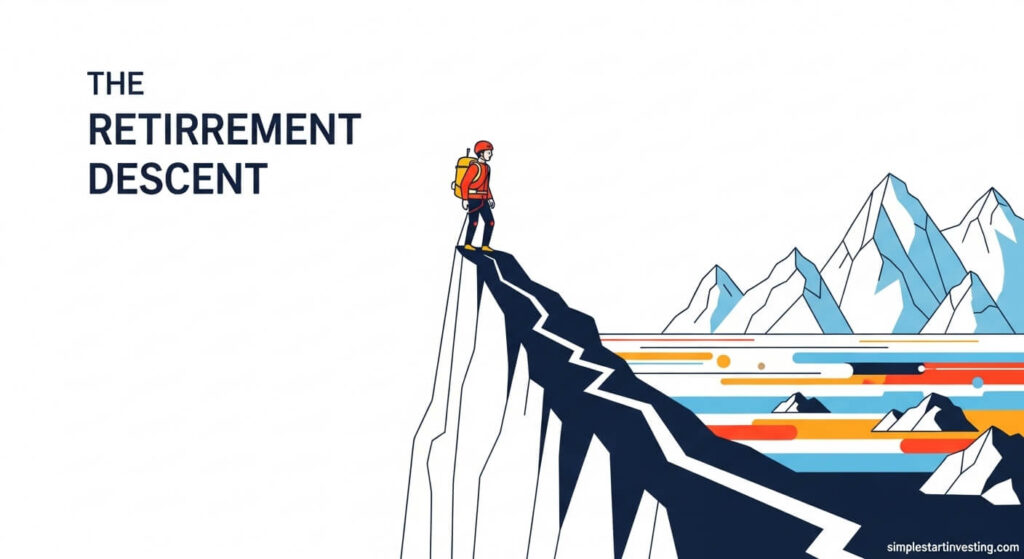
Imagine you have spent thirty years climbing a massive mountain. You have braved the wind, paced yourself perfectly, and finally reached the summit. You feel a sense of incredible accomplishment. But as any experienced climber will tell you, reaching the top is only half the journey. Most accidents actually happen on the way down.
In the world of investing, retirement is that descent. While you were working, you were focused on growth—climbing higher. But as you transition to living off your savings, a new and often invisible danger appears. It is called Sequence of Returns Risk. If you do not understand how it works, it could potentially derail even the most well-funded retirement plan.
Many beginners believe that as long as the stock market goes up on average over time, their money is safe. Unfortunately, when you start withdrawing money, the “average” no longer tells the whole story. The order in which those returns happen—the sequence—becomes everything. Let’s break down exactly what this is and how you can protect your hard-earned nest egg.
What is Sequence of Returns Risk?
At its simplest, Sequence of Returns Risk is the danger that the market will experience a significant downturn exactly when you start taking money out of your accounts. When you are still working and the market drops, it is actually an opportunity. You are “buying the dip” with every paycheck. But once you retire, a market drop becomes a double-edged sword.
Think of it like this: If the market falls by 20% right after you retire, and you still need to withdraw 40,000 dollars to pay your bills, you are forced to sell your investments while they are at a low price. This leaves you with fewer “shares” or “units” of your investments remaining in your account. When the market eventually recovers, you have less money left to participate in that recovery.
This risk is most intense during the “Retirement Red Zone.” This is the period roughly five years before you retire and the first five to ten years after you stop working. During this window, your portfolio is usually at its largest size, and you are about to start (or have just started) withdrawing funds. A bad sequence of years here can have a permanent impact on how long your money lasts.
Why Beginners Often Get the “Average Return” Wrong
One of the most common myths in the investing world is that if a fund averages 7% per year, you can safely take out 7% every year forever. On paper, it sounds logical. If the pot grows by the same amount you take out, the balance should stay the same, right?
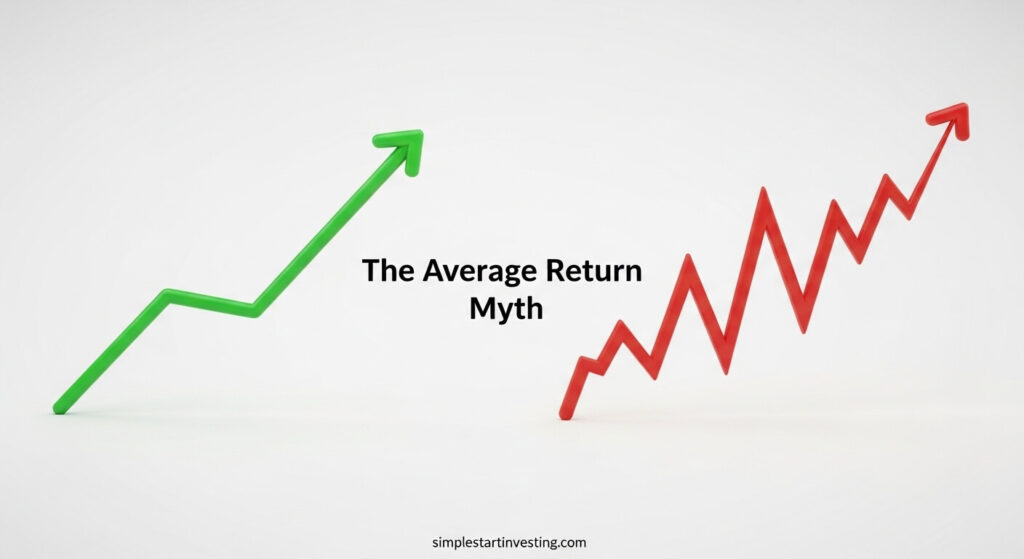
In reality, the stock market is never a smooth 7% line. It might be up 15% one year, down 10% the next, and up 2% the year after that. While the math “averages” out over decades, the timing of those negative years is what creates the risk.
Let’s look at two hypothetical investors, Sarah and Michael. Both start with 1,000,000 dollars and both want to withdraw 50,000 dollars every year. Over the next 20 years, the market gives both of them an average return of 6%.
Sarah gets lucky. The market goes up significantly in her first few years of retirement. Because her portfolio grew early on, her 50,000 dollar withdrawals represent a very small percentage of her total wealth. Even when a bad year eventually hits ten years later, her “cushion” is so large that it doesn’t hurt her long-term security.
Michael is not so lucky. The market crashes by 15% in his first year of retirement. He still takes out his 50,000 dollars to live on. By the end of year one, his million-dollar portfolio has shrunk significantly because of both the market loss and his withdrawal. To get back to his original million, he now needs a massive gain, but he has less money working for him. If another bad year follows, Michael might run out of money years earlier than Sarah, even though their “average” return over 20 years was identical.
The Reverse Dollar-Cost Averaging Effect
If you have been investing for a while, you have likely heard of Dollar-Cost Averaging. This is the strategy where you put a set amount of money (like 500 dollars) into the market every month, regardless of whether prices are up or down. When prices are low, your 500 dollars buys more shares. This is a beginner’s best friend.
However, once you retire, you encounter the “evil twin” of this strategy: Reverse Dollar-Cost Averaging.
When you need to withdraw a fixed amount of money to pay for your lifestyle in a down market, you are forced to sell more shares to reach that dollar amount. For example, if a share costs 100 dollars, you only need to sell 10 shares to get 1,000 dollars. But if the price drops to 50 dollars, you must sell 20 shares to get that same 1,000 dollars.
By selling more shares when prices are low, you are effectively “locking in” your losses and depleting your portfolio’s “engine” much faster. This is why Sequence of Returns Risk is so much more dangerous than a simple market correction during your working years.
How the “Retirement Red Zone” Increases Your Vulnerability
The five years leading up to retirement are critical because your portfolio is likely at its peak value. A 20% drop on a 10,000 dollar account early in your career is only a 2,000 dollar loss—annoying, but easy to recover from. A 20% drop on a 1,000,000 dollar account right as you are planning to quit your job is a 200,000 dollar loss.
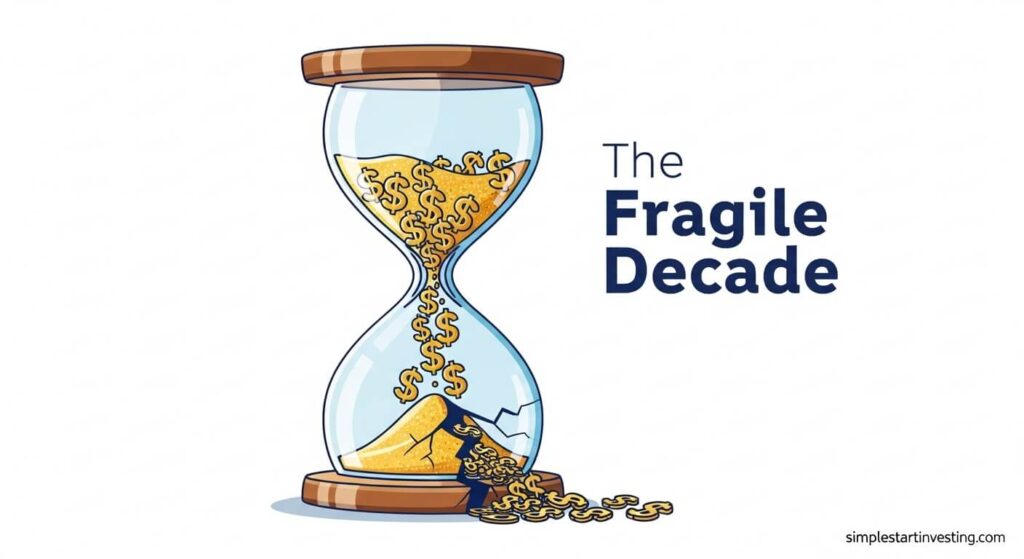
This creates a psychological and financial “fragility.” Many people feel forced to work longer or, worse, they retire anyway and start withdrawing from a shrinking pot.
The first few years after you stop working are equally dangerous. If you experience a “bear market” (a period where stocks fall 20% or more) in the first three years of retirement, the math shows that the probability of your money lasting 30 years drops significantly. Conversely, if you have a “bull market” (prices rising) in those first few years, your plan becomes much more robust.
Strategy 1: The “Cash Cushion” or Emergency Fund
One of the most effective ways to manage Sequence of Returns Risk is to avoid selling stocks when they are down. But how do you pay your bills if you don’t sell stocks? You use a cash cushion.
A common strategy is to keep two to three years’ worth of living expenses in very safe, liquid accounts, such as a high-yield savings account or a money market fund.
If the stock market has a terrible year, you simply stop selling your stocks. Instead, you live off your cash cushion. This gives the stock market time to recover without you being forced to “sell low.” Once the market bounces back, you can sell some of your gains to refill your cash cushion for the next rainy day.
Strategy 2: The Bucket Strategy
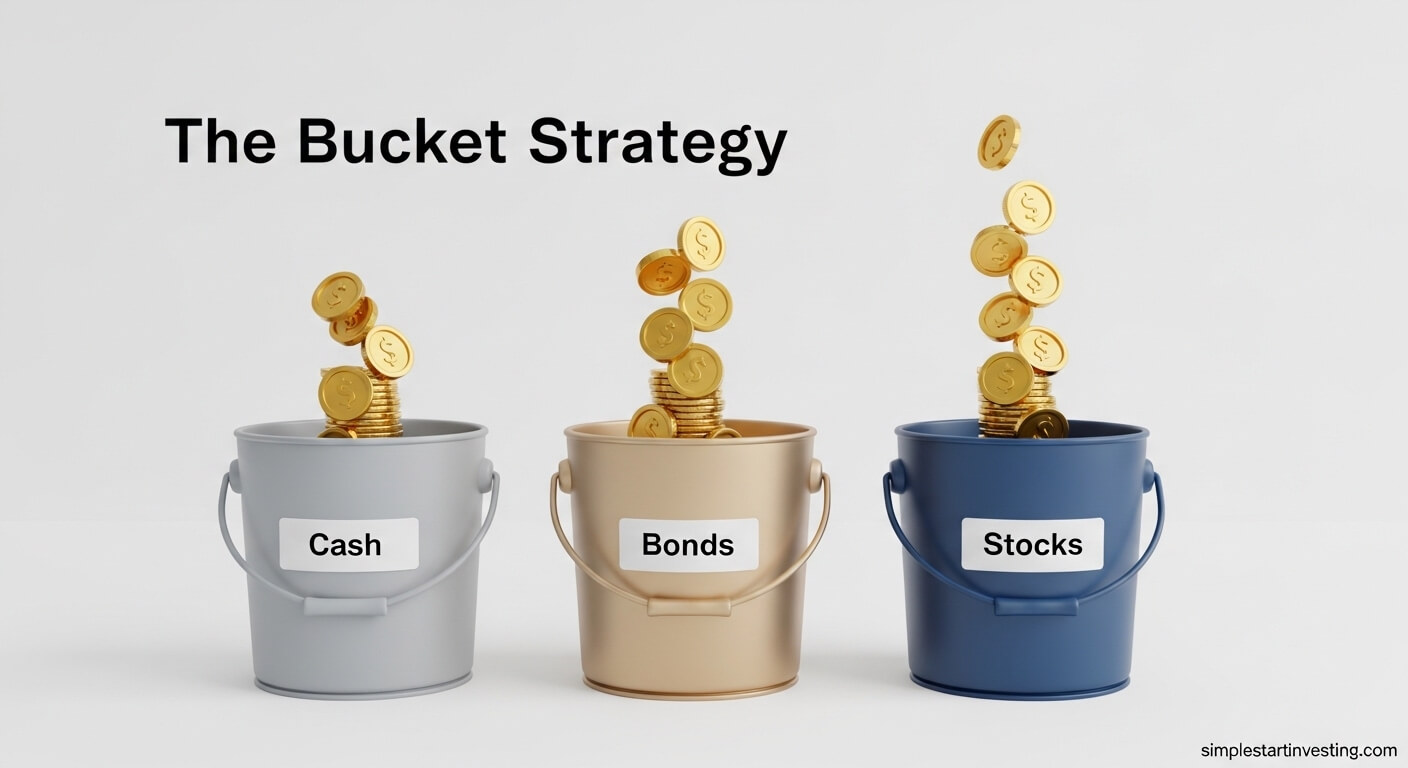
The Bucket Strategy is a popular way to visualize and manage your money to fight sequence risk. It involves dividing your total savings into three different “buckets” based on when you will need the money.
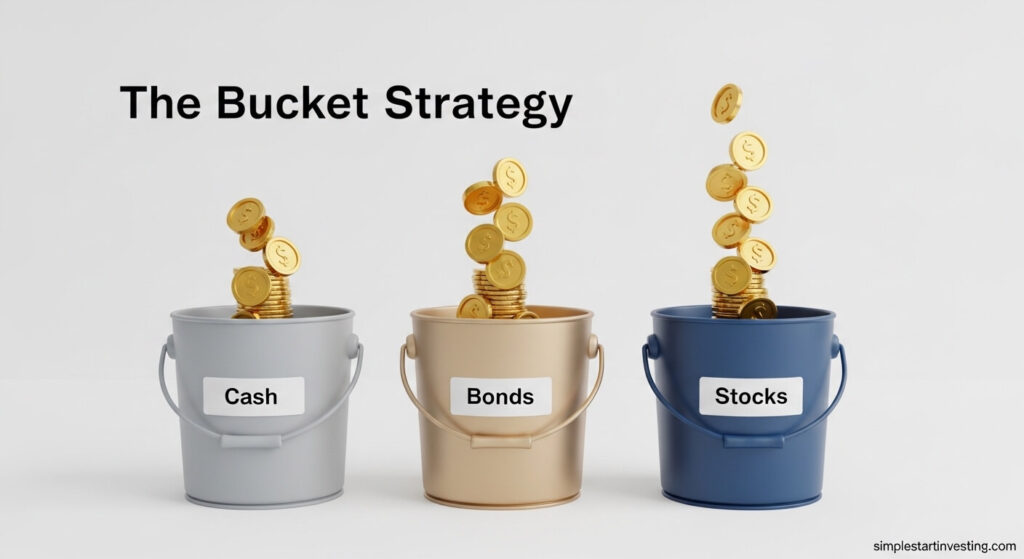
- Bucket 1 (Short Term): This contains the cash you need for the next 1 to 2 years. It sits in a bank account where it won’t grow much, but it won’t lose value either.
- Bucket 2 (Medium Term): This covers years 3 through 10. It is usually invested in “safer” assets like high-quality bonds or certificates of deposit (CDs). These provide a little more growth than cash but are much less volatile than stocks.
- Bucket 3 (Long Term): This is for money you won’t need for 10 years or more. This stays in the stock market (like an S&P 500 index fund) to capture long-term growth.
By using this structure, you ensure that you never have to touch your “Long Term” bucket during a market crash. You have a decade of “buffer” in Buckets 1 and 2 to wait for the stock market to heal itself.
Strategy 3: Dynamic Spending (The Variable Withdrawal Method)
Many beginners follow the “4% Rule,” which suggests you can take out 4% of your starting balance and increase that amount for inflation every year. While this is a good starting point, it can be rigid and dangerous if a bad sequence hits early.
A better way to protect yourself is to be flexible. This is called Dynamic Spending.
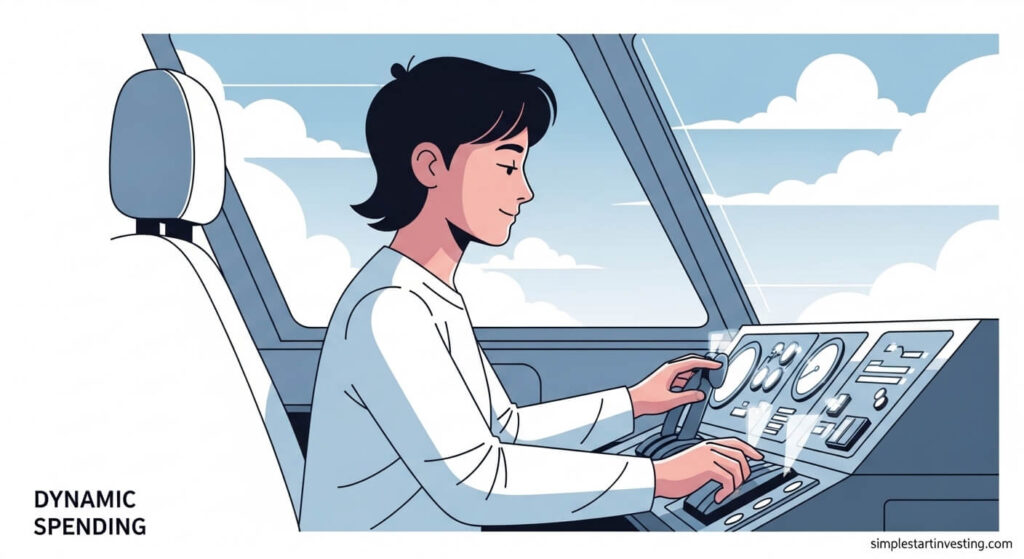
If the market has a bad year, you might decide to skip your big vacation or delay buying a new car. By reducing your withdrawals by even 10% or 20% during a down year, you significantly reduce the amount of shares you have to sell at low prices. This small sacrifice in the short term can add years of “life” to your portfolio in the long run.
Think of it like a pilot adjusting for turbulence. You don’t just keep the same speed and altitude; you adjust to keep the flight safe.
Strategy 4: Rebalancing Your Portfolio
When the stock market is booming, your “stock” portion of your portfolio grows faster than your “bond” or “cash” portion. If you started with 60% stocks and 40% bonds, a big market run might leave you with 75% stocks.
This makes you much more vulnerable to Sequence of Returns Risk because you have more money exposed to a potential crash.
Regularly “rebalancing”—selling some of your winners (stocks) to buy more of your stable assets (bonds/cash)—is a built-in way to “sell high.” It ensures that when a crash does happen, you aren’t over-exposed. This is a disciplined way to manage risk without trying to “time” the market, which is something even the pros struggle to do.
Common Misunderstandings About Sequence Risk
A very common mistake is thinking that “diversification” alone solves this problem. While owning a mix of different companies is good, most stocks tend to go down together during a major recession. Diversification helps with market risk, but it doesn’t automatically solve sequence risk.
Another misunderstanding is the idea that you should move everything to “safe” investments like gold or cash right before you retire. This is often an overcorrection. Because retirements can last 30 years or more, you still need the growth that stocks provide to beat inflation. If you go 100% into cash, you might solve the sequence risk but create a “longevity risk”—the risk of outliving your money because it didn’t grow enough.
The goal is not to eliminate risk entirely, but to find a balance where you have enough safety to survive a bad five-year sequence, but enough growth to survive a thirty-year retirement.
The Role of Guaranteed Income
In the United States, we have built-in protections that help mitigate Sequence of Returns Risk. Social Security is a form of guaranteed income that doesn’t change based on what the stock market does. For many retirees, Social Security acts as their “Bucket 1.”
If your Social Security covers 50% of your basic needs (housing, food, utilities), then you only need to withdraw the other 50% from your portfolio. This makes your portfolio much more resilient because your “required” withdrawal is smaller.
Some people also look into annuities or pensions, which provide a similar “floor” of income. The more of your basic living expenses you can cover with guaranteed income, the less you have to worry about the specific sequence of your investment returns.
Understanding the Emotional Side of the Risk
Retirement is a massive psychological shift. You go from a lifetime of seeing a paycheck land in your account to seeing money leave your account every month.
When you see your balance drop because the market is down and because you just paid your mortgage, it can cause panic. Panic leads to the biggest mistake of all: selling everything at the bottom and moving to cash.
Understanding Sequence of Returns Risk before you retire allows you to build a plan that accounts for the “worst-case scenario.” When the market eventually does drop (and it will), you can tell yourself: “I expected this. I have my three-year cash cushion. My stocks are for ten years from now. I don’t need to sell them today.”
Knowledge is the best defense against the emotional urge to make a bad financial decision.
Practical Steps to Take Today
If you are within ten years of your goal retirement date, now is the time to start preparing for Sequence of Returns Risk. You do not want to be “figuring it out” while the market is crashing.
First, track your actual spending. You cannot build a “cash cushion” if you don’t know how much money you need for a year of life. Second, look at your current mix of investments. Are you too aggressive? If you have 90% of your money in stocks and you plan to retire in two years, a sudden 30% drop could change your life.
Third, start building that “Bucket 1.” You don’t have to do it all at once. You can slowly move small amounts into a high-yield savings account over the next few years.
Managing this risk isn’t about being a math genius. It is about being a good “risk manager.” It’s about acknowledging that the “average” path is rarely the path we actually walk, and preparing for the bumps along the way.
By focusing on a solid sequence-of-returns strategy, you can turn a potentially stressful retirement into one of security and peace of mind. You’ve done the hard work of climbing the mountain. Now, make sure you have the right gear for a safe and enjoyable descent.
Disclaimer: This content is for educational purposes only and does not constitute financial advice. Financial regulations and market conditions change frequently; please consult with a qualified professional or check current IRS and SEC guidelines before making any investment decisions.