If you have ever looked at the financial news and seen a headline like “Apple Announces $110 Billion Stock Buyback,” you might have wondered what that actually means for you. Why would a company spend billions of dollars just to buy its own shares back from the market? Why wouldn’t they just keep the cash, build a new factory, or give it directly to you as a check?
Understanding stock buybacks is one of the most important steps for a new investor. It is a powerful tool that companies use to return value to their shareholders, but it is often misunderstood. Some see it as a “hidden gift,” while others worry it is just a way to manipulate stock prices.

In this guide, we are going to break down exactly what a buyback is, why companies do them, and how they impact your portfolio. We will keep it simple, using real-world examples and clear logic, so you can decide for yourself if a buyback is a good sign for the companies you own.
What Exactly Is a Stock Buyback?
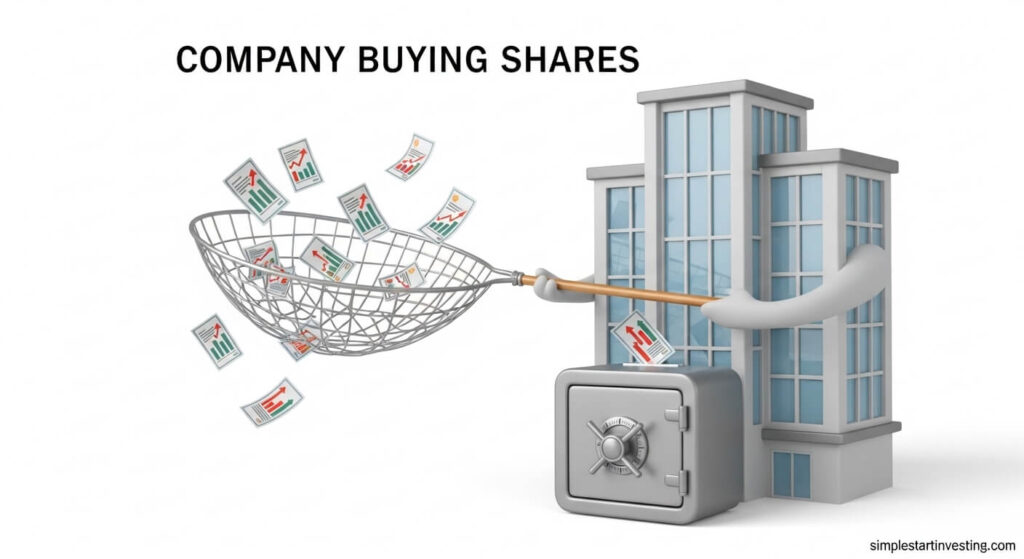
At its simplest level, a stock buyback (also called a share repurchase) is when a company uses its own cash to buy its shares from the open market. These are the same shares that you and I buy through our brokerage accounts.
Once the company buys these shares back, they usually “cancel” them or keep them in their treasury. This means those shares are no longer circulating in the public market. They effectively disappear from the count of “shares outstanding.”
Think of a pizza. If a pizza is cut into 10 slices and you own one slice, you own 10 percent of that pizza. Now, imagine the restaurant owner comes over, buys two slices back from other people, and throws them away. The pizza is still the same size, but now there are only 8 slices left.
Your one slice didn’t change in size, but because there are fewer slices total, you now own a bigger percentage of the pizza. Instead of 10 percent, you now own 12.5 percent. You didn’t have to spend an extra penny, yet your “stake” in the pizza grew. That is the fundamental logic behind stock buybacks.
How Buybacks Work Without the Math
To understand the impact of a buyback, we need to look at how a company’s value is divided among its owners. When a company earns a profit, that profit is technically owned by all the shareholders.
Let’s imagine a company called “Best Coffee Inc.” This company has 100 shares of stock held by the public. Last year, the company made a total profit of 1,000 dollars. If you divide that profit by the number of shares, each share is “entitled” to 10 dollars of profit. This is what Wall Street calls Earnings Per Share or EPS.
Now, imagine Best Coffee Inc. decides to do a stock buyback. They use their extra cash to buy back 20 shares and cancel them. Now, there are only 80 shares left in the world.
If the company makes the same 1,000 dollars in profit next year, we now divide that 1,000 dollars by only 80 shares. Suddenly, each share is entitled to 12.50 dollars of profit.
The company didn’t even have to sell more coffee or raise its prices. Just by reducing the number of “claimants” to the profit, each remaining share became more valuable. This is why investors often cheer when a company announces a buyback program.
Why Do Companies Choose Buybacks Over Dividends?
You might be thinking, “If the company has all this extra cash, why don’t they just send me a check?” That check is called a dividend, and it is the other main way companies return money to shareholders.
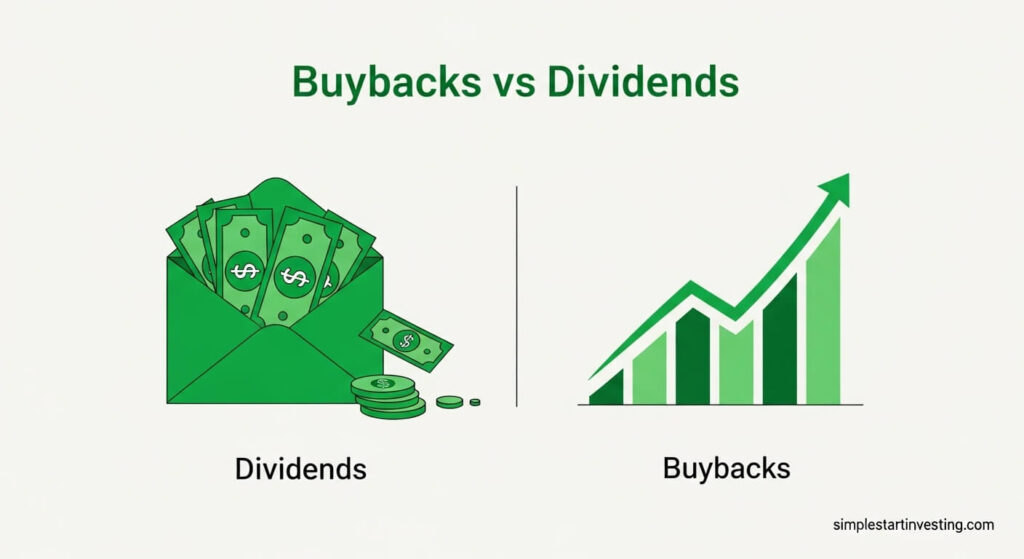
While dividends are great because they put cash in your pocket today, stock buybacks offer a few unique advantages, especially for investors in the US market.
1. Tax Efficiency
In the US, when a company pays you a dividend, you usually have to pay taxes on that money in the year you receive it. Even if you reinvest that money, Uncle Sam takes his cut first.
With a buyback, the value of your remaining shares goes up, but you don’t owe any taxes until you actually sell your stock. This allows your investment to grow “tax-deferred” for years or even decades. It’s a way of increasing your wealth without triggering an immediate bill from the IRS.
2. Flexibility for the Company
Dividends are a commitment. If a company starts paying a dividend of 1 dollar per share, investors expect that check every single quarter. If the company stops or even lowers the dividend, the stock price usually crashes because it signals the company is in trouble.
Stock buybacks are much more flexible. A company can announce they want to buy back 5 billion dollars of stock over the next two years. If they have a bad month or see a better opportunity to buy a competitor, they can just pause the buyback without causing a panic.
3. Signaling Confidence
When a CEO decides to spend the company’s hard-earned cash to buy its own stock, it’s a massive vote of confidence. It essentially says, “We think our own stock is the best investment we can find right now.” It tells the market that the leadership believes the company is undervalued.
The Different Ways Companies Buy Back Shares
Not all buybacks happen the same way. As a new investor, you don’t need to know the technical jargon, but you should understand the two main “vibes” of a buyback.
The Open Market Repurchase
This is the most common type. The company just goes out and buys shares on the stock exchange, just like you do. They might buy a little bit every day for months. This provides a “floor” for the stock price because the company is acting as a consistent buyer.
The Tender Offer
This is more dramatic. The company tells all shareholders, “We want to buy back 10 percent of the company right now. We will pay 50 dollars per share, which is 5 dollars more than the current price.” Shareholders can then choose to sell their shares back to the company at that premium price.
Common Misconceptions About Buybacks
Because stock buybacks involve large amounts of money and influence stock prices, they are often surrounded by myths. Let’s clear a few up.
Misconception 1: “Buybacks are just price manipulation.”
Critics sometimes say buybacks are used to artificially inflate the stock price so executives can get their bonuses. While it is true that buybacks can increase the price (by increasing demand and reducing supply), this only works long-term if the company is actually healthy. If a company is failing and uses its last bit of cash to buy shares, the price might jump for a week, but it will eventually fall. A buyback cannot save a bad business.
Misconception 2: “Companies only buy back stock when they have no better ideas.”
Some people argue that if a company is buying its own stock, it means they aren’t innovating. They think the money should go toward research or new products.
However, many of the world’s most successful companies—like Apple and Google—spend billions on research and billions on buybacks. For these giants, they simply make so much cash that they can do both. Buying back stock is often a smarter move than wasting money on a risky project that might not work.
Misconception 3: “A buyback always means the stock price will go up.”
While buybacks are generally positive, they aren’t a guarantee. If a company buys its stock when the price is extremely high (overvalued), they are actually wasting shareholder money. It is like buying a house for 500,000 dollars when it’s only worth 400,000 dollars. In that case, the buyback actually destroys value for the remaining owners.
What Should You Look for as a Beginner?
If you see a company in your portfolio announce a buyback, don’t just celebrate blindly. You want to ask a few “common sense” questions to see if it’s a smart move.
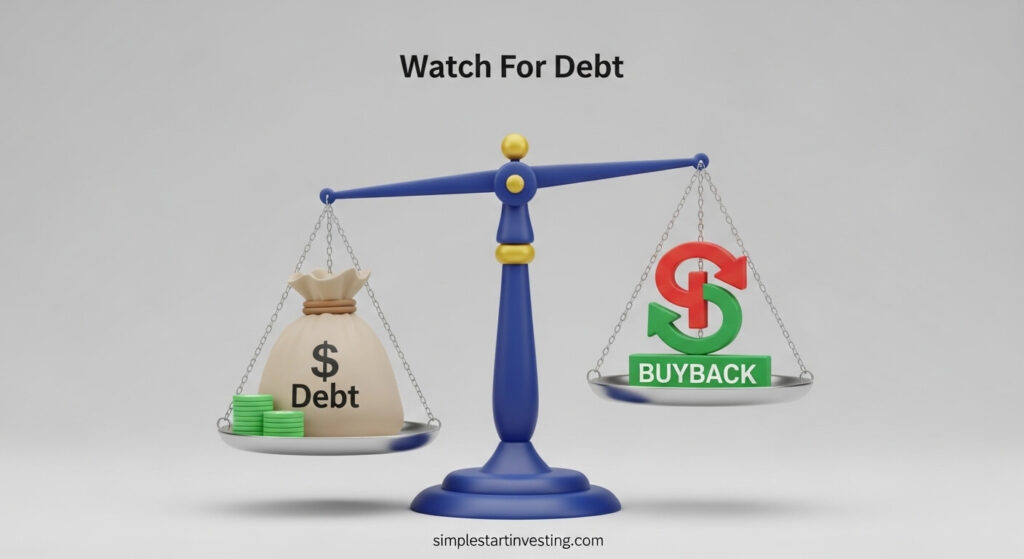
- Where is the money coming from? A good buyback uses “Free Cash Flow”—which is just the cash left over after all bills are paid. A bad buyback is when a company borrows money (takes on debt) just to buy back shares. That is like taking out a high-interest credit card to buy a luxury watch; it looks good, but it’s financially dangerous.
- Is the stock “cheap”? Buybacks are most effective when the stock price is low or fair. If a company buys back shares at an all-time high right before a market crash, they effectively “bought high,” which is the opposite of what a good investor does.
- Are they still growing? You want to see a company that is still investing in its future. If a company stops repairing its stores or firing employees just to fund a buyback, that is a major red flag.
Real-World Example: Apple Inc. (AAPL)
Apple is the “king” of stock buybacks. Over the last decade, they have spent hundreds of billions of dollars buying back their own shares.
Why? Because Apple generates an incredible amount of cash every single day from iPhones, Apps, and Services. They already spend plenty on making the next iPhone and building data centers. Even after all that, they have “too much” cash sitting in the bank.
By buying back shares, Apple has reduced the total number of its shares by a massive amount. This means that even in years where Apple’s total profit didn’t grow much, the “Earnings Per Share” still went up because there were fewer shares to go around. For long-term holders of Apple stock, this has been a huge driver of their wealth.
The Risks: When Buybacks Go Wrong
We’ve talked a lot about the benefits, but it is important to know the dark side. Not every buyback is a “gift.”
The “Debt-Fueled” Trap
During periods of low interest rates, some companies were tempted to borrow billions of dollars to buy back their stock. They figured the interest on the debt was cheaper than the “cost” of the shares. However, if interest rates rise or the business slows down, that debt becomes a heavy anchor.
Offsetting “Stock-Based Compensation”
This is a sneaky one. Many tech companies give their employees stock as part of their salary. This creates “new” shares, which dilutes the current owners (your slice of the pizza gets smaller).
Sometimes, a company will announce a 1 billion dollar buyback, but they aren’t actually making your slice bigger. They are just buying shares to give to their employees so your slice doesn’t get smaller. This is called “offsetting dilution.” It’s better than nothing, but it’s not as good as a buyback that actually reduces the total share count.
How to Find Buyback Information
As a beginner, you don’t need to read 200-page financial reports. You can usually find information about stock buybacks in a few easy places:
- Earnings Press Releases: When a company reports its profits every three months, they will almost always mention if they have authorized a new buyback program.
- Financial News Sites: Websites like Yahoo Finance or Google Finance will often have “Buyback” listed under a company’s recent news.
- The Statement of Cash Flows: If you are feeling brave and want to look at the “official” numbers, look at a company’s annual report (Form 10-K). Under the “Cash Flow from Financing” section, you will see a line item for “Repurchase of Common Stock.” This tells you exactly how much cash they spent buying their own shares during the year.
Summary: The Investor’s Perspective
At the end of the day, stock buybacks are a signal. They tell you that the company has more cash than it needs for its daily operations and that the leadership believes in the company’s future value.
For you, the long-term investor, a well-executed buyback is a “silent partner” that works to increase your ownership stake without you having to lift a finger. It is a tax-efficient way to grow your wealth and a sign of a mature, cash-generating business.
However, always remember to look at the big picture. A buyback is a great “cherry on top” of a good business, but it cannot turn a bad business into a good one. Always focus on the strength of the company first, its products second, and its buyback program third.
By understanding these concepts, you are already ahead of most casual investors. You now know that when you see a company “buying itself,” they are actually making your piece of the pie just a little bit bigger.
Disclaimer: This content is for educational purposes only and does not constitute financial advice. Market conditions change frequently, and you should always perform your own research or consult with a certified professional before making investment decisions.