Have you ever found yourself staring at a stock chart, wondering if today is the day you should finally press the buy button? Or maybe you’re holding onto some cash, waiting for the market to crash so you can scoop up shares at a discount. We have all been there. The idea of “buying low and selling high” sounds like the perfect plan on paper. It feels like common sense.
However, in the world of professional investing, there is a legendary phrase that most successful millionaires live by: Time in the market is far more important than timing the market. While timing the market feels like a thrilling game of skill, time in the market is a quiet, steady strategy that builds wealth while you sleep.
If you are a beginner, understanding this distinction is the single most important lesson you will ever learn. It is the difference between constant stress and a peaceful retirement. In this guide, we are going to dive deep into why waiting for the “perfect moment” usually leads to missing out on the best gains, and how staying invested through the ups and downs is your most reliable path to financial freedom.
What Exactly is “Time in the Market”?
To understand why this strategy works, we first need to define what we mean by time in the market. Simply put, this means buying quality investments—like a broad index fund that tracks the five hundred largest companies in the United States—and holding onto them for years or even decades.
When you practice time in the market, you aren’t trying to guess what will happen tomorrow, next week, or even next month. You are betting on the long-term growth of the American economy. You recognize that while the market might be volatile today, its historical trajectory over ten, twenty, or thirty years has consistently been upward.
A Simple Everyday Example
Think of it like planting an oak tree. If you plant a sapling today and leave it alone for twenty years, you will eventually have a massive tree that provides shade and value. This is “time in the soil.”
On the other hand, “timing the soil” would be like digging up that sapling every time there is a thunderstorm because you are afraid the rain might hurt it, then replanting it only when you think the weather looks perfect. Obviously, that tree will never grow because it never has the chance to develop deep roots. Investing works exactly the same way.
The Common Newbie Mistake
Most beginners believe that successful investing is about being “smart” enough to avoid the bad days. They think they can jump out of the market right before a drop and jump back in just as things start to recover.

The Reality Check
In reality, even professional fund managers with supercomputers struggle to do this consistently. By trying to avoid the “bad” days, you almost always end up missing the “best” days, which usually happen right after a market dip.
Why “Timing the Market” is a Dangerous Trap
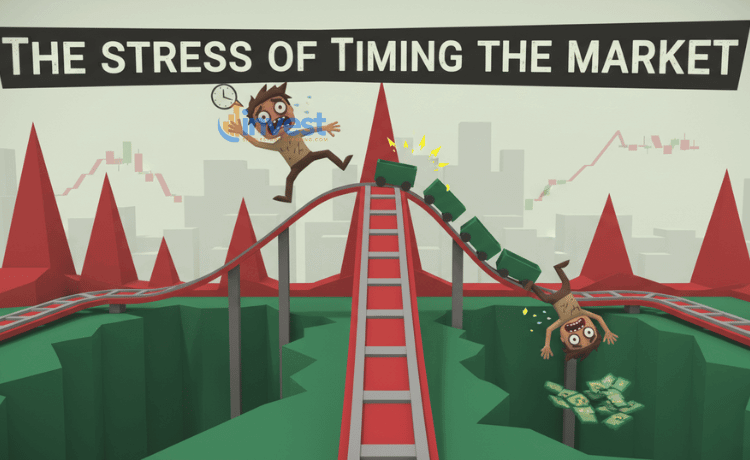
If time in the market is the hero of our story, then “timing the market” is often the villain. Timing the market is the attempt to predict future price movements. It is driven by two of the strongest human emotions: fear and greed.
When the market is hitting new all-time highs, greed takes over. New investors feel like they are missing out (the “FOMO” effect), so they rush in when prices are expensive. Then, when the market inevitably takes a breather and prices drop, fear takes over. They sell their shares at a loss because they are afraid of losing everything.
The Problem with “Waiting for a Dip”
Let’s look at a hypothetical scenario. Imagine you have 10,000 dollars ready to invest in a company like Apple (AAPL) or Microsoft (MSFT). You decide to wait for a 10 percent “dip” before buying.
While you are waiting on the sidelines, the market might actually go up by 20 percent. Even if that 10 percent dip eventually happens, the price will still be higher than it was when you first started waiting! You ended up paying more because you were trying to be “clever.”
The Lizard Brain at Work
Our brains are biologically wired for survival, not for the stock market. When we see a “Red Day” on Wall Street, our instincts scream at us to run. We see our account balance drop from 5,000 dollars to 4,500 dollars, and it feels like a physical threat.
But in the world of finance, that 500-dollar drop is just a “paper loss.” It only becomes a real loss if you sell. The successful investor acknowledges the fear but stays the course, knowing that the “Time in the Market” is doing the heavy lifting.
The Stunning Cost of Missing the Best Days
This is where the logic of staying invested becomes undeniable. Historical data from major financial institutions like J.P. Morgan Asset Management reveals a shocking truth: a huge portion of the stock market’s total returns over the last twenty years came from just a handful of days.
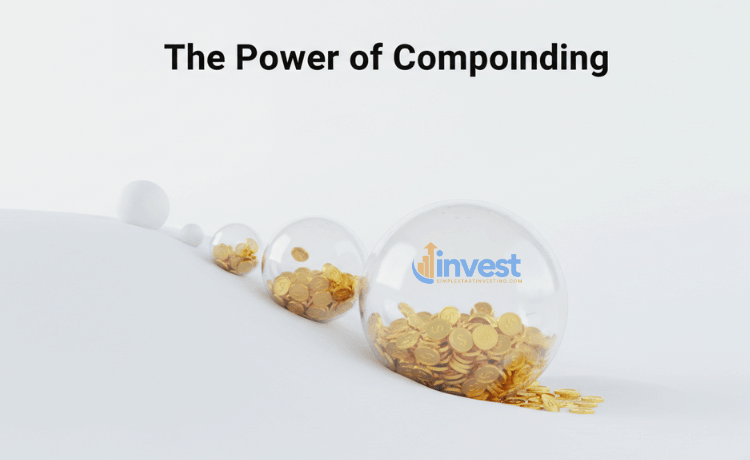
If you stayed fully invested in the market for the last two decades, your money would have grown significantly. For example, a 10,000-dollar investment could have grown to over 60,000 dollars.
However, if you tried to time the market and missed just the ten best trading days of those twenty years, your final balance would be less than half of that—around 30,000 dollars. If you missed the twenty best days, you might have barely made any profit at all!
Why Does This Happen?
The market’s “best days” almost always happen immediately after the “worst days.” When the market crashes, it often snaps back with incredible speed. If you sell your stocks because you are scared during a crash, you won’t be in the market when that recovery happens.
The Beginner’s Misconception
Many beginners think, “I’ll just wait for things to calm down before I buy back in.”
The Logical Adjustment
By the time things feel “calm,” the market has usually already recovered its most significant gains. You can’t have the “recovery” without sitting through the “crash.” They are two sides of the same coin. Staying invested—maintaining your time in the market—ensures you are always present for the recovery.
The Secret Weapon: The Power of Compounding
The reason time in the market is so effective is because of something Albert Einstein reportedly called the eighth wonder of the world: Compounding.
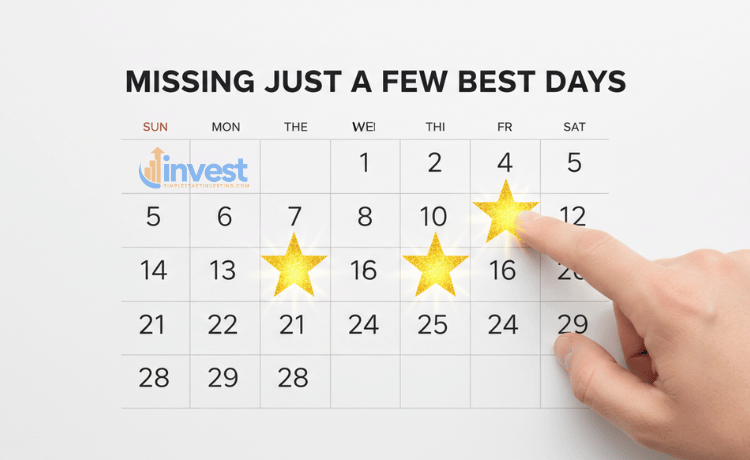
Compounding is the process where your investment earnings are reinvested to generate their own earnings. It is like a snowball rolling down a hill. At first, it grows slowly. But as it gets bigger, it picks up more snow with every rotation.
How it Works in Plain English
Suppose you invest 100 dollars and it grows by 10 percent in one year. You now have 110 dollars. In the second year, you don’t just earn 10 percent on your original 100 dollars; you earn 10 percent on the full 110 dollars. That means you earn 11 dollars this year instead of 10 dollars.
Now, imagine this happening over thirty years with thousands of dollars. The growth in the final five years of your journey will likely be larger than the growth in the first twenty years combined.
The Time Component
The most important ingredient in the compounding “recipe” is not the amount of money you start with. It is time. This is why a person who starts investing 200 dollars a month at age twenty-five will likely end up with much more money at retirement than someone who starts investing 500 dollars a month at age forty-five.
By staying in the market, you give the compounding engine the fuel it needs to work its magic. Every time you “jump out” to time the market, you turn the engine off and have to start from zero again.
The IRS Factor: Why the Tax Man Prefers “Time in the Market”
There is another, very practical reason why staying invested is better for your wallet: Taxes. In the United States, the IRS (Internal Revenue Service) treats long-term investors much better than short-term traders.
Short-Term Capital Gains
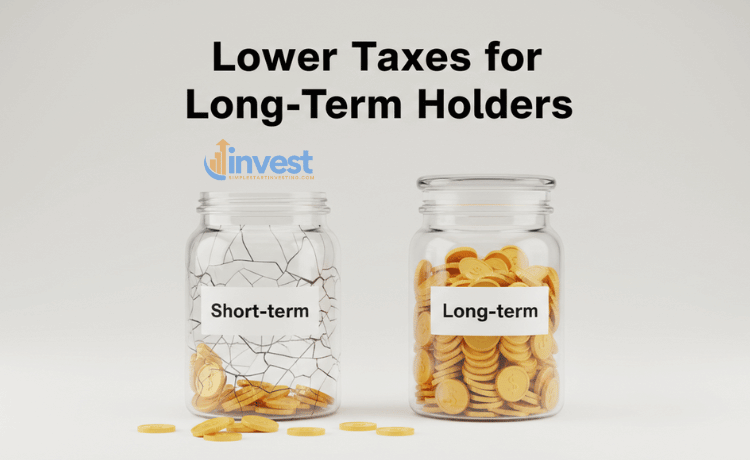
If you buy a stock today and sell it six months later for a profit, the IRS considers that a “short-term capital gain.” This profit is taxed at your ordinary income tax rate, which can be as high as 37 percent for some people.
Long-Term Capital Gains
However, if you practice time in the market and hold that stock for more than one year, it becomes a “long-term capital gain.” For many people, the tax rate on these gains is much lower—often 15 percent, and in some cases, even 0 percent depending on your total income for the year.
The Logic of the Pro
By trading in and out of the market (timing), you are essentially handing a huge chunk of your profits to the government every single year. By staying invested (time), you allow your money to grow tax-deferred for years, and you pay a much smaller percentage when you finally decide to use the money in retirement.
Note: Tax regulations are subject to change; please check current IRS guidelines or consult a tax professional for your specific situation.
Dollar-Cost Averaging: The Easy Way to Achieve “Time in the Market”
If you are feeling overwhelmed by the idea of when to start, there is a simple “cheat code” used by the most successful investors. It is called Dollar-Cost Averaging (DCA).
Instead of trying to guess if today is a good day to buy, you simply invest a fixed amount of money at regular intervals—like 200 dollars every paycheck—no matter what the market is doing.
Why DCA is a Beginner’s Best Friend
- When prices are high: Your 200 dollars buys fewer shares.
- When prices are low (on sale): Your 200 dollars buys more shares.
Over time, you end up with an average cost that is very competitive. More importantly, DCA removes the emotional stress of timing the market. You don’t have to watch the news or follow influencers on social media. You just stay consistent.
The Misunderstanding
New investors often feel like they need to “wait for a sign” before they start. They think they need to be experts in the economy.
The Correction
The best “sign” to start investing was yesterday. The second best time is today. By using Dollar-Cost Averaging, you ensure you have maximum time in the market without ever having to worry about “timing” it perfectly.
Real-World Examples: Giants of the Market
Let’s look at some of the biggest companies in the U.S. market to see how this plays out. Think about companies like Nvidia (NVDA), Costco (COST), or Amazon (AMZN).
Over the last decade, these companies have had many “bad” months. There were times when their stock prices dropped by 20 percent or even 30 percent in a short period. People who were trying to “time” the market likely sold their shares during those drops, fearing the worst.
However, the people who ignored the noise and focused on time in the market have seen their wealth multiply. They didn’t need to be geniuses; they just needed to be patient. They understood that a company like Amazon is a fundamental part of American life, and as long as the company continues to innovate and grow, the stock price will eventually follow—regardless of what happens in a single week of trading.
How to Start Your “Time in the Market” Journey Today
If you are ready to stop gambling on the market’s next move and start building real wealth, here is a simple roadmap for a beginner:
- Open a Brokerage Account: Use a reputable U.S. platform like Vanguard, Fidelity, or Charles Schwab.
- Choose a Broad Market Index Fund: Look for an ETF (Exchange Traded Fund) that tracks the S&P 500. This gives you a piece of the 500 largest companies in America at once.
- Set Up Auto-Invest: Decide on an amount you can afford to lose for the next ten years. Set it to automatically buy every month.
- Delete the App (Metaphorically): Stop checking the price every day. Checking the price daily only invites fear and the temptation to “time” the market.
- Think in Decades: When you see a news headline about a market crash, remind yourself: “I am an investor for the next 20 years. This headline doesn’t matter for my long-term goal.”
Conclusion
At the end of the day, the stock market is a device for transferring money from the impatient to the patient. Trying to “time the market” is exhausting, stressful, and mathematically unlikely to work for most people.
On the other hand, embracing time in the market is the ultimate “set it and forget it” strategy. It allows you to benefit from the growth of the world’s greatest companies, the power of compounding, and the favorable tax laws of the United States.
The market will go up, and the market will go down. But as long as you stay in the game, time is on your side.
Disclaimer: This content is for educational purposes only and does not constitute financial advice. Investing involves risk, including the loss of principal. Past performance is not indicative of future results. Please consult with a qualified financial advisor before making any investment decisions.