
Imagine you are standing in front of a massive lemonade stand. Throughout the day, thousands of people walk by and hand over five dollars for a cup. By sunset, the cash box is overflowing with twenty-thousand dollars. To anyone watching, it looks like you are getting rich. But what if you spent twenty-five thousand dollars on high-end lemons, premium sugar, expensive organic ice, and hiring ten workers to help you?
Even though you brought in a huge amount of money, you actually ended the day with less than you started. This is the fundamental mystery that many new investors face when they look at the stock market. You see headlines about companies like Amazon or Tesla making billions of dollars in sales, yet sometimes their official reports say they lost money.
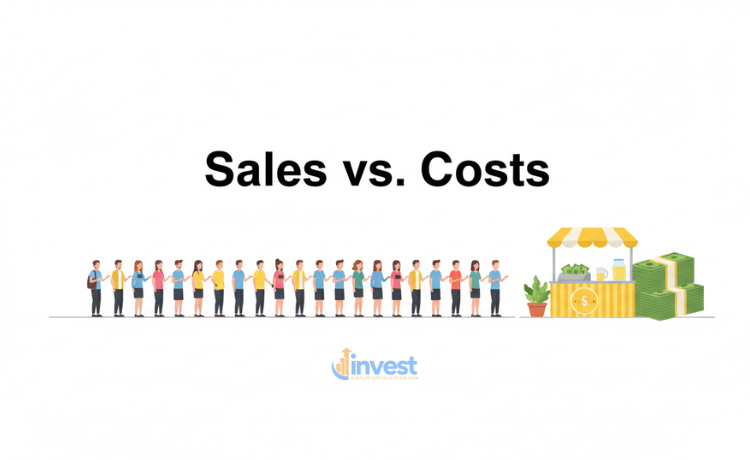
Understanding the difference between revenue vs. profit is the single most important step in moving from a casual observer to a smart investor. In the financial world, we often call revenue the top-line and profit the bottom-line. If you don’t know how to look past the big sales numbers, you might find yourself investing in a “leaky bucket” rather than a gold mine.
What Exactly Is Revenue?
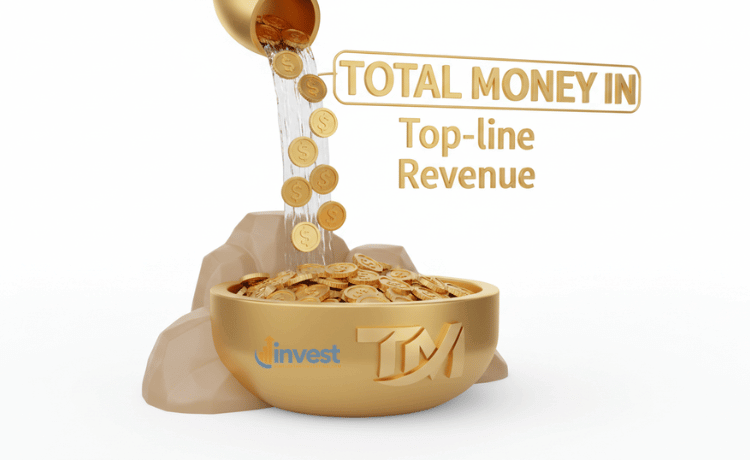
When we talk about revenue, we are talking about the total amount of money a company brings in from its business activities. If you go to a Walmart and buy a fifty-dollar toaster, that fifty dollars is counted as revenue for Walmart. It doesn’t matter how much Walmart paid to buy that toaster from the factory or how much they paid the cashier to ring you up. At this stage, we are only looking at the “money in.”
Revenue is often the first number you see on a financial statement. This is why it is called the top-line. It represents the size of the company’s “territory” in the market. A company with massive revenue, like Apple (AAPL), has a huge influence because so many people are buying their products.
However, revenue is a bit like the speed of a car. It tells you how fast you are moving, but it doesn’t tell you how much fuel you have left or if the engine is about to explode. You can have a car going a hundred miles per hour that is burning through gas so fast it will stop in ten minutes. In the same way, a company can have billions in revenue but be incredibly unhealthy.
Defining Profit: The Real Prize
Profit, or net income, is what stays in the company’s pocket after every single bill is paid. Think of it as the “take-home pay.” When you get your paycheck from your job, your gross pay is like revenue. But after the government takes taxes, and after you pay for health insurance and your 401k contribution, the amount that actually hits your bank account is your profit.
In the corporate world, getting from revenue to profit is a long and difficult journey. A company has to pay for raw materials, rent for their offices, salaries for thousands of employees, electricity, shipping, marketing, and taxes to the IRS. Only after all those people and entities are paid does the company get to claim “profit.”
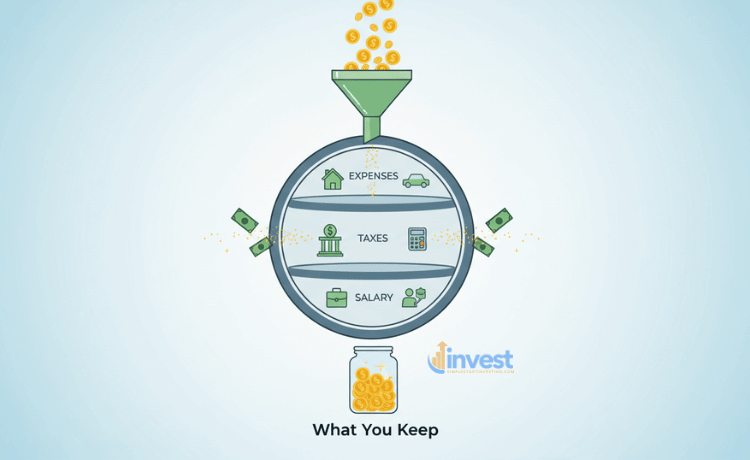
If revenue is the top-line, profit is the bottom-line because it is literally the last line on the income statement. It is the most honest number a company has. While companies can sometimes use accounting tricks to make revenue look bigger, it is much harder to fake a consistent, healthy profit over many years.
Why Do New Investors Get Confused?
A very common mistake for beginners is to equate “big sales” with “big success.” You might see a news report saying a startup just hit one-billion dollars in annual sales. Naturally, you might think, “Wow, they are doing amazing! I should buy their stock.”
The reality is that many high-growth companies in the US, especially in the tech sector, lose money for years despite having massive revenue. Take a company like Uber or Airbnb in their early days. They were processing billions of dollars in transactions. Millions of people were using their apps. Yet, at the end of the year, they were reporting losses of hundreds of millions of dollars.
The misunderstanding happens because beginners often forget about the “Cost of Growth.” If a company spends two dollars in advertising to get a customer to spend one dollar on their product, they are growing their revenue, but they are also growing their losses. In the financial world, this is known as “buying your customers.” It is a risky strategy that only works if the company eventually finds a way to lower their costs or raise their prices.
The Leaky Bucket: How Billions Disappear
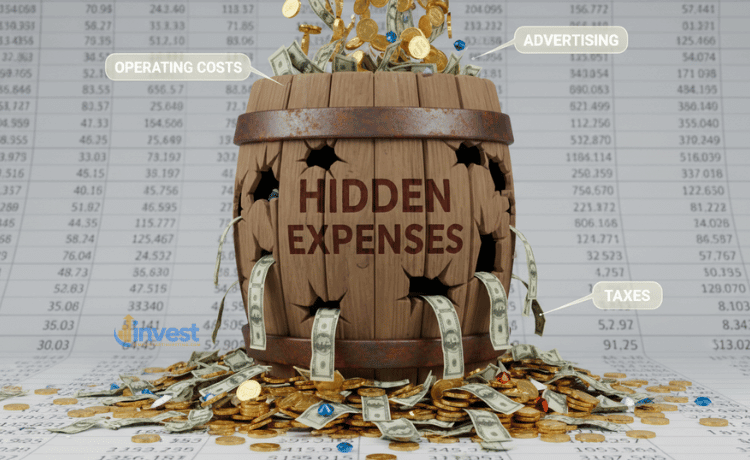
To understand how a company making billions can lose money, you have to look at the expenses. Let’s use a hypothetical example with a large retailer like Costco.
Imagine Costco sells one-billion dollars worth of rotisserie chickens and bulk paper towels in a single month. That one-billion dollars is their revenue. Now, let’s look at where that money goes:
- They spend seven-hundred million dollars to buy those goods from farmers and manufacturers.
- They spend two-hundred million dollars on wages for their store employees and managers.
- They spend fifty million dollars on electricity, rent, and maintenance for their massive warehouses.
- They spend forty million dollars on shipping and logistics to get the goods to the stores.
- They spend twenty million dollars on corporate taxes and interest on their business loans.
If you add those up, the total expenses are one-billion and ten-million dollars. Even though they had a billion dollars in sales, they actually lost ten-million dollars that month. This is why revenue alone is a dangerous metric. You must always ask: “What did it cost to make that money?”
The Role of Reinvestment and Innovation
There is another reason a company might lose money despite high revenue, and this one is actually sometimes a good sign. It’s called Reinvestment.
For many years, Amazon (AMZN) famously reported very little profit or even losses, despite becoming a household name with massive sales. Was Jeff Bezos a bad businessman? Not at all. Amazon was taking every single dollar they made and immediately spending it on building new shipping centers, developing the Kindle, and creating Amazon Web Services (AWS).
They chose to have zero profit so they could build a much bigger empire for the future. As an investor, you have to distinguish between a company that is losing money because their business is bad (like the lemonade stand with expensive lemons) and a company that is “losing” money because they are building a giant future (like Amazon).
The IRS and the SEC have specific rules about how these expenses are reported. Companies are allowed to deduct these business expenses from their revenue to calculate their taxable income. If a company spends more on R&D (Research and Development) than it brings in, it may report a “Net Operating Loss.” In some cases, the IRS allows companies to use these losses to offset future taxes when they finally become profitable.

Revenue vs. Profit: How to Adjust Your Mindset
As a new investor, you need to change how you “read” the news. When you hear that a company’s revenue grew by 20%, don’t celebrate just yet. Instead, follow up with these questions:
- Did their profit grow by 20% too?
- If they are losing money, is it because they are growing or because their costs are out of control?
- Are they becoming more efficient over time, or is the “leaky bucket” getting bigger?
A healthy company usually shows that as revenue goes up, the profit stays stable or grows even faster. This is called Operating Leverage. It means the company has figured out how to sell more without having to spend proportionally more on expenses.
On the other hand, if you see a company where revenue is skyrocketing but losses are also skyrocketing, be very careful. This is often a sign of an unsustainable business model that relies on constant infusions of cash from investors rather than actual business success.
Final Thoughts for the Beginner
In the world of investing, revenue is the “glamour” stat—it’s what people talk about at parties and what makes for great headlines. Profit is the “grit” stat—it’s what actually pays the dividends and drives the stock price up over the long term.
Don’t be blinded by the billions. Always look down to the bottom-line to see what is actually left for the owners of the company (which, if you buy the stock, includes you). Understanding the balance between these two will help you avoid the traps of “hyped” companies and find the true engines of wealth.
Note: Regulations and tax laws regarding corporate earnings can change; please check current IRS guidelines or consult a financial professional for specific tax or legal advice.