Have you ever looked at your investment account and noticed that one specific stock seems to be taking over everything? Maybe you started with a healthy mix of different companies, but now, because one tech giant performed exceptionally well, it makes up nearly all of your account. While seeing a high balance is great, this shift might actually be putting your money at more risk than you realize. This is where the concept of portfolio rebalancing comes into play.
In the world of investing, your “portfolio” is simply the collection of assets you own, like stocks, bonds, or cash. Portfolio rebalancing is the process of bringing your investments back to their original intended proportions. It is like a tune-up for your car or spring cleaning for your house. It ensures that your investment strategy stays aligned with your goals rather than being pushed around by the unpredictable waves of the stock market.
Many new investors think that if a stock is going up, they should just leave it alone forever. However, successful long-term investing often requires the discipline to sell a little bit of what has grown too large and buy a little more of what is currently undervalued. In this guide, we will break down why portfolio rebalancing is the secret weapon of smart investors and how you can do it without feeling like a math genius.
What Exactly is Portfolio Rebalancing?
To understand portfolio rebalancing, imagine you are packing a lunch box. You want a healthy balance: one apple, one sandwich, and one bag of carrots. This represents your original plan. However, over time, imagine the apple magically grows to the size of a watermelon, while the sandwich stays the same. Now, your lunch is mostly apple. Your “balance” is gone.
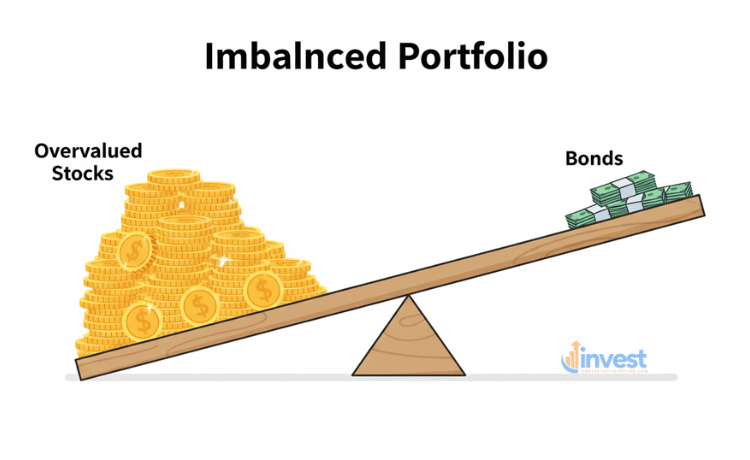
In your investment account, you might decide that you want half of your money in safe bonds and half in growth stocks. If the stock market has a fantastic year, those stocks will grow in value. Suddenly, you might find that sixty percent or seventy percent of your money is in stocks. While you have more money than you started with, you are also now much more exposed to a potential market crash. Portfolio rebalancing is the act of selling some of those stocks and putting that money back into bonds to return to your original fifty-fifty split.
A Real-World Example with Big Names
Let’s say you started with 10,000 dollars. You decided to put 5,000 dollars into a stable company like Walmart (WMT) and 5,000 dollars into a high-growth company like Tesla (TSLA). After one year, Tesla has an incredible run and your 5,000 dollars turns into 8,000 dollars. Meanwhile, Walmart stays steady at 5,000 dollars.
Now, your total account is 13,000 dollars. But instead of being split evenly, Tesla now makes up about sixty percent of your total wealth. If Tesla’s stock price suddenly drops, it will hurt your total account much more than it would have at the beginning. To rebalance, you would sell some Tesla shares and use that cash to buy more Walmart shares until both are equal again.
The Common Beginner Mistake
Most beginners believe that “rebalancing” means they are “losing out” on future gains. They think, “Tesla is doing so well, why would I sell it to buy boring Walmart?” They fall into the trap of performance chasing, assuming that what went up yesterday must go up tomorrow.
The Correct Financial Logic
The truth is that trees don’t grow to the sky. Every stock goes through cycles. By rebalancing, you are actually forcing yourself to follow the most famous rule in investing: Buy low and sell high. You are selling a portion of your “expensive” shares (Tesla) and buying more of your “cheaper” shares (Walmart). This keeps your risk level exactly where you want it.
Why “Set It and Forget It” Can Be Dangerous
You might have heard the advice to “buy and hold” for the long term. While holding your investments is generally a great strategy, “forgetting” them entirely can lead to something called asset drift. This happens when the natural movement of the market changes the fundamental DNA of your portfolio.
If you don’t perform portfolio rebalancing, a portfolio that was meant to be conservative (safe) can slowly turn into an aggressive (risky) one without you even noticing. If a major market correction happens, an unbalanced portfolio could lose thirty percent of its value, while a rebalanced one might only lose fifteen percent.
An Everyday Example
Think of your portfolio like the tires on your car. Over time, because of the way you drive or the bumps in the road, the tires become slightly misaligned. If you ignore it, the car might still drive, but you will experience a bumpy ride, your tires will wear out faster, and you might eventually lose control. Rebalancing is like taking the car to the shop to get the wheels aligned so you can drive safely at high speeds.
The Common Beginner Mistake
Many new investors assume that as long as the “total balance” of their account is going up, they are doing everything right. They ignore the internal mix of their stocks. They think that risk is something that only happens to “other people” or only happens during a recession.
The Correct Financial Logic
Risk is managed before the disaster happens. Rebalancing is not about maximizing every single penny of profit; it is about ensuring that one bad week in the tech sector doesn’t wipe out your entire retirement fund. It is a defensive move that protects your wins.
When Should You Actually Rebalance?
There are two main ways to decide when it is time for some “spring cleaning” in your portfolio. Neither is “better,” but you should choose the one that fits your personality and schedule.
1. The Calendar Method (Time-Based)
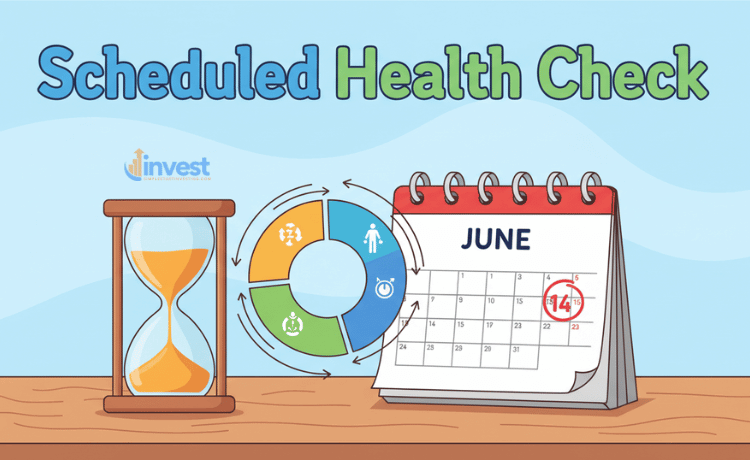
This is the simplest version. You pick a date—maybe your birthday, New Year’s Day, or the start of spring—and you check your account. Once a year or twice a year is usually enough for most people. If your percentages are off by a significant amount, you fix them.
2. The Threshold Method (Percentage-Based)
This requires a bit more monitoring. You set a rule for yourself, such as “If any investment moves more than five percent away from my goal, I will rebalance.” For example, if you want Amazon (AMZN) to be ten percent of your portfolio, but it grows to fifteen percent, that triggers a rebalance.
A Hypothetical Scenario
Imagine you have a portfolio worth 100,000 dollars. You want twenty percent in JPMorgan Chase (JPM) for stability and dividends. That means you want 20,000 dollars in JPM. If the banking sector has a massive rally and your JPM shares are now worth 27,000 dollars, they now represent twenty-seven percent of your total. Since this is more than five percent away from your target, you would sell 7,000 dollars worth of JPM to bring it back down to your 20,000 dollar goal.
The Common Beginner Mistake
Beginners often rebalance too often. They check their apps every single day and panic if a stock moves by one percent. This leads to excessive trading fees and unnecessary stress.
The Correct Financial Logic
Investing is a marathon, not a sprint. Small daily fluctuations are just “noise.” You only need to act when the “drift” is large enough to fundamentally change your risk profile. Most professionals recommend checking in no more than once every six months.
The Tax Man Cometh: Rebalancing and the IRS
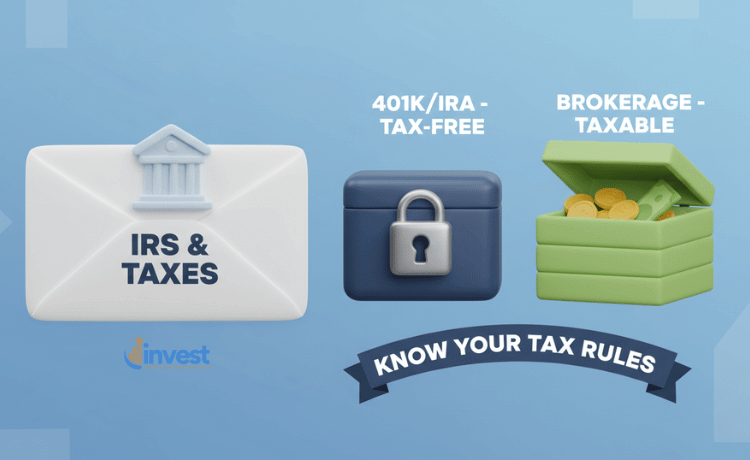
In the United States, selling stocks for a profit usually triggers something called Capital Gains Tax. This is a very important detail that beginners often overlook. When you sell those “winning” stocks to rebalance, the IRS (Internal Revenue Service) sees that as a taxable event.
However, the rules change depending on what kind of account you are using. This is why understanding your account type is crucial for portfolio rebalancing.
Tax-Advantaged Accounts (401k and IRA)
If your investments are inside a retirement account like a 401k or an Individual Retirement Account (IRA), you can usually buy and sell stocks within that account without paying any immediate taxes. This makes rebalancing very easy. You can sell your winners and buy your laggards as much as you want, and you won’t owe the IRS a penny until you start taking the money out in retirement.
Taxable Brokerage Accounts
If you are using a standard brokerage account (like the one you might have on Robinhood, Fidelity, or Schwab that isn’t a retirement account), every time you sell a stock for more than you paid for it, you will owe taxes. If you held the stock for less than a year, you pay a higher rate. If you held it for more than a year, you pay a lower “long-term” rate.
A Smart Way to Rebalance Without Selling
If you have a taxable account and don’t want to pay taxes, you can “rebalance with new money.” Instead of selling your winners, simply use your next paycheck to buy more of the “underweighted” stocks.
For example, if you want more Apple (AAPL) but have too much Microsoft (MSFT), don’t sell Microsoft. Just put your next 500 dollars of investment money specifically into Apple. Over time, this brings your percentages back into balance without triggering a tax bill.
The Common Beginner Mistake
New investors often sell their stocks to rebalance in a taxable account without realizing they will get a big tax bill in April. They are shocked to find out they owe money to the government even though they didn’t “withdraw” the cash to their bank account.
The Correct Financial Logic
Always check which type of account you are using before you hit the “sell” button. If it is a taxable account, try to rebalance by buying new shares first. If you must sell, try to wait until you have held the stock for at least one year and one day to qualify for lower tax rates. Note: Tax regulations can change; please check current IRS guidelines or consult a professional.
Step-by-Step: How to Rebalance Your Portfolio
Now that you understand the “why,” let’s look at the “how.” You don’t need complex software to do this; you just need a clear head and a little bit of time.
Step 1: Record Your Current Balances
Log into your brokerage account and look at the total value of each investment. Let’s say your total portfolio is 50,000 dollars. You have 30,000 dollars in a Total Stock Market Fund and 20,000 dollars in a Bond Fund.
Step 2: Compare to Your Target
What was your original plan? If your plan was to be sixty percent stocks and forty percent bonds, you need to see if you are still there. In this case, sixty percent of 50,000 dollars is 30,000 dollars. Forty percent of 50,000 dollars is 20,000 dollars. Since your current amounts match your target, you don’t need to do anything!
But what if your stocks grew to 40,000 dollars and your bonds stayed at 10,000 dollars? Now you have eighty percent in stocks. You are way off your target.
Step 3: Calculate the Difference
To get back to sixty percent (30,000 dollars), you need to sell 10,000 dollars worth of your Stock Fund.
Step 4: Execute the Trades
You would place a sell order for 10,000 dollars of the Stock Fund. Once that trade clears, you use that 10,000 dollars to buy more of the Bond Fund. Now, you are back to your 30,000 dollar and 20,000 dollar split.
The Common Beginner Mistake
Many beginners feel a “sunk cost” or emotional attachment to their stocks. They feel like they are “killing their darlings” by selling the stocks that have performed well. They hesitate and wait for the “perfect time” to sell, which never comes.
The Correct Financial Logic
Rebalancing is a mechanical process, not an emotional one. By taking the emotion out of it and sticking to your percentages, you protect yourself from your own greed and fear. You are simply following a pre-set map to reach your financial destination.
Why Rebalancing Feels “Wrong” (And Why That’s Good)
The hardest part of portfolio rebalancing isn’t the math—it’s the psychology. Rebalancing often requires you to do the exact opposite of what your brain wants to do.
When the market is booming and everyone is talking about how much money they are making in tech stocks like Nvidia (NVDA), rebalancing tells you to sell some of that Nvidia and buy something that hasn’t been doing as well, like a boring Treasury Bond or a Value Stock fund.
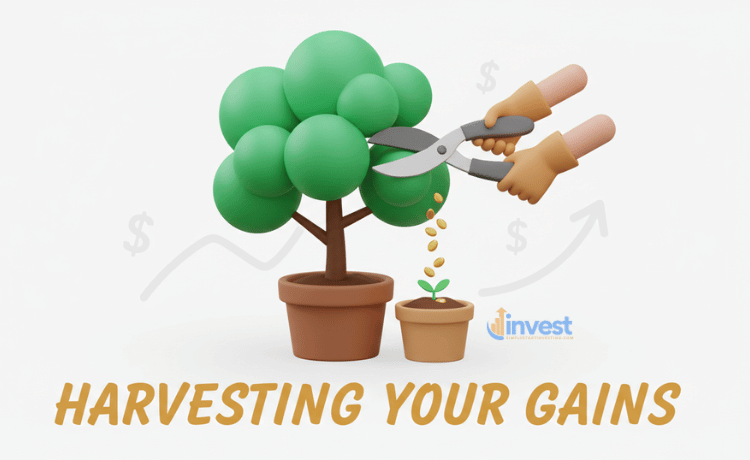
It feels like you are “punishing” your winners and “rewarding” your losers. But in the investment world, today’s winners are often tomorrow’s losers, and vice versa. By rebalancing, you are essentially “harvesting” your profits. You are taking money off the table while prices are high and putting it into assets that are currently on sale.
A Simple Logic Check
Imagine a store is having a massive sale on winter coats in the middle of July. Most people aren’t thinking about coats because it’s hot. But a smart shopper buys the coat now because they know winter is coming and the price will be much higher then. Rebalancing is how you become that smart shopper in the stock market.
Summary of Best Practices for Beginners
As you start your journey with portfolio rebalancing, keep these simple rules in mind:
- Don’t Over-complicate: You don’t need to be perfect. If your target is fifty percent and you are at fifty-two percent, you are doing fine.
- Check the “Big Picture”: Look at your total wealth across all accounts (401k, IRA, and Brokerage) to see your true balance.
- Automate if Possible: Many modern robo-advisors or 401k platforms offer “Automatic Rebalancing.” If you are nervous about doing it yourself, turn this feature on. It will handle the selling and buying for you automatically.
- Stay Consistent: The benefits of rebalancing only show up over years and decades. It helps you survive the bad years so you can thrive in the good ones.
By taking the time to “spring clean” your investments, you are ensuring that your money is working for you, rather than you being a slave to the market’s whims. You are staying in the driver’s seat of your financial future.
Disclaimer: This content is for educational purposes only and does not constitute financial advice. Investment involves risk, and past performance is no guarantee of future results.