Have you ever looked at a high-flying tech company like NVIDIA or Amazon and felt like the price was just too high to reach? One day the stock is trading at 1,000 dollars per share, and the next day, it is suddenly 100 dollars. You might think the company just lost 90 percent of its value, or perhaps you think you just got a 90 percent discount. In reality, you are likely witnessing a common corporate maneuver. If you are asking yourself, what is a stock split, you are in the right place to understand how this process works and why it matters for your portfolio.
A stock split is one of those events that creates a lot of buzz in the news, but for a beginner, it can be deeply confusing. It sounds like magic—turning one thing into many things. However, in the world of Wall Street, there is no such thing as a free lunch. Understanding the mechanics behind a split will help you look past the headlines and see the actual value of your investments.
What Is a Stock Split in Simple Terms?
At its most basic level, a stock split is when a company decides to increase the number of its outstanding shares while simultaneously lowering the price per share. The most important thing to remember is that the total value of the company does not change. Imagine you have a twenty-dollar bill in your wallet. If you go to a bank and ask them to exchange it for two ten-dollar bills, do you have more money? No. You have more pieces of paper, but your total purchasing power remains exactly twenty dollars.
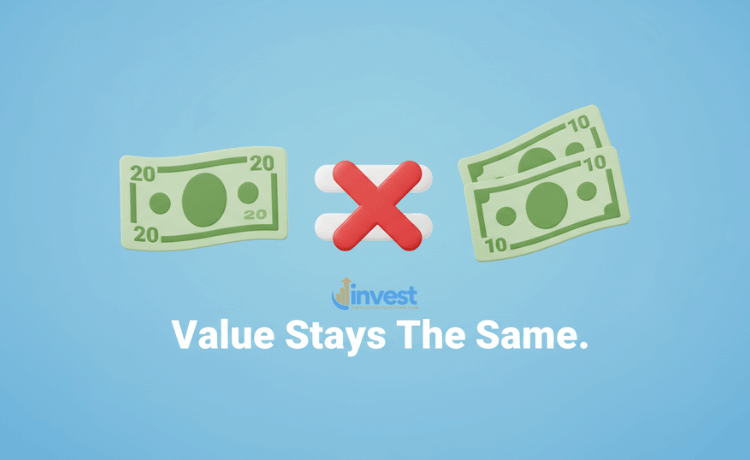
In the stock market, a company does this to make its shares feel more accessible. When a stock price gets very high, it can be intimidating for smaller investors. By “splitting” the stock, the company makes each individual share cheaper without changing the underlying health or size of the business.
A Real-World Example: The Pizza Metaphor
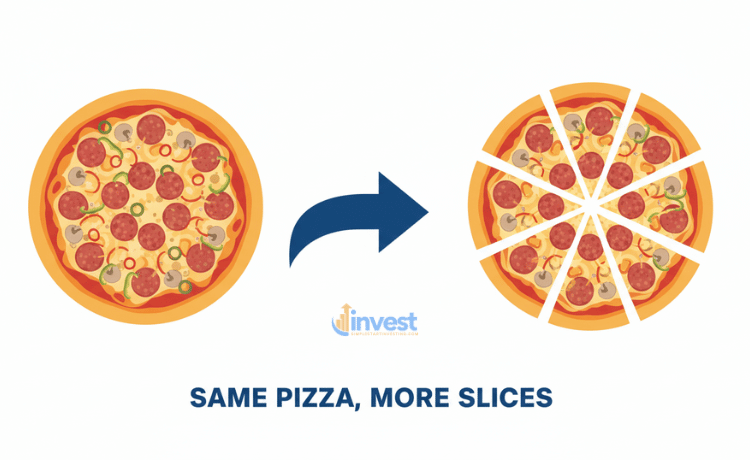
Imagine you order a large pepperoni pizza from a local shop. The pizza is delivered as one whole, uncut pie. This represents one share of a company. Now, imagine you take a pizza cutter and slice that pie into eight equal pieces. Do you have more pizza than you started with? Of course not. You simply have eight slices instead of one whole pie. If the whole pizza was worth 80 dollars, each of your eight slices is now worth 10 dollars.
The Common Beginner Mistake
Many new investors see a headline that says “Company X Announces a Ten-for-One Stock Split” and assume they are getting free shares. They think, “If I own ten shares, I will soon own one hundred shares, so I must be getting ten times richer!” This is a fundamental misunderstanding of how value is calculated.
The Correct Financial Logic
The logic you should follow is that your “slice of the pie” remains the same percentage of the company. If a company has 1,000 shares total and you own 10, you own one percent of the company. After a ten-for-one split, the company now has 10,000 shares total and you own 100. You still own exactly one percent of the company. Your wealth hasn’t changed; only the units used to measure it have.
Why Do Companies Split Their Stocks?
If a stock split doesn’t actually create value, you might wonder why famous companies like Apple (AAPL) or Walmart (WMT) bother doing it at all. The reasons are mostly psychological and structural rather than financial.
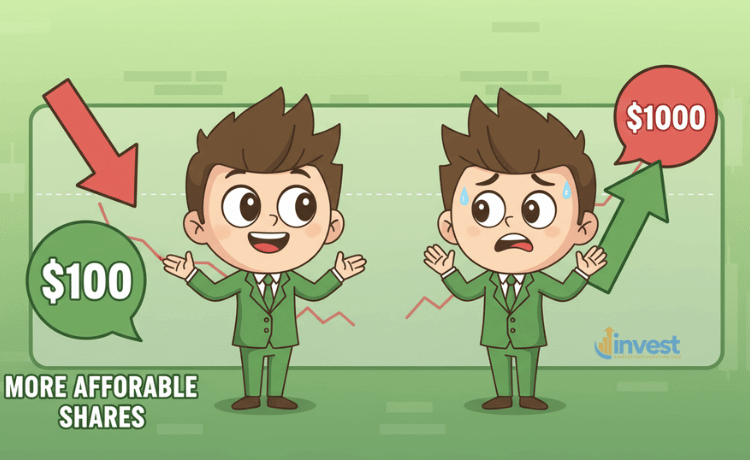
Increasing Liquidity and Accessibility
When a stock price reaches 3,000 dollars per share, like Amazon (AMZN) did before its recent split, it becomes difficult for a beginner with only 500 dollars to start investing in that specific company. By splitting the stock twenty-for-one, the price drops to 150 dollars. Now, that same beginner can easily buy three shares. This increases “liquidity,” which is just a fancy way of saying it is easier for people to buy and sell the stock because more people can afford it.
Boosting Employee Morale and Options
Many large American corporations give their employees stock options as part of their benefits package. If a single share is worth 2,000 dollars, it is hard to give small, incremental raises or bonuses in the form of stock. Splitting the stock allows the company to be more flexible with how they reward their team members.
A Real-World Example: The Walmart Approach
Walmart has split its stock many times over the decades. Their leadership often explains that they want their own associates (the people working in the stores) to be able to afford to buy shares. If the price gets too high, the very people who build the company can’t afford to own a piece of it. Keeping the price “affordable” maintains a sense of ownership across the entire company.
The Common Beginner Mistake
New investors often believe that a stock split is a “buy signal.” They think that because the price is lower, the stock is now “cheap.”
The Correct Financial Logic
Lower price does not mean better value. A stock at 10 dollars can be “expensive” if the company is failing, while a stock at 1,000 dollars can be “cheap” if the company is earning massive profits. You should judge a stock based on its valuation (how much profit it makes compared to its price), not the absolute dollar amount of a single share.
The Two Types of Splits You Need to Know
While most people talk about “forward” splits (where you get more shares), there is another version that works in the opposite direction.
1. The Forward Stock Split
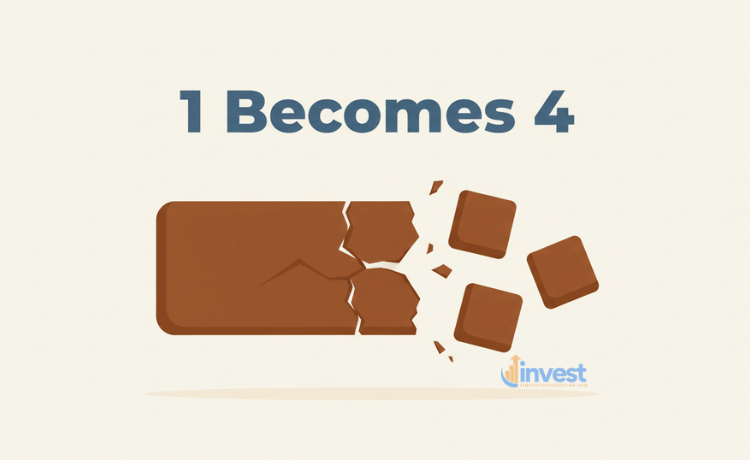
This is the most common type. In a two-for-one split, for every one share you own, you receive an additional share. The price is cut in half.
- Example: You own 10 shares of a tech company worth 200 dollars each (total value 2,000 dollars). After a two-for-one split, you own 20 shares worth 100 dollars each (total value 2,000 dollars).
2. The Reverse Stock Split
This is often a red flag for investors. In a reverse split, the company reduces the number of shares and increases the price. A one-for-ten reverse split means that for every ten shares you own, they are sucked up and replaced by just one share.
- Example: You own 1,000 shares of a struggling penny stock worth 1 dollar each. The company does a one-for-ten reverse split. You now own 100 shares worth 10 dollars each.

Why Do Companies Do Reverse Splits?
Usually, companies do this because their stock price has fallen so low that they are at risk of being kicked off a major stock exchange like the New York Stock Exchange or the NASDAQ. These exchanges often require a minimum price (usually 1 dollar) to stay listed. A reverse split is an artificial way to pump the price back up.
The Common Beginner Mistake
Investors sometimes see a reverse split and think, “Wow, the price of this stock just jumped from 1 dollar to 10 dollars! It’s skyrocketing!” They fail to check their account and realize they have 90 percent fewer shares than they did yesterday.
The Correct Financial Logic
A reverse split is often a sign of a company in trouble. While it isn’t always a death sentence, you should investigate why the price was so low in the first place. Don’t be fooled by the higher price tag; the company’s total value is still the same, and the underlying business problems likely still exist.
Do Stock Splits Affect My Taxes?
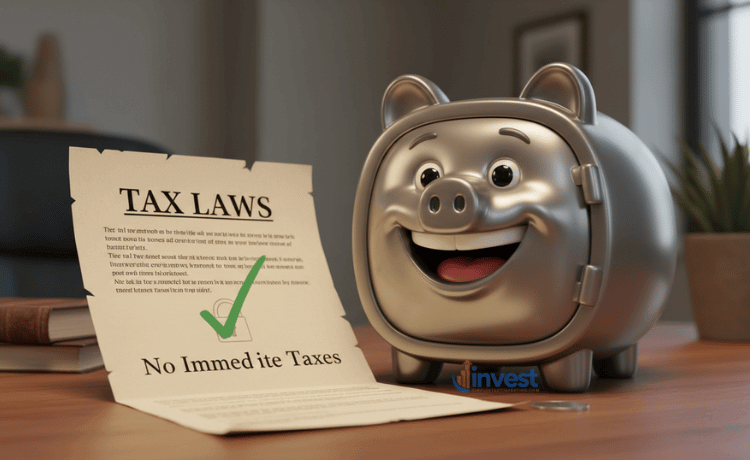
One of the biggest concerns for beginners in the US market is whether a stock split will trigger a tax bill from the IRS. The good news is that for most investors, a stock split is a “non-taxable event.”
How It Works in Your Brokerage Account
Because your total wealth has not changed, the IRS does not consider this a capital gain. You haven’t “made” any money yet; you just have more units of the same investment. Your “cost basis” (the amount you originally paid) is simply spread out over more shares.
A Number-Based Example
Suppose you bought one share of a company for 100 dollars. Later, the company does a two-for-one split. You now have two shares. Your cost basis for each share is now 50 dollars. If you sell one share for 60 dollars in the future, you will only pay taxes on the 10-dollar profit for that specific share.
The Common Beginner Mistake
Some people fear that receiving “new” shares in a split is like receiving a dividend, and they worry they will owe taxes on the value of those new shares immediately.
The Correct Financial Logic
You only owe taxes when you sell the shares for a profit (a capital gain). Simply holding shares through a split does not cost you anything in taxes. As always, tax laws can be complex and subject to change, so you should check current IRS guidelines or speak with a tax professional regarding your specific situation.
Does a Stock Split Change Dividends?
If you are an investor who loves receiving regular checks from companies (dividends), you might wonder if a split will cut your income.
Proportional Adjustments
When a company splits its stock, it also adjusts its dividend per share proportionally. This ensures that the total amount of money they pay out to you stays exactly the same.
A Real-World Example: The Dividend Payout
Imagine a company pays a dividend of 4 dollars per share every year. You own 10 shares, so you receive 40 dollars a year. The company decides to do a four-for-one stock split.
- You now own 40 shares.
- The company adjusts the dividend to 1 dollar per share.
- Your total annual payment is still 40 dollars (40 shares multiplied by 1 dollar).
The Common Beginner Mistake
A beginner might see that the dividend “dropped” from 4 dollars to 1 dollar and panic, thinking the company is cutting its dividend. They might sell their shares in fear.
The Correct Financial Logic
Always look at the “Dividend Yield” (the percentage) rather than just the dollar amount. If the price of the stock and the dividend both split by the same ratio, your actual return stays the same. The company is not being less generous; it is just keeping the math consistent with the new share count.
The Role of Fractional Shares in Modern Investing
In the past, stock splits were a massive deal because most people had to buy “round lots” of 100 shares, or at least one whole share. If a share of Berkshire Hathaway (Class A) costs over 500,000 dollars, it is impossible for a regular person to buy it.

However, today, many popular US brokerages (like Fidelity, Schwab, or Robinhood) allow you to buy “fractional shares.” This means you can invest 5 dollars into a company even if the share price is 500 dollars. You simply own one percent of a share.
Are Splits Still Relevant?
Because of fractional shares, stock splits are technically less important than they used to be. You don’t need a split to “afford” a piece of a high-priced company anymore. However, splits still matter because they signal that management is confident about the future. A company usually doesn’t split its stock if it expects the price to crash next month.
The Common Beginner Mistake
Some beginners think that because they can buy fractional shares, they should ignore stock splits entirely.
The Correct Financial Logic
While you don’t need a split to invest, you should still pay attention to them. They often lead to increased trading volume and can change the “options” market for a stock, which can indirectly affect the stock’s price movements and volatility.
Summary: What Every Beginner Should Remember
A stock split is a cosmetic change, like changing a ten-dollar bill for ten ones. It makes the shares look more attractive and makes them easier to trade, but it doesn’t change the fundamental value of your investment.

- Forward Split: Good sign, makes shares cheaper to buy, total value stays the same.
- Reverse Split: Potential warning sign, makes shares look more expensive to meet exchange requirements.
- Taxes: Generally not an issue until you sell.
- Dividends: The total amount you receive stays the same, even if the “per share” amount changes.
When you see a headline about a stock split, don’t rush to buy or sell based on the split alone. Instead, use it as an opportunity to re-evaluate the company. Is it growing? Is it profitable? Does it fit your long-term goals? Those are the questions that will actually build your wealth over time.
Disclaimer: This content is for educational purposes only and does not constitute financial advice. Investment involves risk, and past performance is no guarantee of future results.