
Buying a home is likely the biggest purchase you will ever make. It is an exciting milestone, but it also comes with a lot of paperwork and new responsibilities. One of the most important—and often misunderstood—parts of this process is securing the right homeowners insurance coverage.
If you are a first-time buyer, you might think of insurance as just another “closing cost” or a box you need to check to satisfy your bank. However, your policy is much more than a requirement; it is a financial safety net designed to protect your assets and your future.

In this guide, we will break down exactly how homeowners insurance works, what those confusing terms actually mean, and how to decide on the right amount of protection without overpaying. We are going to keep it simple, practical, and focused on your needs as a new homeowner in the U.S. market.
What Exactly Is Homeowners Insurance Coverage?
At its core, homeowners insurance coverage is a contract between you and an insurance company. You pay a fee, known as a premium, and in exchange, the company agrees to pay for specific financial losses related to your home and belongings.
Think of it as a “repair and replace” plan for your life. If a tree falls through your roof or a fire breaks out in the kitchen, the insurance company helps cover the costs so you do not have to pay for everything out of your own pocket.
How it works in plain English
Imagine you have a big emergency savings account that you only use for your house. Instead of trying to save 400,000 dollars yourself just in case the house burns down, you pay a smaller amount (the premium) to an insurance company. They pool your money with thousands of other homeowners to ensure there is enough to pay for anyone who suffers a disaster.
A real-world example
Let’s say you own a home in a quiet suburb. One afternoon, a severe hailstorm rolls through and destroys your roof. A contractor tells you it will cost 15,000 dollars to replace. If you have the right homeowners insurance coverage, you would only pay your agreed-upon “deductible” (perhaps 1,000 dollars), and the insurance company would pay the remaining 14,000 dollars.
The common mistake
Many beginners assume that homeowners insurance covers everything that could possibly go wrong. They think if the dishwasher leaks because it is old, or if a flood from a nearby river enters the home, the insurance will pay for it.
The correct mindset
In reality, standard policies cover “sudden and accidental” damage, like fire, wind, or theft. They do not cover basic maintenance or “wear and tear.” Furthermore, flood insurance and earthquake insurance are almost always separate policies that you must buy separately. Understanding these boundaries helps you prepare for the real risks.
Understanding Dwelling Coverage: The Foundation of Your Policy
The most significant part of your homeowners insurance coverage is called Dwelling Coverage. This is the part that pays to rebuild the physical structure of your home—the walls, the roof, the floors, and the built-in appliances.
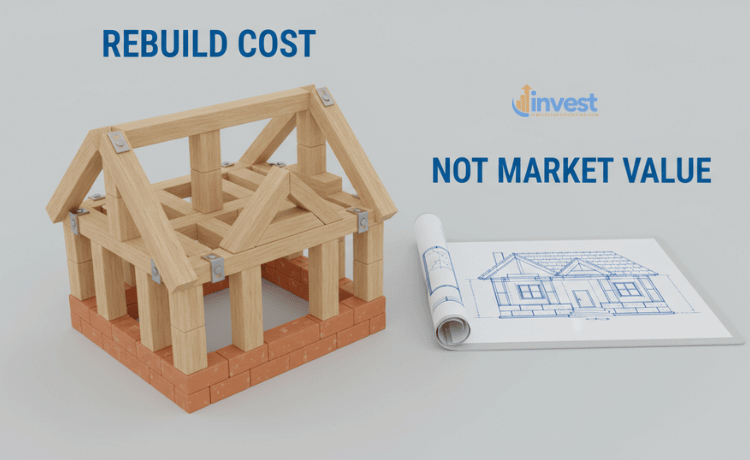
Explaining the “Rebuilding Cost”
The most important thing to understand here is that the amount of dwelling coverage you need is based on the cost to rebuild, not the price you paid for the house. These are two very different numbers.
A real-world example
Suppose you bought a beautiful home in a high-demand area like Austin or Seattle for 600,000 dollars. A large portion of that price is the value of the land itself. If the house were to burn down, the land would still be there. It might only cost 350,000 dollars in materials and labor to build the exact same house from scratch. In this case, you only need 350,000 dollars in dwelling coverage, not 600,000 dollars.
The common mistake
New homeowners often try to match their insurance limit to their mortgage amount or the market value of the home. If you insure your home for the market value (600,000 dollars) when the rebuild cost is only 350,000 dollars, you are paying for extra coverage you can never actually use. Conversely, if you live in an area where construction costs have spiked, and you insure for only what you paid years ago, you might be “underinsured.”
The correct mindset
Focus on the local price of labor and building materials. You can ask a local builder or use online tools to estimate the “square foot construction cost” in your zip code. If it costs 200 dollars per square foot to build and your home is 2,000 square feet, your dwelling coverage should be around 400,000 dollars.
Personal Property Coverage: Protecting Your “Stuff”
What would happen if you took your house, turned it upside down, and shook it? Everything that falls out—your clothes, furniture, electronics, and kitchen tools—is considered Personal Property.

How much do you need?
Most policies automatically set this at a percentage of your dwelling coverage, usually between 50 percent and 70 percent. If your house is insured for 300,000 dollars, your “stuff” might be covered for up to 150,000 dollars or 210,000 dollars.
A real-world example
Imagine a thief breaks into your home while you are on vacation and steals your 2,000-dollar laptop, your high-end camera, and your collection of designer sneakers. With personal property coverage, you can file a claim to get the money back to replace those items. This coverage even applies if your items are stolen while they are in your car or while you are traveling.
The common mistake
Beginners often fail to realize that there are “sub-limits” on expensive items. For example, a policy might limit coverage for jewelry to 1,500 dollars. If you have a 10,000-dollar engagement ring, a standard policy will not fully cover it unless you add a special “rider” or “endorsement” specifically for that ring.
The correct mindset
Take a “home inventory.” Walk through your rooms with a phone and record a video of everything you own. If you have specific high-value items like expensive art, rare coins, or high-end musical instruments, talk to your agent about adding extra protection for those specific pieces.
Liability Coverage: The Shield for Your Savings
Liability is perhaps the most overlooked part of homeowners insurance coverage, but it is vital for your financial survival. This part of the policy protects you if someone gets hurt on your property or if you accidentally damage someone else’s property and they sue you.

Why it matters
In the U.S., legal fees and medical bills can be incredibly high. If a delivery driver slips on your icy walkway and breaks their leg, they could sue you for medical expenses and lost wages. Liability coverage pays for your legal defense and any settlements or judgments up to your policy limit.
A real-world example
Let’s say you are playing golf and you accidentally hit a ball that strikes someone in the head, causing a serious injury. Even though this happened away from your home, your homeowners liability coverage usually follows you and provides protection for your personal actions.
The common mistake
Many people stick with the “minimum” liability limit offered by the insurance company, which is often 100,000 dollars. While that sounds like a lot, a single serious injury or a long lawsuit can easily exceed that amount. If the judgment is for 300,000 dollars and you only have 100,000 dollars in coverage, you are personally responsible for the remaining 200,000 dollars.
The correct mindset
Your liability limit should be high enough to protect all of your assets (your home equity, your savings, and your future earnings). Most experts recommend a minimum of 300,000 dollars to 500,000 dollars. The price difference between 100,000 dollars and 300,000 dollars in coverage is usually very small—often just a few dollars a month.
Loss of Use: When You Can’t Stay at Home
If a fire or a major storm makes your home uninhabitable, where will you live while it is being repaired? This is where “Loss of Use” (also called Additional Living Expenses) comes in.
Covering the extra costs
This coverage pays for the “additional” costs you incur because you cannot live at home. This includes hotel bills, restaurant meals (because you don’t have a kitchen), and even extra gasoline if your temporary home is further from your job.
A real-world example
Suppose your kitchen is destroyed by a grease fire. It will take three months to repair. You move into a rental apartment that costs 2,000 dollars a month. Your Loss of Use coverage will pay that 2,000 dollars, plus the extra money you spend on laundry and dining out, so that your standard of living remains the same.
The common mistake
People often forget to keep receipts during a disaster. Insurance companies require proof of these “extra” expenses. They don’t just give you a lump sum; they reimburse you for the actual costs that are higher than your normal spending.
The correct mindset
Treat this coverage as your “disaster lifestyle” fund. Usually, it is set at 20 percent of your dwelling coverage. For a 300,000-dollar home, that gives you 60,000 dollars for temporary living. This is usually more than enough for most people, but it is good to know it is there.
Deductibles: Choosing Your Out-of-Pocket Cost
The deductible is the amount of money you agree to pay yourself before the insurance company kicks in. This is a key lever you can pull to change the price of your premium.
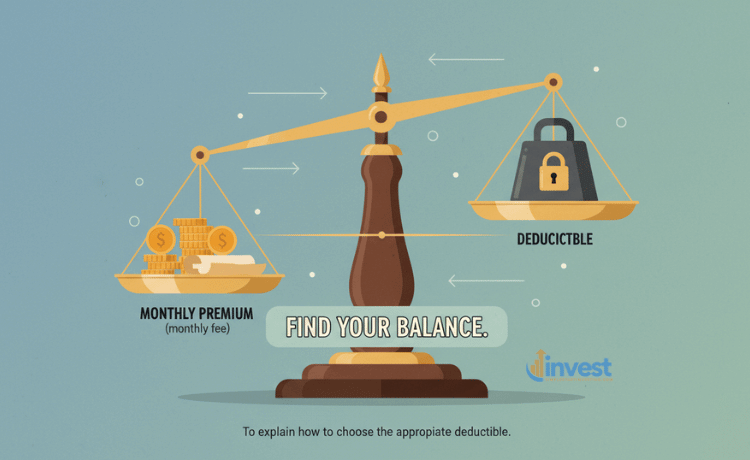
The balance of risk
If you choose a low deductible (like 500 dollars), your monthly premium will be higher. If you choose a high deductible (like 2,500 dollars), your monthly premium will be lower.
A real-world example
Imagine you have two choices. Option A has a 500-dollar deductible and costs 150 dollars a month. Option B has a 2,500-dollar deductible and costs 100 dollars a month. By choosing Option B, you save 50 dollars a month (or 600 dollars a year). If you go four years without a claim, you have saved 2,400 dollars—which almost covers the higher deductible if something finally does happen.
The common mistake
New homeowners often pick the lowest deductible possible because they are afraid of a big bill. However, filing small claims (like for a 600-dollar repair with a 500-dollar deductible) can actually cause your insurance rates to go up significantly in the future.
The correct mindset
Choose the highest deductible that you can comfortably afford to pay out of your emergency savings. This keeps your monthly costs down and prevents you from being tempted to file small claims that aren’t worth the risk of a rate hike.
Actual Cash Value vs. Replacement Cost: The Crucial Difference
This is perhaps the most technical part of homeowners insurance coverage, but you must understand it to avoid a heartbreak later. These are the two ways insurance companies calculate how much to pay you for your lost items.
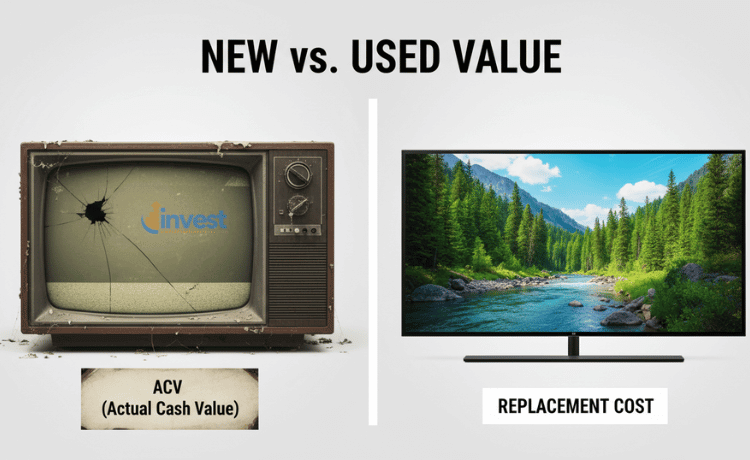
Actual Cash Value (ACV)
This takes “depreciation” into account. It pays you what your item was worth right before it was destroyed. Think of it like a garage sale price. If your 5-year-old TV is destroyed, ACV will pay you what that old TV would sell for on eBay today—maybe only 100 dollars—even if a new one costs 800 dollars.
Replacement Cost Value (RCV)
This pays you the actual amount it costs to buy a brand-new version of what you lost. In the TV example, RCV would pay you the full 800 dollars to get a new, comparable television.
The common mistake
Many people choose Actual Cash Value for their personal property or their roof because the premium is slightly cheaper. They don’t realize that if a disaster strikes, they will receive a check for a much smaller amount than they need to actually replace their things.
The correct mindset
Always aim for “Replacement Cost” coverage for both your dwelling and your personal property. It provides much better protection and ensures that a disaster doesn’t leave you with a massive financial gap that you have to fill yourself.
How to Get the Best Rate on Your Policy
Now that you understand the components of homeowners insurance coverage, how do you get the best deal? Insurance companies love “low-risk” homeowners, and you can prove you are one by taking a few simple steps.
- Bundle your policies: Most companies (like State Farm, Allstate, or Progressive) will give you a significant discount if you buy both your home and auto insurance from them.
- Improve home security: Installing a monitored alarm system or smart water-leak detectors can often lead to a lower premium.
- Maintain a good credit score: In most U.S. states, insurance companies use a “credit-based insurance score.” A higher credit score usually means lower insurance rates.
- Shop around: Don’t just take the first quote you get. Prices can vary by hundreds of dollars between different companies for the exact same coverage.
Regulations and Changes
It is important to remember that insurance rules can vary by state. For example, homeowners in Florida or California may face different requirements and challenges due to hurricanes or wildfires. Always check current local guidelines or consult with a licensed insurance professional in your specific area to ensure you are compliant with local laws.
Summary Checklist for Beginners
To ensure you have the right homeowners insurance coverage, follow these steps:
- Determine Rebuild Cost: Do not use the market price; use the cost to rebuild the structure.
- Set Liability High: Aim for at least 300,000 dollars to protect your assets.
- Choose Replacement Cost: Ensure you are getting “new for old” and not the depreciated value.
- Right-size your Deductible: Match it to your emergency fund.
- Inventory your belongings: Record a video of your home’s contents.
By taking the time to understand these layers of protection, you move from being a “required” insurance buyer to a smart homeowner who is actively protecting their financial future.
Disclaimer: This content is for educational purposes only and does not constitute financial, legal, or professional insurance advice. Insurance regulations and policy terms can change; please consult with a licensed insurance agent or check current state guidelines before making any purchasing decisions.