
If you were to ask most people how they are doing financially, they would probably tell you how much they earn per year. In the United States, we are conditioned to view our annual salary as the ultimate badge of success. We think that if someone makes 150,000 dollars a year, they must be wealthy, while someone making 50,000 dollars is struggling. But the truth is, your paycheck is only a small piece of the puzzle. If you want to know how much progress you are actually making, you need to start tracking net worth.
The reality of the American economy is that it is very easy to earn a lot of money and still be broke. You might have a neighbor with a brand-new SUV and a massive house who earns a high salary but has a negative net worth because of debt. Meanwhile, a librarian who has been consistently saving and investing for decades might be a secret millionaire. This article is designed to help you shift your mindset from “how much do I make?” to “how much do I keep?” and show you why tracking net worth is the single most important habit for your financial freedom.

What Exactly Is Net Worth?
Think of your net worth as a financial “health report card.” While your paycheck shows your income for a specific month, your net worth shows the total value of everything you have built up over your entire life. At its simplest level, it is the difference between what you own and what you owe.
To figure this out, you look at your assets and subtract your liabilities. An asset is anything you own that has cash value, like the money in your checking account, your retirement funds, or the equity in your home. A liability is anything you owe to someone else, such as a mortgage, a car loan, student loans, or credit card debt.
If you have 50,000 dollars in total assets and 30,000 dollars in total debt, your net worth is 20,000 dollars. It does not matter if you earned that 50,000 dollars this year or over the last ten years; the net worth figure tells you exactly where you stand right now.
Why Your Paycheck Can Be Deceptive
Many people in the U.S. fall into the trap of “lifestyle creep.” As their salary increases, their spending increases at the exact same rate, or sometimes even faster. This is why tracking net worth is so vital—it exposes the truth that a high income does not automatically lead to wealth.

Imagine two different people. Person A earns 200,000 dollars a year. They live in a high-cost city, drive a luxury car with a massive monthly payment, and have significant student loan debt from an elite university. At the end of the month, after paying for their lifestyle and debt, they have zero dollars left to save. Their net worth stays flat or even goes down if they take on more debt.
Now, look at Person B. They earn 65,000 dollars a year. They live in a modest apartment, drive an older but reliable car, and consistently put 500 dollars a month into a retirement account. Over time, Person B’s net worth will grow steadily because they are keeping a portion of what they earn. Despite earning less than a third of what Person A makes, Person B is actually becoming wealthier.
The Problem with High-Income Poverty
There is a term often used in personal finance circles: HENRY, which stands for “High Earner, Not Rich Yet.” These are individuals who have the high-paying jobs we all envy but have very little to show for it in terms of actual assets. Without tracking net worth, a HENRY might feel successful because their bank account gets a large deposit every two weeks, but they are actually one job loss away from a total financial crisis.
Tracking your net worth forces you to see that your salary is just a tool. It is the “raw material” you use to build wealth. If you use all that material to buy things that lose value (like clothes or expensive dinners), you aren’t building anything permanent.
The Two Sides of the Net Worth Coin
To master tracking net worth, you have to understand the two categories that move the needle. You are either adding to your assets or shrinking your liabilities. Both actions increase your net worth.
Understanding Your Assets
Assets are the “good guys” in your financial story. In the American context, these usually fall into a few main buckets:
- Liquid Cash: This includes your checking and savings accounts. This is the money you can access immediately for emergencies.
- Retirement Accounts: This includes your 401k, 403b, or IRAs. Even if you cannot touch this money until you are older, it is a huge part of your net worth.
- Investments: This refers to brokerage accounts where you might own stocks, bonds, or index funds.
- Real Estate: If you own a home, the market value of that home is an asset.
- Personal Property: While things like your car or jewelry are technically assets, many experts suggest being conservative here because cars lose value so quickly.
Understanding Your Liabilities
Liabilities are the “anchors” that hold your net worth back. Common American liabilities include:
- Mortgage Loans: For most people, this is their largest debt.
- Student Loans: These can be a significant drag on net worth for young professionals.
- Credit Card Balances: These are particularly damaging because of high interest rates.
- Auto Loans: Debt taken out to buy a vehicle.
When you are tracking net worth, your goal is to see the asset side grow while the liability side shrinks. If you pay 1,000 dollars toward your student loans, your net worth goes up by 1,000 dollars, even if your bank account balance didn’t change. That is the magic of this perspective—it rewards you for making smart moves that don’t always “feel” like you have more money.
Why Beginners Often Get Net Worth Wrong
If you are new to this, it is easy to make mistakes that either make you feel poorer than you are or give you a false sense of security.
Counting “Stuff” Instead of Value
Many beginners try to list every item in their house—their laptop, their couch, their television. Unless you have high-end collectibles, it is usually better to leave these out. These items lose value the moment you buy them and are hard to sell for cash. For a clean look at your finances, focus on the big items that actually build wealth.
The Car Trap
In the U.S., we love our cars, and they are expensive. A beginner might list their 40,000-dollar truck as a 40,000-dollar asset. But if they owe 35,000 dollars on it, the actual impact on their net worth is only 5,000 dollars. Furthermore, that truck might be worth only 30,000 dollars by next year. This is why tracking net worth often reveals that “buying too much car” is the biggest hurdle to building real wealth.
Ignoring Taxes
A common misconception is that the 100,000 dollars in your 401k is the same as 100,000 dollars in your savings account. It isn’t. When you eventually withdraw money from a traditional 401k or IRA, you will owe taxes to the IRS. While you should still list the full amount when tracking net worth, it is helpful to remember that a portion of that money will eventually go to the government.
How to Start Tracking Net Worth Step-by-Step
You don’t need a degree in finance to do this. You just need a little bit of time and a commitment to being honest with yourself.

Step 1: Gather Your Numbers
Spend an hour logging into all your accounts. Look at your bank balances, your retirement portals, and your loan statements. Write down the current balance for every single one. If you own a home, use a conservative estimate for its value based on recent sales in your neighborhood.
Step 2: The Logic of the Calculation
You don’t need a calculator to understand the logic. Imagine you have a bucket. Every asset you own is like pouring water into the bucket. Every debt you owe is like a hole in the bottom of the bucket. Your net worth is the amount of water that actually stays in the bucket.

If you have 10,000 dollars in a 401k and 5,000 dollars in savings, you have 15,000 dollars in “water.” If you owe 5,000 dollars on a car and 2,000 dollars on a credit card, you have 7,000 dollars in “holes.” 15,000 minus 7,000 leaves you with 8,000 dollars. That is your starting point.
Step 3: Choose a Frequency
Most people find that updating their net worth once a month or once a quarter is perfect. Doing it every day is overkill because the stock market and home prices fluctuate constantly. You are looking for the long-term trend, not daily noise.
The Psychological Power of the Upward Trend
One of the best reasons for tracking net worth is the motivation it provides. When you focus only on your paycheck, you might feel like you aren’t getting anywhere. If you work hard all month and your bank account still looks low after paying bills, it can be discouraging.
However, when you look at your net worth, you see the “invisible” progress. You might see that while your checking account stayed the same, your mortgage balance dropped by 400 dollars and your retirement account grew by 600 dollars because of a market gain. Suddenly, you realize you are 1,000 dollars “richer” than you were 30 days ago.
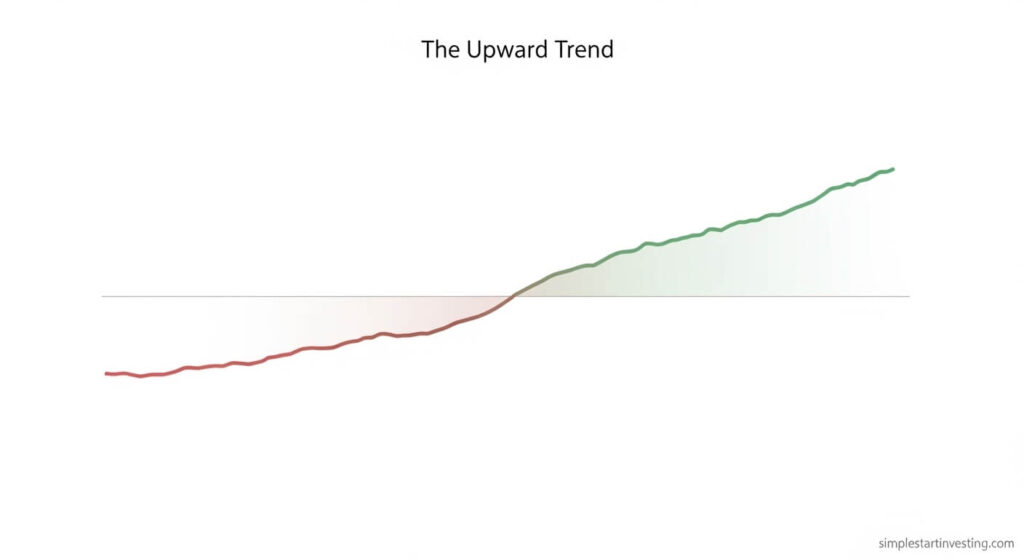
This shift in focus turns the boring task of “saving money” into a game of “growing my number.” It makes it easier to skip an expensive dinner or a flashy purchase because you would rather see that net worth line on your chart move upward.
Dealing with a Negative Net Worth
If you calculate your numbers and realize you have a negative net worth, do not panic. This is incredibly common in the United States, especially for recent college graduates or young families with a new mortgage.
A negative net worth simply means you have more holes in your bucket than water. The solution is two-fold: you must aggressively plug the holes (pay off debt) while slowly pouring in more water (saving and investing). Tracking net worth during this phase is actually more important because it shows you that your debt payments are actually doing something. Every dollar you pay toward a loan makes your “negative” number get closer to zero. Reaching a “zero” net worth (often called “Worthless Day” in the finance community) is a major milestone worth celebrating!
How This Helps You Make Better Decisions
Once you are in the habit of tracking net worth, your decision-making process changes. You stop asking “Can I afford the monthly payment?” and start asking “How will this affect my net worth?”
Buying a Home
A person who doesn’t track net worth might see a home as just a place to live. Someone who does track it sees a home as a forced savings account. As they pay down the mortgage, they are building equity, which increases their net worth over time.
Career Changes
If you have a high net worth, you have more “runway.” You might feel comfortable taking a lower-paying job that you love because you know you have a solid foundation of assets. Your paycheck no longer dictates your life because your net worth provides a safety net.
Retirement Planning
You cannot plan for retirement based on a paycheck. Retirement is entirely about net worth. You need a big enough pile of assets to support you when the paychecks stop coming. By tracking net worth early, you can see if you are on track to build a big enough “nest egg” to cover your expenses in the future.
Simple Tools for Tracking
You don’t need fancy software. A simple digital document or even a physical notebook will work. There are many apps available in the U.S. that can link to your accounts and update your net worth automatically. While these are convenient, some people prefer manual tracking because it forces them to look at every number, which creates a stronger emotional connection to their financial progress.
Whichever method you choose, the key is consistency. The value of tracking net worth isn’t found in the first time you do it; it’s found in the comparison between year one and year five.
Summary: Your Path to Financial Clarity
Wealth is not what you spend; it is what you keep. By shifting your focus away from your annual salary and toward your total net worth, you are taking control of your financial destiny. You are moving away from the “paycheck to paycheck” cycle and toward a future where your money works for you.
Start today. Don’t worry if the number is smaller than you’d like. The act of looking at it is the first step toward changing it. As you watch your assets grow and your debts shrink, you will find a sense of peace that no paycheck—no matter how large—can provide.
Disclaimer: This content is for educational purposes only and does not constitute financial advice. Market conditions and tax regulations change frequently; please consult with a professional regarding your specific situation.