Most people think that a balanced investment portfolio is like a simple recipe. You take a little bit of this, a little bit of that, and you are good to go. The most famous “recipe” in the world of investing is the 60/40 portfolio. You put 60 percent of your money into stocks and 40 percent into bonds. On paper, it looks perfectly balanced. You have more “growth” (stocks) and a solid “safety net” (bonds).
But here is the secret that professional fund managers know, and most beginners don’t: your money might be split 60/40, but your risk is not. In a traditional 60/40 setup, your stocks are so much more volatile—meaning they swing up and down much harder—that they actually account for about 90 percent of your portfolio’s total risk.
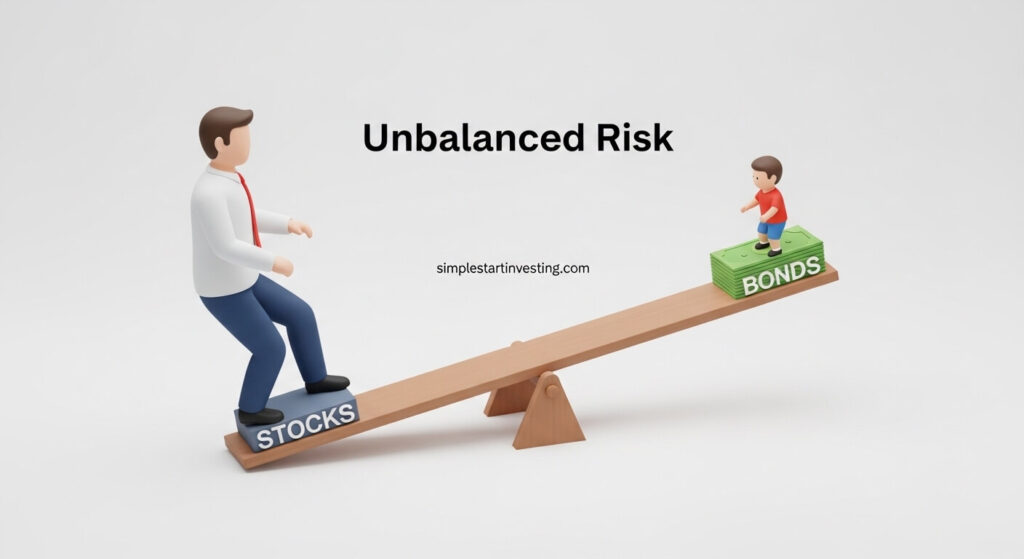
When the stock market crashes, that 40 percent in bonds often isn’t enough to cushion the fall because the “weight” of the stock market’s movement is just too heavy. This is where Risk Parity comes in. It is a strategy that focuses on balancing the “wiggle” of your investments rather than just the dollar amount you put into them.
What Exactly Is Risk Parity?
At its heart, Risk Parity is an investing strategy that seeks to equalize the risk contribution of every asset in your portfolio. Instead of saying, “I want half my money in stocks and half in bonds,” you say, “I want the risk coming from my stocks to be equal to the risk coming from my bonds.”
Think of it like a seesaw at a playground. If you put a 200-pound adult on one side and a 50-pound child on the other, the adult is going to dominate the movement. To balance the seesaw, you don’t give them both the same amount of space. You have to move the adult closer to the center or put more children on the other side to create true balance.
In your portfolio, stocks are the “200-pound adult.” They move fast and they move big. Bonds are often the “child”—they move much more slowly and gently. To have a truly balanced ride, you need to adjust how much of each you own so that one doesn’t completely overpower the other during a market storm.
Why the Traditional 60/40 Portfolio Can Be Deceptive
For decades, the 60/40 rule was the gold standard for anyone starting their journey in the US markets. It worked well when interest rates were falling and stocks were booming. However, many beginners find out the hard way that this “balance” is an illusion.
Because stocks are roughly three to four times as “risky” (volatile) as bonds, having 60 percent of your dollars in stocks means they are the only thing that really matters for your performance. If the S&P 500 drops by 20 percent, and your bonds only go up by 2 percent, your total account is still going to take a massive hit.
The goal of Risk Parity is to fix this imbalance. By spreading the risk equally, you create a portfolio that doesn’t rely on one single “engine” to move forward. You aren’t just betting on stocks to go up; you are betting on the balance of the entire system.
Understanding “Volatility” Without the Math
In the world of finance, risk is often measured by volatility. For a beginner, the easiest way to think about volatility is “how much does this investment move in a single day, month, or year?”
Imagine you have two employees.
- Employee A (Stocks) is a superstar who can produce 1,000 units a day but sometimes gets frustrated and produces zero units, or even breaks the machinery.
- Employee B (Bonds) is steady and reliable, producing exactly 100 units every single day without fail.
If you hire one of each, your daily output is still mostly dependent on how Employee A is feeling. If Employee A has a bad day, your total production tanks. To have a “stable” business, you might need to hire ten versions of Employee B to match the potential impact of one Employee A.
That is the logic of Risk Parity. Since bonds “move” less, you usually need to hold more of them (or other stable assets) to make their impact on the portfolio equal to the impact of your stocks.
The Four “Economic Seasons”
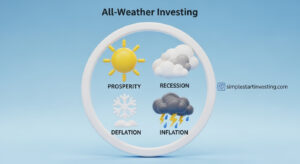
One of the most famous versions of Risk Parity was popularized by Ray Dalio, the founder of Bridgewater Associates, through his All Weather Portfolio. The idea is that the economy always moves through four different “seasons”:
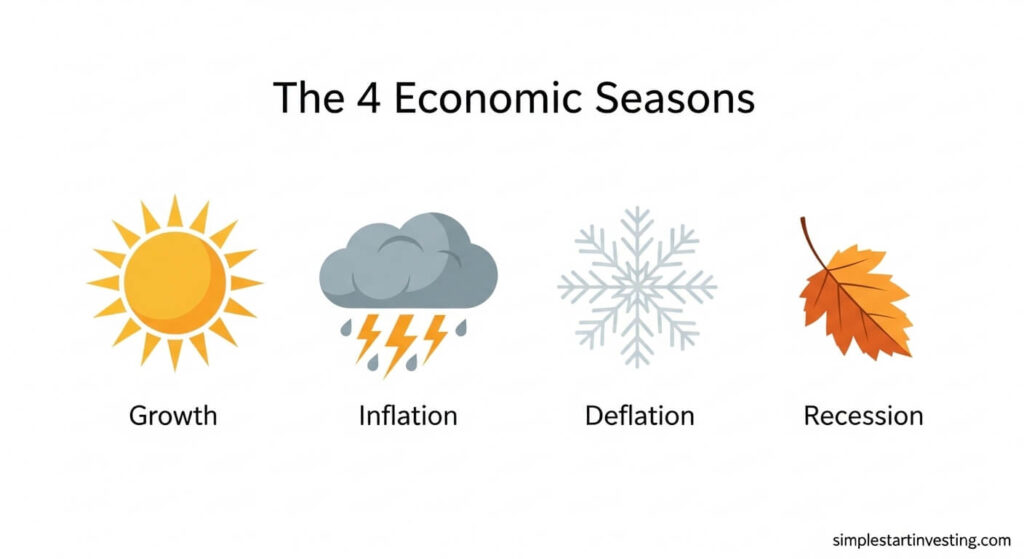
- Inflation: Prices for goods and services are rising faster than expected.
- Deflation: Prices are falling, or growth is slowing significantly.
- Rising Economic Growth: The economy is booming, businesses are hiring, and spending is up.
- Falling Economic Growth: The economy is shrinking, often leading to a recession.
Different investments perform well in different seasons. For example, stocks love “Rising Economic Growth.” Bonds do well during “Deflation” or falling growth. Commodities like gold or oil often thrive during “Inflation.”
A beginner using a Risk Parity mindset doesn’t try to guess which season is coming next. Instead, they give each season an “equal seat at the table” by balancing the risk across assets that perform well in each environment.
Why Beginners Often Get It Wrong
The biggest hurdle for new investors is the urge to “chase returns.” When you see a tech company like Nvidia or Apple soaring, it is tempting to put all your money there. That is the opposite of balancing risk.
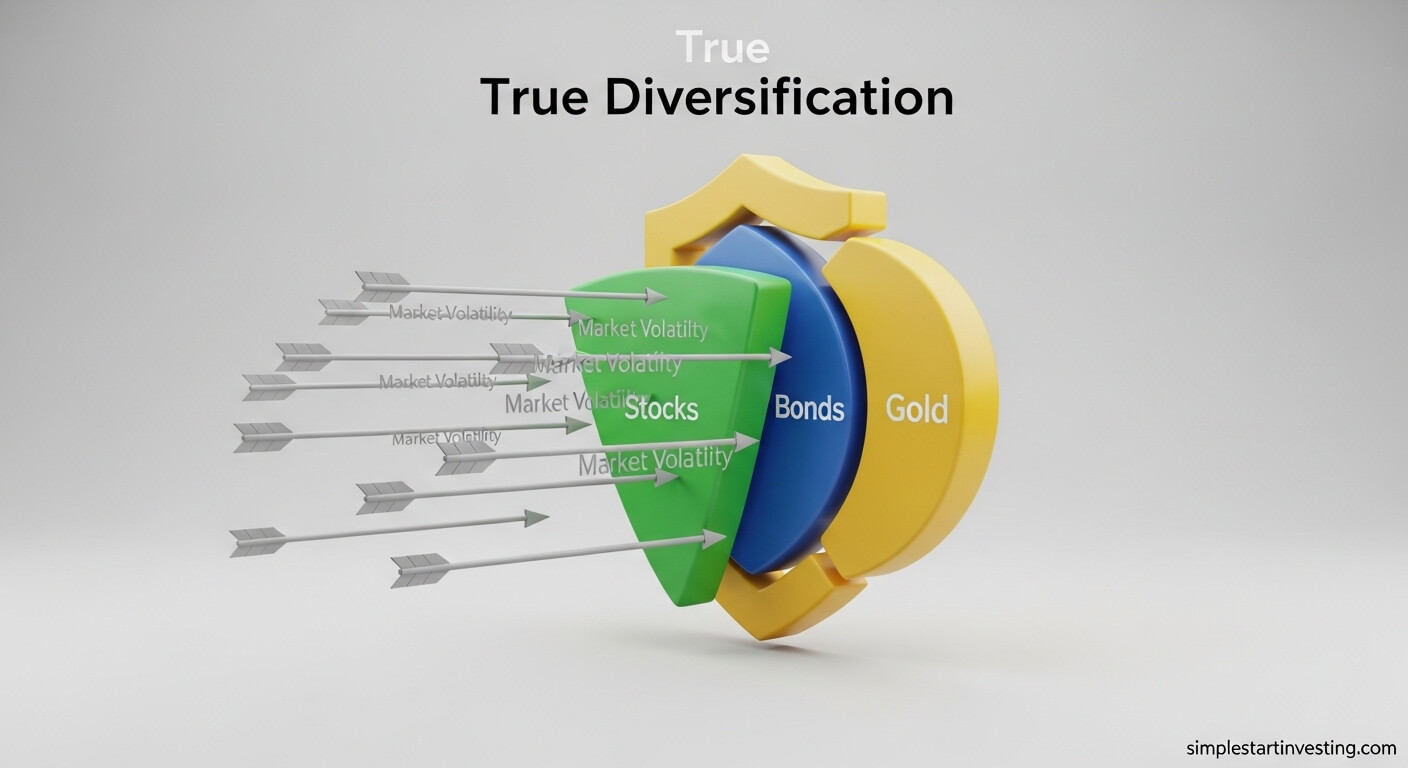
Another common mistake is thinking that “diversification” just means owning a lot of different things. If you own ten different tech stocks, you aren’t diversified—you are just heavily invested in one specific type of risk. If the tech sector drops, all ten of those stocks will likely drop together.
True diversification through Risk Parity means owning things that behave differently from each other. You want assets that don’t “walk in the same direction” at the same time. When your stocks are struggling, you want your bonds or your gold to be the ones doing the heavy lifting.
The Role of Different Assets in a Balanced Portfolio
To build a strategy focused on risk parity, you have to look beyond just the S&P 500. Here is how a beginner can view the different “players” on their team:
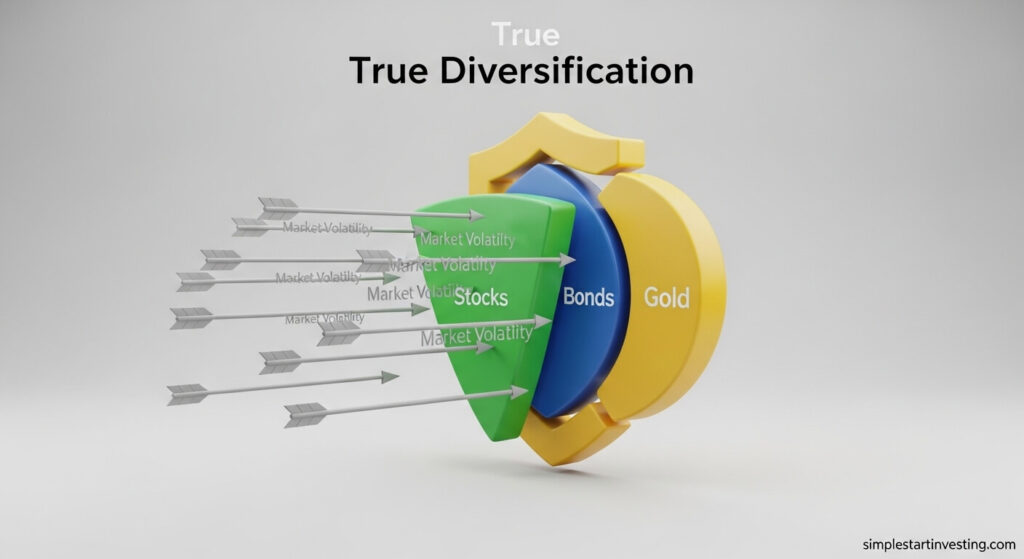
Equities (Stocks)
These are your growth drivers. They offer high potential returns but come with high “wiggle.” In a risk-balanced world, you might actually hold a smaller percentage of these than you think, because their “punch” is so strong.
Sovereign Bonds (US Treasuries)
These are generally seen as the “ballast” of the ship. When the stock market panics, investors often run to the safety of government bonds. Because they move less violently than stocks, you often need a larger portion of these to balance out the stock risk.
Commodities and Gold
These are your “inflation insurance.” When the dollar loses its purchasing power and prices at the grocery store go up, tangible things like gold or energy often hold their value or increase. They provide a different type of risk that doesn’t usually move in sync with the stock market.
Inflation-Linked Bonds (TIPS)
In the US, the Treasury offers bonds specifically designed to protect you from inflation. These are another tool in the Risk Parity shed to ensure that even if the “season” turns toward high inflation, your portfolio has a protector.
How to Think About “Weighting” Your Investments
Let’s look at a simple, non-mathematical example of how this looks in practice.
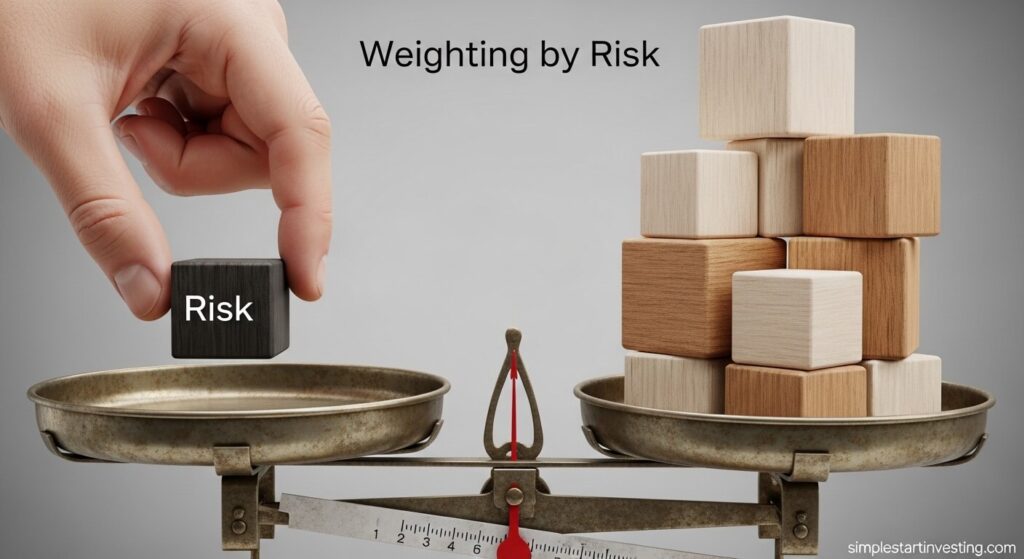
Imagine you have 1,000 dollars to invest. If you go the traditional route, you might put 600 dollars in a Total Stock Market ETF and 400 dollars in a Bond ETF. If stocks drop 10 percent, you lose 60 dollars. If bonds go up 2 percent, you gain 8 dollars. Your total loss is 52 dollars. Your “balance” didn’t really save you.
Now, imagine a Risk Parity approach. You realize stocks are much “noisier” than bonds. To make them equal, you might decide to put only 250 dollars in stocks and 750 dollars in bonds and other stable assets. Now, if stocks drop 10 percent, you only lose 25 dollars. Because you have more money in bonds (750 dollars), that same 2 percent gain now gives you 15 dollars. Your total loss is only 10 dollars.
By adjusting the “weight” based on how much the assets move, you have created a much smoother ride. You won’t see the massive 50 percent gains when stocks moon, but you also won’t see the soul-crushing 40 percent drops that make most beginners quit investing entirely.
The Psychological Advantage of Risk Parity
Investing is as much about your brain as it is about your bank account. Most beginners fail because they “panic sell.” They see their account balance drop significantly and their survival instinct kicks in, telling them to “save what is left.”
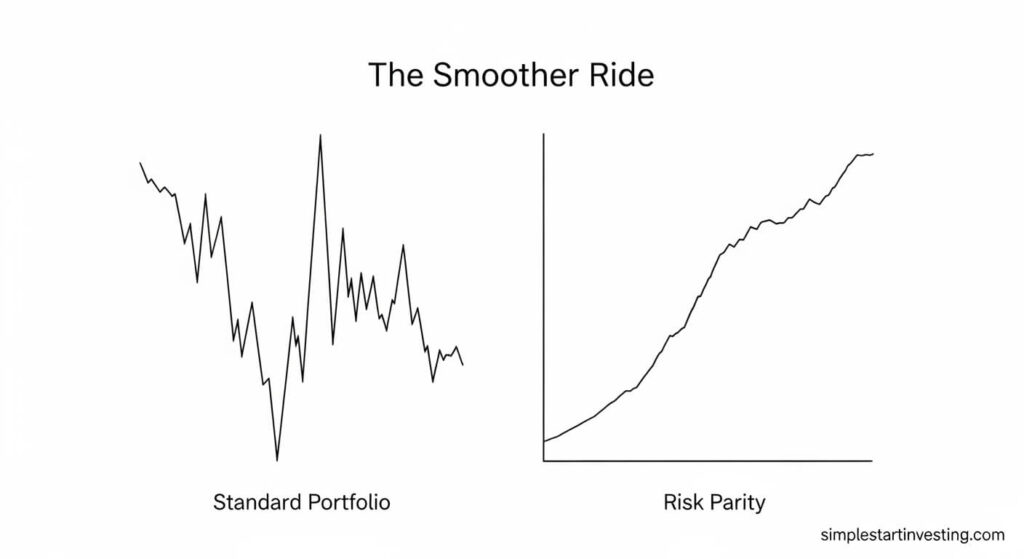
Risk Parity is designed to reduce the size of those drops (known as drawdowns). When your portfolio is balanced by risk, the “wiggles” are smaller. If your account only drops 5 percent while the rest of the market is dropping 20 percent, you are much more likely to stay the course.
Consistency is the real secret to building wealth in the US markets. The investor who stays invested for 30 years with moderate returns will almost always beat the investor who tries to get rich quick, loses half their money, and sits on the sidelines for five years out of fear.
Common Misconceptions About Risk Parity
“It’s only for wealthy people or hedge funds.”
While high-end firms use complex computers to do this, the concept is for everyone. You can apply a “Risk Parity light” approach simply by being honest about how much your assets move and adjusting your percentages accordingly.
“I will miss out on all the gains.”
It is true that in a massive “bull market” where stocks only go up, a risk-balanced portfolio will return less than a 100 percent stock portfolio. However, Risk Parity aims for better “risk-adjusted returns.” This means you get more “bang for your buck” in terms of how much stress you have to endure for every dollar you earn.
“Bonds are useless when interest rates rise.”
This is a common fear. While it’s true that bond prices can fall when rates rise, a true Risk Parity approach doesn’t just use one type of bond. It uses a mix of assets, including commodities or short-term notes, to cover those bases. The goal is the balance, not any one single asset’s performance.
Is Risk Parity Right for You?
If you are a beginner who wants to “set it and forget it,” or if you find that you have a low tolerance for watching your account balance swing wildly, this philosophy is worth exploring.
It requires a shift in mindset. You have to stop looking at your “dollars invested” as the primary measure of balance and start looking at “risk contributed.” It means being okay with owning things that feel “boring” (like bonds or cash) because you understand their job is to protect the growth you get from your “exciting” investments (like stocks).
Taking the First Step Toward a Balanced Portfolio
You don’t need to change everything overnight. Start by looking at your current investments. Are you 100 percent in one or two stocks? If so, your risk is extremely concentrated.
Ask yourself: “If the stock market took a 30 percent hit tomorrow, how much would my total account drop?” If the answer scares you, you might be over-weighted in “growth risk.”
To move toward a Risk Parity mindset:
- Acknowledge that different assets have different ‘speeds’. Stocks are fast; bonds are slow.
- Look for ‘negative correlation’. Find assets that tend to go up when others go down.
- Don’t ignore the ‘boring’ stuff. Gold, treasury bonds, and even cash have roles to play in a truly balanced engine.
By focusing on the “wiggle” instead of just the “price tag,” you are building a portfolio that can survive any economic season the US market throws at you. You are moving from being a gambler to being a strategist.
Final Thoughts for the New Investor
Risk Parity isn’t about finding the “best” investment. It’s about creating the best team of investments. Just like a championship basketball team needs more than just five players who only know how to shoot three-pointers, your portfolio needs defenders, rebounders, and playmakers.
When you balance the risk, you take the power away from the market’s volatility and put the power back in your own hands. You might not have the most “exciting” portfolio at a dinner party, but you will likely be the one sleeping the soundest when the headlines turn red.
Disclaimer: This content is for educational purposes only and does not constitute financial advice. Market conditions change constantly, and you should always perform your own due diligence or consult with a qualified professional before making investment decisions.