Starting your journey in the world of investing can feel like trying to learn a new language while everyone else is already speaking it fluently. You hear people talking about picking the next “moon shot” stock like Tesla (TSLA) or NVIDIA (NVDA), but the pressure of choosing just one company feels overwhelming. What if you pick the wrong one? What if the market crashes tomorrow?
This is where the ETF for beginners strategy comes in. Instead of trying to find the needle in the haystack, an ETF—or Exchange-Traded Fund—allows you to simply buy the entire haystack. It is arguably the single most important tool for any new American investor who wants to build wealth without spending forty hours a week staring at stock charts.
In this guide, we are going to break down exactly what these “magic baskets” are, why they are a favorite of the SEC, and how you can use them to own a piece of the biggest companies in America like Apple (AAPL), Amazon (AMZN), and Microsoft (MSFT) with just a few dollars.
What Exactly is an ETF? The Grocery Store Analogy
Imagine you walk into a high-end grocery store. You want a healthy diet, but you don’t have the time to research the nutritional value of every single apple, orange, and head of broccoli in the produce section. You also don’t want to risk buying ten pounds of kale only to find out you hate the taste.
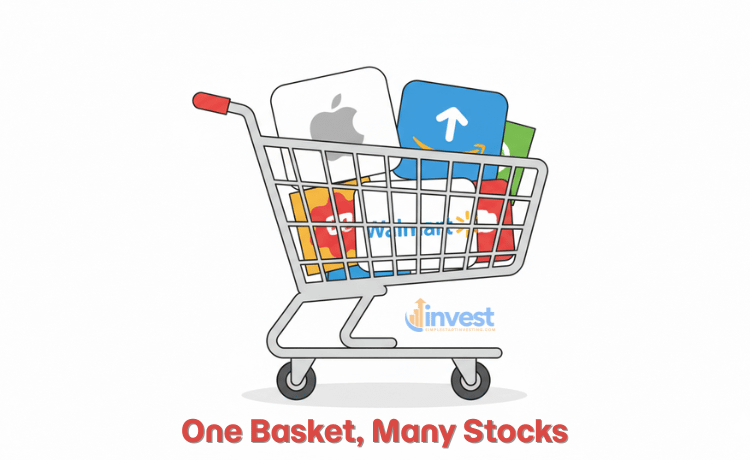
Instead of picking individual items, you see a “Healthy Starter Basket” already packed and ready to go. Inside, there is a perfect mix of fruits, vegetables, and grains chosen by a nutritionist. When you buy that one basket, you own everything inside it.
That is exactly what an ETF for beginners is. An ETF is a basket of different investments—like stocks or bonds—that trades on the stock exchange just like a single stock. When you buy one share of an ETF like VOO (Vanguard S&P 500 ETF), you aren’t just buying one company. You are buying a tiny piece of 500 of the largest, most successful companies in the United States.
The 4-Step Deep Dive: Understanding the “Basket” Concept
- Plain English Explanation: An ETF is a collection of many different companies bundled together into one single “stock” that you can buy and sell.
- US Market Example: If you buy the SPY ETF, you are instantly an owner in JPMorgan Chase (JPM), Walmart (WMT), and Home Depot (HD) all at once. You don’t have to go to each company and buy their stock individually.
- Common Beginner Mistake: Many new investors think they need thousands of dollars to be “diversified.” They believe they have to buy one share of every company they like.
- Correct Logic: With an ETF, you can start with as little as 10 dollars or 100 dollars. Because many brokers now allow “fractional shares,” your small investment is automatically spread across all the companies in that basket. One single purchase gives you a professional level of variety.
Why the “Set It and Forget It” Strategy Wins
For a beginner, the biggest enemy isn’t the market—it’s emotion. When you own a single stock like Tesla, and the news says there is a problem with a new factory, the price might drop 10 percent in one day. This causes many new investors to panic and sell at a loss.
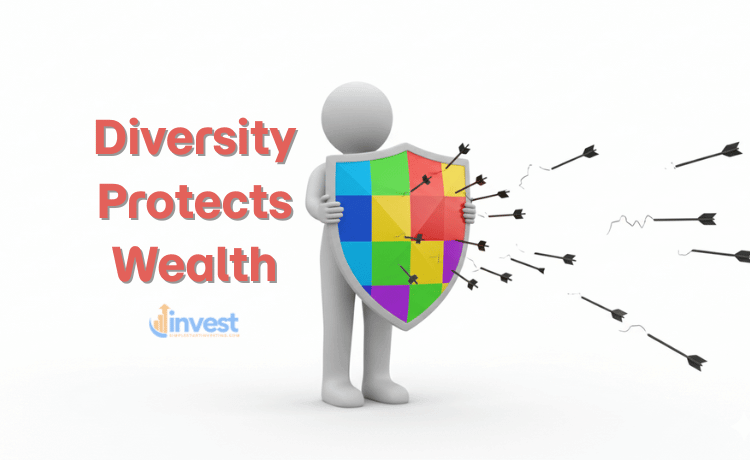
However, when you use an ETF for beginners, that volatility is smoothed out. If one company in your basket of 500 has a bad day, there are 499 other companies to help balance it out. This is called diversification, and it is the closest thing to a “free lunch” in the financial world.
The SEC (Securities and Exchange Commission) and major financial institutions often highlight ETFs because they offer transparency and liquidity. This means you can see exactly what is inside your basket every day, and you can sell it for cash whenever the market is open.
The 4-Step Deep Dive: The Power of Diversification
- Plain English Explanation: Diversification is just a fancy way of saying “don’t put all your eggs in one basket.” If you have 500 eggs in 500 different baskets, one basket breaking won’t ruin your breakfast.
- US Market Example: Imagine you only owned Intel (INTC) stock during a year when they struggled, but the rest of the tech world thrived. You would lose money. But if you owned a tech ETF like QQQ, your gains from NVIDIA and Microsoft would likely cover the losses from Intel.
- Common Beginner Mistake: Thinking that “diversification” means buying five different tech stocks.
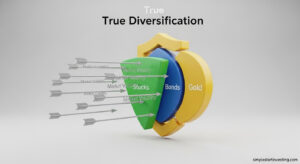
- Correct Logic: True diversification means owning different types of companies in different industries. A broad market ETF includes tech, healthcare, banks, and energy companies. This protects you from a downturn that might only hit one specific part of the economy.
Hidden Costs: The “Low Fee” Advantage
One of the most important things to understand about an ETF for beginners is the “Expense Ratio.” This is the fee you pay the fund company (like Vanguard or BlackRock) to manage the basket for you.
In the old days of investing, you might pay a financial advisor or a “Mutual Fund” 1 percent or 2 percent of your money every year just to manage it. That might sound small, but it adds up to a massive amount of lost wealth over twenty years. Modern ETFs have brought those costs down to almost zero.
Understanding Fees Without the Math
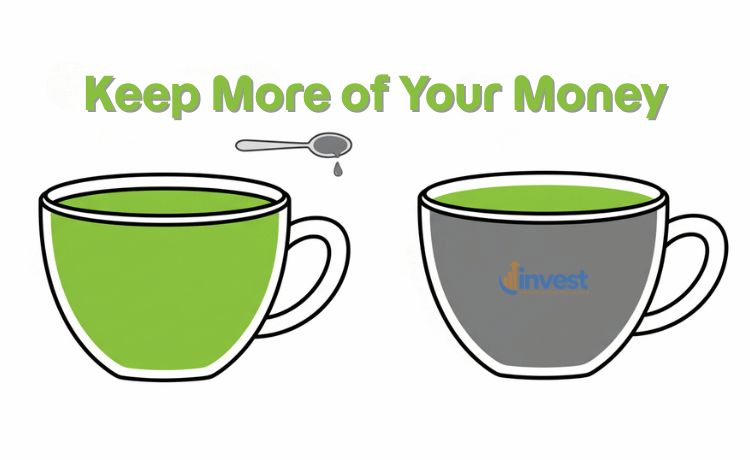
If you invest 10,000 dollars into an ETF with an expense ratio of 0.03 percent (like VOO), you are only paying 3 dollars a year in fees. That is less than the price of a coffee at Starbucks!
On the other hand, if you put that same 10,000 dollars into an old-fashioned fund with a 1 percent fee, you are paying 100 dollars every year. Over thirty years, that difference of 97 dollars a year—plus the growth that money would have earned—can cost you tens of thousands of dollars.
The 4-Step Deep Dive: Expense Ratios
- Plain English Explanation: The expense ratio is the “management fee” taken out of the fund’s assets. You don’t get a bill in the mail; it is just deducted automatically from the value of your shares.
- US Market Example: State Street’s SPY is the most famous ETF, but it has a fee of about 0.09 percent. Meanwhile, Vanguard’s VOO tracks the exact same companies but only charges 0.03 percent. Choosing the lower fee for the same product is an instant win for your wallet.
- Common Beginner Mistake: Ignoring the fee because “it’s just a tiny percentage.”
- Correct Logic: In investing, you usually get what you pay for. But with index ETFs, the cheaper the fund, the more money stays in your pocket to grow. Always look for “Low-Cost Index ETFs.”
How to Buy Your First ETF: A Practical Guide
Buying an ETF for beginners is just as easy as ordering something on Amazon. You need a brokerage account (like Charles Schwab, Fidelity, or Vanguard). Once your account is set up and linked to your bank, you follow these steps:
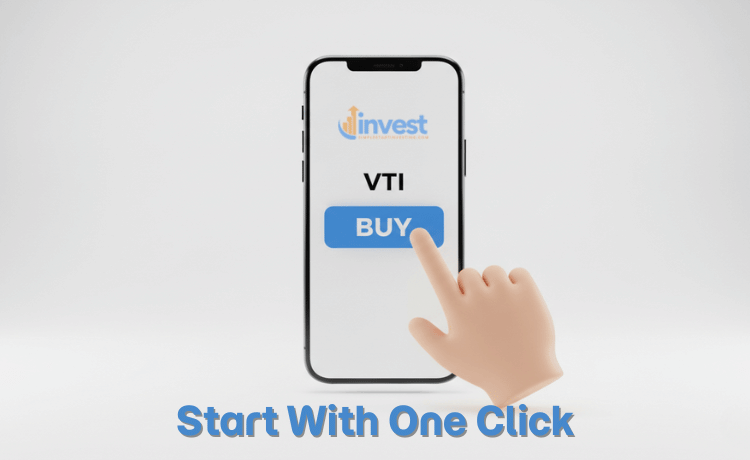
- Search for the Ticker Symbol: Every ETF has a 3 or 4-letter code. For example, VTI stands for the Total Stock Market.
- Choose the Amount: You can buy “shares” (the number of baskets) or “dollars” (if your broker allows fractional shares).
- Click Buy: Once you confirm, you officially own a piece of the US economy.
Trends for This Year: Passive vs. Active
As we look at the market this year, there is a new trend called “Active ETFs.” While traditional ETFs just follow an index (like the S&P 500), Active ETFs have a human manager who tries to beat the market by picking specific winners.
For a total beginner, Passive Index ETFs are usually the better starting point. They are cheaper and historically have performed better than most people who try to “pick winners.” The IRS also tends to favor these because they generate fewer “capital gains taxes” until you actually decide to sell your shares for a profit.
Common Myths That Trip Up New Investors
Myth 1: “ETFs are only for long-term retirement.”
While ETFs are amazing for retirement, they are also highly “liquid.” This means you can sell them and have your cash back in a few days. You aren’t “locked in” like you might be with some other types of investments.
Myth 2: “If the stock market crashes, I lose everything.”
If a single company goes bankrupt, your investment goes to zero. But for an S&P 500 ETF to go to zero, all 500 of the biggest companies in America would have to go bankrupt at the same time. If that happens, we probably have bigger problems than our stock portfolios! Markets do go down, but they have historically always recovered over time.
Myth 3: “I need to wait for the perfect time to buy.”
New investors often try to “time the market,” waiting for a “dip” or a “crash” to buy in. Research shows that “time in the market” is much more important than “timing the market.” This year, the best time to start is usually as soon as you have the extra money available.
Mindset Shift: From Consumer to Owner
The most powerful part of the ETF for beginners journey is changing how you see the world.
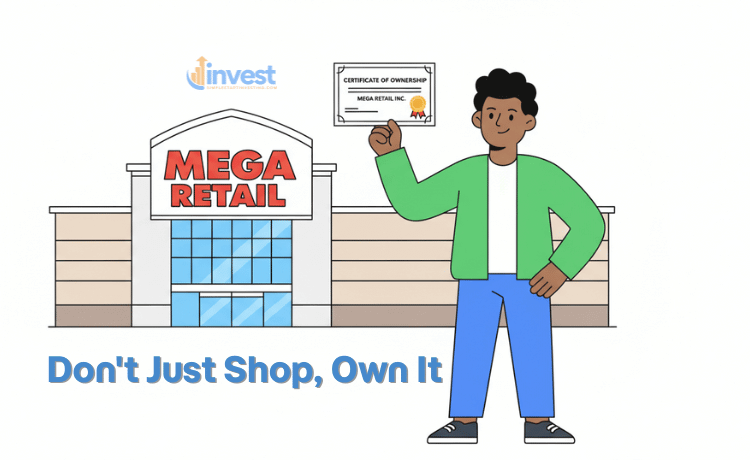
When you go to Costco (COST) to buy groceries, you aren’t just a customer anymore; you are a part-owner. When you pay your phone bill to Verizon (VZ) or buy a new iPhone, a tiny piece of those profits eventually flows back to you in the form of share price growth or “Dividends” (cash payments companies give to their owners).
By holding a broad market ETF, you are betting on American ingenuity. You are saying, “I believe that over the next ten, twenty, or thirty years, these companies will continue to work hard, innovate, and make a profit.”
Summary for Your Simple Start
Investing doesn’t have to be a gamble. By choosing a low-cost ETF for beginners, you are choosing the path of least resistance and highest historical probability of success. You don’t need to be a math genius or a Wall Street pro. You just need a little bit of patience and a “basket” that holds the best companies in the world.
As regulations evolve this year, including the introduction of new tax-advantaged accounts like the “Trump Accounts” for children’s savings, ETFs remain the gold standard for simple, effective wealth building.
Final Thought: The goal isn’t to get rich overnight. The goal is to stay invested long enough for the power of the US economy to do the heavy lifting for you.
Disclaimer: This content is for educational purposes only and does not constitute financial advice. Regulations regarding taxes and investments can change; please check current IRS or SEC guidelines or consult with a qualified professional before making financial decisions.