When you first open a brokerage account, the advice you hear most often is simple: “Don’t put all your eggs in one basket.” This is the core of stock diversification. It sounds easy enough. If you buy a variety of companies, you protect yourself if one of them fails.
However, many new investors fall into a trap. They buy so many different stocks that they end up “diworsifying” their portfolio. Instead of protecting their money, they dilute their potential profits and make their investments impossible to manage. Understanding the balance between safety and over-complication is the first major step toward building real wealth in the US market.
In this guide, we will break down exactly how stock diversification works, why more isn’t always better, and how to find the “sweet spot” for your personal portfolio.
What Exactly Is Stock Diversification?
At its simplest level, stock diversification is a strategy used to manage risk. It means spreading your money across different investments so that the performance of a single company doesn’t dictate your entire financial future.

Think of it like a sports team. If your entire team consists of only one superstar player, and 그 player gets injured, the team is in big trouble. But if you have a well-rounded roster with many talented players, the team can still win even if one person has a bad night. In the stock market, your “players” are the companies you own.
The Real-World Example
Imagine you have 10,000 dollars to invest. If you put all 10,000 dollars into a single company like Tesla (TSLA), your entire fortune depends on Elon Musk and the electric vehicle market. If Tesla stock drops by 20 percent, you lose 2,000 dollars instantly.
Now, imagine you split that 10,000 dollars. You put 5,000 dollars into Tesla and 5,000 dollars into Walmart (WMT). If Tesla has a bad month and drops 20 percent, but Walmart gains 10 percent because people are buying more groceries, your total loss is much smaller. By owning two different types of businesses, you have cushioned the blow.
The Beginner’s Blind Spot
Many beginners think that diversification just means owning “a lot of stocks.” They might buy 50 different companies, but all 50 are in the technology sector. They own Apple, Microsoft, Nvidia, and Google. While these are different companies, they often move in the same direction. If the tech industry faces a new regulation or interest rates rise, all 50 of those stocks might crash at the same time.
The Pro Mindset
True diversification is about owning “uncorrelated assets.” This means owning businesses that operate in different industries and respond differently to the economy. For example, owning a tech giant like Microsoft (MSFT) alongside a healthcare provider like UnitedHealth (UNH) and a utility company like NextEra Energy (NEE). When tech is down, healthcare or utilities might be up.
The Danger of Diworsification: When More Becomes Less
The term “diworsification” was made famous by legendary investor Peter Lynch. It describes the point where adding more stocks to your portfolio actually makes your investment results worse, not better.

When you own too many stocks, you are no longer an “investor”; you are a “collector.” You begin to collect companies like trading cards without actually knowing what they do. This leads to several problems that can stall your path to retirement.
Why It Happens
Let’s say you own 15 great companies that you have researched thoroughly. You know their CEOs, their products, and their earnings. Then, you see a “hot tip” on social media about a new biotech firm. Then you hear about a new crypto-mining company. You keep adding small pieces of these companies until you own 100 different stocks.
At this point, you have “diworsified.” You have spread your money so thin that even if one of your stocks “goes to the moon” and doubles in price, it won’t actually change your life because it only represents 1 percent of your portfolio.
The Real-World Example
Suppose you have a 10,000 dollar portfolio spread equally across 100 stocks. That means you have only 100 dollars in each stock. If one of those companies performs incredibly well and its stock price grows by 500 percent, your 100 dollars becomes 600 dollars.
While a 500 percent gain sounds amazing, your total portfolio only grew from 10,000 dollars to 10,500 dollars. The massive success of that one company was “diluted” by the 99 other stocks you own. You did a lot of work for a very small total gain.
The Beginner’s Blind Spot
New investors often feel a “Fear Of Missing Out” (FOMO). They feel that if they don’t own a little bit of every trending stock, they will lose out on the next big thing. They think owning 100 stocks is “safer” than owning 20.
The Pro Mindset
Pros know that every stock you add to your portfolio requires time. You have to read the quarterly reports and follow the news for every company you own. If you own 100 stocks, it is physically impossible for a normal person to keep up. Diworsification increases “knowledge risk”—the risk that you own something you no longer understand.
The “Sweet Spot”: How Many Stocks Is Enough?
If 1 stock is too risky and 100 stocks is too many, what is the right number? Most financial experts and academic studies suggest a specific range for individual stock investors.
The Magic Number Range
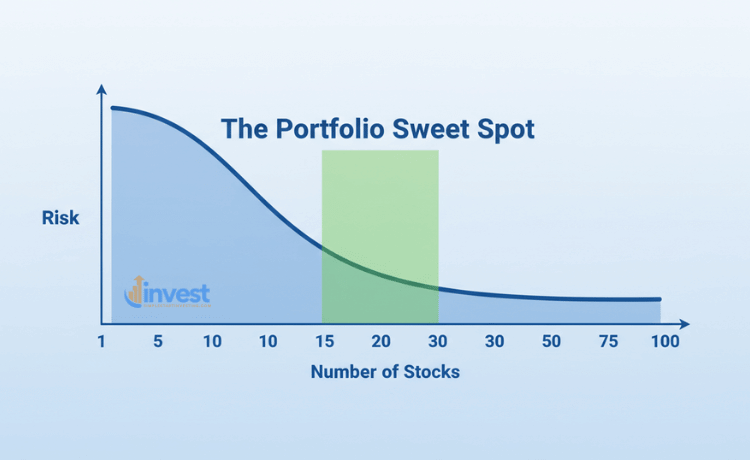
For most people, owning between 15 and 30 stocks provides the maximum benefit of diversification without falling into the trap of diworsification.
Research shows that once you reach about 20 to 25 stocks—provided they are in different industries—you have already eliminated about 90 percent of the “unmarketable risk” (the risk specific to one company). Adding the 26th, 50th, or 100th stock does very little to lower your risk further, but it adds a lot of complexity.
How to Calculate Your Spread (The Simple Way)
If you want to be equal-weighted in 20 stocks, you simply divide 100 percent by 20. This means each stock should represent 5 percent of your total investment.
- If you have 20,000 dollars, you put 1,000 dollars into each of the 20 companies.
- If one company fails and goes to zero, you only lose 5 percent of your total money.
- This is a manageable loss that won’t ruin your financial life, but it still allows your winners to have a big impact on your wealth.
The Beginner’s Blind Spot
Many beginners try to “rank” their stocks and put 50 percent of their money in their “favorite” and 1 percent in others. While this can work, it often leads to emotional stress. If your “favorite” stock has one bad week, you might panic and sell everything.
The Pro Mindset
Experienced investors often start with a “core and satellite” approach. They might put a large portion of their money into a broad Index Fund (which owns hundreds of stocks automatically) and then pick 5 to 10 individual stocks they really believe in. This gives them the safety of massive diversification with the “excitement” of individual stock picking.
Sector Diversification: The Secret Ingredient
Quantity isn’t everything; quality and variety matter more. To truly achieve stock diversification, you must look at the different “Sectors” of the US economy. The S&P 500, the benchmark for the US market, is divided into 11 sectors.

If you own 20 stocks, but 15 of them are in the “Information Technology” sector (like Apple, Microsoft, and Nvidia), you are not diversified. You are heavily bet on Tech.
The 11 Sectors to Watch:
- Information Technology: Software, hardware, chips (e.g., Apple, Microsoft).
- Health Care: Hospitals, drug makers, medical devices (e.g., Johnson & Johnson, Pfizer).
- Financials: Banks, insurance, credit cards (e.g., JP Morgan, Visa).
- Consumer Discretionary: Things you want but don’t need (e.g., Amazon, Tesla, Starbucks).
- Consumer Staples: Things you need regardless of the economy (e.g., Coca-Cola, Walmart).
- Communication Services: Internet, phones, media (e.g., Google, Disney).
- Energy: Oil, gas, renewable energy (e.g., ExxonMobil).
- Industrials: Construction, aerospace, railroads (e.g., Boeing, Caterpillar).
- Utilities: Electricity, water, gas (e.g., Duke Energy).
- Real Estate: REITs, property management (e.g., American Tower).
- Materials: Mining, chemicals, forest products (e.g., Sherwin-Williams).
The Real-World Example
Imagine a year where inflation is high. Technology stocks often struggle when interest rates rise to fight inflation. However, Energy companies and Consumer Staples (like grocery stores) often do well because they can pass those higher costs on to customers. If your 20 stocks are spread across these different sectors, your portfolio stays balanced while others are crashing.
Why “Fractional Shares” Changed the Game
In the old days of investing, you had to buy a full share of a stock. If a single share of a company cost 500 dollars, and you only had 1,000 dollars, you could only buy two stocks. This made stock diversification almost impossible for beginners with small amounts of money.
Today, most US brokerages (like Fidelity, Schwab, or Robinhood) allow you to buy “Fractional Shares.” This means you can buy 5 dollars worth of a stock, even if the full share costs 3,000 dollars.
How to Use This
If you have 500 dollars today, you don’t have to choose between Apple or Amazon. You can put 25 dollars into 20 different stocks across different sectors. This allows you to build a professional-grade, diversified portfolio from day one, regardless of how much money you have in your bank account.
The Beginner’s Blind Spot
New investors often think they should wait until they have “enough money” to diversify. They might spend their first 1,000 dollars on one single stock, thinking they will diversify later. This exposes them to “single-stock risk” unnecessarily.
The Pro Mindset
Start diversified and stay diversified. Use fractional shares to build the structure of a great portfolio immediately. As you add more money over time, you simply add to those 20 positions.
The Shortcut: Let an Index Fund Do the Work
If managing 20 different stocks and tracking 11 different sectors sounds like a part-time job you don’t want, there is a “cheat code.” It’s called an Exchange-Traded Fund (ETF) or an Index Fund.
An ETF like the SPDR S&P 500 ETF (Symbol: SPY) or the Vanguard Total Stock Market ETF (Symbol: VTI) allows you to buy one single “ticker” that contains hundreds or even thousands of stocks.

Why This Is the Ultimate Diversification
When you buy one share of VTI, you are instantly buying a tiny piece of almost every public company in the United States. You get the tech giants, the banks, the energy companies, and the retail stores all in one package.
- Risk: Extremely low (the only way this goes to zero is if every company in America goes bankrupt).
- Effort: Zero (the fund automatically rebalances the companies for you).
- Cost: Usually very low (Vanguard charges almost nothing to manage these funds).
The Real-World Example
Think of an Index Fund like a pre-made “Variety Pack” of snacks. Instead of walking down every aisle in the grocery store to pick out 20 different bags of chips, you just grab the one box that has a little bit of everything. It saves you time and ensures you don’t accidentally buy 20 bags of the same flavor.
The Beginner’s Blind Spot
Many beginners feel that Index Funds are “boring.” They want to find the next “Amazon” and get rich overnight. They think they are smarter than the market and can pick the winners better than a diversified fund.
The Pro Mindset
Even Warren Buffett, one of the greatest investors in history, recommends that the average person should just buy a low-cost S&P 500 index fund. It is the most efficient way to achieve stock diversification without the risk of “diworsifying” through poor individual choices.
When Should You Rebalance?
Once you have your 15 to 30 stocks (or your combination of funds), you can’t just leave them forever. Over time, some stocks will grow faster than others.
If you started with 20 stocks at 5 percent each, but one stock (like Nvidia) grows so much that it now represents 30 percent of your portfolio, you are no longer diversified. You are now heavily dependent on that one stock again.
The Logic of Rebalancing
Rebalancing is the process of selling a little bit of your “winners” and using that money to buy more of your “underperformers.”
- Sell High: You take profits from the stock that has grown too large.
- Buy Low: You put that money into other great companies in your portfolio that are currently “on sale.”
- Reset: You bring your portfolio back to your target goal (e.g., 5 percent per stock).

The Beginner’s Blind Spot
It is emotionally difficult to sell a stock that is doing well. Beginners want to “let it ride.” However, this is how people lost everything in the “Dot Com” crash of 2000. They held onto their winning tech stocks until those stocks became 90 percent of their portfolio, and then the whole thing collapsed.
The Pro Mindset
Treat your portfolio like a garden. You have to prune the plants that are growing too wild so that the rest of the garden has room to breathe. Rebalancing once or twice a year is usually enough to keep your risk under control.
Summary: Finding Your Balance
The journey from a beginner to a successful investor involves mastering the art of balance.
- Diversification is your shield against the unexpected failure of a single company.
- Concentration (owning fewer stocks) is how you build wealth faster, but with higher risk.
- Diworsification is the “danger zone” where you own so much that you lose control and dilute your success.
If you are just starting out, aim for 15 to 30 stocks across different sectors, or simplify your life by using a broad Index Fund. The goal isn’t to own the most stocks; it’s to own the best combination of businesses that allow you to sleep soundly at night while your money grows.
The US market offers incredible opportunities, but only to those who respect the risk. Keep your portfolio clean, keep your research current, and don’t let “more” get in the way of “better.”
Disclaimer: This content is for educational purposes only and does not constitute financial advice. Market investments involve risk, and past performance is not indicative of future results. Please consult with a qualified financial advisor or tax professional before making any investment decisions. Regulations and tax laws regarding investments can change; always verify current IRS and SEC guidelines.