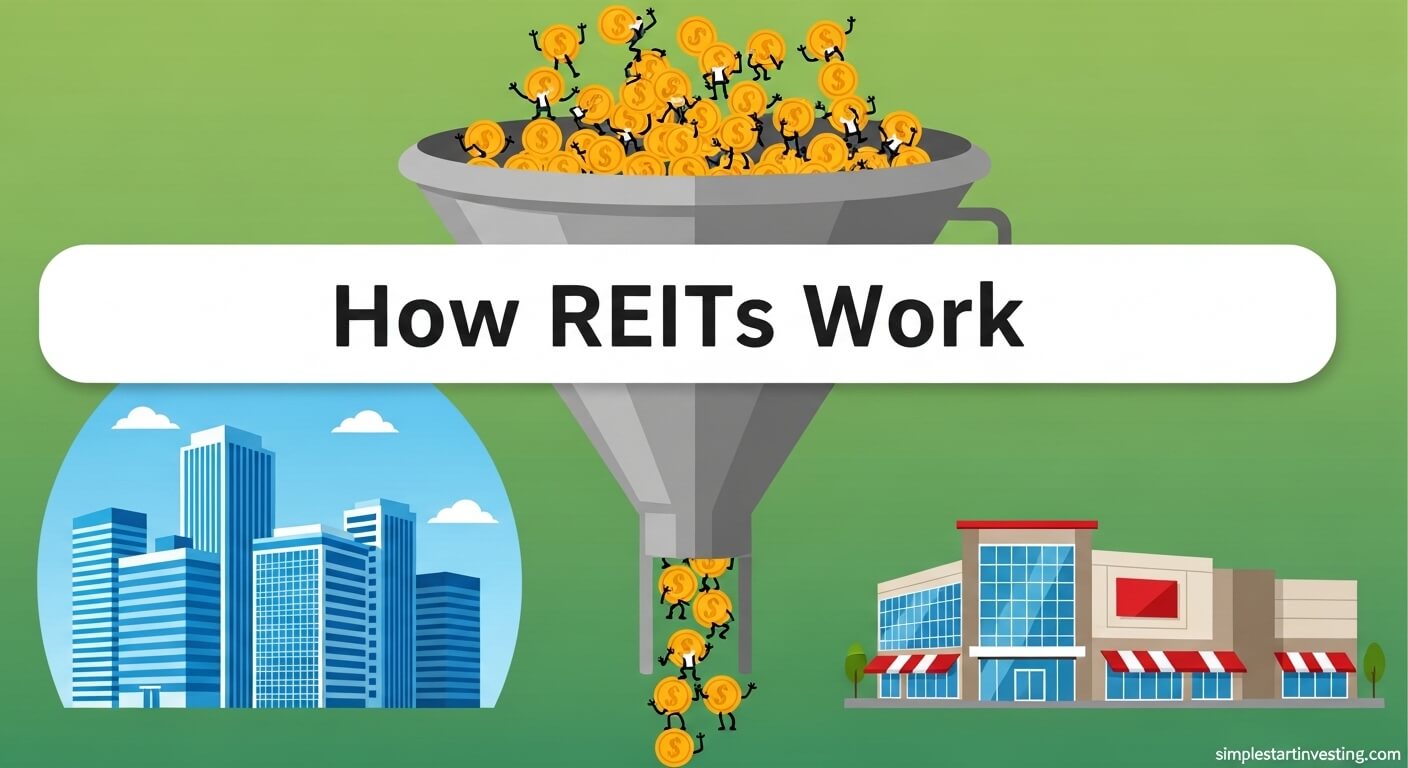
Have you ever looked at a massive apartment complex or a bustling shopping center and wished you could own a piece of it? Most of us assume that real estate investing requires hundreds of thousands of dollars, a massive bank loan, and the willingness to take phone calls about broken toilets at 3:00 AM. For a long time, that was mostly true. But there is a way to get into the game without the headaches of physical property management.
Investing in REITs—or Real Estate Investment Trusts—has changed the landscape for the everyday person. It allows you to participate in the real estate market the same way you buy a share of a company like Apple or Walmart. You get the benefits of property ownership, like regular income, without ever having to pick up a paintbrush or chase down a tenant for rent.

If you are a beginner looking to diversify your portfolio, understanding how these trusts work is a vital first step. Let’s pull back the curtain on this corner of the financial world and see how you can start building a “silent” real estate empire from your laptop.
What Exactly Is a REIT?
To understand investing in REITs, think of them as a mutual fund for real estate. Just as a mutual fund pools money from many investors to buy a basket of stocks, a REIT pools money to buy a collection of properties or real estate debts.
A REIT is a company that owns, operates, or finances income-producing real estate. These companies were created by Congress in the 1960s to give everyone—not just the wealthy—the chance to invest in large-scale, commercial real estate. When you buy a share of a REIT, you are essentially buying a tiny slice of every property that company owns.
In the United States, a company must meet very specific rules set by the Internal Revenue Service (IRS) to qualify as a REIT. The most famous rule is that the company must pay out at least 90 percent of its taxable income to shareholders in the form of dividends. This is why many people love these investments; they are designed to put cash back into your pocket.
The Secret Sauce of the REIT Structure
Most companies pay corporate taxes on their profits, and then shareholders pay taxes again on their dividends. REITs are different. Because they give 90 percent of their income back to investors, they generally do not pay corporate income tax. This “pass-through” structure means more of the money earned from rent goes directly to you, the investor.
Why Beginners Often Get REITs Wrong
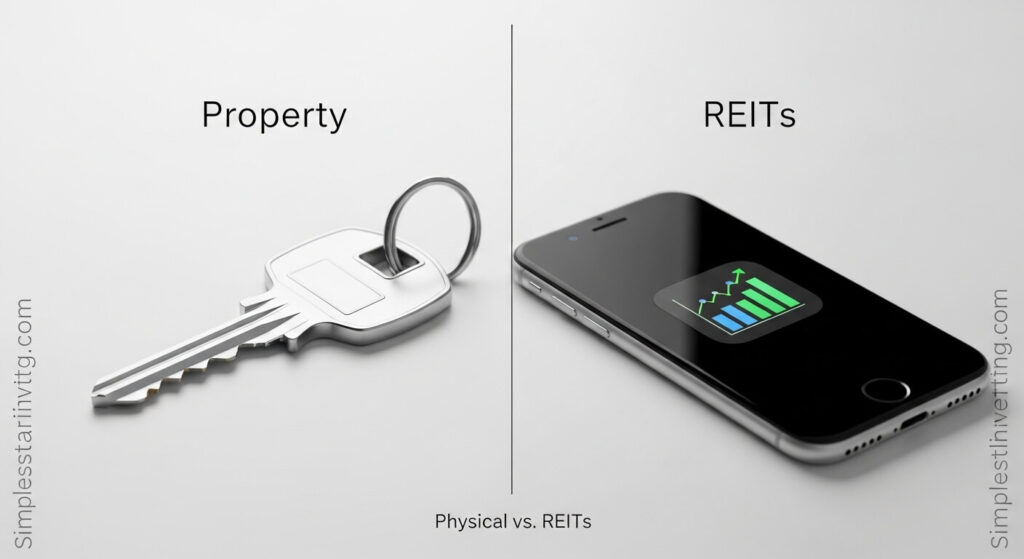
One of the biggest hurdles for new investors is thinking that investing in REITs is the same as owning a house. It isn’t. While the underlying assets are buildings, the experience of owning them is much closer to owning a stock.
Misconception 1: “I own the building”
A common mistake is thinking that if you buy a REIT that owns 500 apartment buildings, you have a say in how those buildings are run. You don’t. You are a shareholder, not the manager. You are trusting the professional management team of the REIT to make the right decisions about which properties to buy, sell, or renovate.
Misconception 2: “REITs are just like physical real estate”
In a “bricks and mortar” investment, if the housing market dips 5 percent, you might not even notice because you aren’t selling your house today. However, because most REITs are traded on the stock exchange, their prices can fluctuate every minute. This can be scary for beginners who expect the slow, steady pace of traditional real estate but see their screen showing “red” during a market sell-off.
Misconception 3: “All REITs are the same”
Newcomers often think “real estate is real estate.” But the world of REITs is vast. A company that owns hospitals behaves very differently than a company that owns warehouses for Amazon or cell phone towers for Verizon. Understanding these sectors is the key to making smart choices.
The Many Flavors of Real Estate Investing
When you start investing in REITs, you quickly realize you aren’t just limited to apartments and offices. The variety is one of the coolest parts of this asset class. Here are the main categories you will encounter:
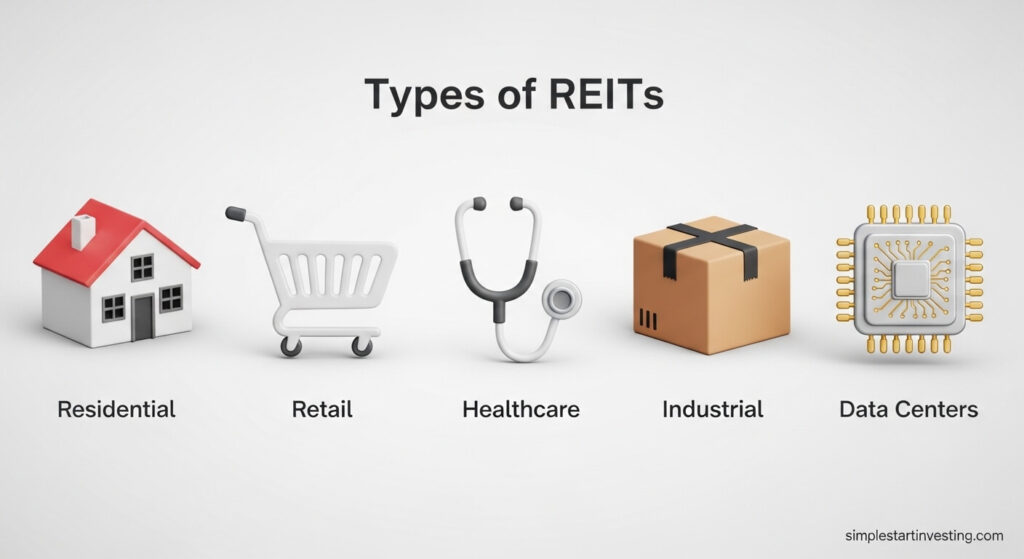
Residential REITs
These companies own and manage multi-family apartment buildings, student housing, or even manufactured home communities. They make money when people pay their monthly rent. Since everyone needs a place to live, these are often seen as more stable during economic shifts.
Retail REITs
These trusts own shopping malls, strip centers, or “big box” retail locations. Think of the building that houses your local Costco or Target. When you hear that “retail is dying,” these are the stocks people are talking about. However, the best retail REITs focus on high-traffic areas and essential services that people can’t get solely online, like grocery stores or pharmacies.
Healthcare REITs
These companies own hospitals, medical office buildings, and senior living facilities. As the population in the United States ages, the demand for these specialized buildings generally goes up. These are often considered more recession-resistant because healthcare is a necessity, not a luxury.
Industrial REITs
This is a “behind the scenes” powerhouse. These REITs own massive warehouses and distribution centers. Every time you order something online, it likely passes through a warehouse owned by an industrial REIT. These have become incredibly popular as e-commerce has grown over the last decade.
Data Center REITs
Did you know your digital photos and emails live in real buildings? Data centers are massive, climate-controlled facilities that house thousands of computer servers. As the world moves more toward AI and cloud computing, the companies that own the buildings housing that technology have become a major part of the real estate market.
How the Money Works (The Simple Logic)
Let’s look at how your investment actually grows. Imagine a REIT called “Sunset Apartments.”
- Step 1: Sunset Apartments owns 10 buildings.
- Step 2: The tenants pay rent every month. After paying for maintenance, property taxes, and staff salaries, the company has 1,000 dollars left over.
- Step 3: Because of the IRS rules, Sunset Apartments must give at least 900 dollars of that profit back to the investors.
- Step 4: If you own a share of that REIT, you get your portion of that 900 dollars.
If you start with an investment of 1,000 dollars and the REIT pays a 5 percent dividend, you would receive 50 dollars over the course of the year. You can take that 50 dollars as cash, or you can use it to buy even more shares, which is how wealth really starts to snowball over time.

Beyond the dividends, there is also the potential for “capital appreciation.” If the value of the properties the REIT owns goes up, or if the company manages its money so well that it becomes more valuable, the price of your shares will rise. If your 1,000 dollars worth of shares grows in value to 1,100 dollars, you’ve made a profit even before counting the dividends.
The Pros: Why Everyone Is Talking About REITs
There are several reasons why investing in REITs is often the first step for people moving beyond just savings accounts.
1. Liquidity (Easy In, Easy Out)
If you own a physical rental house and you suddenly need 10,000 dollars for an emergency, you can’t just sell the kitchen. Selling a house takes months and involves high commissions. With a REIT, you can sell your shares in seconds during market hours and have your money in your bank account a few days later.
2. High Dividend Yields
Because they are required to pay out almost all their profits, REITs often offer much higher dividends than the average stock in the S&P 500. This makes them a favorite for people looking for “passive income” to pay their bills or to reinvest for the future.
3. Professional Management
You don’t have to be an expert in zoning laws, roof repairs, or tenant screening. You are hiring a CEO and a team of experts to do that for you. They spend 40+ hours a week figuring out how to make those buildings more profitable so you don’t have to.
4. Low Entry Cost
You can start investing in REITs with as little as 10 dollars or 100 dollars through many modern brokerage apps. To buy a physical building, you’d likely need at least a 20 percent down payment, which could be 50,000 dollars or more depending on where you live.
The Cons: What to Watch Out For
No investment is perfect, and it would be a mistake to think REITs are a “sure thing.”
1. Interest Rate Sensitivity
Real estate companies usually borrow a lot of money to buy their buildings. When interest rates go up, it becomes more expensive for them to borrow. This can eat into their profits. Also, when interest rates are high, investors might move their money into “safer” things like government bonds, causing REIT share prices to drop.
2. Market Volatility
As mentioned earlier, REITs trade like stocks. If the stock market has a bad day because of news about the economy, your REIT shares will likely go down with it, even if the buildings themselves are still full of happy tenants.
3. Tax Treatment
Most of the dividends you get from REITs are taxed as “ordinary income” at your normal tax rate. This is different from “qualified dividends” from many other stocks, which are taxed at a lower, more favorable rate. It is always a good idea to check current tax regulations or talk to a professional about how this affects your specific situation.
Equity REITs vs. Mortgage REITs: A Key Distinction
When you browse for REITs, you’ll see two main types. It is vital to know which is which.
Equity REITs are what we have been discussing. They own physical buildings. They make money from rent. When you think of a landlord, you are thinking of an Equity REIT. These are generally the best choice for beginners because they are easier to understand.
Mortgage REITs (mREITs) do not own buildings. Instead, they lend money to property owners or buy existing mortgages. They make money from the interest on those loans. These are much more complex and are very sensitive to changes in interest rates. For a total beginner, mREITs can be much riskier and harder to predict.
How to Start Your Journey
If you’ve decided that investing in REITs sounds right for you, the “how-to” is actually the easiest part.
Step 1: Open a Brokerage Account
You can use any major U.S. brokerage—think companies like Vanguard, Fidelity, Schwab, or even apps like Robinhood. Opening an account is usually free and can be done on your phone.
Step 2: Decide on Individual REITs or ETFs
This is a big choice.
- Individual REITs: You pick a specific company, like one that owns only warehouses. This allows for higher potential gains but also higher risk if that specific company hits trouble.
- REIT ETFs (Exchange-Traded Funds): This is often the smartest move for beginners. An ETF like the Vanguard Real Estate ETF (ticker symbol: VNQ) buys dozens of different REITs for you. With one purchase, you own a piece of apartments, offices, malls, and cell towers all at once. This “diversification” protects you if one sector has a bad year.
Step 3: Research the Fundamentals
Don’t just buy a REIT because it has a high dividend. Sometimes a dividend is high because the share price has crashed and the company is in trouble. Look at the “Occupancy Rate”—how many of their buildings actually have tenants? If it’s below 90 percent, you might want to ask why. Look at the “Debt-to-Equity”—are they borrowing too much money?
Making the Decision for Your Portfolio
Real estate has long been a pillar of wealth in the United States. It offers a tangible value that feels more “real” than a tech company that only exists on the internet. Investing in REITs bridges the gap between the stability of real estate and the ease of the stock market.
Think about your goals. Are you looking for a check every three months to help pay for groceries? Are you 25 years old and looking to grow your wealth over the next 30 years by reinvesting your earnings? Or are you just looking for a way to make sure your entire net worth isn’t tied up in just one or two stocks?
REITs can help with all of those goals, provided you treat them with the same respect and research you would give to a physical house you were buying down the street. You are now a part-owner of the infrastructure of America. That’s a powerful place to start.

Understanding the Risks and Realities
While the concept of “passive income” sounds like a dream, remember that the “trust” in Real Estate Investment Trust implies you are trusting a third party. Unlike a house you own where you can decide to paint the walls or change the locks, in a REIT, you are a passenger.
Make sure to monitor the news. If a major tenant like a large pharmacy chain announces they are closing hundreds of stores, the REITs that own those buildings will likely suffer. Staying informed is the only “work” you really have to do as a REIT investor, but it’s the work that separates the successful from the frustrated.
Disclaimer: This content is for educational purposes only and does not constitute financial advice. Investment involve risks, including the loss of principal. Always perform your own due diligence or consult with a qualified financial professional before making any investment decisions.