
Buying a home is often the biggest financial move you will ever make, but the mortgage you signed on closing day isn’t a permanent life sentence. As time passes, the economy shifts, and your personal finances evolve, the loan that made sense a few years ago might be costing you more than it should today. This is where mortgage refinancing enters the picture, offering a way to hit the “reset” button on your debt to potentially save thousands of dollars.
At its core, mortgage refinancing is the process of replacing your current home loan with a brand-new one. You aren’t just changing the rules of your existing loan; you are effectively taking out a new loan to pay off the old one entirely. This new loan comes with its own interest rate, a new set of terms, and often, a different monthly payment that better aligns with your current goals.

Understanding mortgage refinancing is essential for any homeowner because it is one of the few ways to significantly lower your monthly expenses without changing your lifestyle. However, it isn’t a “one-size-fits-all” solution. For some, it is a brilliant financial shortcut; for others, it can be an expensive mistake that extends debt longer than necessary.
The Reality of How Refinancing Works
Most people think of their mortgage as a static monthly bill, like a Netflix subscription that never changes. In reality, a mortgage is a dynamic financial tool. When you decide to look into mortgage refinancing, you are essentially shopping for a new product. You go to a lender—either your current one or a total stranger—and ask them to evaluate your credit and your home’s value again.
If they approve you, they pay off your old bank in full. Now, you owe the new bank the remaining balance of your home, but under the new “contract” you just signed. This is why you often hear people talk about “restarting the clock.” If you were ten years into a thirty-year mortgage and you refinance into a new thirty-year loan, you are technically signing up for another three decades of payments.
The “magic” happens when the new interest rate is significantly lower than the old one. Even a small difference in that percentage can change the trajectory of your wealth over twenty or thirty years. But before you get excited about a lower number, you have to look at the “admission ticket” you have to buy to get that rate: the closing costs.
Why Beginners Often Get Confused
The most common misconception is that mortgage refinancing is a “free” way to lower your rate. Many homeowners see advertisements for “no-cost” refinances and assume the bank is doing them a favor. In the financial world, nothing is truly free. A “no-cost” refinance usually means the lender is either adding the fees to your total loan balance or giving you a slightly higher interest rate to cover those costs.
Another area of confusion is the “break-even point.” People often focus so much on the monthly savings that they forget to calculate how long it takes to recover the upfront costs. If it costs you 5,000 dollars to refinance and you save 100 dollars a month, you have to stay in that house for over four years just to get back to zero. If you plan to move in two years, that “savings” actually cost you money.
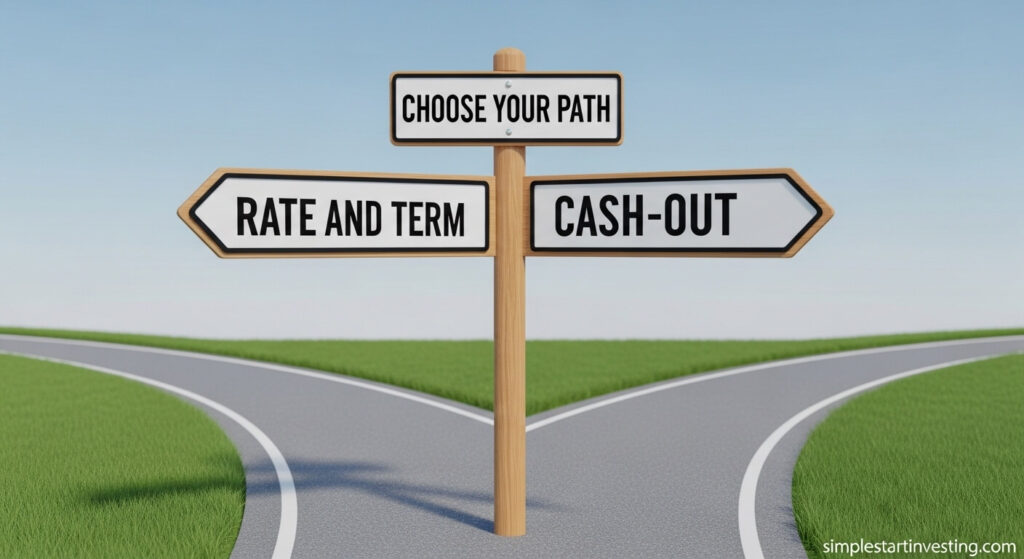
Finally, beginners often struggle with the difference between “Rate-and-Term” and “Cash-Out” options. They sound similar, but they serve completely different masters. One is about saving money on interest, while the other is about turning your home’s value into liquid cash for things like renovations or debt consolidation.
Breaking Down “Rate-and-Term” Refinancing
This is the most standard version of mortgage refinancing. The primary goal here is to change the “rate” (the interest percentage) or the “term” (how many years the loan lasts). You aren’t taking any extra money out of the house; you are simply trying to get a better deal on the debt you already have.
Imagine you bought a house when interest rates were at 7%. A few years later, the market shifts, and rates for people with your credit score drop to 5%. By switching to a lower rate, a larger portion of your monthly payment goes toward the actual balance of the house rather than disappearing into the bank’s pocket as interest.
Changing the “term” is equally powerful. Some homeowners use mortgage refinancing to move from a thirty-year loan to a fifteen-year loan. While this usually makes the monthly payment go up, it drastically reduces the total amount of interest paid over the life of the loan. You end up owning your home outright much faster, which is a common goal for those looking toward a comfortable retirement.
Understanding the “Cash-Out” Refinance
A “Cash-Out” refinance is a different beast entirely. Over time, as you pay down your mortgage and the value of your home hopefully increases, you build up “equity.” Equity is the difference between what your home is worth and what you still owe the bank. If your home is worth 400,000 dollars and you owe 250,000 dollars, you have 150,000 dollars in equity.
In a cash-out mortgage refinancing scenario, you take out a new loan for more than what you currently owe. The bank pays off your old loan and gives you the difference in a check. For example, you might take out a new loan for 300,000 dollars. The bank pays off your 250,000 dollar debt, and you walk away with 50,000 dollars in your pocket.
People use this money for many things, such as repairing a roof, adding a bedroom, or paying off high-interest credit card debt. However, you must be careful. You are essentially turning your home’s “safety net” into debt again. If home values drop, you could end up “underwater,” meaning you owe the bank more than the house is worth.
The Hidden Costs: What You Need to Know
When you first bought your home, you paid closing costs. When you pursue mortgage refinancing, you have to pay them again. These costs typically range from 2% to 6% of the loan amount. If you are refinancing a 300,000 dollar loan, you might be looking at fees between 6,000 dollars and 18,000 dollars.
These fees cover a variety of things. You will likely need a new home appraisal to prove the house is still worth what the bank thinks it is. There are also application fees, title search fees, and loan origination fees. Even if you don’t pay these “out of pocket” on closing day, they are often rolled into the new loan, which means you will be paying interest on those fees for years to come.
This is why the “Rule of Thumb” is so important. Most experts suggest that mortgage refinancing only makes sense if you can lower your interest rate by at least 0.75% to 1%. While this isn’t a hard law, it serves as a guardrail to ensure the savings are actually worth the heavy price of the paperwork.
How to Calculate Your Break-Even Point (Without Formulas)
To decide if mortgage refinancing is right for you, you need to find your “break-even point.” This is the moment when the amount you have saved on your monthly payments finally equals the amount you paid in closing costs. Everything after that point is “pure profit” or real savings.
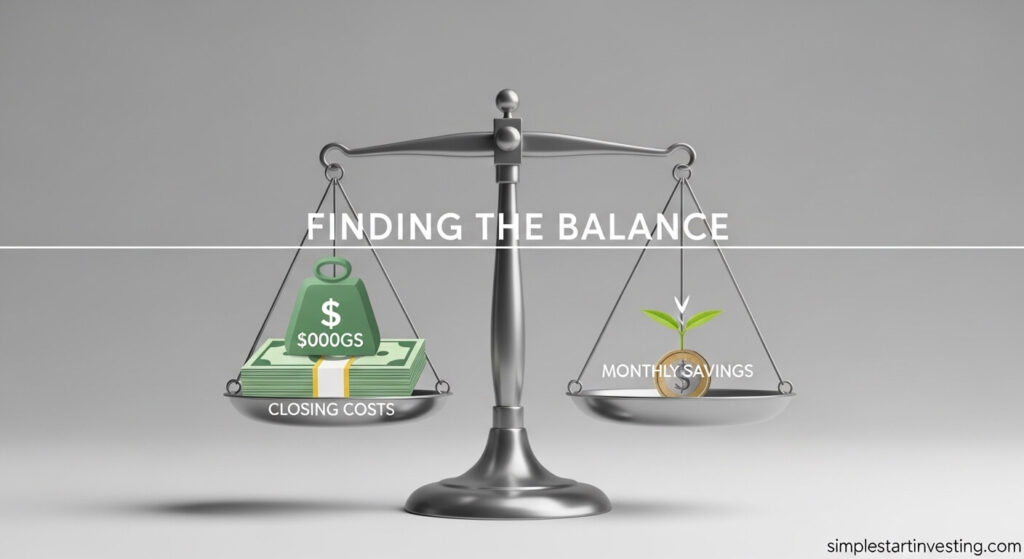
Let’s look at a simple example. Imagine your new loan will cost you 3,600 dollars in total closing costs. After refinancing, your new monthly mortgage payment is 150 dollars lower than your old one. To find your break-even point, you look at how many “150-dollar chunks” it takes to cover that 3,600 dollar cost.
In this case, 3,600 divided by 150 is 24. This means it will take 24 months, or exactly two years, to break even. If you plan to stay in the house for five or ten years, this refinance is a fantastic deal. But if your job might move you to a different state in 18 months, you would actually lose money by refinancing, because you wouldn’t have enough time to earn back those initial costs.
When Should You Avoid Refinancing?
Just because you can refinance doesn’t mean you should. One of the biggest traps is “restarting” your loan when you are already deep into your current one. If you have been paying off a thirty-year mortgage for fifteen years, you have finally reached the point where most of your payment is going toward the principal (the actual house balance) rather than interest.
If you perform a mortgage refinancing back into a new thirty-year loan at that stage, you might lower your monthly payment, but you are starting the interest-heavy years all over again. You might end up paying much more in total interest over the combined forty-five years than if you had just stuck with your original higher-rate loan for the remaining fifteen years.
Another reason to wait is if your credit score has recently taken a dip. Lenders save their best rates for those with high credit scores. If you have had some late payments or high credit card balances lately, the rate you are offered might not be low enough to justify the closing costs. It is often better to spend six months improving your credit score before applying.
The Impact on Your Private Mortgage Insurance (PMI)
For many beginners, the best reason to look into mortgage refinancing has nothing to do with interest rates and everything to do with Private Mortgage Insurance (PMI). If you bought your home with less than a 20% down payment, you are likely paying PMI every month. This is a fee that protects the lender, not you.

If your home’s value has increased significantly since you bought it, or if you have paid down a good portion of the balance, you might now own more than 20% of the home’s value. By refinancing, you can get a new appraisal. If that appraisal shows you have enough equity, the new loan won’t require PMI.
Removing a 150 dollar monthly PMI payment is like getting a 150 dollar raise. When you combine that with a potentially lower interest rate, the savings can be massive. This is a common strategy for first-time buyers who used FHA loans with low down payments to get into the market and later want to “graduate” to a conventional loan without the extra insurance costs.
Tax Implications and the IRS
It is important to remember that the IRS treats mortgage refinancing differently than an original home purchase. When you first buy a home, you can often deduct points paid to lower your interest rate in the year you buy the house. With a refinance, the IRS generally requires you to spread those deductions out over the entire life of the loan.
Furthermore, if you do a “Cash-Out” refinance, the interest on the “extra” money you took out might not be tax-deductible unless you use that money specifically to “buy, build, or substantially improve” the home that secures the loan. If you use the cash to pay off a credit card or buy a new car, you generally cannot deduct the interest on that portion of the loan.
Tax laws are complex and change frequently, so it is always wise to check the current IRS guidelines or speak with a tax professional before making a move based on expected tax breaks. Understanding the fine print ensures that your “savings” don’t disappear when April 15th rolls around.
The Step-by-Step Process for Beginners
If you’ve weighed the pros and cons and decided that mortgage refinancing makes sense, the process usually looks like this:
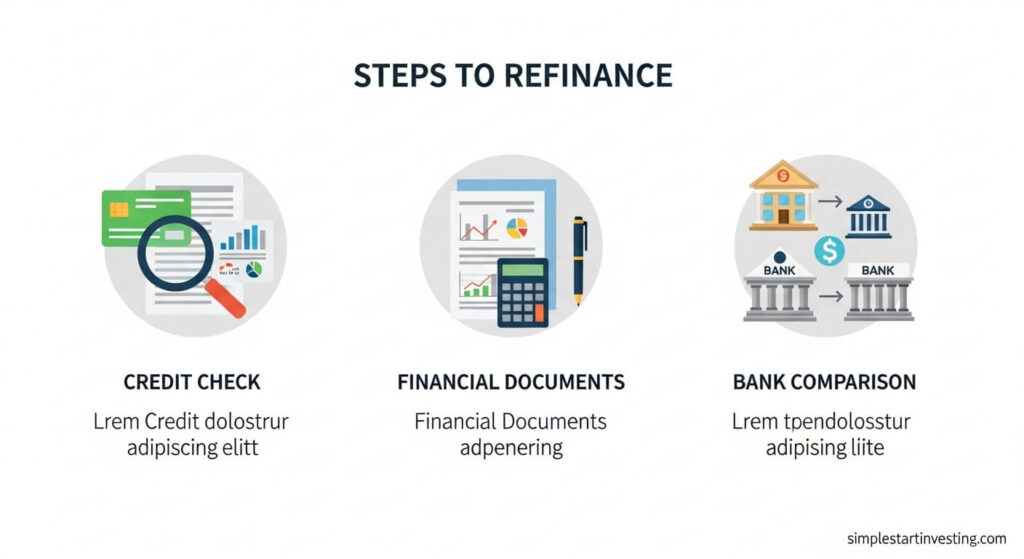
First, check your credit. You want to be in the best possible shape before a lender looks at your file. Even a few points on your credit score can mean a difference of hundreds of dollars in interest every year.
Second, gather your paperwork. Just like when you first bought the house, the bank will want to see your tax returns, pay stubs, and bank statements. They want to be absolutely sure you can afford the new payment, even if it is lower than the old one.
Third, shop around. Do not just go to your current bank. Talk to credit unions, online lenders, and local banks. Ask for a “Loan Estimate” from each one. This is a standard three-page form that makes it easy to compare interest rates and closing costs side-by-side.
Finally, prepare for the appraisal. The lender will send someone to look at your house to determine its current market value. Clean up the yard, fix any minor issues, and make sure the house looks its best. The higher the appraisal, the better your “loan-to-value” ratio, which can lead to better rates.
Final Thoughts for the New Homeowner
Deciding on a mortgage refinancing is a math problem wrapped in a lifestyle choice. It requires you to look honestly at your future. Are you planning to stay in this house for a long time? Do you need extra cash for a necessary renovation? Is your current interest rate significantly higher than what is being offered today?
If the answer is yes, then refinancing could be the key to unlocking better cash flow and faster wealth building. Just remember to look past the “monthly savings” and focus on the total cost and the time it takes to break even. A mortgage is a tool; make sure you are the one using it, rather than it using you.
By staying informed and doing the legwork, you can turn your home into a more efficient financial engine for your family. Don’t be afraid to ask lenders tough questions and walk away if the numbers don’t add up. Your home is your sanctuary, but it is also a major part of your financial foundation.
Disclaimer: This content is for educational purposes only and does not constitute financial, legal, or tax advice. Market conditions and regulations change frequently; please consult with a qualified professional before making any significant financial decisions.