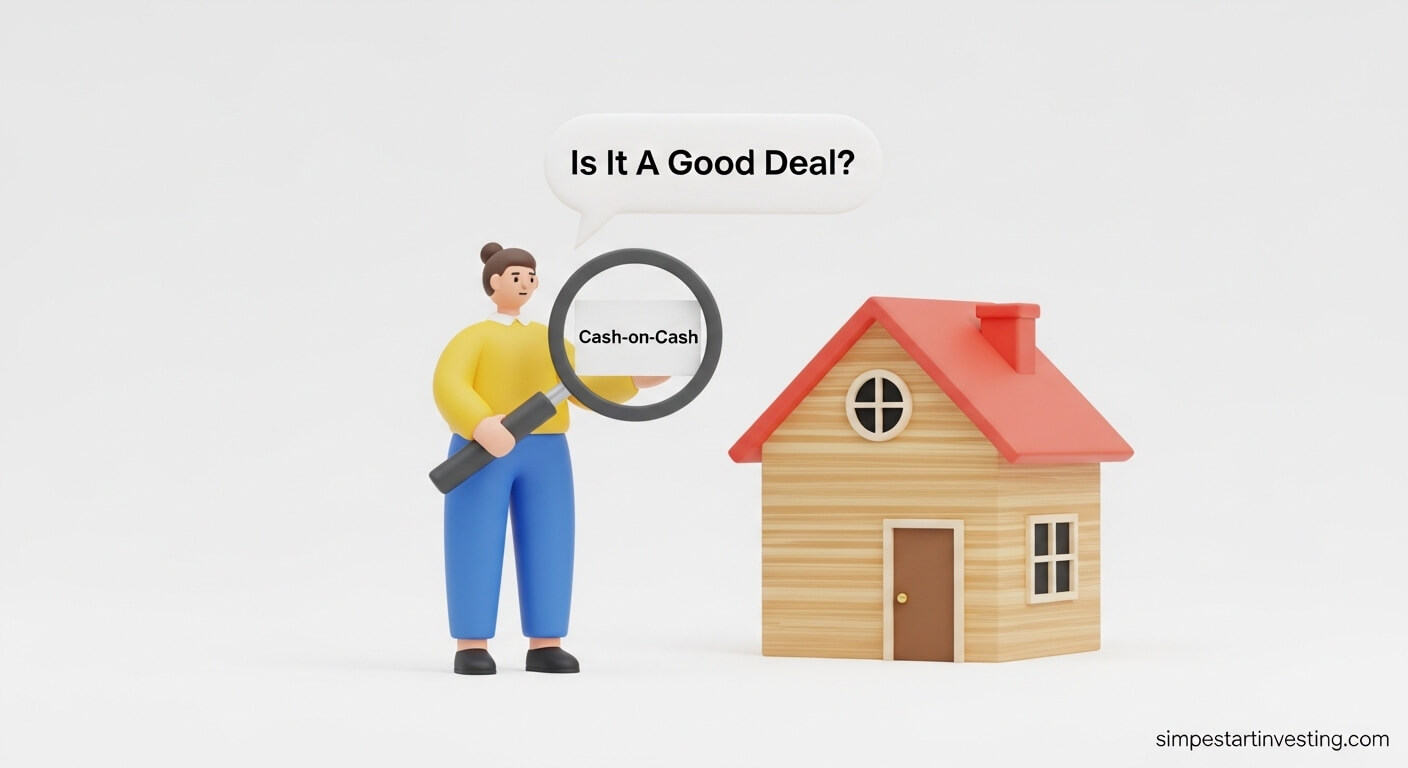
You are standing in front of a charming three-bedroom house. The paint is fresh, the neighborhood is quiet, and the price seems “fair” based on what you have seen on Zillow. But as a new investor, a nagging question keeps you up at night: Is this actually a good deal? Or are you just buying a very expensive hobby?
Most beginners make the mistake of looking only at the total price of the house or the monthly rent coming in. They see 2,000 dollars in rent and a 1,500 dollar mortgage and think they are “making” 500 dollars a month. Unfortunately, real estate is rarely that simple. To know if your money is actually working for you, you need to understand one specific number: the cash-on-cash return.
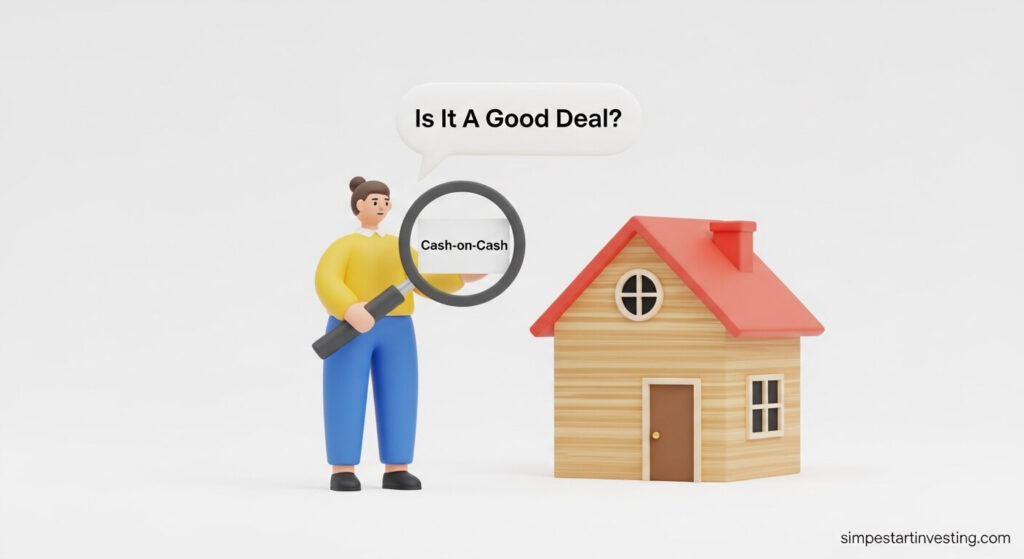
This metric is the “secret sauce” used by professional investors to cut through the noise. It doesn’t care about the total value of the home or how much the market might go up in ten years. Instead, it focuses on one thing: how much cash is hitting your bank account compared to the actual cash you pulled out of your pocket to buy the property.
What Exactly Is Cash-on-Cash Return?
Think of cash-on-cash return as a way to measure the “efficiency” of your money. If you put 100 dollars into a high-yield savings account and the bank gives you 5 dollars in interest at the end of the year, your return is 5%. Simple, right?
In real estate, it works the same way, but the “input” isn’t just the purchase price. It is the total amount of cash you spent to get the keys and get the unit ready for a tenant. The “output” is the net cash flow left over after every single bill—from the mortgage to the leaky faucet fund—has been paid.
Many beginners confuse this with “Total ROI” or “Cap Rate,” but those are different animals. Total ROI includes things like the house gaining value over time (appreciation) and the tenant paying down your loan. While those are great, you can’t pay your groceries with “potential appreciation.” You pay them with cash. That is why cash-on-cash return is the king of metrics for people who want to build passive income.
The Two Parts of the Equation: Cash In and Cash Out
To figure out this percentage, we have to look at two distinct buckets of money. If you get either of these wrong, your math will be off, and you might buy a “lemon” of an investment.
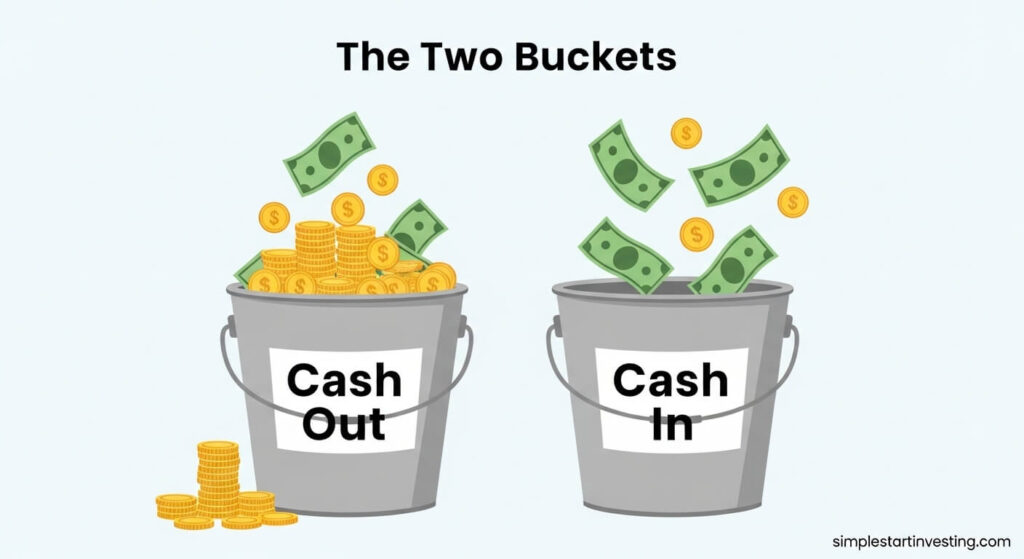
Bucket 1: Your Total Cash Investment (Cash Out of Pocket)
This is where many beginners underestimate their costs. They think the “investment” is just the down payment. In reality, your total cash investment includes every dollar you spent to make the deal happen.
- The Down Payment: This is usually 20% to 25% of the purchase price for an investment property.
- Closing Costs: These are the fees for the loan, the title company, and the government. They usually run between 2% and 5% of the total loan amount.
- Initial Repairs: If the house needs a new roof or a fresh coat of paint before a tenant moves in, that is cash coming out of your pocket.
- Pre-paid Items: Sometimes you have to pay for a full year of insurance or property taxes upfront at the closing table.
If you bought a house for 200,000 dollars and put 40,000 dollars down, but you also spent 5,000 dollars on closing costs and 10,000 dollars on a new kitchen, your total cash investment is 55,000 dollars. This 55,000 dollars is the number we care about, not the 200,000 dollar price tag.
Bucket 2: Your Annual Pre-Tax Cash Flow (Cash Into Your Pocket)
This is the money left over at the end of the year after the house has “fed” itself. To find this, you take your total annual rent and subtract every possible expense.
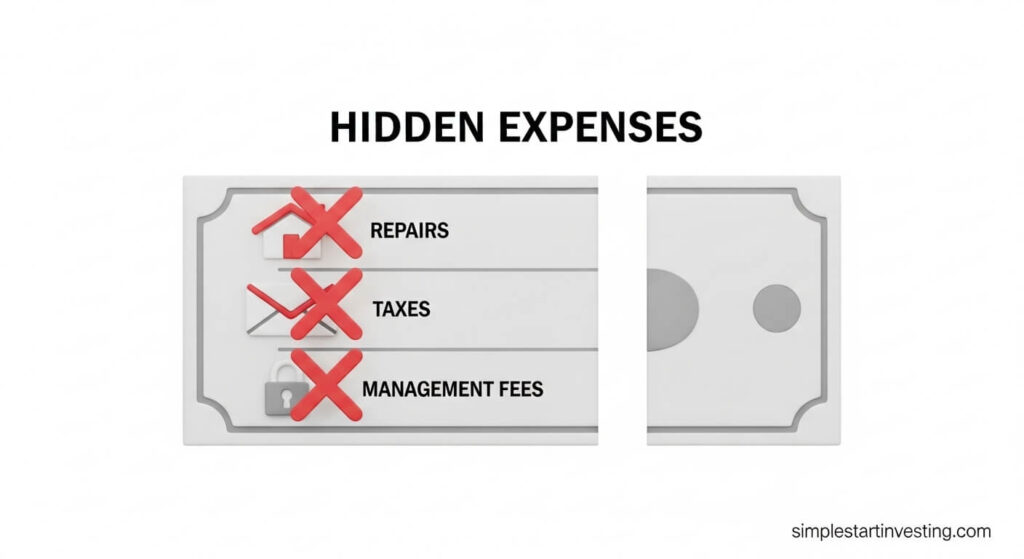
Common expenses include:
- Mortgage Payments: Both the interest and the principal.
- Property Taxes: These can change, so always check the local county records.
- Homeowners Insurance: Essential for protecting your asset.
- Property Management Fees: Even if you manage it yourself now, you should account for the 8% to 10% fee a pro would charge.
- Maintenance and Repairs: A good rule of thumb is setting aside 5% to 10% of the rent for when things break.
- Vacancy: Houses aren’t always occupied. Smart investors assume the house will be empty for about 3 to 4 weeks a year (roughly 5% to 8% vacancy).
Whatever is left after these are subtracted from your total rent is your “Net Cash Flow.”
Why the “Price” of the House Can Be Deceptive
One of the biggest hurdles for new investors is getting over the “sticker price.” You might see a house in the Midwest for 100,000 dollars and a house in Florida for 400,000 dollars. At first glance, the 400,000 dollar house looks “better” because it is more prestigious or in a “better” area.
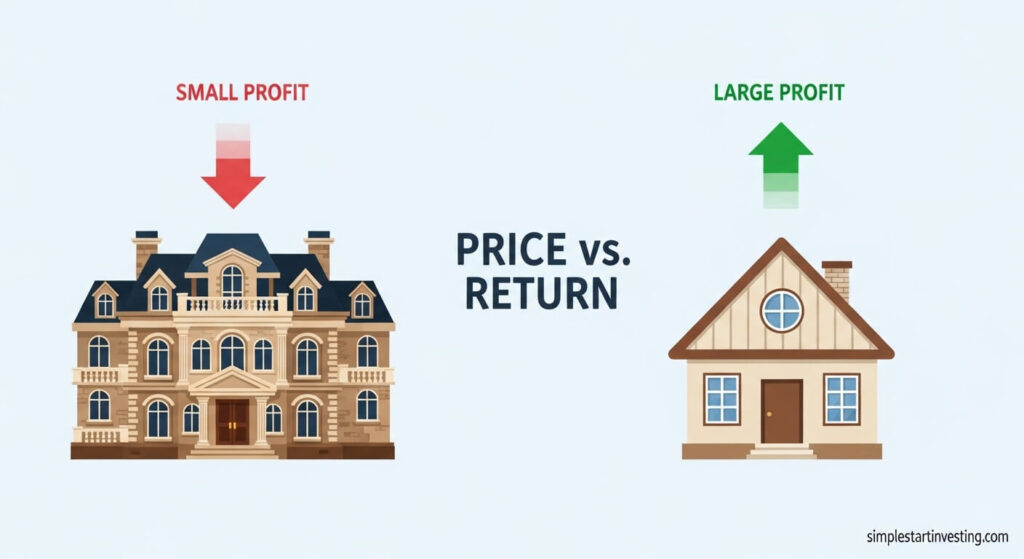
However, if the 100,000 dollar house requires only 25,000 dollars of your cash and produces 3,000 dollars of profit a year, while the 400,000 dollar house requires 100,000 dollars of your cash but only produces 4,000 dollars of profit, the cheaper house is actually the much better investment.
The 100,000 dollar house is giving you a 12% cash-on-cash return, while the expensive house is only giving you 4%. You are working much harder for every dollar in the second scenario. This is why you must focus on the return on your cash, not the value of the building.
Step-by-Step: An Example of the Logic
Let’s walk through a realistic scenario for a beginner. Imagine you are buying a rental property for 250,000 dollars.
1. Calculating the “Cash In”
- You put down 20%, which is 50,000 dollars.
- Your closing costs and inspections total 6,000 dollars.
- You spend 4,000 dollars on minor repairs like carpet cleaning and locks.
- Total Cash Invested: 60,000 dollars.
2. Calculating the “Cash Out” (Monthly)
- The rent is 2,200 dollars.
- Your mortgage (including taxes and insurance) is 1,600 dollars.
- You set aside 110 dollars (5%) for future repairs.
- You set aside 110 dollars (5%) for potential vacancy.
- You pay a manager 180 dollars a month to handle the tenants.
- Total Monthly Expenses: 2,000 dollars.
3. The Final Result
- Your monthly profit is 200 dollars (2,200 minus 2,000).
- Your annual profit is 2,400 dollars (200 multiplied by 12 months).
- Now, take that 2,400 dollars and divide it by your original 60,000 dollar investment.
- The result is 0.04, which means your cash-on-cash return is 4%.
In this case, you might decide that 4% is too low. You could get that same return in a low-risk government bond without ever having to worry about a tenant’s clogged toilet. This math just saved you from a mediocre investment.
Why Beginners Often Get This Wrong
The most common mistake is “The Optimism Trap.” When you want a deal to work, it is easy to ignore the “boring” expenses. Beginners often forget to account for the fact that a water heater will eventually burst, or that a tenant will move out and leave the place empty for a month.
When you ignore these costs, your cash-on-cash return looks amazing on paper—maybe 15% or 20%. But then reality hits. If you don’t budget for repairs, one 3,000 dollar HVAC repair can wipe out two years of profit.
Another error is failing to include the “opportunity cost” of their time. If you are doing all the repairs and management yourself, you are essentially working a part-time job for free. True “passive” income should account for the cost of paying someone else to do the work. If the deal still has a good cash-on-cash return after paying a manager, you have a winner.
What Is a “Good” Return?
There is no single answer to this because it depends on your goals and the location. However, in the US market, most experienced rental investors look for a cash-on-cash return between 8% and 12%.
- Low Return (0% – 5%): Common in high-priced cities like Los Angeles or New York. Investors here usually bet on the house value doubling over time, rather than monthly cash.
- Moderate Return (6% – 10%): A solid “bread and butter” investment in stable suburbs.
- High Return (12% +): Often found in lower-income areas or “up-and-coming” neighborhoods. These carry more risk, such as higher vacancy rates or more difficult tenant management.
As a beginner, don’t just chase the highest percentage. A 15% return in a dangerous neighborhood might actually be worse than a 7% return in a safe, growing suburb where people stay for years.
The Power of Leverage (Using a Loan)
One of the strangest things about cash-on-cash return is that sometimes, having a mortgage makes your return higher than if you paid for the house in full cash. This is called “leverage.”
If you pay 200,000 dollars in cash for a house and it makes 10,000 dollars in profit, your return is 5%.
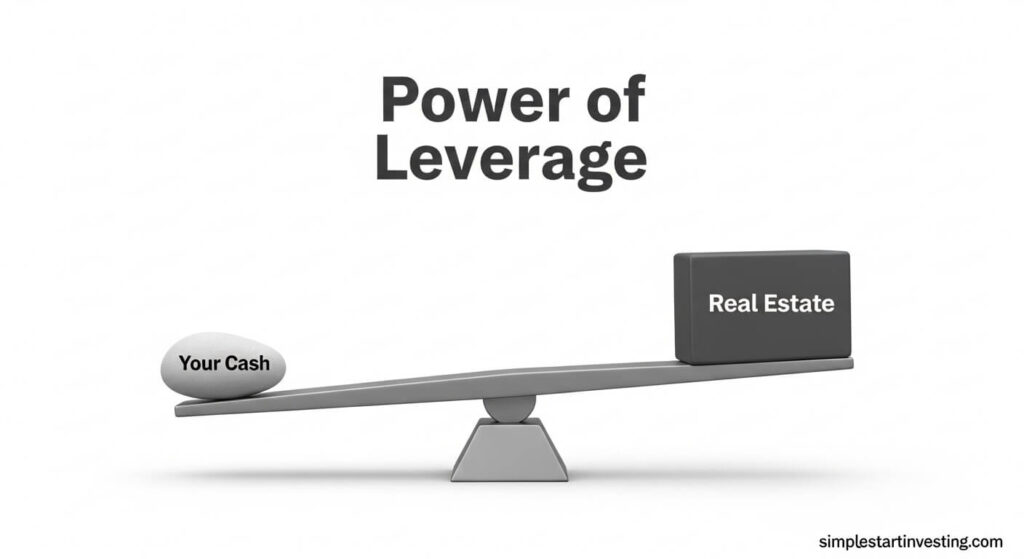
But if you use a loan and only put down 40,000 dollars, even though you now have a mortgage payment that reduces your profit to 4,000 dollars, your return is now 10% (4,000 divided by 40,000). You are using the bank’s money to increase the efficiency of your own cash. This is why real estate is such a powerful wealth-building tool—but it also adds the risk of having a monthly payment you must meet.
How to Use This Knowledge Today
Before you put an offer on a property, run the “prose” version of this math. List out every dollar you will spend to own it. Then, be brutally honest about every dollar that will leave your pocket every month.
If the resulting cash-on-cash return makes you smile, you can proceed with confidence. If the number is lower than what you could earn in the stock market or a savings account, it is okay to walk away. The best investment you ever make might be the one you decided not to buy.
Investing is about data, not emotions. While the house might have a “cute” porch, the math tells the real story. By mastering the cash-on-cash return, you are moving from being a “hoper” to being a “strategist.” You are no longer just buying property; you are buying a stream of income that has been carefully vetted for success.
Remember that real estate is a long-term game. Your returns might fluctuate year to year as taxes change or major repairs happen. But if you start with a strong foundation and a clear understanding of your cash flow, you are already miles ahead of most new investors.
Take your time, run the numbers on dozens of properties before you buy one, and always keep a “cushion” of extra cash for the unexpected. Real estate can change your financial future, but only if you respect the math behind the doors.
Disclaimer: This content is for educational purposes only and does not constitute financial advice. Real estate investing involves significant risk, and you should consult with a qualified professional before making any investment decisions.