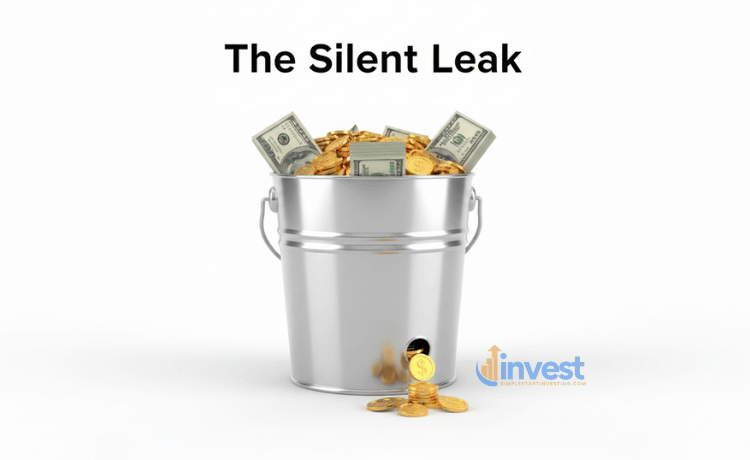
Imagine you are filling a bucket with water from a steady tap. You expect the bucket to be full by morning. But when you wake up, it is only half full. You look closely and find a tiny, almost invisible pinhole at the bottom. That hole has been leaking water the entire night. In the world of finance, investment fees are that pinhole. They seem small, maybe even insignificant, but over decades of saving, they can drain away a massive portion of your hard-earned wealth.
Many people starting their financial journey focus entirely on how much their stocks or funds are “going up.” While returns are important, what you actually get to keep is what matters. Investment fees are the costs you pay to own a fund, use a platform, or work with an advisor. Because these fees are often deducted automatically from your account, you never see a bill in the mail. This makes them a “silent killer” of long-term wealth.
If you want to reach your retirement goals or build a college fund for your kids, understanding investment fees is not optional. It is one of the most powerful levers you can pull to ensure more money stays in your pocket. In this guide, we will break down exactly how these costs work, why they are more dangerous than they look, and how you can switch to a low-cost strategy this year.
What Exactly Are Investment Fees?
At its simplest level, an investment fee is the price you pay for a service. Just like you pay a subscription fee for Netflix or a service fee for a food delivery app, financial companies charge you for managing your money. These companies have employees to pay, offices to rent, and technology to maintain. To cover these costs, they take a small slice of your investment.
A simple way to see it
Think of investment fees like a “toll” on a highway. To get to your destination (wealth), you have to drive on the road provided by an investment company. Every few miles, there is a toll booth. You don’t stop and hand over cash; instead, the toll is automatically scanned and taken from your account. If the toll is high, you arrive at your destination with much less money than if the toll was low.
Real-world example in the US market
Let’s say you decide to invest in a mutual fund that holds big American companies like Apple (AAPL), Amazon (AMZN), and Tesla (TSLA). The company managing that fund might charge a fee of 1 percent every year. If you have 10,000 dollars in that fund, they will take 100 dollars this year to cover their costs. If the market stays flat and your 10,000 dollars doesn’t grow, you still owe that 100 dollars.

The common beginner mistake
A very common mistake for beginners is thinking that a 1 percent fee is “cheap.” After all, in daily life, we are used to much higher numbers. A 7 percent sales tax or a 15 percent tip at a restaurant feels normal. So, when a bank or an advisor mentions a 1 percent fee, most people nod and think, “That sounds like a great deal.”
Shifting your mindset
The correct way to look at it is to compare the fee to your expected profit, not your total balance. If your investment earns a 7 percent return in a year, and the fee is 1 percent, that fee isn’t just taking 1 percent of your money—it is taking about 14 percent of your actual profit! Over 30 years, that “tiny” 1 percent fee can end up eating 25 percent to 30 percent of your total final nest egg.
The Silent Impact of the Expense Ratio
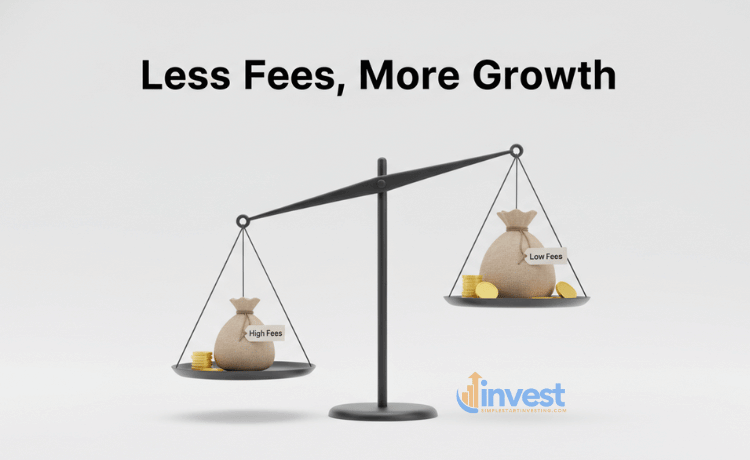
The most common type of fee you will encounter is called the expense ratio. This is the annual fee that all mutual funds and Exchange-Traded Funds (ETFs) charge their shareholders. It is expressed as a percentage of your total investment.
Explaining the Expense Ratio
The expense ratio covers the cost of the fund’s managers, the legal paperwork required by the SEC (Securities and Exchange Commission), and the marketing of the fund. You don’t pay this fee directly. Instead, the fund company takes it out of the fund’s assets before they report the daily price. This is why many investors don’t even realize they are paying it.
Real-world example
- Fund A is an “active” fund where professional managers try to pick the best stocks. It has an expense ratio of 1 percent.
- Fund B is a “passive” index fund that simply follows the market. It has an expense ratio of 0.03 percent.
If you invest 100,000 dollars in Fund A, you pay 1,000 dollars per year. If you invest that same 100,000 dollars in Fund B, you pay only 30 dollars per year. Over 30 years, that 970-dollar difference—and the growth that money would have earned—can turn into a difference of over 200,000 dollars in your final balance.
The common beginner mistake
Beginners often assume that a higher expense ratio means a “better” or “more premium” product. They think, “If I pay more for a manager, they must be smarter and will get me better results.” They treat investing like buying a car or a house, where higher price usually equals higher quality.
Shifting your mindset
In the world of investing, the opposite is often true. Study after study from organizations like Morningstar shows that low-cost funds almost always outperform high-cost funds over long periods. This is because it is very hard for a manager to consistently “beat the market” by enough to cover their high fees. When you pay less in fees, more of the market’s growth stays in your account.
The Danger of Sales Loads and Transaction Costs
Some fees are charged only when you buy or sell an investment. These are often called sales loads or commissions. While many major US brokerages like Fidelity, Schwab, and Vanguard have moved to zero-commission trading for most stocks, hidden sales charges still exist in certain types of mutual funds.
Explaining Sales Loads
A “front-end load” is a fee you pay the moment you put money into a fund. If a fund has a 5 percent front-end load and you invest 1,000 dollars, only 950 dollars actually gets invested. The other 50 dollars goes straight to the broker as a commission. A “back-end load” is a fee you pay when you sell your shares, usually if you sell them too soon.
Real-world example
Let’s say a family friend who works as a financial “representative” suggests a specific mutual fund for your IRA. You invest 5,000 dollars. If that fund has a 5.75 percent front-end load (which is common for some “Class A” shares), you immediately lose 287 dollars and 50 cents. Your account starts at 4,712 dollars and 50 cents. Even before the market moves, you are already “down” by over 5 percent.
The common beginner mistake
Many beginners believe that if they are working with a “free” advisor at a local bank, there are no fees. They don’t realize that the advisor is being paid through these hidden sales loads. They think they are getting professional advice for nothing, but they are actually paying a steep entry price that stunts their growth from day one.
Shifting your mindset
You should almost never pay a sales load. There are thousands of high-quality “no-load” funds and ETFs available today that allow 100 percent of your money to go to work for you immediately. Always ask: “Is this a no-load fund?” If the answer is no, there is almost certainly a cheaper, better alternative.
Advisory Fees: Paying for a Pilot
Beyond the fees inside the funds themselves, many people hire a financial advisor to manage their entire portfolio. The most common way advisors charge is a percentage of your “Assets Under Management” (AUM).
Explaining Advisory Fees
An advisory fee is what you pay for someone to give you a plan, choose your investments, and keep you from making emotional mistakes (like selling when the market crashes). The standard fee in the US for many years has been 1 percent of your total balance per year. This is on top of the expense ratios of the funds the advisor chooses for you.
Real-world example
Suppose you have a 500,000 dollar retirement account. An advisor charging a 1 percent AUM fee will cost you 5,000 dollars every year. If they put your money into funds that have their own 0.50 percent expense ratio, your total cost is 1.5 percent, or 7,500 dollars a year. Over a 20-year retirement, you could easily pay over 150,000 dollars in fees just to have your money managed.
The common beginner mistake
Beginners often think that a 1 percent advisory fee is the only way to get “good” help. They don’t realize that there are many different ways to pay for financial advice. They also often fail to calculate the total cost (Advisory fee + Fund fees) and instead only look at the advisor’s 1 percent sticker price.
Shifting your mindset
Advice is valuable, but you must be sure the value you receive is greater than the cost. This year, many investors are choosing “Fee-Only” advisors who charge a flat hourly rate or a one-time project fee instead of taking a percentage of their wealth every year. Alternatively, “Robo-advisors” use computer programs to manage your money for a much lower fee, often around 0.25 percent.
How to Find the Fees (Reading the Prospectus)
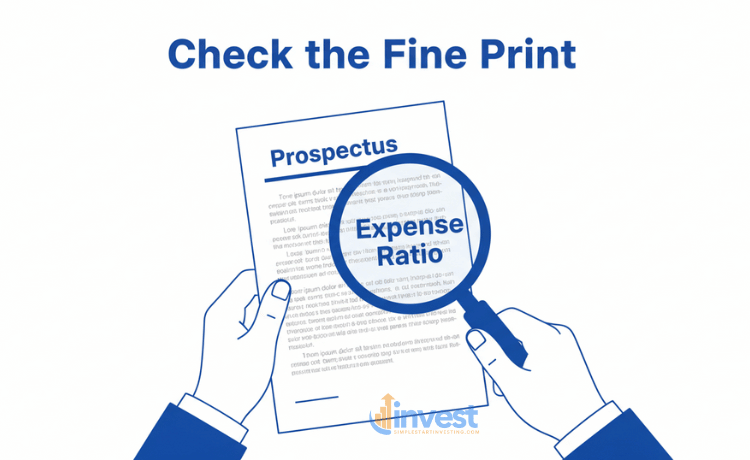
Investment companies are required by law to tell you what they charge, but they don’t always make it easy to find. The document that contains this information is called a Prospectus.
Explaining the Prospectus
A prospectus is a legal document that describes an investment’s goals, risks, and costs. Every mutual fund and ETF has one. While they are often long and boring, there is one section you must always check: the Fee Table.
How to do it: A step-by-step guide
- Search for the ticker symbol of your fund (like VOO or SPY) on a site like Yahoo Finance or the fund company’s own website.
- Look for a link that says “Prospectus” or “Summary Prospectus.”
- Scroll down to the “Fees and Expenses” section.
- Look for the line that says “Total Annual Fund Operating Expenses.” That is your expense ratio.
The common beginner mistake
Most beginners never look at a prospectus. They rely on the marketing materials or a “one-page” flyer that highlights high past returns but hides the fees in tiny print at the bottom. They assume that if a fund is popular, the fees must be fair.
Shifting your mindset
Treat the Fee Table like the “Nutrition Facts” label on a box of cereal. You wouldn’t buy food without knowing how much sugar is in it; don’t buy an investment without knowing the expense ratio. Make it a habit to check the fee of every single fund before you click the “buy” button.
The Strategy for Keeping Fees Low
Now that you know how investment fees work, how do you actually lower them? The goal is to get your total costs as close to zero as possible without sacrificing the quality of your investments.
Use Index Funds and ETFs
Instead of trying to find the one “genius” manager who might beat the market, buy the whole market. Index funds track a specific list of stocks, like the 500 largest companies in the US. Because no one has to sit in a room and “pick” stocks, these funds are incredibly cheap to run.
Real-world example
Companies like Vanguard, Charles Schwab, and BlackRock (iShares) offer total stock market index funds with expense ratios as low as 0.03 percent or even zero in some cases. At 0.03 percent, you are only paying 3 dollars a year for every 10,000 dollars you invest. This is effectively “free” compared to older, active funds that charge 100 dollars or more for the same amount.
Look for “No-Transaction-Fee” (NTF) Platforms
When you open a brokerage account, make sure you can buy your chosen funds without paying a “transaction fee.” Most major US brokers now offer a huge list of ETFs and mutual funds that you can buy and sell for 0 dollars.
Avoid the “Churn”
Every time you sell one stock to buy another, there can be hidden costs called the “bid-ask spread.” This is the difference between what a buyer will pay and what a seller will accept. If you trade too often, these tiny slices add up. A “buy and hold” strategy is not just easier—it is also much cheaper.
Summary of Key Points
Building wealth is about two things: how much you make and how much you keep. Investment fees are the biggest obstacle to the “keeping” part of that equation.
- Fees compound in reverse: Just like your money grows over time, the “lost” money from fees would have also grown. A 1 percent fee today isn’t just 100 dollars; it’s the thousands of dollars that 100 dollars would have become over 30 years.
- Price does not equal quality: In investing, the less you pay, the more you usually get. Low-cost index funds consistently beat expensive actively managed funds.
- Always check the Fee Table: Never buy a fund without knowing its expense ratio. Aim for funds with costs below 0.20 percent.
- Beware of commissions: You should almost never pay a sales load or a trading commission in today’s US market.
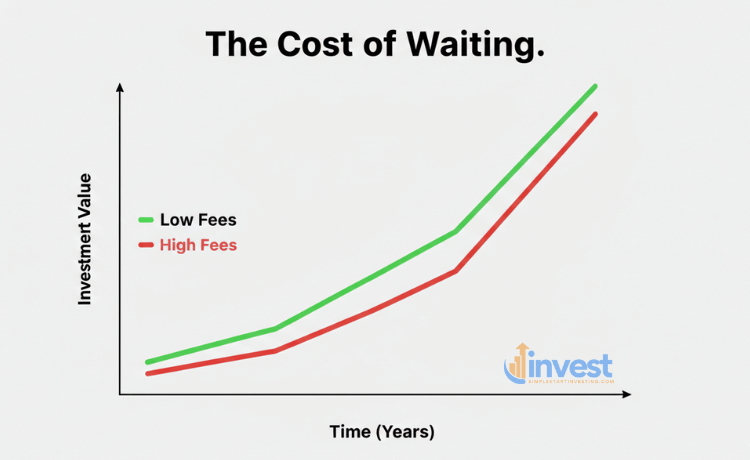
By paying attention to these small percentages today, you are protecting your future self. Every dollar you save in fees is a dollar that stays in your account, compounding for your benefit instead of the bank’s.
Disclaimer: This content is for educational purposes only and does not constitute financial advice. Investment regulations and fees can change; please check current guidelines or consult with a qualified professional.