What is a company actually worth on paper? Learn how the Price to Book ratio helps you find hidden gems by looking at a company’s balance sheet.
Imagine you are walking down a street in your neighborhood and you see a small, successful local bakery. You know they make great cookies, but you are curious about what the business is actually “worth.” If the owner decided to close the doors today, sell every oven, every bag of flour, and the building itself, and then paid off all the loans they owed to the bank, how much cash would be left over?
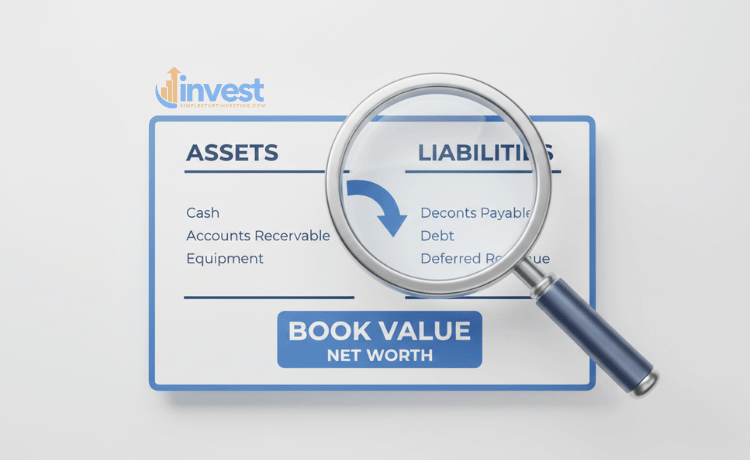
That “leftover” amount is what investors call the Book Value. When you compare that number to the actual price of the company’s stock, you get the Price to Book ratio. This simple but powerful tool helps you understand if you are paying a fair price for the physical “stuff” a company owns, or if you are paying a premium for its future potential. For anyone starting their journey in the US stock market, understanding the Price to Book ratio is like having a magnifying glass that lets you see past the hype and look at the actual foundation of a business.
What is the Price to Book Ratio?
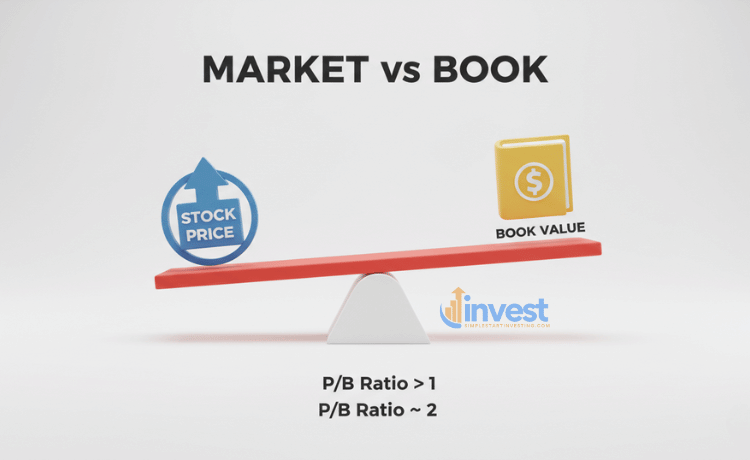
In the simplest terms, the Price to Book ratio is a way to compare a company’s market value—what people are paying for it on the stock exchange—to its accounting value—what the company says it is worth on its official books. It tells you how many dollars you are paying for every one dollar of the company’s net assets.
If a company has a Price to Book ratio of one, it means you are paying exactly what the company’s net assets are worth on paper. If the ratio is two, you are paying double. If it is less than one, you might be getting a bargain, or there might be a very good reason why the market doesn’t trust the company’s “stuff” is actually worth that much.
A Layered Explanation for Beginners
Think of a company like a house. The “Market Price” is what a buyer is willing to pay for that house today because it’s in a great school district and has a beautiful view. The “Book Value,” however, is the cost of the bricks, the wood, the land, and the pipes, minus the mortgage. The Price to Book ratio helps you decide if the “view” is worth the extra money you are paying over the cost of the “bricks.”
Real-World Example: The Local Car Dealership
Suppose there is a car dealership in Texas called “Lone Star Motors.” If Lone Star Motors owns its building, a fleet of 100 trucks, and some specialized repair tools, all those things are assets. If they owe money to a bank for those trucks, that is a liability.
If you take all those trucks and the building (Assets) and subtract the bank debt (Liabilities), you might find the company is worth 1 million dollars on paper. If the stock market says the whole company is worth 2 million dollars, then the Price to Book ratio is two. You are paying two dollars for every one dollar of physical trucks and buildings.
Common Misconception
Many beginners believe that a low Price to Book ratio (specifically anything under one) is an automatic “buy” signal because the stock is “cheap.” They think they are getting a dollar’s worth of assets for only 80 cents.
The Financial Logic Shift
A low ratio isn’t always a bargain. Sometimes, a company has a low Price to Book ratio because its “stuff” is outdated or losing value. For example, a company that owns a giant warehouse full of old DVD players might have a high “Book Value,” but those assets aren’t very useful today. The market realizes those assets won’t generate future profits, so the stock price drops, making the ratio look “cheap” when it’s actually a warning sign.
Understanding the Foundation: What is Book Value?
Before we dive deeper into the ratio, we must understand the “Book” part. In the world of accounting, every company in the US, from a small tech startup in Silicon Valley to a giant like Walmart, must keep a “Balance Sheet.” This document lists everything they own and everything they owe.
The Ingredients of Book Value
- Total Assets: This includes cash in the bank, inventory (like iPhones sitting in an Apple store), property (like a Ford factory), and even patents.
- Total Liabilities: This is the money the company owes to others, such as bank loans, bonds, or money owed to suppliers.
To find the Book Value, you simply take the Total Assets and subtract the Total Liabilities. What remains is often called “Shareholders’ Equity.” This is the core value of the company if it were to stop operating and sell everything off tomorrow.
Real-World Example: A Tech Giant vs. a Bank
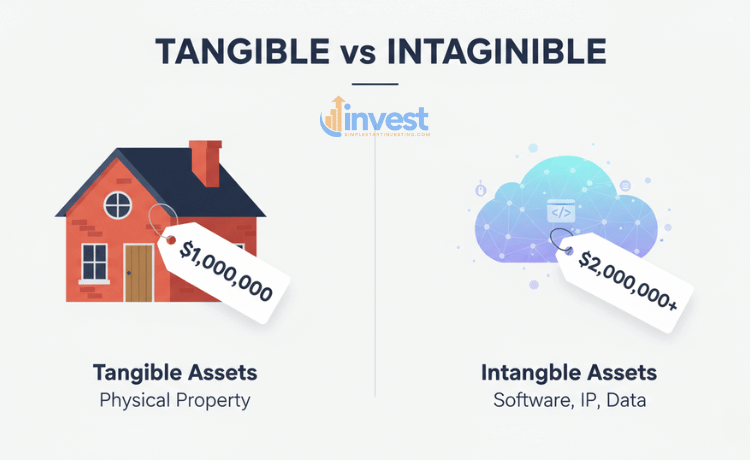
Consider a company like J.P. Morgan Chase. Because banks deal mostly with money, loans, and physical buildings, their Book Value is very important. Their assets are “tangible”—you can see and count them.
Now, look at a company like Apple (AAPL). Apple owns some factories and stores, but their biggest “value” is their brand and their software. These are “intangible assets.” Because the “Book” doesn’t always capture the true value of a brand, a company like Apple will almost always have a much higher Price to Book ratio than a bank.
How to Calculate the Ratio (The Simple Way)
You do not need to be a math genius to find this number. Most financial websites will calculate it for you, but knowing the logic behind it helps you spot mistakes.
Step-by-Step Logic
Let’s use a hypothetical company called “Sunshine Solar.”
- Sunshine Solar has a stock price of 50 dollars per share.
- On their balance sheet, after they subtract all their debts from their assets, they have 1 billion dollars left.
- They have 40 million shares of stock held by investors.
To find the “Book Value per Share,” you take that 1 billion dollars and divide it by the 40 million shares. This gives you a Book Value of 25 dollars per share.
Now, to find the Price to Book ratio, you take the current stock price of 50 dollars and divide it by the Book Value of 25 dollars. The result is two. This means the market is currently valuing the company at two times its “on-paper” worth.
Real-World Comparison
If you look at the US market today, you might see a utility company with a ratio of 1.5 and a software company with a ratio of 15. The software company is much “more expensive” relative to its assets, but that might be because its software can be sold to millions of people with very little extra “stuff” needed.
Common Misconception
New investors often think they need to do these calculations by hand for every stock. They get overwhelmed by the large numbers on a balance sheet.
The Financial Logic Shift
Focus on the meaning of the number rather than the math. Most professional tools like Yahoo Finance or Morningstar will give you the Price to Book ratio instantly. Your job as an investor is not to be a calculator; it is to ask: “Why is the market paying this much for these assets?”
What is a “Good” Price to Book Ratio?
There is no single “perfect” number. A “good” ratio depends entirely on the industry the company is in.
1. The Value Investing Standard
Followers of famous investors like Benjamin Graham often look for a Price to Book ratio under 1.5. They want to make sure they aren’t overpaying for the company’s physical worth. In some cases, finding a company with a ratio below one (meaning the stock is cheaper than the net assets) is seen as the “holy grail” of value investing.
2. Industry Context is Key
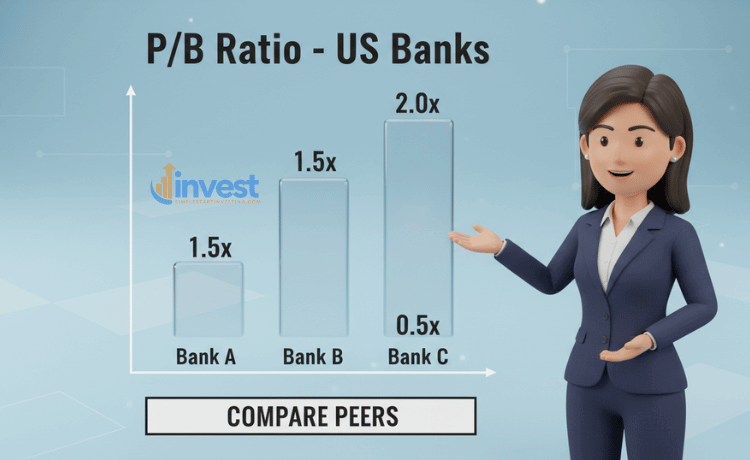
- Banking and Finance: These companies are often judged very strictly by their Price to Book ratio. A bank with a ratio of 1.2 is often seen as healthy, while a ratio of 0.8 might suggest the bank is in trouble or its loans are risky.
- Technology and Software: Companies like Microsoft or Nvidia have very high ratios. Why? Because their value isn’t in “stuff” like desks and trucks. Their value is in their code, their patents, and their people—things that don’t always show up clearly on a balance sheet.
Real-World Example: Walmart vs. Amazon
Walmart (WMT) owns a massive amount of real estate and physical inventory. Its Price to Book ratio usually stays in a moderate range because its assets are physical. Amazon, however, has a massive cloud computing business (AWS). A huge part of Amazon’s value is intangible, so its Price to Book ratio is often much higher than Walmart’s.
Common Misconception
Beginners often compare the Price to Book ratio of a tech company to a manufacturing company. They might see a tech stock with a ratio of 10 and a car company with a ratio of 1 and think, “The car company is a much better deal!”
The Financial Logic Shift
Comparing ratios across different industries is like comparing the weight of a bird to the weight of a fish to see which one is a better “animal.” They live in different environments. Only compare a company’s ratio to its direct competitors (e.g., compare Ford to GM, or J.P. Morgan to Bank of America).
The Danger Zones: When a Low Ratio is a Trap
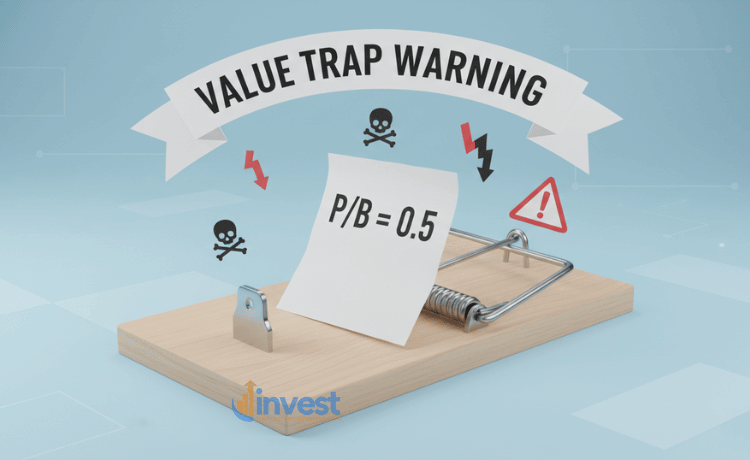
In the investing world, a “Value Trap” is a stock that looks cheap based on its numbers but is actually a failing business. A low Price to Book ratio is one of the most common ways investors get lured into these traps.
Why a Ratio Below One Can Be Scary
If a company’s stock is trading for 10 dollars, but its Book Value says it’s worth 15 dollars, you might think you are getting a 5-dollar discount. But ask yourself: Why is the rest of the world willing to sell it to you so cheaply?
- Declining Industry: Maybe the company makes parts for gas-powered cars, and the market is moving toward electric vehicles. The factories (assets) are still there, but they are becoming useless.
- Hidden Debt: Sometimes companies have “off-balance-sheet” liabilities that make their Book Value look better than it actually is.
- Poor Earnings: If a company has a lot of “stuff” but keeps losing money every year, that “stuff” is actually a burden because it costs money to maintain.
Real-World Example: Retail Stores
Think of a large department store chain that owns its buildings but hasn’t had a profitable year in a decade. The Price to Book ratio might be 0.5. However, if they have to sell those buildings quickly to pay off debt, they might not get the full “Book Value” for them. The market knows this and prices the stock accordingly.
Why the Ratio is Changing in the Modern Economy
The Price to Book ratio was much more popular 50 years ago when the US economy was dominated by steel mills, railroads, and oil companies. In those days, a company’s success was directly tied to how many machines and acres of land it owned.
The Rise of the Intangible
Today, many of the largest US companies own very little physical property. Think of a company like Meta (Facebook). What is their most valuable asset? It is the data and the network of billions of users. You cannot touch or sell a “user network” in the same way you can sell a pile of steel.
As a result, the Price to Book ratio has become less useful for analyzing “Growth” stocks and more useful for “Value” stocks in traditional industries like:
- Real Estate (REITs)
- Banking and Insurance
- Heavy Manufacturing
- Utilities
Adjusting Your Perspective
For a modern investor, the Price to Book ratio should be just one tool in your toolbox. If you are looking at a traditional company like an energy producer or a bank, look at the P/B ratio closely. If you are looking at a high-tech AI company, you might want to focus more on earnings and revenue growth instead.
Summary for Your First Investment Step
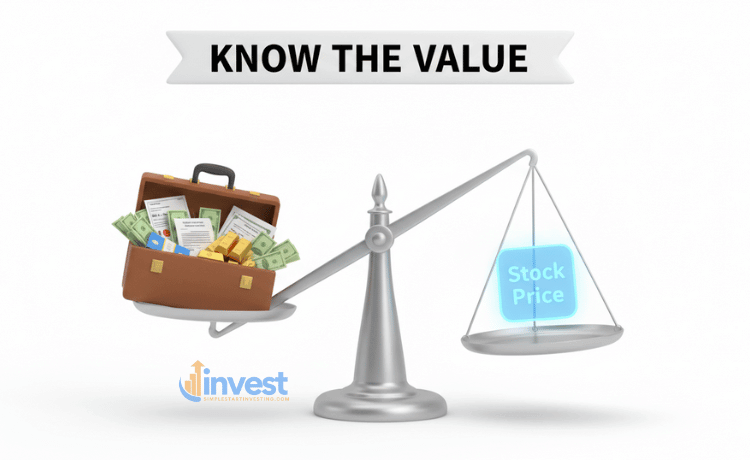
The Price to Book ratio is a reality check. It grounds the stock price in the physical reality of the company’s balance sheet.
How to use it today:
- Check the industry: Only use P/B to compare similar companies.
- Look for consistency: See if the company’s ratio has been stable over the last few years.
- Watch for extremes: Be careful with ratios that are extremely high (overvalued?) or extremely low (value trap?).
- Combine with other metrics: Never buy a stock based only on its Price to Book ratio. Look at its debt and its earnings too.
By understanding the value of a company’s “stuff,” you become a more disciplined investor who doesn’t just chase the latest trend. You are looking at the foundation, ensuring that the company you own has the strength to stand the test of time.
Note: Financial regulations and accounting standards (set by the SEC and IRS) can change over time, affecting how companies report their assets. Always check the latest guidelines or consult with a certified financial professional before making significant investment decisions.
Disclaimer: This content is for educational purposes only and does not constitute financial advice.