Choosing the right protection for your family can feel like navigating a maze without a map. Most people realize they need some form of safety net, but as soon as they start looking, they are hit with confusing terms like “premiums,” “cash value,” and “dividends.” At the heart of this confusion is the classic debate: should you get Term Life Insurance or Whole Life Insurance?
Getting this decision wrong isn’t just a minor paperwork error. For many American families, picking the wrong policy can mean overpaying by thousands of dollars every year for coverage that doesn’t actually fit their needs. In this guide, we are going to strip away the jargon and look at the simple reality of how these two options work so you can protect your loved ones with confidence.
Term Life Insurance is often described as the “purest” form of insurance because it does exactly one thing: it pays your family a set amount of money if you pass away during the time you are covered. It is straightforward, affordable, and easy to understand. But why do so many people end up with more expensive policies they don’t need? Let’s dive into the details.
What is Term Life Insurance?
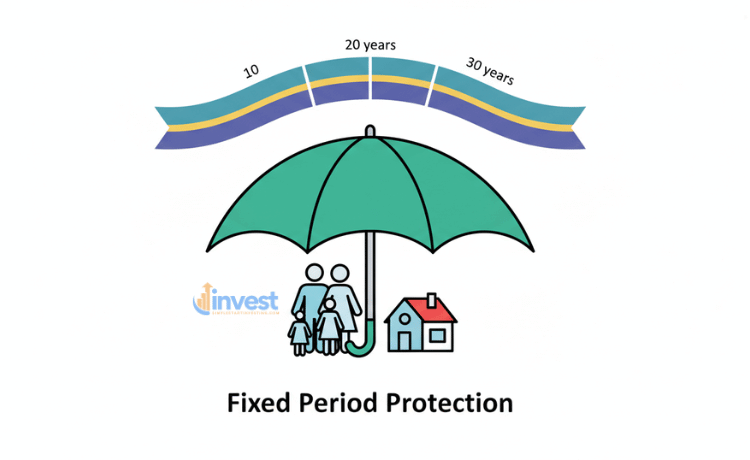
Think of Term Life Insurance like renting a house. You pay a monthly fee (the premium) to live in the house (the coverage) for a specific amount of time, such as 10, 20, or 30 years. If that time period ends and you are still healthy, the “lease” is up, and the coverage stops. You don’t get your rent back, but you had the protection of a roof over your head the whole time.
How it works in plain English
This type of insurance is designed to cover a specific “term” or window of your life when your financial responsibilities are at their highest. For most people, this is the period when they are raising children, paying off a mortgage, or building their career. You choose a death benefit (the amount paid to your family) and a length of time, and the price stays exactly the same for that entire period.
Real-world American example
Imagine Sarah, a 32-year-old manager at a company like Walmart or Costco. She just bought a home with a 30-year mortgage and has two young children. Sarah buys a 30-year Term Life Insurance policy with a one-million-dollar death benefit. Her monthly payment is roughly 50 dollars. If anything happens to Sarah during those 30 years, her family receives that million dollars tax-free to pay off the house and fund the kids’ college. If she reaches age 62 healthy, the policy simply ends.
The common beginner mistake
A common mistake beginners make is thinking that “renting” insurance is a waste of money because you don’t get a check back at the end. They feel like they “lost” the money they paid in premiums if they didn’t die during the term.
The mindset shift
You must view insurance as a tool for risk management, not a savings account. You don’t feel “cheated” when your car insurance doesn’t pay out because you didn’t get into a wreck, or when your house doesn’t burn down. Term Life Insurance is there to provide high-value protection at a low cost during your most vulnerable years. Its purpose is to disappear once your kids are grown and your house is paid off.
What is Whole Life Insurance?
If term insurance is like renting, Whole Life Insurance is more like a high-cost “rent-to-own” arrangement that lasts your entire life. As long as you keep paying the premiums, the policy never expires. It also includes a “savings” component called cash value, which is why agents often pitch it as an investment.

How it works in plain English
Whole life is a type of permanent insurance. It combines a death benefit with a separate account that builds value over time. Part of your much higher monthly payment goes toward the insurance, part goes toward the insurance company’s overhead and commissions, and a small remaining portion goes into a “cash value” account that grows at a guaranteed rate.
Real-world American example
Let’s look at Mike, a 30-year-old who works at Amazon. Mike is told by an agent that he should buy a Whole Life policy because it “builds wealth.” Instead of paying 40 dollars a month for a term policy, Mike pays 450 dollars a month for the same amount of coverage. The agent explains that in 20 years, Mike will have a “cash value” of sixty thousand dollars that he can borrow against. Mike feels like he is “investing” while being insured.
The common beginner mistake
Beginners often fall for the “forced savings” narrative. They believe that because they are “getting something back,” it is a better deal than term insurance. They don’t realize that the fees and commissions inside a whole life policy are so high that it often takes ten to fifteen years just for the cash value to equal the amount of money they have paid in.
The mindset shift
The reality is that you are paying a massive premium for a mediocre investment. If Mike had taken the 410-dollar difference (the 450-dollar whole life premium minus the 40-dollar term premium) and simply put it into a low-cost index fund or bought shares in stable companies like Apple (AAPL) or Microsoft (MSFT), he would likely have significantly more than sixty thousand dollars after 20 years. Mixing insurance with investing usually results in a product that does neither job very well.
The Massive Gap in Cost
One of the most important things for a beginner to understand is the sheer scale of the price difference. Because Whole Life is guaranteed to pay out eventually (since everyone dies) and includes a savings account, it is exponentially more expensive than Term Life Insurance.
Breaking down the numbers (The Logic of Cost)
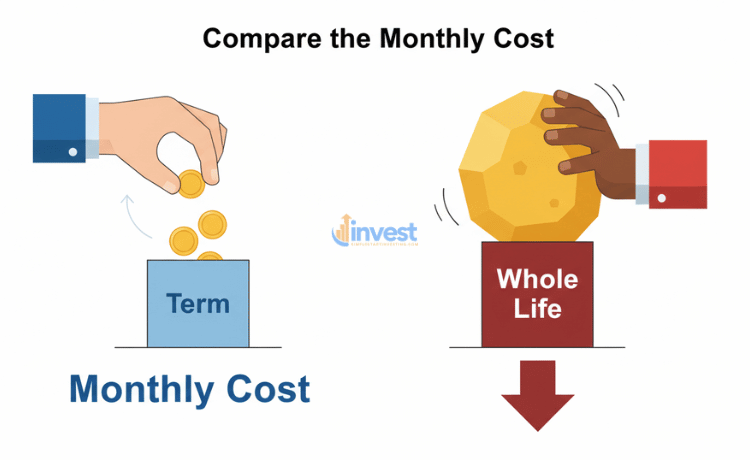
Imagine two siblings, John and Mary. John chooses a 20-year term policy for five hundred thousand dollars and pays 30 dollars a month. Mary chooses a whole life policy for the same five hundred thousand dollars and pays 350 dollars a month.
In just one year, Mary has spent 4,200 dollars, while John has spent only 360 dollars. Mary has spent nearly 4,000 dollars more than her brother for the exact same amount of protection for her family today.
The “Opportunity Cost” mistake
Many people forget about “opportunity cost”—the money you lose by not being able to use those extra dollars elsewhere. If Mary struggles with high-interest credit card debt or hasn’t filled her 401k at work, that extra 4,000 dollars a year is a heavy burden.
The logic adjustment
For the average American, the goal of life insurance is to replace your income so your family can survive without you. By choosing Term Life Insurance, you free up hundreds of dollars every month. That “saved” money can be used to pay off your mortgage faster, contribute to your Roth IRA, or build an emergency fund. You are essentially “self-insuring” over time by building actual wealth instead of letting an insurance company manage it for you.
Why “Cash Value” Can Be Misleading
The “cash value” component is the most marketed feature of permanent insurance, but it is also the most misunderstood. It sounds great on paper: your money grows tax-deferred, and you can take loans against it. However, the fine print often reveals a different story.

The hidden reality of loans
If you want to access the cash value in your policy, you aren’t just withdrawing “your” money like a bank account. You are usually taking a loan from the insurance company, using your cash value as collateral. This means you have to pay interest back to the company on your own money.
What happens to the cash when you die?
This is the biggest shock for most beginners. In a standard whole life policy, if you die, your family receives the death benefit (the face value), but the insurance company often keeps the cash value you worked so hard to build.
For example, if you have a five-hundred-thousand-dollar policy and fifty thousand dollars in cash value, your beneficiaries get five hundred thousand dollars. The fifty thousand dollars essentially disappears into the insurance company’s pocket.
How to think about it correctly
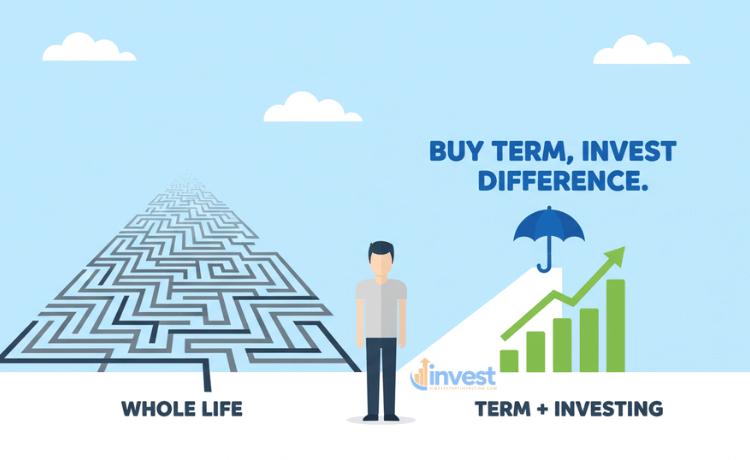
Compare this to Term Life Insurance plus a separate brokerage account. If you have a five-hundred-thousand-dollar term policy and fifty thousand dollars in a Vanguard or Fidelity account, your family gets both. They get the insurance payout AND the fifty thousand dollars in your investment account. This is why the strategy of “Buy Term and Invest the Difference” is a cornerstone of modern personal finance.
When Does Whole Life Actually Make Sense?
While Term Life Insurance is the right choice for about 95% of people, Whole Life and other permanent policies aren’t “scams”—they are specialized tools. They are designed for very specific, high-net-worth situations that don’t apply to most beginners.
The 2026 Estate Tax Landscape
This year, the rules for estate taxes are changing. The amount of money you can pass on to your heirs tax-free is expected to drop significantly. Under the new guidelines, estates worth more than roughly 7 million dollars (for individuals) may face heavy federal taxes.
High-net-worth protection
For families with multi-million dollar estates, a permanent life insurance policy can be used to provide “liquidity.” This means when the person passes away, the insurance payout provides the cash needed to pay the IRS so the family doesn’t have to sell off a family business or a piece of valuable real estate in a hurry.
The “Beginner’s Trap”
The mistake is when a middle-class family with a normal income is sold a permanent policy under the guise of “estate planning” or “tax strategy.” If your total net worth is not in the several-millions range, you likely do not have an estate tax problem that requires an expensive whole life policy. For most, the primary “tax strategy” should be using a 401k, a Roth IRA, or a Health Savings Account (HSA) before even considering insurance as an investment.
How to Choose the Right Policy for You
Now that you understand the mechanics, how do you actually make the call? For most people starting their financial journey, simplicity is your best friend.
Step 1: Calculate your “Need”
Don’t let an agent tell you how much you need. Look at your life. If you have 200,000 dollars left on your mortgage, 50,000 dollars in student loans, and you want to leave 200,000 dollars for your child’s future, you need at least 450,000 dollars in coverage. A common rule of thumb is 10 to 12 times your annual income.
Step 2: Match the “Term” to the “Responsibility”
If your youngest child is two years old, you need coverage for at least 20 years. If you just signed a 30-year mortgage, a 30-year term makes sense. You want the insurance to “expire” exactly when the financial burden is gone.
Step 3: Check your health
Insurance companies look at your health data (and sometimes your driving record) to set your price. Since you are likely younger and healthier now than you will be in ten years, locking in a low-rate Term Life Insurance policy today is a smart move.
Step 4: Shop around
Prices vary wildly between companies. Don’t just go with the first quote you get. Use an independent broker or an online comparison tool to see rates from multiple high-rated carriers. Look for companies with an “A” rating or better from agencies like A.M. Best.
Final Thoughts: Simplicity Wins
In the world of finance, complex products are usually designed to benefit the person selling them more than the person buying them. Term Life Insurance is simple, transparent, and incredibly effective. It does one job—protecting your family—and it does it at a price that allows you to actually save and invest for your future.
Whole life insurance has its place in complex estate planning for the very wealthy, but for the rest of us, it often acts as an expensive anchor that slows down our progress. By choosing term, you are choosing to stay in control of your money. You are choosing to protect your family today while building a life where, one day, you won’t need insurance at all because you’ll have plenty of wealth of your own.
Disclaimer: This content is for educational purposes only and does not constitute financial advice. Regulations regarding insurance and taxes can change; please check current guidelines or consult with a licensed professional before making financial decisions.