Imagine you are looking at two neighbors who both drive luxury SUVs. One neighbor paid for the car in cash using years of savings. The other neighbor took out a massive loan with high monthly payments that eat up half their paycheck.
On the outside, both look successful. But if they both lost their jobs tomorrow, the second neighbor would be in serious trouble. The same logic applies to the stock market. Some companies grow using their own profits, while others rely heavily on borrowed money.
To tell the difference, smart investors look at the Debt-to-equity ratio. This simple but powerful tool helps you see behind the shiny exterior of a company’s stock price. It reveals whether a business is standing on solid ground or sinking under the weight of its own debts.
In this guide, we will break down what the Debt-to-equity ratio is, why it matters for your portfolio, and how to spot red flags before you invest your hard-earned money.
What is the Debt-to-Equity Ratio in Simple Terms?
At its core, the Debt-to-equity ratio is a way to measure how a company pays for its operations and growth. Every business needs money to run. They can get this money from two main places: borrowing it (Debt) or using money from owners and investors (Equity).
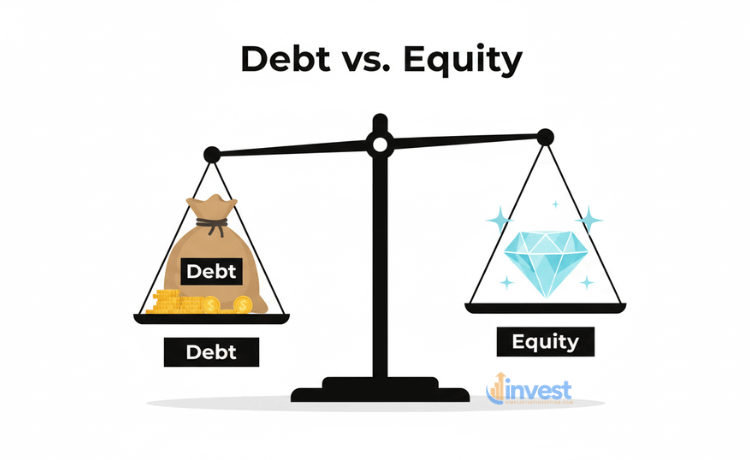
Think of a company like a house. The “Debt” is the mortgage you owe to the bank. The “Equity” is the portion of the house you actually own—the down payment you made plus any value that has increased over time.
The Debt-to-equity ratio tells you how much of the company is “mortgaged” compared to how much is truly owned by shareholders. If a company has high debt relative to its equity, it is “highly leveraged.” This means it is using a lot of borrowed money to fuel its business.
A Real-World Example
Let’s look at a fictional company called “Quick-Tech.” If Quick-Tech has 1 million dollars in total debt and 1 million dollars in shareholder equity, its ratio is 1. This means for every 1 dollar of their own money, they have borrowed 1 dollar.
Now, imagine “Mega-Retail” has 4 million dollars in debt but only 1 million dollars in equity. Its ratio is 4. For every 1 dollar of its own money, it has borrowed 4 dollars. Mega-Retail is much more dependent on lenders than Quick-Tech.
The Beginner’s Misconception
Many new investors see the word “Debt” and immediately think it is a bad sign. They assume a company with zero debt is always a better investment than one with some debt.
The Financial Reality
Debt is a tool. Just like a student loan can help you earn a higher salary later, a business loan can help a company build a new factory that generates more profit. The goal isn’t necessarily to have zero debt, but to have a manageable amount of debt that the company can easily pay back.
Why Should You Care About This Ratio?
You might wonder why you can’t just look at a company’s profit. While profit is important, the Debt-to-equity ratio tells you about the risk behind that profit.
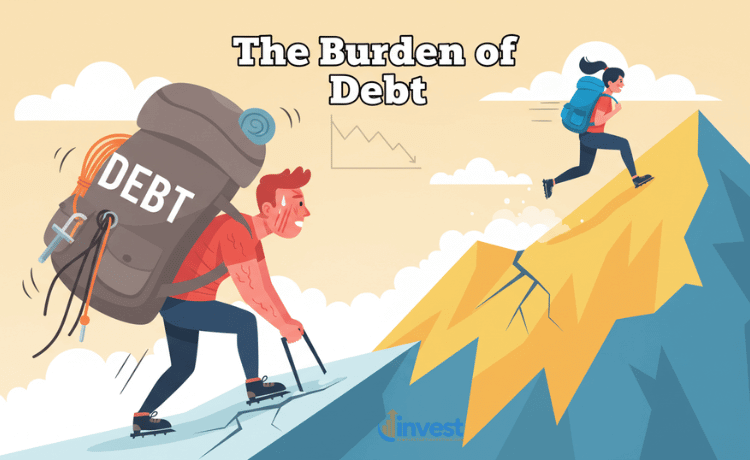
If the economy takes a downturn, companies with massive debts still have to make their interest payments. If they can’t pay, they might go bankrupt. On the other hand, a company with very little debt can survive a “rainy day” much more easily.
During times when interest rates are high, as we have seen recently in the US market, debt becomes more expensive. Companies that need to borrow more money or “roll over” their existing debt will face higher costs, which can eat into their profits.
A Hypothetical Scenario
Suppose you are looking at two fast-food chains. Chain A has almost no debt. Chain B has a high Debt-to-equity ratio because it borrowed heavily to open 100 new locations last year.
If a recession hits and people stop eating out, Chain A can just slow down and wait for things to improve. Chain B, however, still owes millions to the bank every month. If they can’t make those payments, the bank could take over, and your stock value could go to zero.
How to Calculate the Ratio (Without Complex Math)
You don’t need a PhD in finance to find this number. In fact, most financial websites like Yahoo Finance or Google Finance calculate it for you. But understanding the logic is vital.
To find the Debt-to-equity ratio, you only need two numbers from a company’s Balance Sheet: Total Liabilities and Total Shareholders’ Equity.
The Logical Steps
- Find the Total Liabilities: This is everything the company owes to others (loans, unpaid bills, bonds).
- Find the Shareholders’ Equity: This is the value left for owners after all debts are paid off.
- Divide the first number by the second.
For example, if a company has 200 dollars in total liabilities and 100 dollars in equity, the ratio is 2. This tells you that for every 1 dollar the owners have put in, the company has borrowed 2 dollars.

If the numbers were flipped—100 dollars in debt and 200 dollars in equity—the ratio would be 0.5. This indicates a much more conservative and potentially safer financial structure.
The Beginner’s Misconception
Newbies often confuse “Total Assets” with “Equity.” They might think that if a company has 1,000 dollars in buildings and equipment (assets), it is rich.
The Financial Reality
Assets don’t matter as much if they were all bought with borrowed money. If you have a 1,000 dollar laptop but you owe 900 dollars on your credit card for it, your “Equity” is only 100 dollars. The Debt-to-equity ratio focuses on that relationship between what is owed and what is truly owned.
What is a “Good” Debt-to-Equity Ratio?
This is the most common question, and the answer is: “It depends on the industry.”
A “good” ratio for a tech company like Apple (AAPL) is very different from a “good” ratio for a utility company that provides electricity to a whole state. This is where many beginners make their biggest mistakes in stock research.
Comparing Industries
Capital-intensive industries require massive amounts of money upfront to build infrastructure. Think of airlines, car manufacturers like Tesla (TSLA) or Ford, and utility companies. These businesses almost always have a higher Debt-to-equity ratio because they must borrow to buy planes, build factories, or lay power lines.
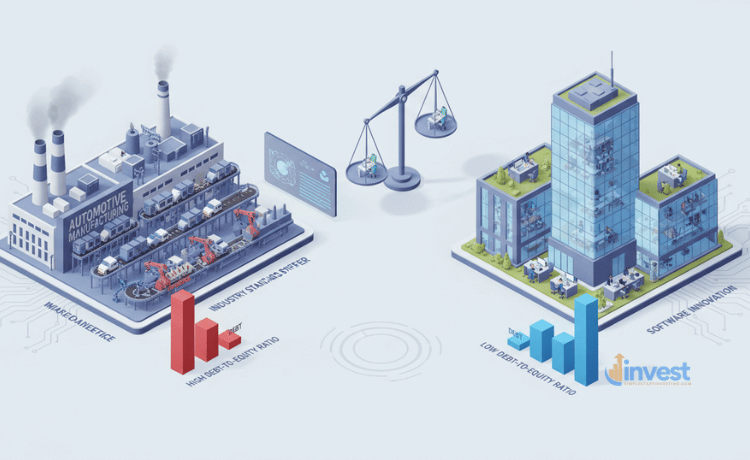
In contrast, software or service companies like Microsoft (MSFT) or consulting firms have lower overhead. They don’t need to build massive factories, so they often have much lower ratios—sometimes even close to zero.
The Beginner’s Misconception
An investor might compare a utility company with a ratio of 2.0 to a tech company with a ratio of 0.5 and conclude that the tech company is “safer.”
The Financial Reality
The utility company might have very predictable, steady income because everyone needs electricity. They can handle a ratio of 2.0 easily. The tech company might be in a volatile market where profits disappear overnight. A “safe” ratio is one that is normal or slightly better than the company’s direct competitors.
Red Flags to Watch For
When you are using the Debt-to-equity ratio to screen stocks, you should look for specific warning signs. These are the “smoke” that might indicate a fire in the company’s finances.
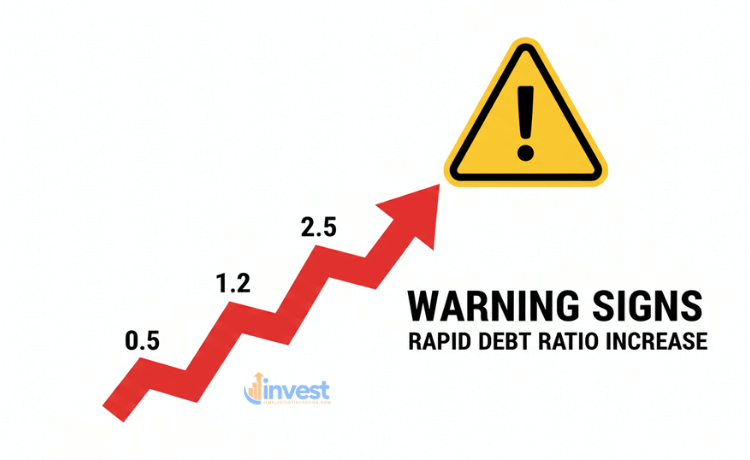
1. A Rising Trend
If a company’s ratio was 0.5 three years ago, then 1.0 last year, and is now 1.8, you should ask why. Is the company borrowing more because it is expanding aggressively, or is it borrowing just to keep the lights on because profits are falling?
2. Much Higher Than Peers
Always compare a company to its “cousins.” If most grocery stores like Walmart or Costco have a ratio around 0.6, but a new grocery chain has a ratio of 3.0, that company is taking a much bigger risk. One bad holiday season could put them out of business while the others survive.
3. Negative Equity
Sometimes you will see a company with a negative Debt-to-equity ratio. This usually happens when a company has lost so much money over the years that its liabilities are actually greater than its assets. This is often a massive red flag and a sign that the company may be on the verge of collapse.
How to Check This Yourself
Checking the Debt-to-equity ratio is easier than checking your own credit score. You don’t need to do the math yourself because the data is public and widely available.
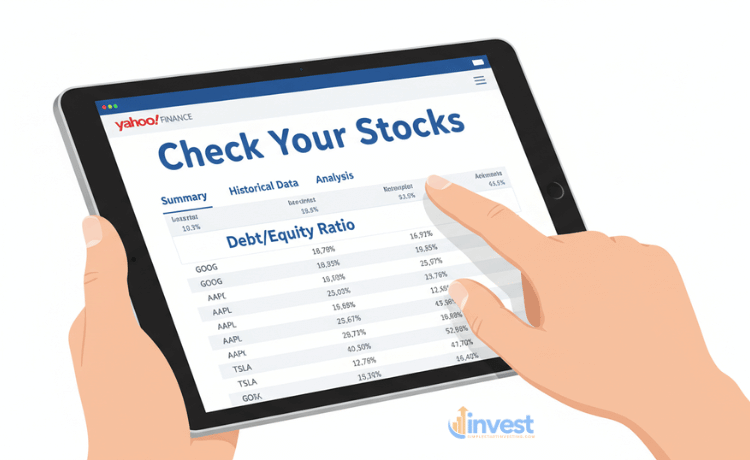
Steps to Follow:
- Go to a site like Yahoo Finance or MSN Money.
- Type in a stock ticker symbol, like AMZN for Amazon or JPM for JPMorgan Chase.
- Look for the “Statistics” or “Key Statistics” tab.
- Scroll down until you see “Total Debt/Equity (mrq)”—the “mrq” just stands for “most recent quarter.”
If you see a number like 120.50, it usually means 120%. In our decimal format, that is 1.2. If you see 45.00, that is 0.45.
The Beginner’s Misconception
Many beginners check this number once and then never look at it again. They assume that if it’s “good” today, it will stay “good” forever.
The Financial Reality
Companies change. They might take on a huge loan to acquire a competitor or buy back their own shares. Smart investors check this ratio at least once a year, or whenever the company releases its annual report, to make sure the “load” isn’t getting too heavy.
Using Debt to Fuel Growth: The AI Example
Right now, many of the biggest companies in the US are spending billions of dollars on Artificial Intelligence (AI). This requires buying expensive computer chips and building massive data centers.
Companies like the “Magnificent 7” (which includes names like Nvidia, Alphabet, and Meta) have historically kept very healthy Debt-to-equity ratios. However, as they spend more on AI infrastructure, investors are watching their debt levels closely.
If a company borrows money to invest in AI and that AI leads to huge new profits, the debt was a smart move. But if they borrow billions and the AI doesn’t make money, they will be left with a high Debt-to-equity ratio and nothing to show for it.
As a beginner, you want to see that the company’s “Equity” (its own value) is growing alongside its “Debt.” If the debt is growing but the equity is staying the same, the company is becoming riskier.
Summary: Your Checklist for Success
The Debt-to-equity ratio is your financial “X-ray.” It lets you see if a company’s bones are strong enough to support its weight. Before you buy your next stock, remember these key points:
- Low isn’t always best: Some debt is necessary for growth, especially in industries like utilities or manufacturing.
- Context is king: Always compare a company’s ratio to its industry peers.
- Watch the trend: Is the company becoming more or less dependent on debt over time?
- Safety first: In a volatile economy, companies with lower debt relative to their equity generally have a higher chance of survival.
Investing is about balancing potential rewards with potential risks. By checking the Debt-to-equity ratio, you are taking a major step toward becoming a more disciplined and successful investor.
Note: Regulations regarding financial reporting (SEC) and tax treatments of debt (IRS) can change. Always check for current guidance or consult with a professional financial advisor.
Disclaimer: This content is for educational purposes only and does not constitute financial advice.