
Have you ever looked at your bank account and felt a sense of peace seeing a large balance sitting there? Most of us were raised to believe that keeping cash in a savings account is the ultimate sign of financial responsibility. It feels safe, accessible, and stable. However, there is a silent predator in the world of finance that thrives on that very sense of safety. It is called cash drag, and if you are not careful, it can quietly shave years off your retirement or thousands of dollars off your long-term wealth.
In the world of investing, cash is often seen as a double-edged sword. While you need some of it for emergencies, holding too much of it can lead to a significant loss in potential earnings. This article is designed to help you understand why your “safe” pile of money might be doing more harm than good and how you can strike the perfect balance to keep your financial journey on track.
What Exactly Is Cash Drag?
To understand cash drag, think of a high-performance sports car trying to win a race while towing a heavy boat. The car is your investment portfolio, and the heavy boat is the excess cash sitting on the sidelines. Even if the car has a powerful engine, that extra weight is going to slow it down, making it impossible to reach top speed.
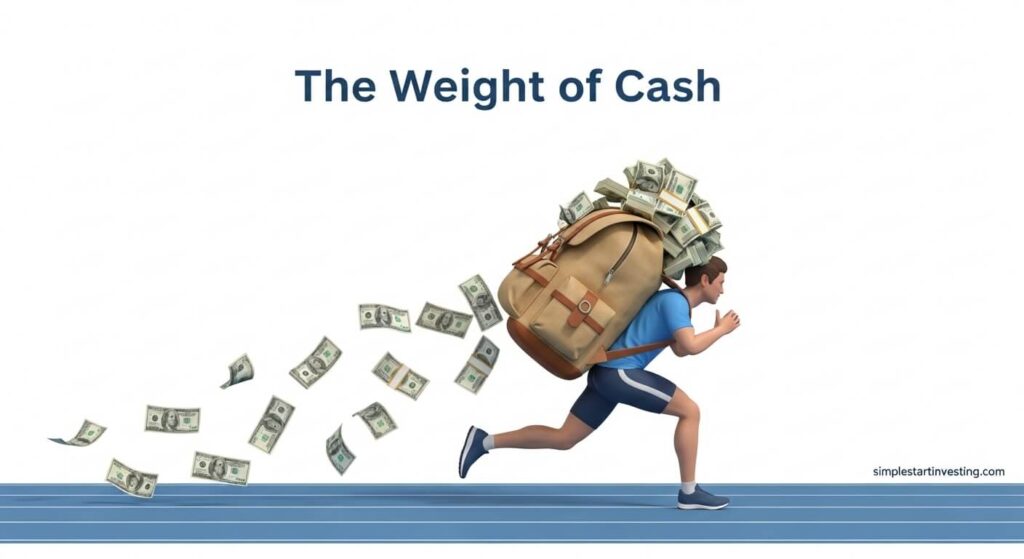
In financial terms, cash drag is the reduction in your total portfolio returns because a portion of your money is held in cash rather than being invested in assets like stocks, bonds, or real estate. Because cash generally earns very little interest compared to the historical growth of the stock market, every dollar sitting idle is a dollar that isn’t working for you.
For a beginner, this might seem like a small issue. You might think, “It is only a few thousand dollars, what is the big deal?” But over ten, twenty, or thirty years, the difference between a fully invested portfolio and one with significant cash drag can be the difference between retiring comfortably and having to work several extra years.
Why Do We Fall Into the Cash Trap?
Most beginners suffer from cash drag not because they are lazy, but because they are cautious. It often stems from a few very human emotions and common misunderstandings about how money works in the US market.
The Fear of “Losing It All”
The stock market can be volatile. We see headlines about “market crashes” or “economic downturns,” and our natural instinct is to hoard cash. We feel that if the money is in a bank account, it is safe from the “scary” market. However, this is a misunderstanding of risk. While the market goes up and down in the short term, the long-term risk of cash is almost guaranteed: it will lose purchasing power.
Waiting for the “Perfect Time”
Many new investors fall into the trap of market timing. They tell themselves, “I will wait for the market to drop ten percent, and then I will invest my ten thousand dollars.” Weeks turn into months, and months turn into years. While they wait for a dip that may never come, the market continues to climb. The growth they missed out on while waiting is often much larger than the discount they hoped to get.
Forgetting About “Dry Powder”
Some people keep extra cash because they want “dry powder” to jump on opportunities. While having a little bit of opportunistic cash is a strategy used by pros, beginners often keep way too much. If thirty percent of your money is waiting for an “opportunity” for three years, you have missed three years of dividends and compounding growth on nearly a third of your wealth.
The Silent Thief: How Inflation Fuels Cash Drag
One of the biggest reasons cash drag is so dangerous is something called inflation. If you think your cash is “breaking even” by sitting in a bank, you are actually losing money every single day.
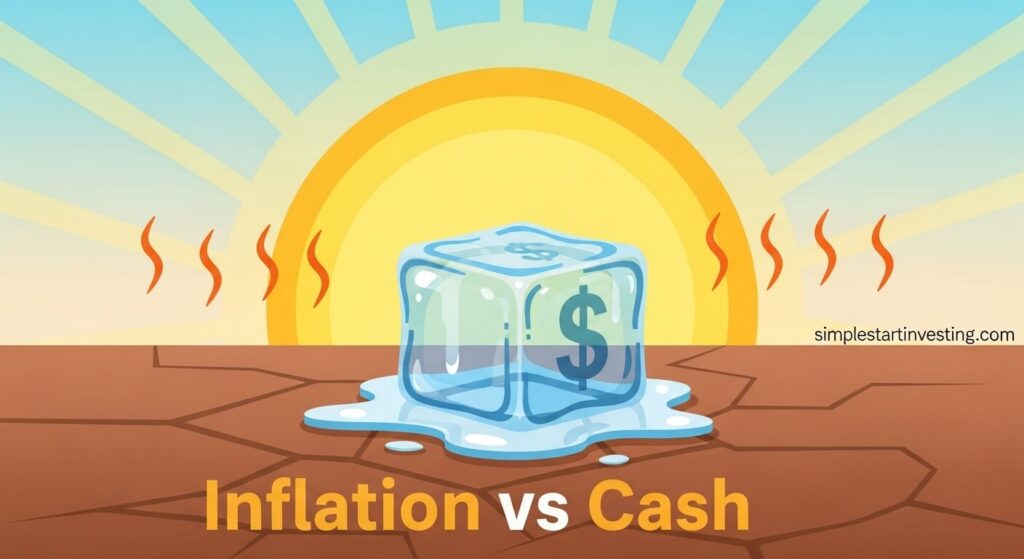
Imagine you have 100 dollars under your mattress. If the cost of groceries and gas goes up by five percent this year, that 100 dollars can now only buy 95 dollars’ worth of goods. Your balance stayed the same, but your wealth decreased. This is why “safe” cash is actually a guaranteed loss in purchasing power over time.
When you invest that money, you are looking for a return that beats inflation. If the market returns seven percent and inflation is three percent, you are actually “growing” by four percent. If you keep it in a standard savings account earning almost zero interest, you are effectively “shrinking” by three percent every year. When you add that loss to the missed gains of the stock market, the cash drag becomes a massive financial burden.
Is Your Emergency Fund Part of the Problem?
Let’s clear up one big misconception: having an emergency fund is NOT cash drag. Every financial expert in the US will tell you that you need a safety net. This is usually three to six months of your essential living expenses kept in a liquid, safe place like a High-Yield Savings Account (HYSA).

The problem starts when your “emergency fund” starts to look more like a “mountain of cash.” If you need 20,000 dollars for a solid six-month safety net, but you are keeping 80,000 dollars in your savings account “just in case,” that extra 60,000 dollars is creating severe cash drag.
The key is to define your emergency number clearly. Once you hit that goal, every dollar after that should be assigned a job in your investment portfolio. Your emergency fund is your insurance; anything beyond that is an idle employee who isn’t doing their work.
How Cash Drag Sneaks Into Your Retirement Accounts
You might think that because you have a 401k or an IRA, you are safe from cash drag. Unfortunately, this is where many beginners make their costliest mistake.
In many retirement plans, when you contribute money from your paycheck, it doesn’t always get invested automatically. Sometimes, it just sits in a “settlement fund” or a “money market fund” which is essentially cash. We have seen people contribute to their accounts for years, only to log in and realize their balance hasn’t grown because they never actually chose their investments.
This is the ultimate form of cash drag. You did the hard work of saving the money and moving it into a tax-advantaged account, but because of a missed click, that money sat idle for years. Always double-check that your contributions are actually buying shares of the index funds or ETFs you intended to own.
The Math of Doing Nothing: A Simple Example
Let’s look at how this works in the real world without using any complex formulas. We will just use logic and simple numbers.
Imagine two friends, Sarah and Mark. Both have 50,000 dollars to start their journey.
Sarah decides to be fully invested. She keeps a small emergency fund separate and puts her 50,000 dollars into a total stock market index fund. If the market earns an average of 10 percent a year, after one year, her 50,000 dollars has grown by 5,000 dollars. She now has 55,000 dollars.
Mark is nervous. He decides to keep half of his money, 25,000 dollars, in a basic savings account earning nearly zero, and invests the other 25,000 dollars. After one year, his invested half grows by 2,500 dollars (10 percent of 25,000). His cash half is still just 25,000 dollars. His total is now 52,500 dollars.
In just one year, Mark’s cash drag cost him 2,500 dollars. If this continues for twenty years, the gap between Sarah and Mark won’t just be a few thousand dollars; it will be hundreds of thousands. This happens because Sarah is earning “interest on her interest” (compounding) on the full amount, while Mark is only compounding on half.
Common Misconceptions About Holding Cash
As you navigate your early investing years, you will hear a lot of conflicting advice. Let’s debunk some of the myths that lead to cash drag.
“Cash is King”
You will hear this phrase often during market volatility. While cash is great for buying things when they are cheap, it is only “King” if you actually use it to buy. If you hold it forever because you are scared the market will go lower, the king loses his crown to inflation. For most beginners, “Time in the market” is much more important than “Timing the market.”
“I’ll Wait for the Recession”
People have been predicting recessions every year for decades. If you sat in cash in 2021 waiting for a crash, you missed the massive gains of that year. Even if a crash happens later, the market often rises so much before the crash that the “bottom” of the crash is still higher than the price was when you first started waiting.
“My Savings Account Pays 4 Percent”
High-Yield Savings Accounts (HYSAs) are great right now compared to the past decade. However, 4 percent is still often lower than the long-term average of the stock market. More importantly, if inflation is also high, your “real” gain is much smaller than it looks. A savings account is a place to hide, not a place to grow.
Strategic Ways to Minimize Cash Drag
Now that we know the enemy, how do we fight it? Avoiding cash drag doesn’t mean being reckless. It means being intentional.
Use Dollar-Cost Averaging (DCA)
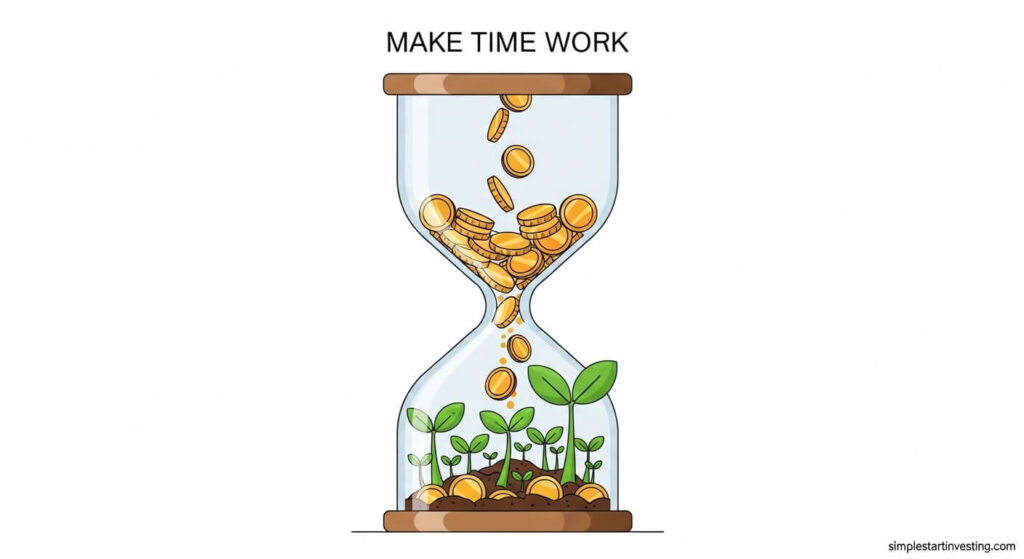
If you have a large sum of cash and you are too scared to put it all in at once, don’t just let it sit there. Set up an automatic plan to invest a certain amount every week or every month. This gets your money moving and takes the emotion out of the decision. Even if the market goes down, you are buying more shares at a lower price.
Automate Your Contributions
The best way to avoid cash drag in your 401k or IRA is to set it and forget it. Ensure your “automatic investment” feature is turned on so that as soon as your paycheck hits the account, it immediately buys your chosen funds.
Rebalance Your Portfolio
Once or twice a year, look at your “Asset Allocation.” If you decided you wanted 90 percent stocks and 10 percent bonds/cash, but over time your cash has grown to 20 percent because you were afraid to click “buy,” it is time to rebalance. Sell the excess “weight” and put it into your growth assets.
Dividend Reinvestment (DRIP)
Many stocks and funds pay dividends (a small share of the company’s profits). If you don’t have “Dividend Reinvestment” turned on, that money sits in your account as cash. This is a subtle form of cash drag. By turning on “DRIP,” those small payments are immediately used to buy more shares, keeping your money 100 percent at work.
Understanding Your Personal “Cash Comfort” Level
Everyone has a different tolerance for risk. Some people can sleep soundly with zero extra cash, while others need a little “buffer” to feel okay. The goal of avoiding cash drag isn’t to make you lose sleep; it is to make sure you aren’t paying a “fear tax” that is higher than it needs to be.
If keeping an extra 5,000 dollars in cash prevents you from panicking and selling all your investments during a market dip, then that 5,000 dollars is serving a psychological purpose. However, you must recognize that this is a choice with a cost.
Ask yourself: “Is this cash for a specific purpose (like a house down payment in two years) or is it just sitting here because I’m undecided?” If the answer is “undecided,” you are likely suffering from cash drag.
The Opportunity Cost of Hesitation
In finance, we call the cost of a missed opportunity the “Opportunity Cost.” When you choose to hold cash, your opportunity cost is the return you could have had in the market.

For many beginners in the US, the stock market is the most accessible wealth-building tool in history. Through low-cost index funds that track companies like Apple, Microsoft, or Amazon, you can participate in the growth of the entire economy. When you hold excess cash, you are voluntarily opting out of that growth.
Think of your financial life as a ladder. Every year you wait to fully invest is like removing a few rungs from the top of that ladder. You can still climb, but you won’t get nearly as high.
Summary for the Simple Start Investor
To wrap things up, let’s look at the simple steps you can take today to eliminate unnecessary cash drag:
- Define your Emergency Fund: Calculate exactly how much you need for six months of bills. Put that in a High-Yield Savings Account and don’t touch it.
- Audit your accounts: Log into your 401k, IRA, or brokerage account. Is there money sitting in “Cash,” “Money Market,” or “Settlement Funds”? If so, decide on an investment and put that money to work.
- Turn on DRIP: Ensure your dividends are being automatically reinvested.
- Stop timing the market: Accept that you cannot predict the future. Consistent investing beats “waiting for a dip” almost every single time.
- Check your “Extra” Cash: If you have more than your emergency fund in a checking account, ask yourself why. If you don’t need it for a purchase in the next year or two, it probably belongs in your investment portfolio.
Investing is a marathon, not a sprint. By reducing your cash drag, you are ensuring that you are running that marathon with the best possible gear and the lightest possible load. Your future self will thank you for the growth you captured today.
Disclaimer: This content is for educational purposes only and does not constitute financial advice. Market investments involve risk, and past performance is not indicative of future results. Please consult with a qualified financial professional before making significant investment decisions.