Investing in fractional shares is perhaps the single biggest game-changer for regular people wanting to build wealth today. For a long time, the stock market felt like an exclusive club with a very expensive velvet rope at the entrance. If you wanted to own a piece of a powerhouse company like Amazon or Costco, you often needed hundreds or even thousands of dollars just to buy a single share. If you didn’t have that much cash sitting around, you were stuck on the sidelines.
Thankfully, those days are over. This year, the walls have come down. You no longer need to save up for months just to buy one unit of a high-priced stock. Through the power of investing in fractional shares, you can start owning the world’s most successful companies with as little as one dollar. This shift has turned the stock market from a rich person’s playground into a tool that anyone with a smartphone and a bit of spare change can use.
In this guide, we are going to pull back the curtain on how this works. We will look at why you don’t need a fortune to get started, how your money actually grows when you own just a tiny “slice” of a company, and the common traps beginners fall into when they first start “slicing” their investments.
What Exactly is a Fractional Share?
To understand investing in fractional shares, we first need to understand what a “whole” share is. Think of a company like a giant pie. When a company “goes public,” they cut that pie into millions of pieces. Each piece is a share of stock. In the old days, you had to buy at least one full slice. If a single slice of Amazon cost 3,000 dollars, and you only had 100 dollars, you were out of luck. You couldn’t buy the slice, so you couldn’t eat the pie.
A fractional share is exactly what it sounds like: it is a “slice of a slice.” Instead of buying the whole piece of pie for 3,000 dollars, your brokerage allows you to buy a tiny crumb of it for whatever amount you can afford.
The Pizza Party Analogy
Imagine you and your friends go to a pizza place. A whole pepperoni pizza costs 20 dollars. You only have 5 dollars in your pocket. In a traditional world, the owner tells you that you can’t have any pizza because you don’t have enough for the whole thing.

But in a “fractional” world, the owner says, “No problem! I’ll give you exactly 5 dollars’ worth of pizza.” You get two small slices instead of the whole eight-slice pie. You are still eating the same quality pepperoni pizza as the guy who bought the whole tray; you just have a portion that fits your budget.
A Real-World Market Example
Let’s look at a company like Amazon, which often trades at a high price point. If the stock is currently priced at 3,000 dollars per share, and you decide to invest 30 dollars, you would own one-hundredth of a share.
If Amazon’s stock price goes up by 10 percent, the value of your tiny slice also goes up by 10 percent. Your 30 dollars would turn into 33 dollars. You get the exact same percentage of growth as a billionaire who owns a million shares. This is why investing in fractional shares is the ultimate equalizer in the financial world.
Why Beginners Often Get This Wrong
Many new investors hesitate to use fractional shares because they feel like owning “0.01” of a company isn’t “real” investing. This is a classic psychological trap.
The Common Misconception: Many beginners believe that they need to own “whole numbers” for their investment to count. They think, “What’s the point of owning 0.5 shares of Nvidia? I should wait until I have the full 900 dollars to buy a whole share so I can be a ‘real’ shareholder.”
The Reality Check: Waiting to buy a “whole share” is one of the biggest mistakes you can make. While you are busy saving up that 900 dollars, the stock price might climb to 1,200 dollars. By waiting, you missed out on all the growth that happened in the meantime.
Adjusting Your Mindset: In the world of wealth building, time is more important than the “cleanliness” of your share count. It is much better to have 100 dollars working for you right now in a fractional slice of a great company than to have that 100 dollars sitting in a shoebox waiting for “friends” so it can buy a whole share. The market doesn’t care if your share count has a decimal point; it only cares about how much capital you have invested and how long it stays there.
The Hidden Benefits: Why “Slices” are Better Than “Wholes”
Beyond just being cheaper, investing in fractional shares offers several strategic advantages that even wealthy investors use to stay ahead.
1. Instant Diversification
Diversification is a fancy word for “not putting all your eggs in one basket.” If you only have 500 dollars to invest and you have to buy whole shares, you might only be able to afford one or two companies. If one of those companies has a bad year, half of your money is in trouble.
With fractional shares, you can take that 500 dollars and split it across 50 different companies. You could put 10 dollars into Apple, 10 dollars into Tesla, 10 dollars into Walmart, and so on. If one company fails, it only represents a tiny fraction of your total wealth.

2. Perfect Dollar-Cost Averaging
Dollar-cost averaging is the practice of investing the same amount of money every month, regardless of whether the market is up or down.
If you decide to invest 200 dollars every payday, fractional shares make this easy. You don’t have to worry if the stock price is 150 dollars or 210 dollars. You just tell your broker, “Invest my 200 dollars,” and they will buy exactly 200 dollars’ worth of shares—even if that means buying 1.32 shares or 0.95 shares. Every penny of your 200 dollars goes to work immediately.
3. No “Leftover” Cash
When you are forced to buy whole shares, you often end up with “dead money” sitting in your account. For example, if you have 1,000 dollars and the stock you want costs 300 dollars, you can buy three shares for 900 dollars. But now you have 100 dollars just sitting there doing nothing because it isn’t enough to buy a fourth share. With fractional investing, you would simply buy 3.33 shares and put every single dollar to work.
How Does it Actually Work? (The Behind-the-Scenes)
You might wonder, “If the stock exchange only sells whole shares, how is my broker giving me a tiny piece?”
The truth is that the stock exchanges themselves (like the New York Stock Exchange) usually don’t deal in fractions. Your broker—the app or company you use to buy stocks—is the one doing the heavy lifting.
When you buy a fractional share, your broker often buys a whole share themselves and then virtually “sub-divides” it among their customers. If ten people all want to buy 0.1 shares of Apple, the broker buys one whole share and keeps track of who owns which 10 percent slice.
Common Mistake: Beginners sometimes worry that if the broker “owns” the whole share, the investor doesn’t actually own the stock.
The Reality: As long as you are using a reputable, regulated US broker, those fractional slices are legally yours. You are entitled to the economic benefits of ownership, such as the increase in price and your portion of any dividends the company pays out.
Dividends: Do You Still Get Paid?
One of the best parts of owning stocks is receiving dividends. A dividend is a small “thank you” payment a company sends to its shareholders, usually four times a year, just for owning the stock.
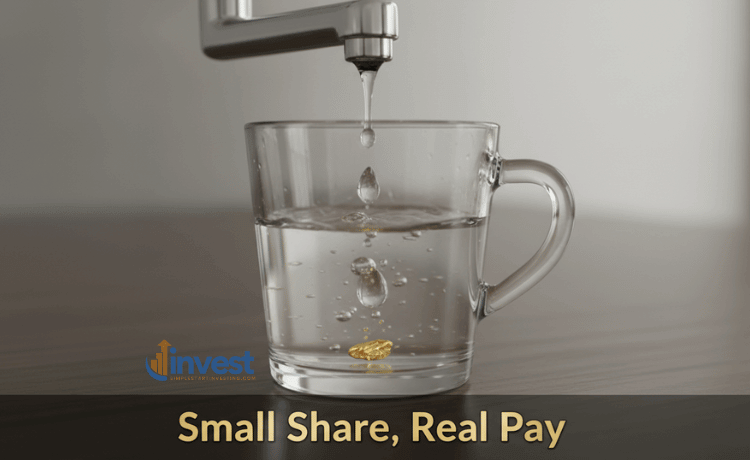
The Beginner Question: “If a company pays a dividend of 1 dollar per share, but I only own half a share, do I get nothing?”
The Simple Math (No Formulas): The answer is that you get your fair share. Everything is proportional. If you own exactly half of a share, and the company pays out a 1 dollar dividend for every whole share, the broker will deposit 50 cents into your account. If you own one-tenth of a share, you get 10 cents.
This is incredibly powerful because most modern brokers allow you to “reinvest” those tiny dividend payments automatically. Your 10-cent dividend can be used to buy even more fractional shares, creating a snowball effect of wealth over time.
Are There Any Downsides?
While investing in fractional shares is mostly positive, you should be aware of a few technical “catches” that often surprise beginners.
1. The Transfer Problem
In the US, there is a system called ACATS that allows you to move your stocks from one broker to another (like moving from Robinhood to Fidelity). Most brokers can only move whole shares through this system.
If you have 5.5 shares of a company and you want to switch brokers, the 5 whole shares will move over easily. However, the 0.5 fractional share usually has to be sold for cash, and that cash is then sent to your new account. This isn’t a huge problem, but it can trigger a small “taxable event” because you technically sold a piece of your investment.
2. Not All Stocks Are “Sliceable”
While most big-name companies (like the ones in the S&P 500 index) are available for fractional trading, some smaller or less popular stocks might not be. Your broker decides which stocks they are willing to “slice” based on how many people are trading them. If you want to buy a tiny, obscure company, you might still be required to buy a whole share.
3. Voting Rights
When you own a whole share, you get to vote on company decisions (like who should be on the board of directors). With fractional shares, many brokers do not pass these voting rights on to you until you own at least one full share. For most beginners, this isn’t a deal-breaker, but it’s something to keep in mind if you want your voice to be heard in the boardroom.
Tax Rules You Should Know This Year
Tax season can be confusing for new investors, but fractional shares don’t actually change the rules very much. The IRS (Internal Revenue Service) treats a fractional share the same way it treats a whole share.
If you sell a fractional slice of stock for more than you paid for it, you owe “capital gains tax” on the profit. If you receive a dividend on your fractional slice, that dividend is generally taxable income.
Wait for Your Forms: This year, as with every year, your broker will send you a form (usually Form 1099-B) that lists all your trades. The form will show your fractional sales just like regular ones. You don’t have to do any complex math yourself; your broker’s computer system does it all for you.
How to Start “Slicing” Today
If you are ready to stop watching from the sidelines and start investing in fractional shares, the process is simple.
- Choose a “Fractional-Friendly” Broker: Most major US brokers now offer this feature. Look for names like Fidelity, Charles Schwab (they call them “Stock Slices”), or Robinhood.
- Check the Minimums: Some brokers let you buy with just 1 dollar, while others might require a 5-dollar minimum.
- Use “Dollar Amount” Orders: When you go to buy a stock, look for a toggle or a dropdown menu that says “Buy in Dollars” instead of “Buy in Shares.” This is the secret button that unlocks fractional investing.
- Pick Quality Companies: Don’t just buy a stock because it’s famous. Research companies that have a history of making profits and growing over time.
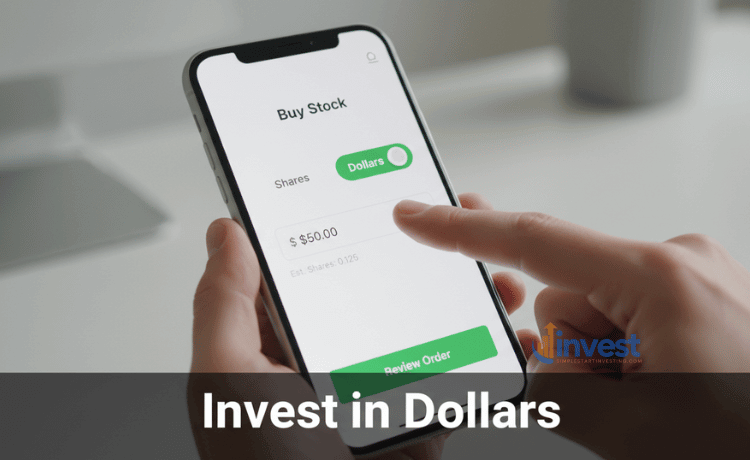
The Logic of Starting Small
Let’s wrap this up by fixing one final mindset error. Many people think they should wait until they have “real money”—like 5,000 dollars—before they start.
Let’s look at a simple example: If you start today with just 5 dollars a week in a fractional share of a solid company, by the end of the year, you have invested over 250 dollars. If you waited until you had 250 dollars all at once, you might have spent that money on coffee or clothes instead.
Investing in fractional shares isn’t about getting rich overnight with one dollar. It is about building the habit of investing. It turns “I can’t afford that” into “I’ll take a piece of that.”
The magic isn’t in the size of the share; the magic is in the fact that you are finally an owner. Whether you own 1,000 shares or 0.001 shares, you are now a part-owner of a business. You are moving from being a consumer who gives money to companies to being an investor who collects money from them.

Key Takeaways for the Absolute Beginner
- Fractional shares allow you to buy stock based on a dollar amount (like 10 dollars) rather than the price of a full share.
- You are entitled to a proportional amount of dividends and price growth.
- It is the best way to diversify a small amount of money across many different companies.
- Don’t wait to save for a “whole share”—the time in the market is your greatest asset.
- Regulations this year continue to make these trades more transparent and accessible for everyone.
Disclaimer: This content is for educational purposes only and does not constitute financial, legal, or tax advice. Investing involves risk, including the possible loss of principal. Past performance is not indicative of future results. Please consult with a qualified professional before making any investment decisions.