When you first open a brokerage account and look at the tiny ticker symbols flashing across your screen, you might notice something interesting. Some stocks, like Disney or Walmart, are listed on the New York Stock Exchange (NYSE). Others, like Apple or Amazon, call the Nasdaq home.
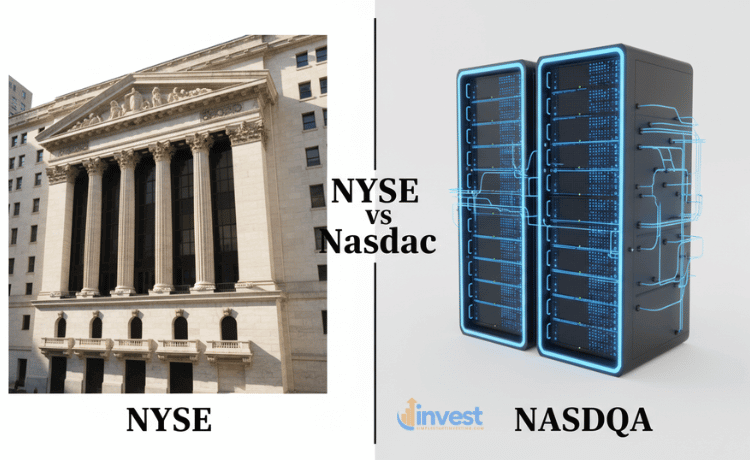
If you are just starting out, you might wonder about the stock exchange differences and whether they actually impact your money. Does it matter if a company is traded on a physical floor in Wall Street or through a sophisticated network of computers? The short answer is that while the mechanics differ, your experience as a retail investor remains mostly the same. However, understanding how these giants work is a vital step in your financial education.
In this guide, we will break down the two most famous stock exchanges in the world. We will look at their history, how they operate today, and why a company chooses one over the other. Most importantly, we will clear up some common myths that often trip up new investors.
What Exactly is a Stock Exchange?
Before we dive into the battle of NYSE vs. Nasdaq, let’s define what a stock exchange actually is. Think of it as a massive, highly regulated digital marketplace. Just like you go to an online store to buy a pair of shoes, investors go to an exchange to buy and sell pieces of companies.
A stock exchange provides a safe, transparent place for these transactions to happen. Without them, you would have to find someone individually who wanted to sell you their shares of a company, which would be nearly impossible. The exchange ensures that when you click “buy” on your phone, there is a verified seller on the other side and the price is fair based on current market demand.
The Simplified Explanation: Imagine a giant farmers’ market. The “exchange” is the person who organizes the market, provides the stalls, and makes sure everyone follows the rules. The “stocks” are the produce being sold. The NYSE and Nasdaq are simply the two biggest market organizers in the United States.
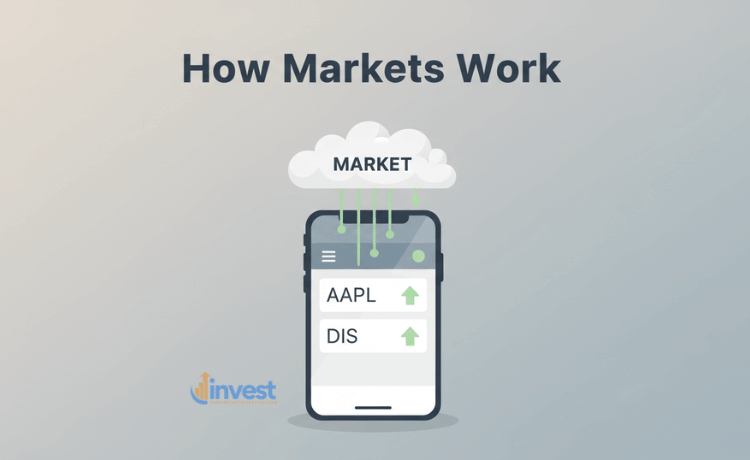
A Real-World Example: Let’s look at Apple (AAPL). When you decide to buy one share of Apple, your brokerage sends that request to the Nasdaq. The Nasdaq’s system matches your order with someone who wants to sell a share at that exact price. This happens in milliseconds. If Apple were listed on the NYSE instead, the process would be similar, but the “pipes” the order travels through would belong to the New York Stock Exchange.
The Newbie Pitfall: Many beginners think that the “stock market” is just one single entity. They might say, “The stock market is down today,” without realizing that different exchanges might be behaving differently depending on the types of companies they host.
The Mindset Shift: Instead of seeing the market as one big cloud, realize it is a collection of different “clubs” or exchanges. Each club has its own members (companies) and its own set of rules for joining.
The New York Stock Exchange (NYSE): The Big Board
The NYSE is the “old guard.” Founded in 1792 under a buttonwood tree in Wall Street, it is the world’s largest stock exchange by market capitalization. When you see movies with people in colorful vests screaming and waving papers on a chaotic floor, you are usually looking at the NYSE.
While most trading is electronic today, the NYSE still maintains a physical trading floor. It uses a “hybrid” model that combines high-tech computer systems with human oversight.
How the NYSE Works: The Auction Model
The NYSE operates as an auction market. In a traditional auction, buyers and sellers compete against each other simultaneously. The highest bid (what someone is willing to pay) is matched with the lowest ask (what someone is willing to sell for).
To keep things orderly, the NYSE uses people called Designated Market Makers (DMMs), formerly known as specialists. Their job is to ensure that trading remains smooth. If there are suddenly a lot of sellers but no buyers for a stock like Ford (F), the DMM might step in and use their own money to buy shares to prevent a total price collapse.
A Simple Example: Think of a real estate auction. Multiple people are shouting prices for a house. The auctioneer (the DMM) manages the crowd to make sure the sale happens fairly and efficiently.
The Newbie Pitfall: Beginners often think that because the NYSE has a physical floor and humans involved, it must be “slower” or “outdated.” They might worry that their trades take longer to execute on the NYSE than on a digital exchange.
The Mindset Shift: In the modern era, the “human” element at the NYSE is more about managing extreme volatility or complex opening/closing moments of the day. For your everyday trade of 10 shares, the execution is just as fast as any other electronic system.
The Nasdaq: The Tech-Heavy Digital Pioneer
The Nasdaq (which stands for National Association of Securities Dealers Automated Quotations) changed the game in 1971. It was the world’s first electronic stock market. Unlike the NYSE, the Nasdaq has no physical trading floor. It exists entirely as a massive network of computers.
Historically, the Nasdaq was seen as the home for “up-and-coming” companies that couldn’t yet meet the strict listing requirements of the NYSE. Because it was electronic and cheaper to join, it attracted technology companies. This legacy remains today, as the Nasdaq is home to giants like Microsoft (MSFT), Alphabet (GOOGL), and Nvidia (NVDA).

How the Nasdaq Works: The Dealer Model
The Nasdaq is a dealer market. Instead of buyers and sellers meeting directly in an auction, they deal through “Market Makers.” These are large financial firms that hold an inventory of a specific stock.
When you want to buy Tesla (TSLA) on the Nasdaq, you aren’t necessarily buying it from another person like you; you are buying it from a Market Maker’s inventory. These dealers compete with each other to offer the best prices to attract your business.
A Simple Example: Imagine a used car lot. If you want to buy a car, you don’t wait for another person to show up and sell their car to you. Instead, you buy directly from the dealer who already has cars on the lot. There are many car dealers in town, and they all compete to give you the best deal.
The Newbie Pitfall: A common mistake is thinking the Nasdaq only lists “tech stocks.” While it is tech-heavy, many non-tech companies like Starbucks (SBUX) and Costco (COST) are listed there too.
The Mindset Shift: Don’t categorize the Nasdaq as just “tech.” See it as a modern, decentralized computer network that values innovation and lower barriers to entry for growing companies.
Key Differences: Breaking Down the Mechanics
While both exchanges help you buy and sell stocks, the stock exchange differences appear most clearly when we look at how a company gets listed and how it pays for that privilege.
1. Listing Requirements
The NYSE is generally considered to have more “prestigious” and difficult listing requirements. To be listed on the NYSE, a company usually needs to be larger and have a longer history of profitability.
The Nasdaq also has strict rules, but it offers different “tiers.” A smaller, younger company might join the Nasdaq Capital Market tier, which has lower requirements than the Nasdaq Global Select Market. This makes the Nasdaq more accessible to growth-stage companies.
2. Listing Fees
It is significantly more expensive for a company to be on the NYSE. The initial entry fee and the annual “rent” a company pays to stay on the exchange can be several hundred thousand dollars. The Nasdaq is generally more affordable, which is one reason why it became a favorite for startups during the tech boom.
3. Ticker Symbols
In the past, you could tell where a stock was traded just by looking at its ticker symbol (the short code).
- NYSE stocks usually had 1, 2, or 3 letters (e.g., T for AT&T, VZ for Verizon, JPM for JPMorgan).
- Nasdaq stocks almost always had 4 letters (e.g., AAPL for Apple, AMZN for Amazon).
However, these rules have relaxed recently. Some Nasdaq companies now use 3-letter symbols, and some NYSE companies have 4. While the “3-letter vs 4-letter” rule is a good general guide, it is no longer a perfect way to tell them apart.
Does It Affect the Price You Pay?
As a beginner, this is the question that matters most. If you want to buy $1,000 worth of a stock, does the exchange change the outcome?
For a retail investor using a standard brokerage like Charles Schwab, Fidelity, or Robinhood, the exchange makes very little difference in the price. The SEC (Securities and Exchange Commission) has a rule called Regulation NMS. This rule requires brokers to find the “best execution” for your trade.
If you want to buy a share and the Nasdaq is offering it for fifty dollars while the NYSE is offering it for fifty dollars and one cent, your broker is legally obligated to get you the cheaper price at fifty dollars, regardless of where the stock is “officially” listed.
Understanding the “Spread”
The only place you might see a tiny difference is in the “bid-ask spread.” This is the difference between the highest price a buyer will pay and the lowest price a seller will accept.
- If the bid is ten dollars.
- And the ask is ten dollars and five cents.
- The “spread” is five cents.
In very large, popular stocks like Walmart (WMT), this spread is usually just one cent on both exchanges because there are so many people trading. In very small, obscure stocks, the spread might be wider, but this is more about the company’s size than which exchange it uses.
Why Do Companies Choose One Over the Other?
You might wonder why Coca-Cola (KO) stays on the NYSE while PepsiCo (PEP) stays on the Nasdaq. Often, it comes down to “branding” and “vibe.”
- Companies choose the NYSE when they want to project an image of stability, history, and “blue-chip” status. Being listed on the “Big Board” carries a certain old-world prestige.
- Companies choose the Nasdaq when they want to be associated with innovation, technology, and the future. The Nasdaq often markets itself as the exchange for the world’s most innovative brands.
Sometimes, companies even switch. A company might start on the Nasdaq when it is young and then move to the NYSE as it matures to show the world it has “arrived.” Others stay on the Nasdaq forever to maintain their “disruptor” identity.
Common Myths vs. Financial Reality
Let’s clear the air on some things beginners often get wrong about these stock exchange differences.
Myth 1: “Nasdaq stocks are riskier than NYSE stocks.”
- The Misconception: People think that because the Nasdaq has many tech startups, all Nasdaq stocks are “gambles.”
- The Reality: Some of the most stable, cash-rich companies in history, like Microsoft (MSFT), are on the Nasdaq. Conversely, the NYSE has seen many massive companies go bankrupt. Risk is about the company’s business model and debt, not the exchange it trades on.
Myth 2: “If the NYSE floor closes, I can’t trade my stocks.”
- The Misconception: People worry that a storm or power outage in New York City will lock them out of their investments.
- The Reality: The NYSE is almost entirely digital now. Even if the physical floor on Wall Street has to close (as it did during the early days of the pandemic or during major hurricanes), trading continues electronically without a hitch.
Myth 3: “The NYSE is for ‘Value’ stocks and Nasdaq is for ‘Growth’ stocks.”
- The Misconception: Beginners often use the exchanges as a shortcut to categorize their portfolio.
- The Reality: While there is a correlation, it isn’t a rule. You can find “value” companies (older, dividend-paying) on the Nasdaq and “growth” companies (fast-growing, high-risk) on the NYSE. Always analyze the company, not the exchange.
How to Check Where a Stock is Traded
If you are curious about a specific company, checking the exchange is easy:
- Go to a site like Yahoo Finance or Google Finance.
- Type in the company name (e.g., Disney).
- Next to the ticker symbol (DIS), you will see the exchange name in small letters (NYSE: DIS).
A Note on Regulations
Both the NYSE and the Nasdaq are overseen by the SEC (Securities and Exchange Commission) and FINRA (Financial Industry Regulatory Authority). They must follow the same strict federal laws designed to protect you, the investor. Whether you buy an NYSE stock or a Nasdaq stock, you are protected by the same “rules of the road.”
Disclaimer: Regulations and listing requirements can change; please check current guidelines from the SEC or the exchanges themselves or consult a professional.
Summary for the Simple Start Investor
To wrap up, the stock exchange differences between the NYSE and Nasdaq are fascinating from a historical and technical perspective, but they shouldn’t keep you up at night.
- The NYSE is an auction market with a physical floor and a focus on large, established companies.
- The Nasdaq is a dealer market that is entirely electronic and is the preferred home for technology and high-growth companies.
- For you: The process of buying a stock on your app looks exactly the same for both. Your broker will handle the routing to ensure you get a fair price.
When you are building your portfolio, focus on the quality of the business. Is the company making a profit? Does it have a good product? Does it have too much debt? These factors will determine your success far more than whether the company’s ticker symbol flashes in a data center in New Jersey (Nasdaq) or on a trading floor in Manhattan (NYSE).