Have you ever scrolled through a finance app and seen a stock trading for just 10 cents? It’s a tempting sight. You might think to yourself, “If I just put in $100, I could own 1,000 shares! If it goes up to just $1, I’ll have $1,000. That’s a 900% gain!”
This is the siren song of penny stocks. To a complete beginner, these low-priced stocks look like a golden ticket to quick wealth. They feel like a way to “get in early” on the next big thing, similar to buying Apple or Amazon when they were just starting out in a garage.

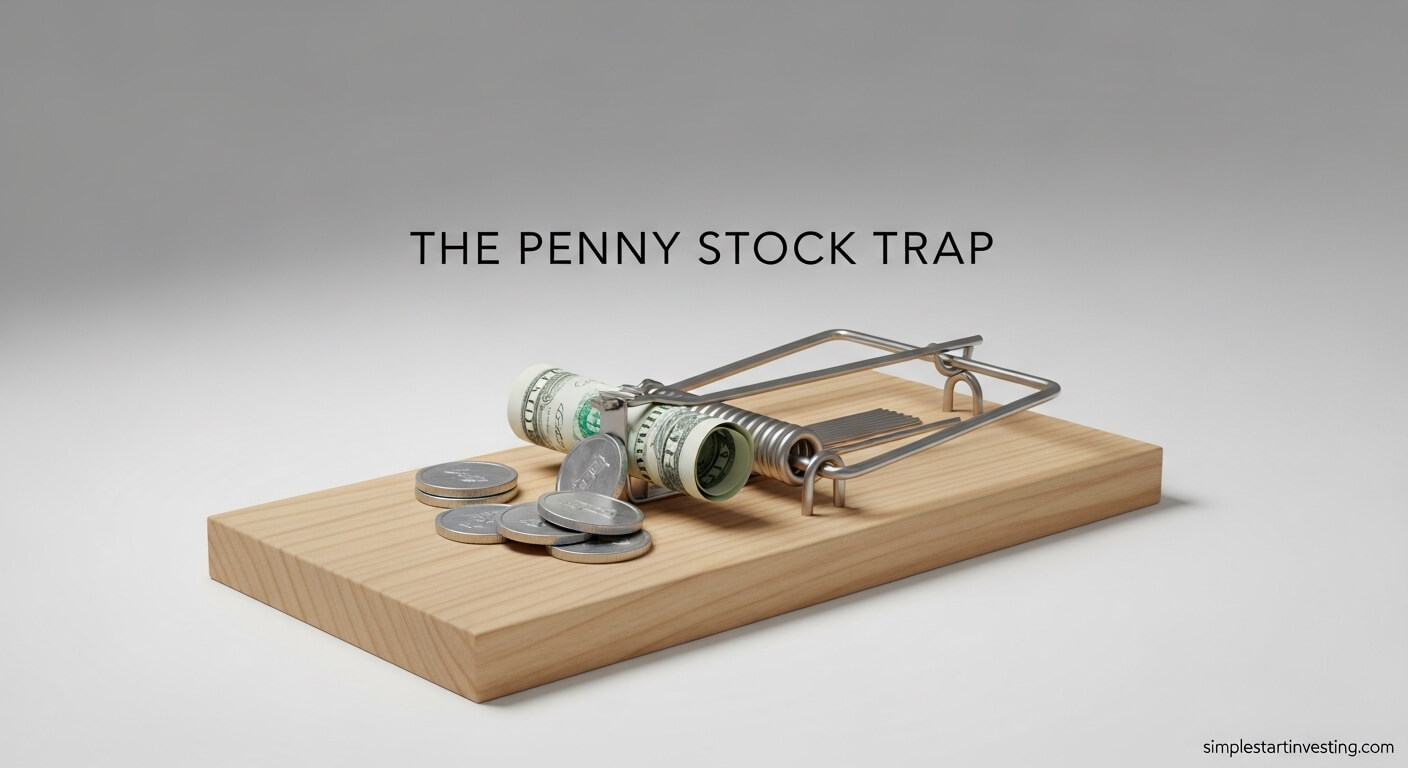
But here is the cold, hard truth: for the vast majority of people, penny stocks are not an investment. They are a high-stakes gamble where the deck is heavily stacked against you. In the world of professional finance, these are often viewed as the “dark alleys” of the market.
In this guide, we are going to pull back the curtain on why these cheap stocks are so dangerous and why your hard-earned money deserves a much safer home.
What Exactly Are Penny Stocks?
Before we dive into the risks, let’s define what we are actually talking about. While the name suggests a stock costs one penny, the official definition used by the U.S. Securities and Exchange Commission (SEC) is broader.
Generally, a penny stock is any stock that trades for less than $5 per share. These stocks usually belong to very small companies, often referred to as “micro-cap” or “nano-cap” companies.
Unlike the household names you know—like Walmart or Costco—most penny stock companies have no track record of success. Many have no profits, very little revenue, and sometimes, they don’t even have a real product yet. They are ideas wrapped in a ticker symbol, and those ideas often fail.
Where These Stocks Live
Most major companies trade on big exchanges like the New York Stock Exchange (NYSE) or the NASDAQ. These exchanges have very strict rules. To stay listed, a company has to maintain a certain stock price and provide regular, audited financial reports.

Penny stocks, however, often trade “Over-the-Counter” (OTC) or on the “Pink Sheets.” These marketplaces have much lower standards. In some cases, a company trading here doesn’t have to tell the public much of anything about its financial health. This lack of transparency is the first major red flag for any new investor.
The Illusion of the “Cheap” Price
The biggest mistake beginners make is confusing a “low price” with “good value.” This is a psychological trap.
Imagine you see two items at a store. One is a high-quality leather jacket for $200. The other is a bag of 500 plastic buttons for $5. The buttons are “cheaper” in terms of total price, but are they a better value? Not if you actually need a jacket.
In the stock market, a stock at $0.50 isn’t necessarily a bargain. It’s often $0.50 because the market has decided the company isn’t worth more than that. It might be drowning in debt, facing lawsuits, or on the verge of bankruptcy.
The “Lottery Ticket” Mentality
Many beginners buy penny stocks because they want to own “a lot” of something. Owning 5,000 shares of a tiny company feels more “powerful” than owning 0.1 shares of a massive, successful company through fractional shares.
But 5,000 shares of zero is still zero. If that tiny company goes bust—which many do—your 5,000 shares become worthless paper. It is always better to own a tiny slice of a world-class business than a mountain of shares in a failing one.
The Danger of Limited Information
When you buy a major stock like Apple (AAPL), you have access to a mountain of data. You can see their quarterly earnings, how much cash they have in the bank, and what their CEO is planning. Thousands of professional analysts are watching them every single day.
With penny stocks, you are often flying blind. Because they trade on smaller exchanges, they aren’t required to provide the same level of detail to the public.
Some of these companies are “dark,” meaning they haven’t released financial statements in years. You have no way of knowing if the company is actually making money or if it’s just a shell company with a fancy website. Investing without information isn’t investing—it’s guessing.
The “Pump and Dump” Scam
This is perhaps the most dangerous part of the penny stock world. Because these stocks have a very low total value and very few people trading them, their prices are incredibly easy to manipulate.
Here is how a typical “Pump and Dump” works:
- The Accumulation: A group of scammers buys a massive amount of a worthless 5-cent stock.
- The Pump: They start a massive marketing campaign. They might send out “hot tip” newsletters, hire social media influencers, or post on message boards claiming this company has just discovered a cure for a disease or signed a billion-dollar contract.
- The Hype: Unsuspecting beginners see the stock price starting to rise because of the fake news. They jump in, afraid of missing out (FOMO). This buying pressure pushes the price even higher—maybe to $0.50 or $1.00.
- The Dump: Once the price is high enough, the scammers sell all their shares at a huge profit.
- The Crash: Because the “news” was fake and the scammers have stopped buying, the stock price collapses back to nearly zero.

The scammers walk away with millions. The beginners are left holding shares that are worth nothing and that no one else wants to buy.
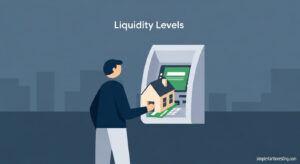
The Liquidity Trap: Easy to Buy, Impossible to Sell
In the stock market, “liquidity” refers to how easily you can turn your shares back into cash.
If you own shares of Amazon (AMZN), you can sell them in a fraction of a second at any time the market is open. There are always millions of people willing to buy them.
Penny stocks are “illiquid.” There are very few buyers and sellers. This creates a terrifying situation for a beginner.
You might see on your app that your stock is worth $0.10. But when you try to sell your 10,000 shares, you realize there is no one on the other side of the trade willing to buy them at that price. To get out, you might have to lower your price to $0.05 or even $0.02.
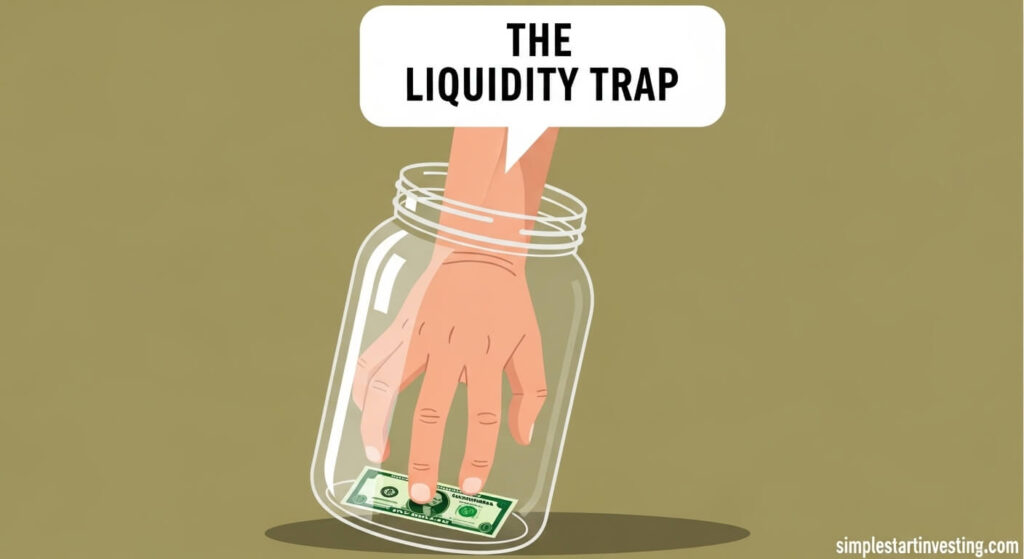
In some cases, the “bid-ask spread” (the difference between the buying price and the selling price) can be 20% or 30%. This means the moment you buy the stock, you are already down 30% because that’s the highest price someone else is willing to pay you for it.
Extreme Volatility Will Test Your Emotions
Most people think they can handle a stock going up and down. But penny stocks don’t just move; they vibrate violently.
If a stock is trading at $0.05, a move of just one penny is a 20% change. In a single afternoon, your account could look like it’s up 50% and then down 70% by the time the market closes.
This level of volatility triggers the “fight or flight” response in our brains. It leads to panic selling at the worst possible time or “revenge trading” where you try to make back your losses by taking even bigger risks. Neither of these is a recipe for long-term success.
Understanding the “Success Stories”
You will inevitably hear stories of someone who turned $500 into $50,000 on a penny stock. These stories are the fuel that keeps the industry alive.
However, you have to look at these stories through the lens of “survivor bias.” For every one person who hits the jackpot, there are thousands of others who lost their entire investment.
Think of it like a casino. You see the person at the slot machine with the flashing lights and the sirens going off. You don’t see the hundreds of people quietly walking out the door after losing their weekend’s budget. The “big win” is the exception, not the rule.
A Better Path for Beginners
If you are a beginner looking to build wealth in the U.S. market, you don’t need to take the massive risks associated with penny stocks.
Today, the barriers to entry in the stock market are lower than ever. Most major brokers now offer fractional shares. This is a game-changer.
In the past, if a stock like Google (GOOGL) cost $150 per share and you only had $10, you couldn’t buy it. You might have felt forced to look at penny stocks.
Now, you can take that same $10 and buy a tiny piece of Google. You are getting a piece of a world-class, profitable company with thousands of employees and billions in revenue. You are participating in real economic growth rather than gambling on a “shell” company.
Focus on Quality and Time
Real investing is about buying quality businesses or “index funds” (which hold a tiny bit of many large companies) and letting them grow over years and decades.
It isn’t as exciting as the “get rich by Friday” promise of penny stocks, but it is the proven way that millions of Americans have built their retirement savings.
When you invest in solid companies, you are an owner of a business that provides value to the world. When you “play” with penny stocks, you are essentially betting on a number at a roulette table where the house has a massive advantage.
How to Spot a “Red Flag” Stock
As you research, you might come across companies that sound exciting but are actually just penny stocks in disguise. Keep an eye out for these warning signs:
- Unsolicited Tips: If you get an email or see a social media post pushing a “secret” stock, run away. Legitimate investment opportunities don’t need to be spammed to strangers.
- “No Revenue” Companies: If a company claims it will be worth billions but hasn’t sold a single dollar’s worth of product yet, it’s a massive risk.
- Suspicious Press Releases: Be wary of companies that put out press releases every day about “potential” partnerships or “groundbreaking” technology without any audited proof.
- The Ticker Symbol: If the stock symbol ends in “.OB” or “.PK,” it means it trades on the over-the-counter markets or the pink sheets, where regulations are very thin.
Summary: Protecting Your Future Self
Investing is one of the best things you can do for your future. It allows your money to work for you so that one day, you don’t have to work for it.
But the foundation of a good investment strategy is capital preservation. This means your first job is to make sure you don’t lose the money you’ve worked so hard to save.
Penny stocks violate this first rule. They are designed to separate hopeful beginners from their cash. By staying away from the “pink sheets” and focusing on established companies with real products and real profits, you are giving yourself the best chance at long-term financial freedom.
Remember: if an investment sounds too good to be true—like a 5-cent stock that is “guaranteed” to go to $10—it almost certainly is.
Stick to the path of slow, steady, and informed investing. Your future self will thank you for your patience and your wisdom.
Disclaimer: This content is for educational purposes only and does not constitute financial advice. The stock market involves risk, and you should always do your own research or consult with a professional before making investment decisions.