If you have ever looked at a stock chart, you probably noticed it looks like a mountain range. There are peaks, valleys, and long stretches of flat ground. Many new investors make the mistake of thinking the market is random, or worse, that it only goes up. But the truth is that the market moves in very specific, repeating patterns known as Stock Market Cycles.
Understanding Stock Market Cycles is like checking the weather forecast before you go for a hike. It won’t tell you exactly when a storm will hit, but it tells you what season you are in so you can dress appropriately. Most beginners lose money because they “buy the sunny day” at the very end of summer and “sell the first snowflake” right before the market starts to heat up again.
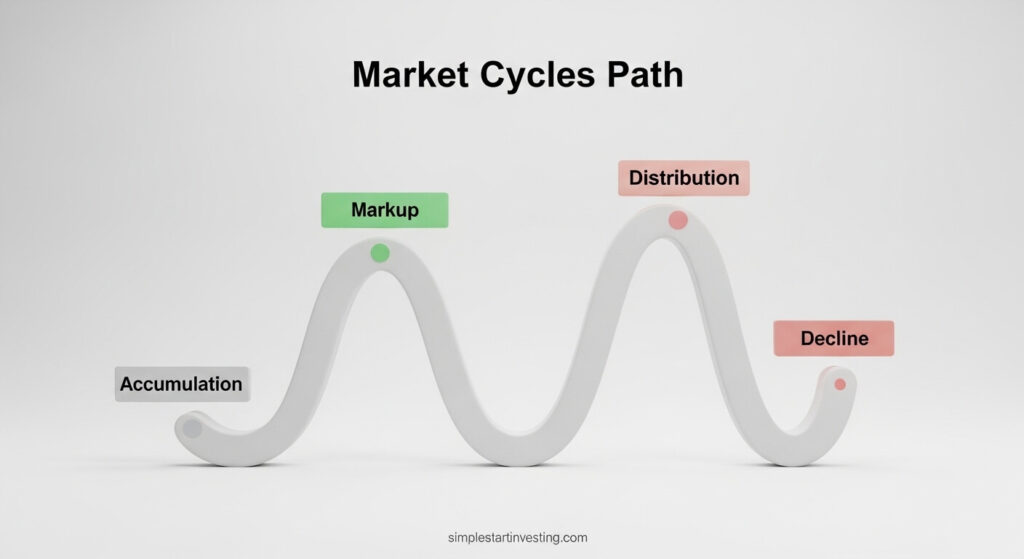
By the time you finish reading this guide, you will be able to look at the market and identify where we likely stand. We are going to break down the four phases that every single market—from stocks to real estate—goes through. More importantly, we will look at the psychology behind these moves so you don’t get caught in the “herd mentality.”
What Exactly is a Stock Market Cycle?
Think of the stock market as a living, breathing thing. It is powered by millions of people making decisions based on two primary emotions: greed and fear. Because human nature hasn’t changed in hundreds of years, the way the market reacts to news and profits remains remarkably consistent.
A cycle represents the entire life of a trend, from the moment it is born to the moment it dies. These cycles can last for several years or even a decade. While the names of the companies might change—maybe it’s railroads in the 1800s or Artificial Intelligence today—the “skeleton” of the cycle remains the same.
A major reason why beginners fail is that they view the market through a tiny window. They look at what happened yesterday or this morning. Professional investors look at the big picture. They know that a “down” market is just a phase, not the end of the world.
Phase 1: The Accumulation Phase (The Quiet Foundation)
This is the phase where the “smart money” enters the room. Imagine a store that just finished a massive, chaotic holiday sale. The floors are messy, the shelves are half-empty, and most shoppers have gone home, exhausted and broke. That is what the Accumulation Phase looks like.
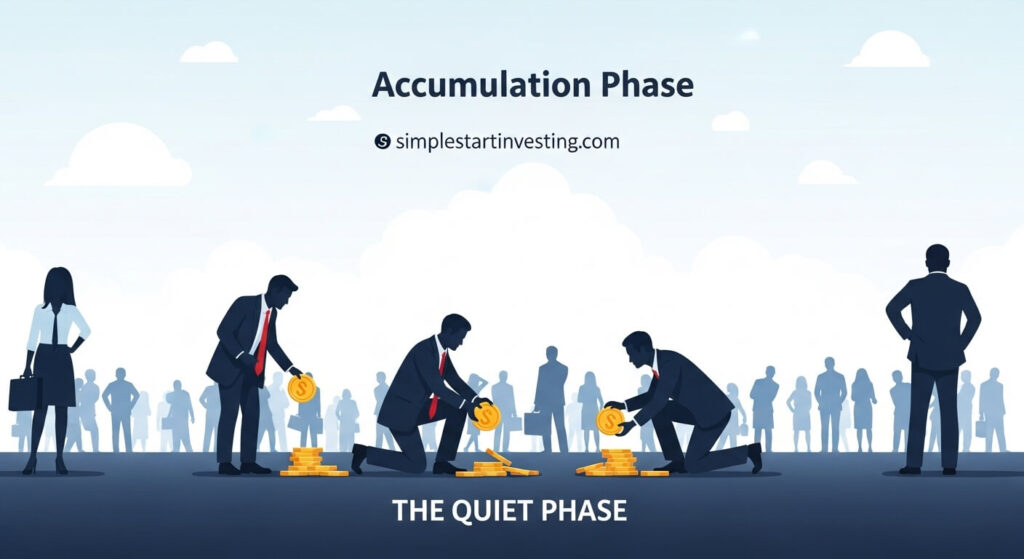
In this stage, the market has usually been “beaten up” for a while. The general public is angry at the stock market. You will hear people saying things like, “Investing is a scam” or “I’m never putting a dollar in stocks again.” This is exactly when seasoned investors, like large institutions and experienced pros, start buying again.
Characteristics of Accumulation
- Sentiment: Boredom or lingering fear.
- Price Action: The market stays mostly flat. It’s not going down anymore, but it’s not really going up yet either.
- Media Coverage: Most news outlets are still talking about how bad the economy is.
For a beginner, this is the hardest time to buy. Why? Because there is no “excitement.” You don’t feel like you’re winning. However, this is where the lowest risk and highest potential rewards are found. You are buying when things are “on sale,” even if the store looks a bit gloomy.
The Logic of the “Smart Money”
Professional investors aren’t looking for a quick win. They are looking for value. If a company used to be worth 100 dollars per share and is now trading at 40 dollars because of a general market crash, the pros know the business is still worth much more. They quietly “accumulate” shares without causing the price to spike.
Phase 2: The Markup Phase (The Golden Trend)
Eventually, the secret gets out. The market has been stable for a while, and prices start to climb. This is the Markup Phase, and it is the most exciting part of the Stock Market Cycles for most investors. This is the “Bull Market” you hear about on the news.
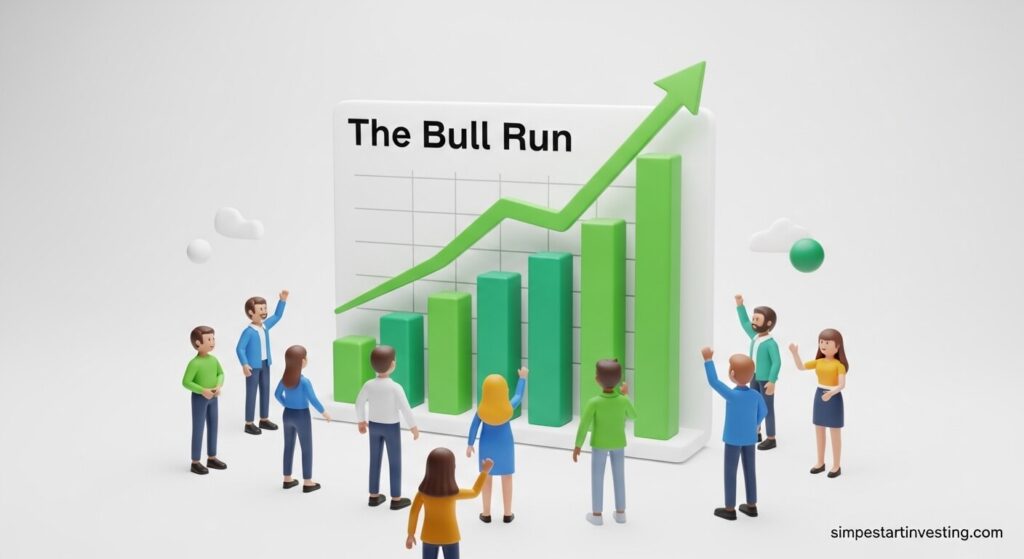
In the beginning of this phase, people are skeptical. They think it’s a “fake” rally. But as the price continues to rise, the skepticism turns into curiosity, and then into full-blown excitement.
Why the Price Shoots Up
As more people notice the upward trend, they don’t want to miss out. This is where FOMO (Fear Of Missing Out) starts to take over. When more people want to buy than there are people willing to sell, the price has only one place to go: up.
The Stages of the Markup Phase
- Early Markup: The price breaks out of its flat range. A few savvy retail investors join in.
- Middle Markup: The “trend” is confirmed. Media starts reporting on “new record highs.”
- Late Markup (The Parabolic Move): This is the dangerous part. The price moves up very fast, almost in a straight line. Your neighbor, your barber, and your cousin are all suddenly “experts” in the market.
If you are a beginner, this is usually when you feel the strongest urge to invest. Everything looks green, and everyone is making money. However, by the time the “late markup” happens, the best opportunities are usually already behind you.
Phase 3: The Distribution Phase (The Crowded Exit)
If Phase 1 was a quiet store after a sale, Phase 3 is a party that has gone on too long. The music is loud, the room is crowded, and a few people are starting to look for their coats.
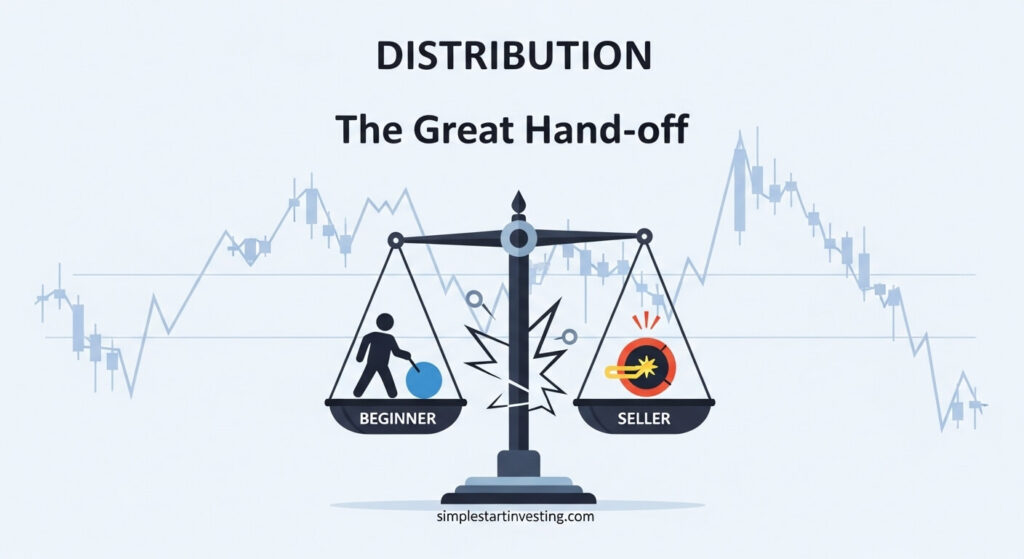
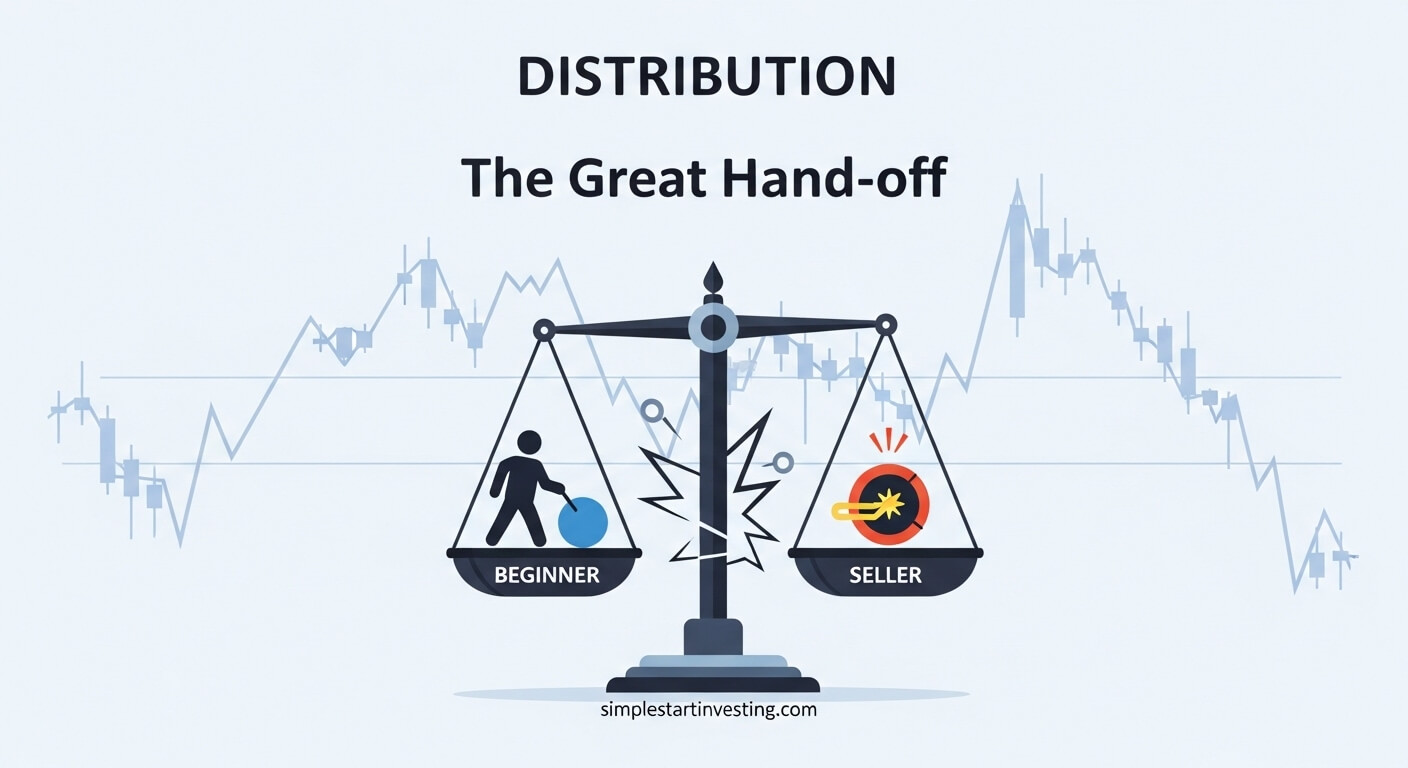
During the Distribution Phase, the “smart money” that bought back in Phase 1 starts to sell. But they don’t sell all at once because that would crash the price. Instead, they sell their shares to the excited beginners who are just arriving at the party.
The “Tug of War”
In this phase, the market looks like it is struggling. It will reach a new high, then quickly drop. Then it will try to reach that high again but fail. This creates a “sideways” movement. The price isn’t going up anymore, but the volume of trading is very high.
Why is the volume high? Because for every beginner who is “buying the dip,” a professional is “selling the peak.” It is a massive hand-off of shares from the pros to the public.
Warning Signs of Distribution
- Extreme Optimism: Everyone thinks the market can only go higher.
- High Volatility: Prices swing wildly up and down within a single day.
- Negative News is Ignored: Even when bad economic data comes out, the market tries to stay up because of pure momentum.
For the beginner, this phase is confusing. You might see your portfolio go from 10,000 dollars to 11,000 dollars, then back to 9,500 dollars, then back to 10,000 dollars. It feels like the market is “stuck.” This is the market catching its breath before a potential fall.
Phase 4: The Decline Phase (The Reality Check)
This is the phase everyone fears. We often call this a “Bear Market” or a “Crash.” The Decline Phase happens when the supply of shares for sale finally outweighs the demand from buyers.
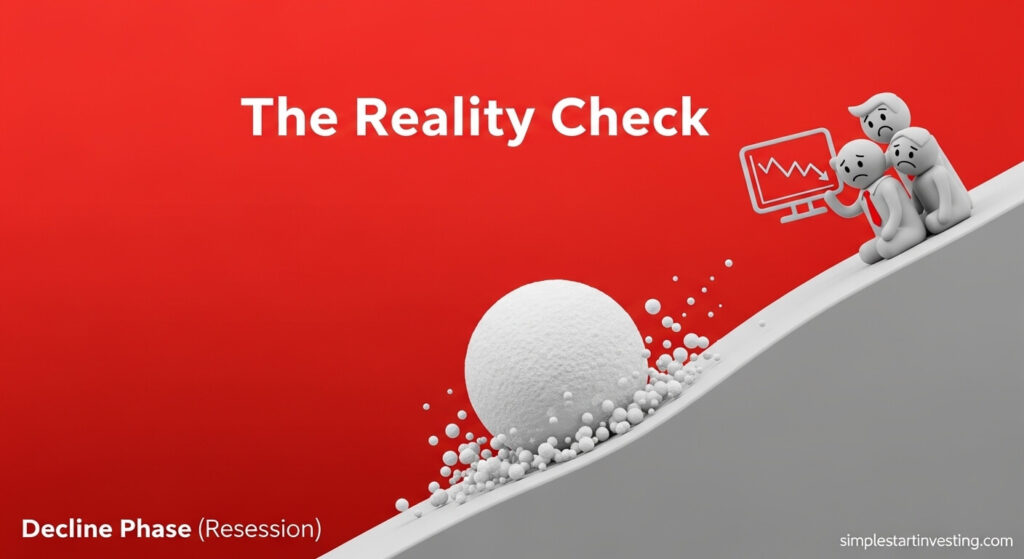
The party is over, and someone just turned on the bright lights. Everyone realizes they stayed too long and starts rushing for the exit at the same time.
How the Fall Happens
The decline usually starts slowly. Maybe a major company misses its earnings goal, or the government raises interest rates. Those who bought at the very top (in Phase 3) start to see small losses. They tell themselves, “It’s just a temporary dip; it will come back.”
But it doesn’t come back. The price drops further. Suddenly, that 10,000 dollar investment is worth 8,000 dollars. Fear turns into panic. People who were bragging about their gains three months ago are now desperate to “just get their money back.”
The “Capitulation” Moment
The end of the decline phase usually ends with a “bang” called capitulation. This is the moment when the last remaining optimists give up. They sell their shares at any price just to stop the pain of losing more.
Ironically, this “darkest hour” is exactly what leads back into Phase 1 (Accumulation). Once the panic sellers have finished selling, there is no one left to push the price lower. The market hits a floor.
Common Misunderstandings About Market Cycles
As a beginner, it is very easy to fall into a few psychological traps. Let’s clear up the most common ones so you can navigate these cycles with a cooler head.
“This Time is Different”
Every time the market is in a massive Markup Phase (Phase 2), people say, “The old rules don’t apply anymore. This time is different because of [New Technology/New Policy].”
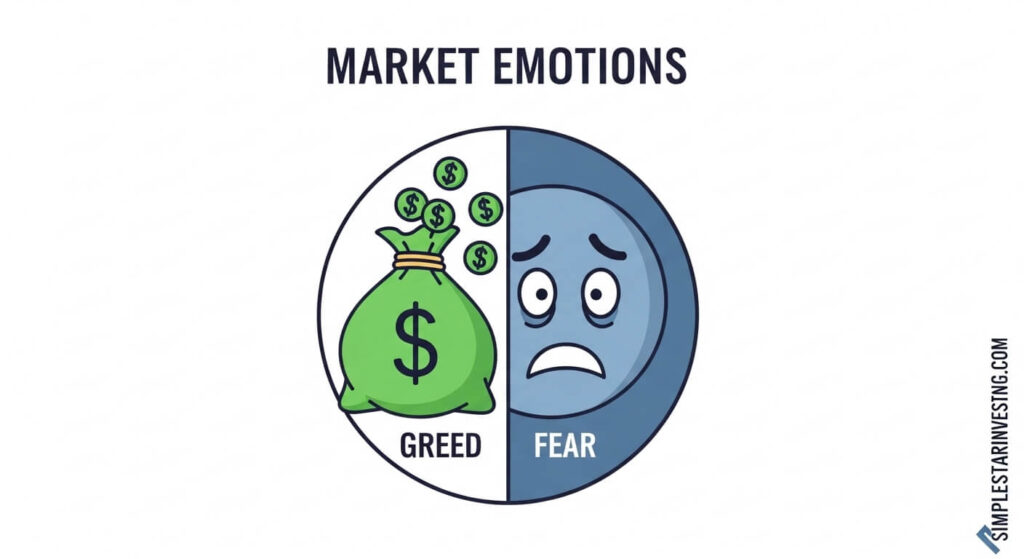
It is almost never different. While the reasons for a boom or bust change, the cycle itself is driven by human emotion, which has not changed in thousands of years. If things feel too good to be true, you are likely in Phase 3.
Timing the Bottom
Many beginners think they should wait for the “absolute bottom” to buy. The problem is that the bottom only looks obvious in a rear-view mirror. When the market is actually at the bottom, it feels like the world is ending.
Instead of trying to find the exact bottom, smart investors look for the “neighborhood” of the bottom. If we are clearly in a Decline Phase and everyone is panicking, you are likely in a good neighborhood to start looking for quality companies.
The “Straight Line” Fallacy
New investors often think that if a stock went up 20 percent last year, it will go up 20 percent this year. This is “linear thinking.” The market is “cyclical,” not linear. It moves in circles and waves. Understanding that a 10 percent drop is a normal part of a cycle—rather than a sign of a total collapse—will save you a lot of sleepless nights.
Why Understanding These Phases Helps You Invest Better
Knowing where you are in the Stock Market Cycles isn’t about “getting rich quick.” It’s about managing your risk and your emotions.
Setting Realistic Expectations
If you know the market is in a Markup Phase, you won’t be surprised when things go up. But you will also be cautious not to “bet the farm” at the very top. If you know we are in a Decline Phase, you won’t be as terrified when you see red numbers in your account. You will recognize it as a necessary part of the cycle.
Avoiding the “Buy High, Sell Low” Trap
The average investor does the exact opposite of what they should. They buy in Phase 3 (Distribution) because they see everyone else making money. Then they sell in Phase 4 (Decline) because they are scared.
By understanding these four phases, you can train yourself to do the opposite:
- Be interested when others are bored (Accumulation).
- Be cautious when others are euphoric (Distribution).
- Be patient when others are panicking (Decline).
A Real-World Example: The “Coffee Shop” Analogy
Let’s step away from the stock market for a second and imagine a small town with one coffee shop.
Phase 1 (Accumulation): The shop is old and dusty. Nobody goes there. But a local businessman sees that the town is planning to build a new park right next door. He quietly buys the shop for a very low price.
Phase 2 (Markup): The park opens. Suddenly, hundreds of people walk by the shop every day. The owner renovates, and the shop starts making a lot of profit. Other people in town see the crowds and say, “I want to own a coffee shop!” They start offering the owner more and more money to buy it from him.
Phase 3 (Distribution): The price of the coffee shop has tripled. The businessman decides it’s time to move on. He sells the shop to a group of friends who have never run a business before but are excited because “everyone loves coffee.” At the same time, two other coffee shops open across the street.
Phase 4 (Decline): Now there are too many coffee shops. The original shop starts losing money. The new owners panic because they took out a big loan to buy it at a high price. They eventually sell the shop at a loss just to get out of the debt. The cycle is ready to start all over again.
Final Thoughts for the New Investor
The stock market is a powerful tool for building wealth over the long term, but it is not a “magic money machine.” It has seasons. Just as a farmer doesn’t panic when winter comes—because they know spring follows—you shouldn’t panic when the market cycle turns cold.
Your goal as a beginner is to stay in the game. Most people quit during Phase 4 and never get to experience the growth of Phase 2. If you can identify these phases, you can keep your emotions in check, avoid the most common mistakes, and build a portfolio that lasts through many cycles.
Success in the market doesn’t come from being the smartest person in the room; it comes from being the most disciplined person in the room. Understand the cycle, respect the phases, and always keep your eyes on the long-term horizon.
Disclaimer: This content is for educational purposes only and does not constitute financial advice. Market cycles are based on historical patterns and are not a guarantee of future results. Always conduct your own research or consult with a qualified financial professional before making investment decisions.