Have you ever looked at a stock and wondered why its price is 2,000 dollars while another is only 20 dollars? You might think the 2,000 dollar stock belongs to a much bigger company. In the world of investing, that is one of the most common traps for beginners. The price of a single share does not tell you how big a company is. To understand the true size and “weight” of a company in the market, you need to understand a concept called Market capitalization.
Market capitalization is the magic yardstick that investors use to group companies into different categories like “Small-Cap” or “Large-Cap.” Knowing which category a company falls into is crucial because it helps you predict how the stock might behave. Is it a slow and steady giant, or a fast but risky newcomer? In this guide, we will break down everything you need to know about company sizes so you can build a portfolio that fits your goals.
What Exactly is Market Capitalization?
Before we dive into the battle between small and large companies, let’s define the term Market capitalization. Think of it as the total price tag of a whole company if you were to buy every single share of it today.
To find this value, you do not need a complex calculator. You simply take the current price of one share and multiply it by the total number of shares that exist in the market. For example, if a company has 1 million shares and each share costs 50 dollars, the total value—or Market capitalization—is 50 million dollars.
Market capitalization is important because it allows you to compare “apples to apples.” It tells you how much the investing public thinks the company is worth. In the United States, companies are generally grouped into three main buckets based on this value:
- Large-Cap: These are the titans of industry, usually worth 10 billion dollars or more.
- Mid-Cap: These are middle-sized companies, usually worth between 2 billion dollars and 10 billion dollars.
- Small-Cap: These are smaller firms, typically worth between 250 million dollars and 2 billion dollars.
A Real-World Example: The Pizza Shop Analogy
Imagine two pizza shops in your town.
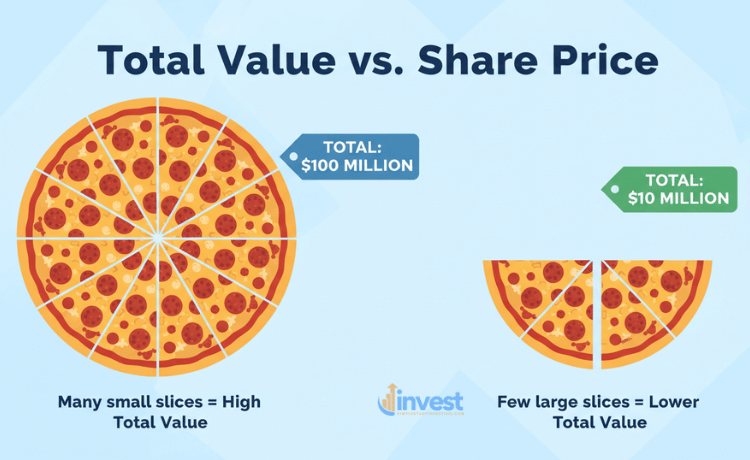
Shop A is a massive national chain with 1,000 locations. They have 1 million “shares” of ownership, and each share costs 10 dollars. The total value of the chain is 10 million dollars.
Shop B is a local boutique shop with only one location but very high-end ingredients. They only have 1,000 “shares” available, but because they are so exclusive, each share costs 1,000 dollars. The total value of this shop is 1 million dollars.
Even though Shop B has a “higher price” per share (1,000 dollars vs 10 dollars), Shop A is actually the “larger” company (10 million dollars vs 1 million dollars). This is why Market capitalization is the only number that truly tells you the size of the business.
The Beginner’s Mistake: Falling for the “Cheap” Price
Many new investors think that a stock trading at 5 dollars is “cheaper” and has more room to grow than a stock trading at 500 dollars. This is a classic misunderstanding. A 5 dollar stock could belong to a company that is already massive but has billions of shares outstanding. Conversely, a 500 dollar stock could belong to a small company with very few shares.
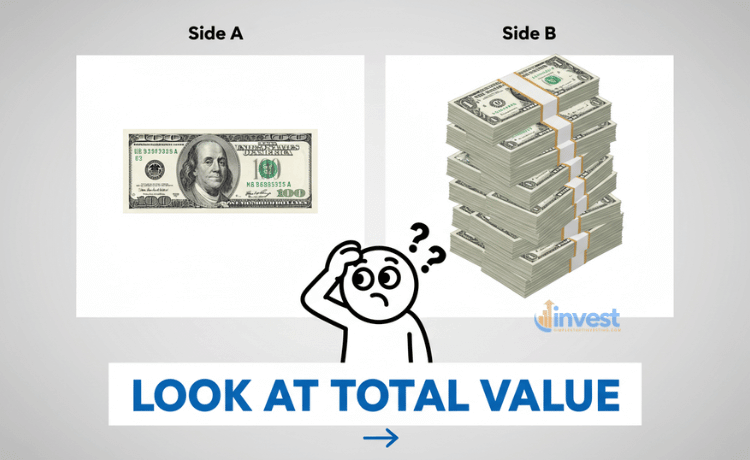
The Correction: Always look at the total Market capitalization instead of just the share price. The size of the company tells you more about its stability and growth potential than the price of a single slice of the pie.
Large-Cap Stocks: The Blue-Chip Giants
When people talk about the “stock market,” they are often referring to Large-Cap stocks. These are the household names you see every day. Think of companies like Apple (AAPL), Walmart (WMT), or JPMorgan Chase (JPM).

Because these companies are so big, they are often called “Blue-Chip” stocks. This term comes from poker, where the blue chips have the highest value. These companies have already “made it.” They have established products, thousands of employees, and usually, a lot of cash in the bank.
Why Investors Love Large-Caps
The main reason beginners flock to Large-Caps is stability. These companies are like giant ocean liners. They don’t move as fast as a speedboat, but they are much harder to tip over in a storm.
If the economy takes a slight downturn, a company like Coca-Cola (KO) or Costco (COST) is likely to survive because people still need to eat and drink. Many of these giants also pay “dividends.” A dividend is a small piece of the company’s profit that they send to you in cash just for owning the stock. This makes them very popular for retirement accounts.
The Common Misconception: Large-Caps Are “Safe”
A very common mistake is believing that because a company is huge, it cannot fail. This is not true. While they are more stable, they can still lose value. For example, during the early 2000s or the 2008 financial crisis, many giant banks and tech companies saw their values drop significantly.
The Correction: No investment is 100% safe. Large-Cap stocks offer “relative” stability, meaning they usually fluctuate less than small companies, but you can still lose money if the entire market or that specific industry hits a rough patch.
Small-Cap Stocks: The Fast-Growing Speedboats
On the other side of the spectrum, we have Small-Cap stocks. These are smaller companies that are often in their early stages of growth or serving a very specific niche. They might be a new biotech firm looking for a cure, or a small tech startup with a revolutionary app.

Why Investors Choose Small-Caps
If Large-Caps are ocean liners, Small-Caps are speedboats. They can turn on a dime and accelerate very quickly. Because they are smaller, it is much easier for them to double in size.
If a company is worth 500 million dollars, it only needs to gain another 500 million to double your money. For a giant like Microsoft (MSFT) to double, it would need to gain trillions of dollars in value—which is much harder to do. This “explosive growth potential” is what attracts people to Small-Cap stocks.
The Reality of the Risk
The trade-off for that growth is high volatility. Small companies often have less cash in the bank and are more affected by changes in the economy. If interest rates go up, it becomes more expensive for these small businesses to borrow money to grow. If a competitor enters their niche, they might not have the resources to fight back.
The Beginner’s Misconception: “I’ll Just Pick the Next Amazon”
Many beginners see the history of Amazon (AMZN) and think they can just pick a few Small-Cap stocks and become millionaires overnight. The problem is that for every Amazon, there are hundreds of small companies that go out of business or never grow at all.
The Correction: Small-Cap investing requires a lot more research and a higher “stomach” for risk. You should expect your account balance to swing up and down much more wildly with these stocks. Most experts suggest that beginners only keep a small portion of their total investments in Small-Caps.
How Interest Rates Affect Small vs. Large Companies
It is important to understand how the current environment affects these different sizes. This year, many investors are watching the Federal Reserve and interest rates closely.
When interest rates are high, it usually hurts Small-Cap companies more than Large-Caps. Why? Because Large-Cap giants often have huge piles of cash. They don’t always need to borrow money to keep the lights on. Small companies, however, often rely on loans to fund their research or expansion. When loans get expensive, their profits shrink.
Conversely, when the government starts talking about lowering interest rates—as we are seeing in the current market cycle—Small-Caps often get a “boost.” Lower rates mean cheaper loans, which acts like fuel for a small company’s growth. This is why you might see Small-Cap stocks performing very well in years when the economy is recovering.
Building Your Portfolio: The Balancing Act
Now that you know the difference, how do you use this information? You don’t have to choose just one. In fact, most successful investors use a mix of both. This is called “Diversification.”
The “Core and Satellite” Strategy
A popular way for beginners to start is the “Core and Satellite” approach.
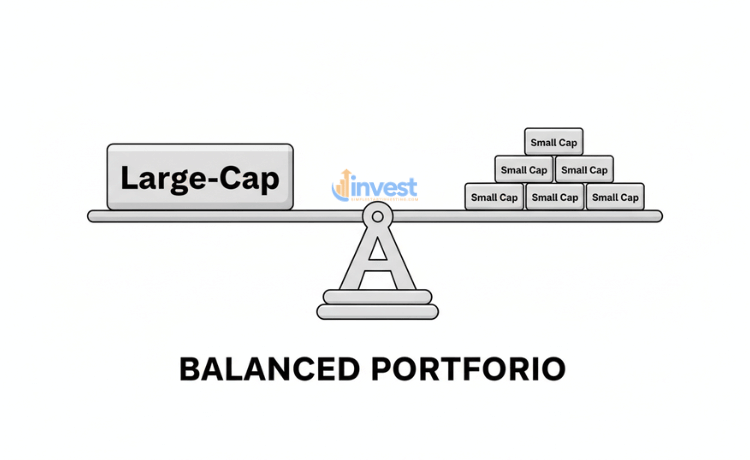
- The Core: You put the majority of your money (maybe 70% to 80%) into Large-Cap stocks or funds that track the whole market (like an S&P 500 fund). This provides your foundation of stability.
- The Satellite: You put a smaller amount (maybe 10% to 20%) into Small-Cap stocks. This gives you a “chance” at those higher returns without risking your entire life savings if a small company fails.
Why Diversification Matters
Imagine you only invested in Small-Cap tech stocks. If the tech industry has a bad year, your entire portfolio could drop by 50%. But if you also held Large-Cap utility companies (like companies that provide electricity and water), those stable stocks might stay flat or even go up, cushioning the blow to your wallet.
Key Differences Summary
To help you decide which is right for your current goal, let’s look at the logical breakdown of these two categories.
1. Volatility (The “Bumpy Ride” Factor): Large-Cap stocks are generally less volatile. If you check your account, a Large-Cap stock might move 1% or 2% in a day. A Small-Cap stock can easily move 5% or 10% in a single afternoon. If you are someone who panics when you see red numbers, you might prefer the steadiness of Large-Caps.
2. Growth Potential: If you are young and have 30 years before you retire, you might want more Small-Cap exposure. You have the time to ride out the “bumps” in exchange for the chance that one of those small companies becomes the next giant. If you are close to retirement, you likely want to preserve the money you already have, making Large-Caps a better fit.
3. Dividends: Most Small-Cap companies do not pay dividends. They take every dollar they earn and plow it back into the business to grow. Large-Cap companies often have “excess” cash, so they share it with stockholders. If you are looking for a steady stream of income to pay your bills, Large-Caps are usually the way to go.
How to Check a Company’s Size
You don’t need to do the math yourself. Almost every financial website, from Yahoo Finance to your own brokerage app (like Robinhood, Fidelity, or Schwab), will list the Market capitalization prominently.
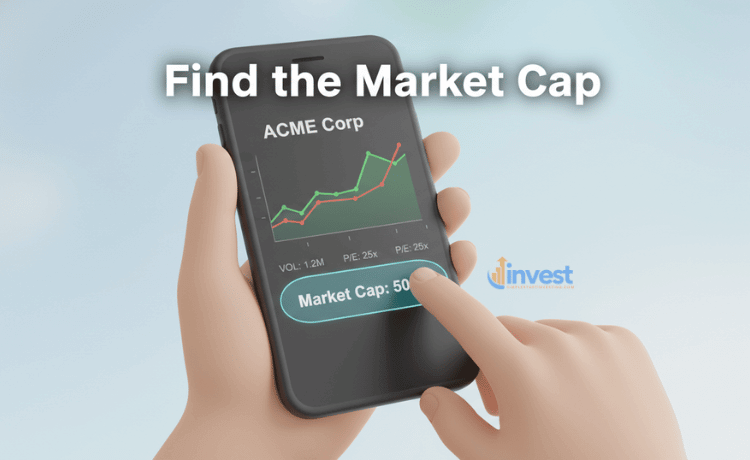
When you search for a ticker symbol like TSLA (Tesla) or AMZN (Amazon), look for a number labeled “Market Cap.”
- If you see a “T” next to the number (like 3.0T), that stands for Trillions. That is a “Mega-Cap” company.
- If you see a “B” (like 50B), that is Billions, usually a Large-Cap.
- If you see an “M” (like 800M), that is Millions, which puts it firmly in the Small-Cap or even “Micro-Cap” territory.
The “Mid-Cap” Middle Ground
We shouldn’t ignore the middle child: Mid-Cap stocks. These are companies that have outgrown the “startup” phase but aren’t quite world-dominating giants yet. They are often seen as the “sweet spot” for many investors because they offer more growth than Large-Caps but more stability than Small-Caps. Examples might include popular regional clothing brands or specialized medical equipment makers.
Final Thoughts for the Beginner
Choosing between Small-Cap and Large-Cap isn’t about finding a “winner.” It’s about understanding what role each one plays in your financial journey.
- Use Large-Caps for the long haul, for dividends, and for peace of mind during market storms.
- Use Small-Caps for growth potential and to add some “excitement” (and risk) to your portfolio.
The most important thing to remember is that Market capitalization changes every day. As a company’s stock price goes up, its market cap grows. Some of the biggest companies today started as tiny Small-Caps decades ago. By understanding these sizes now, you are learning to read the map of the stock market, which will help you stay on track toward your financial goals.
Disclaimer: This content is for educational purposes only and does not constitute financial advice. Market regulations and economic conditions can change; please consult with a qualified professional or check current guidelines before making investment decisions.