
Buying your first home in the United States is a massive milestone. As you browse listings on sites like Zillow or Realtor.com, you will likely notice three letters popping up frequently: HOA. For a beginner, understanding HOA fees and how these associations operate is just as important as knowing your mortgage interest rate.
An HOA, or Homeowners Association, is a private organization in a planned community or condominium building that makes and enforces rules for the properties and their residents. When you buy a home in one of these communities, you automatically become a member and are required to pay monthly or annual dues. These fees can range from a modest 50 dollars a month to well over 1,000 dollars in luxury high-rises.
While the idea of having someone else mow the common lawns or manage the community pool sounds great, there is a complex financial and legal reality behind it. This guide will walk you through everything you need to know about living in an HOA, focusing on the financial impact, the rules you must follow, and how to decide if this lifestyle fits your budget.
What Exactly is an HOA?
At its simplest level, an HOA is like a mini-government for your neighborhood. It is usually run by a board of directors made up of volunteers who are also homeowners in the community. Their job is to maintain the “common areas” and ensure that property values remain high by enforcing a set of rules called Covenants, Conditions, and Restrictions, or CC&Rs.
Plain English Explanation
Imagine you and ten friends buy a large cake to share. You all agree to chip in money every month to pay for a glass case to keep the cake fresh and a professional decorator to touch up the icing. You also agree that no one is allowed to put ugly plastic toppers on their slice of the cake because it would make the whole cake look bad. The HOA is the group of friends making sure everyone pays their share and follows the “no ugly toppers” rule.

Real-World Example
Consider a new housing development in a suburb of Dallas, Texas. The developer builds 200 homes and a central park with a playground. To keep that park clean and the grass cut, the developer creates an HOA. Every homeowner pays 150 dollars a month into a collective fund. If the playground equipment breaks, the HOA uses that money to fix it. If a homeowner decides to paint their house bright neon pink—violating the community’s “neutral colors only” rule—the HOA has the power to fine them.
Common Beginner Mistake
Many first-time buyers think that HOA rules are just “suggestions” or that they can opt-out of the association if they don’t use the amenities like the gym or the pool.
The Correct Financial Logic
When you sign the closing papers on a home in an HOA community, you are entering a legally binding contract. You cannot “opt-out” of the fees or the rules. If you stop paying your dues, the HOA can place a lien on your home, and in some states, they can even initiate foreclosure proceedings—even if you are current on your mortgage payments to the bank.
Understanding HOA Fees and Your Mortgage
One of the biggest hurdles for beginners is realizing that understanding HOA fees is vital for getting a loan. When a bank looks at your mortgage application, they don’t just look at the price of the house. They look at your total “housing expense.”

Plain English Explanation
Lenders use something called a Debt-to-Income ratio, or DTI. This is a way of measuring how much of your monthly income goes toward paying off debts. If your income is 5,000 dollars a month and your total debts—including your new house—are 2,500 dollars, your DTI is 50 percent. Banks usually want this number to be lower, often around 43 percent or less.
Real-World Example
Let’s say you are looking at a beautiful condo in Orlando, Florida. The mortgage payment is 1,800 dollars a month. You feel confident because you can afford that. However, the condo has an HOA fee of 400 dollars a month. To the bank, your monthly housing cost is not 1,800 dollars; it is 2,200 dollars. If that extra 400 dollars pushes your total monthly debt payments above the bank’s limit, they might reject your loan or ask you to buy a cheaper house.
Common Beginner Mistake
A common error is looking at the “estimated mortgage” on a real estate app and assuming that is the final number. Buyers often forget that the HOA fee is a “hard” cost that must be added to the principal, interest, taxes, and insurance.
The Correct Financial Logic
Always ask for the exact HOA fee amount before you fall in love with a property. Use a simple calculation: take your expected mortgage payment and add the HOA fee. If your mortgage is 2,000 dollars and the fee is 300 dollars, your real starting point is 2,300 dollars. This helps you compare “HOA homes” versus “Non-HOA homes” fairly.
The “Surprise Bill”: Special Assessments
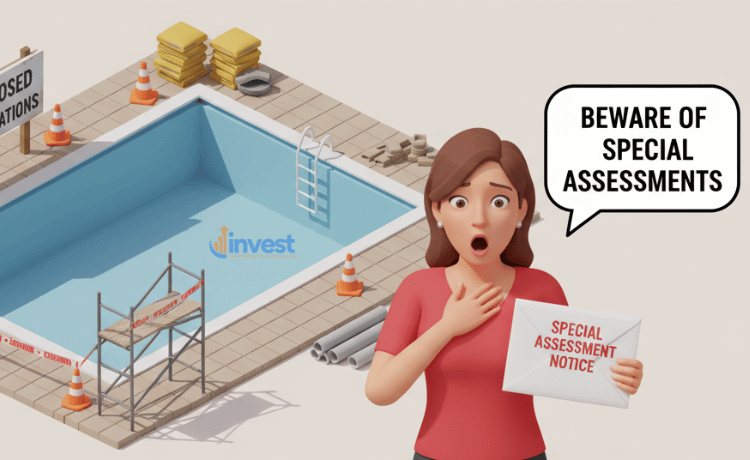
Beyond the monthly dues, there is a financial risk known as a “Special Assessment.” This is perhaps the most feared phrase in the world of HOAs.
Plain English Explanation
A special assessment is an extra, one-time fee charged to all homeowners when the HOA’s “savings account” (called a reserve fund) doesn’t have enough money to cover a major repair. Think of it like an emergency car repair, but instead of just you paying for it, every neighbor has to chip in thousands of dollars at once.
Real-World Example
Imagine a townhome community in Charlotte, North Carolina. A massive hailstorm damages the roofs of all 50 units. The total cost to replace the roofs is 500,000 dollars. The HOA only has 100,000 dollars in its reserve fund. To cover the remaining 400,000 dollars, the board votes for a special assessment. This means every one of the 50 homeowners must pay 8,000 dollars. You might be required to pay this in one lump sum or through increased monthly payments over a year.
Common Beginner Mistake
New buyers often assume that the monthly fee is all they will ever have to pay. They don’t check the financial health of the association before buying.
The Correct Financial Logic
Before you buy, you must request the HOA’s financial documents, specifically the “Reserve Study.” This document tells you how much money the association has saved and when they expect to replace big items like roofs or roads. If the reserve fund is low and the roofs are 20 years old, a special assessment is likely coming. It is better to know this before you buy so you can negotiate the price or walk away.
The Pros: Why People Choose HOAs
It’s not all about rules and fees. There are genuine benefits to living in a community with an association, which is why millions of Americans choose them.
- Amenities: Access to pools, tennis courts, gyms, and clubhouses that you might not be able to afford on your own.
- Maintenance-Free Living: In many HOAs, especially condos and townhomes, the association handles roof repairs, exterior painting, and snow removal.
- Curb Appeal and Property Value: Because the HOA enforces rules about lawn care and house paint, your neighbor can’t leave a rusted car on their front lawn, which helps keep your property value high.
- Dispute Resolution: If a neighbor is playing loud music at 3 AM, the HOA can step in to enforce “quiet hours,” saving you from a direct, awkward confrontation.
The Cons: The Trade-Off for Order
For every benefit, there is a potential drawback. Understanding HOA fees means also understanding the loss of some personal freedoms.
- Restrictive Rules: You might need permission to change your front door color, plant a specific tree, or even park a work truck in your own driveway.
- Inconsistent Management: Since boards are run by volunteers, you might end up with a “power-hungry” board that over-regulates or an “indifferent” board that lets the community fall apart.
- Rising Costs: HOA fees are not fixed. As the cost of insurance and labor goes up, the board can vote to increase your monthly dues. In recent years, insurance costs in states like Florida and California have caused some HOA fees to double.
- Financial Liability: If the HOA is sued or goes bankrupt, it can affect your ability to sell your home.
How an HOA Impacts Property Value
There is a long-standing debate about whether HOAs actually help or hurt property values. On one hand, companies like Walmart or Costco invest heavily in the appearance of their stores because they know a clean environment attracts customers. HOAs do the same for neighborhoods.

Plain English Explanation
Think of two identical houses. House A is in a neighborhood where the grass is perfectly green, the fences are all the same height, and the streets are clean. House B is in a neighborhood where one neighbor has a purple house, another has a yard full of weeds, and three cars are parked on the grass. Most buyers will pay more for House A because it feels “safer” and more “stable.”
Real-World Example
A study of homes in a suburb of Phoenix, Arizona, might show that homes within an HOA sell for 4 percent to 5 percent more than similar homes nearby that are not in an HOA. This “premium” exists because buyers are paying for the guarantee that the neighborhood will look exactly the same ten years from now as it does today.
Common Beginner Mistake
Thinking that a high HOA fee is “throwing money away.”
The Correct Financial Logic
While the fee is an expense, part of it is an investment in your home’s resale value. If the HOA spends 200 dollars of your monthly fee on professional landscaping and a beautiful gated entrance, that might add 20,000 dollars to your home’s value when you decide to sell five years later. You have to weigh the monthly “loss” against the long-term “gain.”
Red Flags to Watch Out For
When you are in the process of understanding HOA fees, you need to be a bit of a detective. Not all HOAs are created equal. Here are some warning signs that a community might be a financial headache:

- A History of Frequent Special Assessments: If the HOA has issued three special assessments in the last five years, it’s a sign they are not budgeting correctly.
- Pending Lawsuits: If the HOA is currently being sued (perhaps by a contractor or a homeowner), this can make it impossible for you to get a mortgage. Banks hate lending on properties with “litigation.”
- Very Low Reserves: If the “Reserve Study” says the community needs 1 million dollars to replace the parking lot in two years, but they only have 50,000 dollars in the bank, you are looking at a massive bill in your near future.
- High Delinquency Rates: If 20 percent of your future neighbors aren’t paying their HOA dues, the association will eventually have to raise your fees to make up the difference.
The Legal Landscape: New Rules for 2025 and 2026
The world of HOAs is changing. Due to some high-profile incidents—like the tragic condo collapse in Surfside, Florida, a few years ago—states are passing much stricter laws.
In Florida, new regulations for 2025 and 2026 require many older condo buildings to have “Structural Integrity Reserve Studies.” This means boards can no longer vote to skip saving for repairs. While this makes the buildings safer, it is causing HOA fees to skyrocket in the short term as associations try to “catch up” on their savings.
In California and Texas, new laws are focused on transparency. Boards are now often required to provide more notice before meetings and have limits on how much they can fine residents for minor infractions.
Important Note: Regulations regarding HOAs can change rapidly at the state and local levels. Always check the current guidelines in your specific state or consult with a real estate attorney before signing a contract.
Is an HOA Right for You?
Deciding to live in an HOA is a personal choice that depends on your lifestyle and your tolerance for rules.
You might love an HOA if:
- You want a “lock-and-leave” lifestyle where you don’t have to worry about the exterior of your home.
- You value a uniform, tidy look for your neighborhood.
- You plan to use the community amenities frequently.
You might hate an HOA if:
- You want to start a home-based business that involves clients coming to your house.
- You want total creative control over your home’s appearance.
- You are on a very tight monthly budget and cannot handle a potential increase in dues.
Final Steps for the Smart Buyer
If you find a home you love that is part of an HOA, do not rush. Follow these steps to protect your finances:
- Read the CC&Rs: Don’t just skim them. Look for rules about pets, parking, and rentals (if you plan to rent the home out later, some HOAs forbid this).
- Review the Minutes: Ask for the last three board meeting minutes. This will tell you if the neighbors are fighting or if there are major repairs being discussed.
- Talk to the Neighbors: Walk around the neighborhood at 6 PM. Ask someone washing their car what they think of the HOA. They will usually be very honest about whether the board is fair or a nightmare.
- Verify the Dues: Ensure the dues listed in the sales brochure are current. Sometimes they go up during the time the house is on the market.
Understanding HOA fees is about more than just a monthly check; it’s about understanding the community’s health. A well-run HOA can be a blessing that protects your biggest investment, while a poorly-run one can be a drain on your bank account and your peace of mind.
Disclaimer: This content is for educational purposes only and does not constitute financial or legal advice. Real estate laws and HOA regulations vary significantly by state and are subject to change.