Many new investors feel like they are caught between a rock and a hard place. On one hand, you hear that you should be “conservative” and put your money into low-risk bonds. On the other hand, you see headlines about people making a fortune in “high-growth” tech stocks or new digital assets. Most people try to compromise by picking something in the middle—a “moderate” risk approach. But what if the middle is actually the most dangerous place to be?
This is where the Barbell Strategy comes in. Instead of trying to be “average” or “moderate,” this strategy suggests you should be both extremely safe and extremely aggressive at the same time. By ignoring the middle ground, you protect yourself from total disaster while keeping the door open for massive wins.
In this guide, we will break down the Barbell Strategy for beginners. You will learn why this approach, popularized by risk expert Nassim Taleb, is designed to help you survive market crashes and still profit from the “next big thing” in the American market.
What Exactly is the Barbell Strategy?
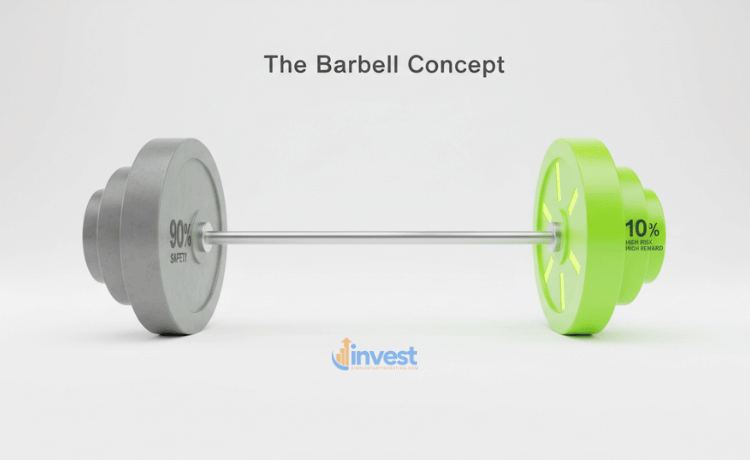
Imagine a physical barbell used in a gym. It has heavy weights on both ends and a thin, empty bar in the middle. In the world of investing, the Barbell Strategy follows this exact shape. You split your money into two extreme categories and avoid the “moderate” middle entirely.
Usually, this means putting about 90 percent of your money into assets that are incredibly safe—things that are very unlikely to lose value. The remaining 10 percent goes into “high-upside” bets. These are investments that are risky but have the potential to grow five, ten, or even twenty times in value.
The goal isn’t to be “balanced” in the traditional sense. It is to be antifragile. This is a term used to describe something that actually gets stronger or benefits from chaos and volatility. By having a huge safety net, you don’t panic when the market drops. By having a small aggressive “tip,” you benefit when the market goes through a massive boom.
Why Beginners Often Get the “Middle” Wrong
Most financial advisors tell beginners to build a “diversified” portfolio that is moderately risky. For example, they might suggest a mix of 60 percent stocks and 40 percent bonds. This is often called the “balanced” approach.
The problem is that in a major financial crisis, many of these “moderate” assets can fall at the same time. If the stock market crashes and interest rates shift unexpectedly, your “moderate” portfolio might lose 20 percent or 30 percent of its value very quickly. For a beginner, seeing a 10,000 dollar account drop to 7,000 dollars in a few weeks can be terrifying.
The Common Mistake
New investors often think that “moderate” risk means “safe enough.” They believe that by picking steady, well-known companies that aren’t too volatile, they are protected. They avoid the “scary” high-risk stuff but also miss out on the truly safe havens.
The Mindset Shift
You need to realize that “moderate” risk often carries the downside of the stock market without the explosive upside of high-growth opportunities. The Barbell Strategy teaches us that it is better to be 90 percent “bulletproof” and 10 percent “speculative” than to be 100 percent “moderately vulnerable.”
The Left Side: 90 Percent Extreme Safety
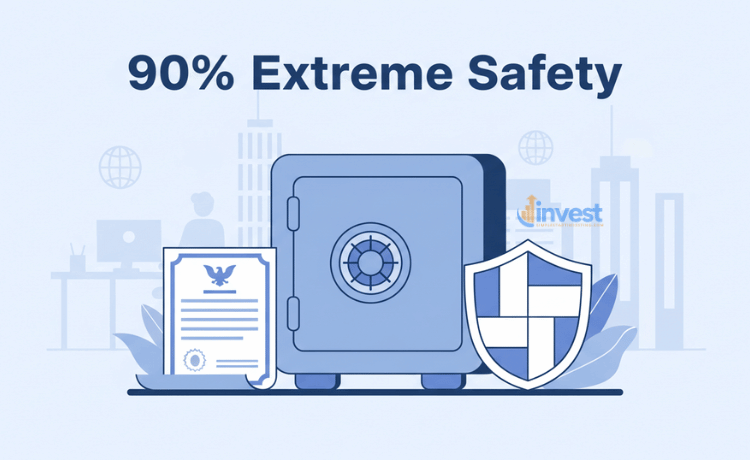
The most important part of the barbell is the heavy side: your safety net. In the United States, “extreme safety” usually refers to assets where the risk of losing your initial investment is as close to zero as possible.
Where to Put the 90 Percent
For an American investor today, this side of the barbell might include:
- U.S. Treasury Bills (T-Bills): These are short-term loans you provide to the U.S. government. They are backed by the “full faith and credit” of the United States.
- High-Yield Savings Accounts (HYSA): Accounts at banks that are insured by the FDIC (Federal Deposit Insurance Corporation). This insurance typically protects your deposits up to 250,000 dollars per person, per bank.
- Certificates of Deposit (CDs): These lock your money away for a set time (like six months or a year) in exchange for a fixed interest rate.
Example in Action
Let’s say you have 10,000 dollars to start. Using the Barbell Strategy, you would put 9,000 dollars into a combination of T-Bills and an FDIC-insured savings account. Even if the entire stock market crashes by 50 percent tomorrow, your 9,000 dollars is safe. In fact, it might even be earning a small amount of interest, perhaps growing to 9,400 dollars over the year.
Why Beginners Misunderstand This
Many beginners think that “safe” means “boring” or “wasting time.” They feel they aren’t “investing” unless their money is moving up and down in the stock market.
The Correct Logic
The 90 percent safety is not there to make you rich; it is there to ensure you never go broke. It gives you the “staying power” to remain in the market for decades. When you know your rent money and emergency fund are 100 percent safe, you won’t make emotional mistakes with your other investments.
The Right Side: 10 Percent High-Risk Opportunities
Now for the “fun” part of the barbell. The remaining 10 percent of your money is used for “aggressive” bets. These are investments that have a high chance of failing but a small chance of becoming a massive success.

What Goes on the Aggressive Side?
In the U.S. market, this might include:
- High-Growth Tech Stocks: Think of companies like Tesla (TSLA) in its early days or smaller AI-focused firms today.
- Venture-Style Investing: Buying small amounts of very young companies or “small-cap” stocks.
- Call Options: A more advanced tool where you pay a small fee for the right to buy a stock like Amazon (AMZN) or Apple (AAPL) at a specific price, hoping the price rockets upward.
- Cryptocurrencies: Digital assets like Bitcoin, which are highly volatile but have historically shown massive growth spurts.
Example in Action
Going back to our 10,000 dollar example: You have 9,000 dollars in safety. Now, you take the remaining 1,000 dollars and buy a very risky, “moonshot” stock.
- Scenario A: The risky company goes bankrupt. You lose the entire 1,000 dollars. However, because you have 9,000 dollars (plus interest) in your safe account, your total wealth is still around 9,400 dollars. You only lost a tiny fraction of your total money.
- Scenario B: The risky company becomes the next big thing and its value increases by ten times. Your 1,000 dollars is now worth 10,000 dollars. Combined with your safe 9,000 dollars, you now have 19,000 dollars. You have almost doubled your total wealth while only ever risking 10 percent of it.
The Common Mistake
Beginners often treat the “risky” side like a casino. They put 50 percent or 100 percent of their money into a “hot tip” they heard on social media. When that investment fails, they are wiped out and quit investing forever.
The Correct Logic
The aggressive side of the barbell must be kept small. The rule is: you must be able to lose that 10 percent and still sleep perfectly fine at night. The goal is “asymmetric upside”—you have a limited amount you can lose (10 percent) but an unlimited amount you could potentially gain.
Why You Must Avoid “The Middle”
The core of the Barbell Strategy is a total rejection of the “middle.” In the financial world, the middle is often filled with “blue-chip” stocks or mutual funds that are supposed to be “steady.”

The Danger of Moderate Risk
Think about a large, older company that has been around for fifty years. It isn’t going to grow by ten times (like a small startup might), but it can still lose 40 percent of its value in a recession. To Nassim Taleb and followers of the barbell, this is a bad deal. You are taking on significant “crash risk” but you don’t have the “explosive growth potential” to make that risk worth it.
If you put 100 percent of your money into “moderate” stocks, a bad year could leave you with 6,000 dollars (starting from 10,000 dollars). You have no “safety” to protect you and no “hyper-growth” to pull you back up quickly.

A 4-Step Deep Dive into Barbelling
To truly master the Barbell Strategy, let’s look at how it functions using our standard four-layer explanation.
1. Simple Explanation
Think of your money like a survival kit. 90 percent of your kit is water, food, and a warm blanket (the essentials for staying alive). The other 10 percent is a lottery ticket. If you don’t win the lottery, you still have food and water. If you do win, you are now rich and still have your food and water. You never trade your water for more lottery tickets.
2. Real-World U.S. Example
Imagine an investor named Sarah. She has 50,000 dollars.
- She puts 45,000 dollars into U.S. Treasury Bonds and a High-Yield Savings Account at a major bank like JPMorgan Chase (JPM).
- She takes the other 5,000 dollars and divides it into five different “risky” bets: a bit of Bitcoin, a small-cap biotech stock, and some shares in a new AI startup.
- If four of those bets go to zero, but one biotech stock discovers a new medicine and grows twenty times in value, that one bet becomes worth 20,000 dollars.
- Sarah’s total portfolio is now 65,000 dollars (plus interest on her safe money), despite four out of five “risky” bets failing completely.
3. The Common Beginner Pitfall
Newcomers often try to “optimize” the safe side. They think, “Why should I only get 4 percent interest in a savings account when I could get 7 percent in a ‘safe’ corporate bond?”
They move their 90 percent safety into something that is “almost safe.” Then, a financial crisis hits, the corporation goes under, and their “safe” money drops by 20 percent. Now, their barbell has snapped in half.
4. The Correct Mindset
Safety must be absolute. Do not try to be “clever” with your 90 percent. Use the most boring, government-backed, insured options available. The 90 percent is your shield; the 10 percent is your sword. A shield is no good if it’s made of thin glass just to make it look prettier.
Implementing the Strategy Today
If you are looking to start this year, the U.S. market offers some unique advantages for the Barbell Strategy.
The “Safety” Environment
Interest rates in the U.S. have been higher recently than they were for much of the last decade. This means your “safe” 90 percent can actually earn a decent return. You can find T-Bills or HYSAs offering 4 percent or even 5 percent. While this won’t make you a millionaire overnight, it protects your purchasing power while you wait for your 10 percent “bets” to pay off.
The “Aggressive” Environment
Technological shifts in AI, green energy, and biotechnology are creating “Black Swan” opportunities—rare events that create massive value. By keeping 10 percent of your money in these areas, you are “positioned” to benefit if a major breakthrough happens.
Regulation and Tax Notes
- Taxes on Safety: The interest you earn on your savings accounts or T-Bills is generally taxed as ordinary income.
- Taxes on Aggression: If you hold your risky stocks for more than a year before selling for a profit, you may qualify for “Long-Term Capital Gains” tax rates, which are often lower than regular income tax.
- The IRS: Always remember that tax rules can change every year. It is a good idea to keep track of your gains and losses, especially on the “risky” side, as you may be able to use losses to offset some of your taxes.
Summary Checklist for Beginners
If you want to try the Barbell Strategy, here is how to think about your steps:
- Calculate your “Survival Number”: How much money do you need to feel 100 percent safe? This should be the bulk of your barbell.
- Secure the 90 Percent: Open an account at an FDIC-insured bank or use a brokerage account to buy U.S. Treasury instruments. Avoid “corporate” bonds or “preferred” stocks for this section; they aren’t safe enough for a true barbell.
- Define the 10 Percent: Identify areas where you see massive potential. This isn’t about “predicting” the future; it’s about buying a “piece” of the future.
- Accept the Losses: Before you buy the 10 percent, tell yourself: “This money is already gone.” If you can’t say that honestly, your risky side is too big.
- Don’t Touch the Middle: When a friend tells you about a “safe” stock that pays a 8 percent dividend but could drop 30 percent in a bad market, recognize it as the “dangerous middle” and stay away.
The Philosophy of Antifragility
The Barbell Strategy is more than just a way to pick stocks; it’s a way to live in an uncertain world. We don’t know when the next recession will happen. We don’t know which new technology will change the world.
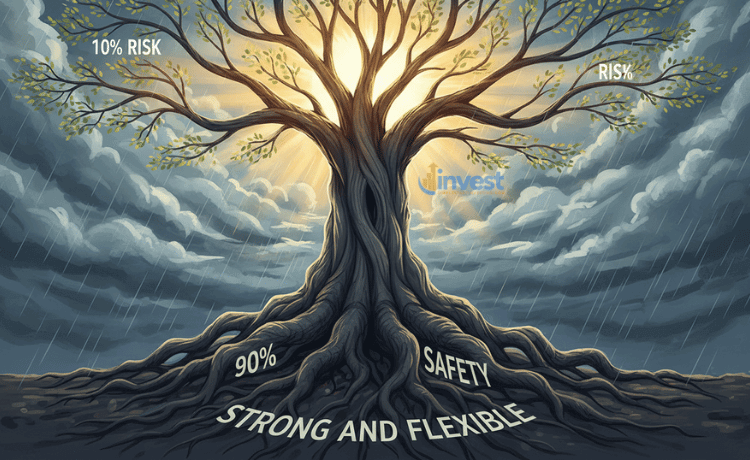
By using a barbell, you admit that you don’t know the future. You prepare for the worst (with your 90 percent) and hope for the best (with your 10 percent). This takes the stress out of investing. When the market is “boring,” your safe money grows slowly. When the market “crashes,” your safe money protects you. When the market “explodes,” your risky 10 percent captures the gains.
You are no longer a victim of the market’s swings. You are someone who is prepared for anything.
Key Terms to Remember
- Asymmetric Risk: A situation where you can only lose a little (your 10 percent) but you can gain a lot.
- Black Swan: An unpredictable event that has a massive impact. Barbells are designed to survive negative Black Swans and profit from positive ones.
- FDIC: A U.S. government agency that insures your bank deposits. Essential for the “Safe” side of your barbell.
- Liquidity: How quickly you can turn an investment into cash. Your 90 percent safety side should be very liquid.
Important Reminder
The regulations regarding taxes, bank insurance, and investment disclosures can change frequently. It is always wise to check current IRS guidelines or speak with a qualified financial professional before making significant changes to your financial plan.
Disclaimer: This content is for educational purposes only and does not constitute financial advice. Investing involves risk, including the potential loss of principal. Past performance is not indicative of future results.